
How Much Electricity Does a Water Softener Use?
Water softener electricity usage is a few watts, day and night. A control valve on a small plug-in transformer typically uses about 26 to 44 kWh a year, roughly $5 to $8 at today's average US electricity price. Even at the transformer's full rating the ceiling is about $15 a year. The energy that really matters is not the valve. It is the scale a softener keeps out of the water heater.
This page answers the direct question with the numbers you can check, then turns to the water heater, where the money is.
Water Softener Electricity Usage, Worked From the Nameplate
Electric softener valves run on low voltage from a plug-in transformer. The transformer's rating is printed on it and in the valve manual, and it sets a hard limit on what the softener can draw.
- The Fleck 5600SXT service manual lists a "Transformer, 24V, 9.6VA".
- Clack's WS1 service manual lists a power supply giving 15 VDC at 500 mA, which is 7.5 watts of output.
The arithmetic for any figure is the same:
kWh a year = watts × 8,760 hours ÷ 1,000
Cost a year = kWh × your price per kWh
The US Energy Information Administration's monthly table of average electricity prices put the average residential price at 18.31 cents per kWh for July 2026. At 18 cents:
| Continuous draw | kWh a year | Cost a year |
|---|---|---|
| 3 watts | 26 | $4.70 |
| 5 watts | 44 | $7.90 |
| 7.5 watts (Clack output ceiling) | 66 | $11.80 |
| 9.6 watts (Fleck transformer ceiling) | 84 | $15.10 |
The first two rows are illustrative of a valve idling between regenerations. The last two are upper limits that a valve would reach only if it drew its full rating every hour of the year, which it does not.
Why the Real Draw Sits Below the Label
A transformer's VA rating is the most it can supply, sized for the moment the motor is turning. Most of the time nothing moves. The circuit board keeps time, the display is lit, and the flow meter's sensor is powered so it can count gallons. That is the continuous load, and it is small.
We have not found a manufacturer that publishes a measured standby figure, so treat the 3 to 5 watt range as illustrative. You can measure yours in a day. Plug the transformer into a plug-in energy monitor, leave it 24 hours, and read the kWh. Multiply by 365. That one reading replaces every estimate on this page, including ours.
What Regeneration Adds
The motor runs only during regeneration, and only while it moves the valve from one stage to the next. For most of a two-hour cycle the valve is parked while water flows.
Take the worst case anyway and assume the valve draws its full 9.6 VA for the whole of a two-hour regeneration. A metered softener regenerating 58 times a year, as in a typical three- to four-person home on 15 gpg water, would then use:
58 × 2 hours × 9.6 watts = 1.1 kWh a year, about 20 cents.
So the number of regenerations barely matters for electricity. It matters a great deal for salt and water, which is where a softener's running cost actually comes from.
Power Draws That Are Not the Valve
- Non-electric softeners use no electricity. A turbine and gear train driven by water pressure moves the valve. Where that trade-off makes sense is covered in electric vs non-electric water softeners.
- On a well, the pump supplies the regeneration water. Roughly 50 gallons a cycle is pump run time that city households do not pay for in electricity. It is small, but it is not zero.
- Other equipment on the same outlet. A UV lamp, a booster pump or an iron filter's valve is often wired alongside a softener. If a plug-in meter shows far more than a few watts, check what else shares the plug.
Across all of these, the valve's power is a rounding error in the total cost of owning a water softener, where salt and regeneration water dominate.
How to Measure Your Own Valve in 24 Hours
A plug-in energy monitor, the kind that sits between the wall socket and a plug, turns the estimates above into your own number.
- Plug the monitor into the outlet, and the softener's transformer into the monitor. Most valves keep their settings through a short power interruption. Check the time of day on the display afterwards anyway.
- Reset the monitor's kWh counter and leave it for at least 24 hours. A full week is better if the softener regenerates less often than daily, because it captures a regeneration.
- Read the kWh. Divide by the hours elapsed and multiply by 1,000 to get average watts. Multiply the daily kWh by 365 for the year.
- Multiply by your price per kWh from your electricity bill. Use the total charge per kWh, including delivery, not just the supply rate.
What the reading tells you:
- A few watts is a normal valve.
- Well above the transformer's rating means something else is on the same plug, or the monitor is reading a different circuit.
- Zero means the valve is not powered. A softener with a dark display cannot count water or regenerate, and the house will soon get hard water.
Blaming the Softener for a High Electric Bill
If your electricity bill has jumped, the softener's valve is almost never the reason. It cannot draw more than its transformer allows, and at 9.6 VA that is about $1.30 a month at most.
The water heater is a much more likely suspect in a house with hard water or a failing softener. An electric storage heater with a failed lower element, or one that is short-cycling, can add far more to a bill than any control valve. A softener that has stopped working can play a part indirectly, because scale starts forming in the heater again. Check that the softener is still softening, then look at the heater.
The Energy Question That Matters: Scale in the Water Heater
Hard water leaves calcium carbonate scale wherever it is heated. In a gas storage heater, the scale settles on the tank bottom between the burner and the water, so less of the flame's heat gets into the water.
The best-known measurement is a 2009 study by Battelle, funded by the Water Quality Research Foundation, the research arm of the water treatment industry's trade association. Battelle ran 30 water heaters for 90 days under conditions "designed to accelerate the waterside scaling", half on softened water and half on unsoftened water. Its executive summary reports:
| Heater type | On unsoftened water | On softened water |
|---|---|---|
| Gas storage | Efficiency fell from 70.4% to 67.4% at two years' equivalent service. Scale built up at about 528 g a year | Efficiency stayed at 70.4%. About 7 g of scale a year |
| Electric storage | Efficiency stayed at 99.5%. Scale built up at about 907 g a year | Efficiency 99.3%, unchanged. About 14 g a year |
| Tankless gas | Efficiency fell from 80% to 72% and needed deliming at 1.6 years' equivalent service | Stayed at 80% |
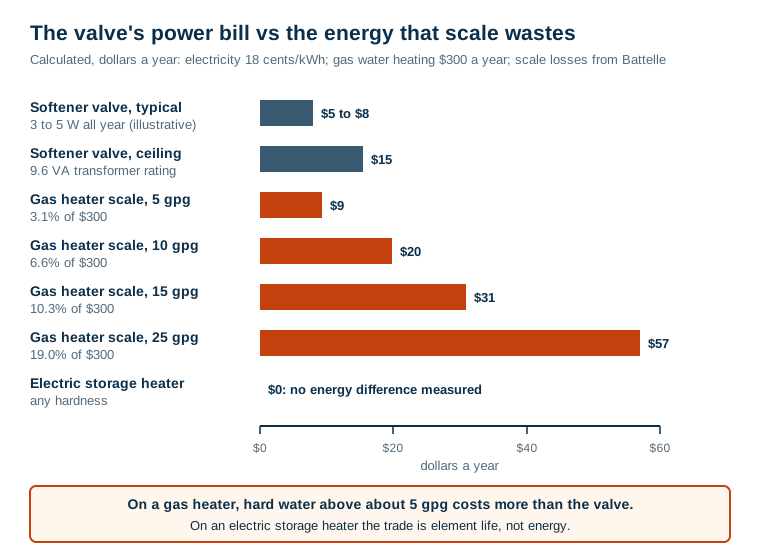
From those data, Battelle estimated life-cycle energy cost savings for gas storage heaters of 3.1 percent at 5 gpg, 6.6 at 10, 10.3 at 15 and 19.0 at 25 gpg. It attributed the extra energy use to "a reduction in heat transfer efficiency", and it rises with hardness.
Two cautions on reading this. The test was accelerated, and the percentages are life-cycle estimates derived from it, not readings from homes. And the funder has an interest in the result. The direction is not in doubt, but treat the exact percentages as estimates.
A Worked Example: Gas Water Heater at 15 gpg
Suppose a household spends $300 a year on gas for water heating. Your own share is hard to read off a gas bill, so treat $300 as a placeholder.
- Energy scale would cost at 15 gpg: 10.3% × $300 = about $31 a year.
- Electricity the softener's valve uses: about $5 to $8 a year, with a $15 ceiling.
On that heater, the softener's electricity is paid back several times over by the gas it saves. At 5 gpg the two are about equal. At 25 gpg the scale cost reaches about $57 a year.
Battelle's carbon footprint figures point the same way. For gas storage heaters it found a 14.8 percent lower footprint over a 15-year life with softened water compared with 26 gpg hard water, counting both the gas for heating and the electricity for softening.
Tankless gas heaters are a separate case. The measured efficiency loss was smaller over the life of the heater, but the scale also forces deliming. Battelle estimated deliming every 2.7 years at 15 gpg. That service cost is usually larger than the energy loss, as covered in scale in a tankless water heater.
Electric Water Heaters: Element Life, Not Energy
Electric storage heaters are the exception, and the reason is simple. The element sits in the water, so all its heat goes into the water whether or not the element is scaled. Battelle "did not record any difference in the electricity consumption" between softened and unsoftened water.
Scale still does damage. Battelle measured about 2 lb of scale a year in its electric heaters on hard water, against a few hundredths of a pound on soft water. It noted that scale raises the element's operating temperature and is expected to shorten its life. Settled scale also fills the tank bottom, which is where the lower element sits. That trade-off, and how to flush it, is covered in hard water sediment in a storage water heater.
So for an electric heater, the honest energy saving from softening is zero. The benefit is fewer elements, fewer flushes and a tank that lasts longer.
What Softening Cannot Do for Your Energy Bill
- It does not remove scale already in the heater. A tank that has been on hard water for years keeps its sediment layer until it is flushed or replaced.
- It does not reduce hot water use. Energy for water heating is mostly volume and temperature. Lower thermostat settings and shorter showers cut it. Softening does not.
- It does not help heaters on soft water. If your raw water is under a few gpg, there is little scale to prevent and no energy case at all.
- It does not offset the other running costs. Salt and regeneration water cost far more than the valve's electricity, and the energy saving on a gas heater only partly covers them.
Measure the valve once with a plug-in meter so you have your own figure. Then, if your water heater burns gas and your water is hard, look at the heater, not the valve. That is where water softener electricity usage stops being the question and energy savings start.
Frequently Asked Questions
How much electricity does a water softener use?
Very little. A typical control valve runs from a low-voltage plug-in transformer and draws a few watts. At 3 to 5 watts all year that is about 26 to 44 kWh, roughly $5 to $8 at 18 cents per kWh. The transformer's rating sets a ceiling: the Fleck 5600SXT's 9.6 VA transformer cannot exceed about 84 kWh, or about $15 a year.
Does a water softener use electricity all the time?
Yes, but only a trickle. The circuit board, display and meter sensor are powered continuously so the valve can count gallons and keep time. The motor that moves the valve runs only during regeneration, and even then only while it moves between stages. That motor time adds well under a dollar a year.
Can I unplug my water softener to save electricity?
It is not worth it. The saving is a few dollars a year, and an unplugged electric softener cannot count water or regenerate, so hard water reaches the house once the resin is exhausted. Many valves also lose their time of day after a long outage. If you are away for weeks, use the bypass instead.
Do non-electric water softeners use any power?
No electricity. Non-electric softeners use water pressure and a turbine to drive the valve. They still use regeneration water and salt like any other softener, and on a well the pump supplies that water, so the energy use is not quite zero.
Does a water softener save energy on water heating?
On gas water heaters, yes. In a 2009 Battelle study funded by the water treatment industry's research foundation, gas storage heaters on unsoftened water lost efficiency as scale built up, with estimated life-cycle energy cost savings from softening of 3.1 percent at 5 gpg up to 19 percent at 25 gpg. Electric storage heaters showed no difference in energy use, though their elements are expected to fail sooner on hard water.
How many watts does a water softener use?
Few manufacturers publish a standby figure. The transformer rating gives the upper limit: 9.6 VA on the Fleck 5600SXT, and 15 volts at 500 mA, or 7.5 watts of output, on Clack's WS1 power supply. Real use is below that most of the time. A plug-in energy meter will show your own valve's figure in a day.
