
How to Estimate Annual Water Softener Salt Cost

Your annual water softener salt cost is simply bags a year multiplied by the price per bag. For most households using sodium chloride, that comes to roughly $45 to $210 a year, or about 7 to 30 bags of 40 lb. A family of four on moderately hard water typically lands between $70 and $125. Where you land in that range depends mostly on the salt dose your valve is set to.
The five steps below turn your hardness, household size and valve setting into your own dollar figure. Then the same numbers show what tuning is worth, what potassium chloride really costs, and why how you buy salt matters as much as which salt you buy.
The Annual Water Softener Salt Cost Formula
A softener spends salt to restore the resin capacity that hardness used up. So the bill follows the hardness removed, divided by how efficiently your valve turns salt into capacity.
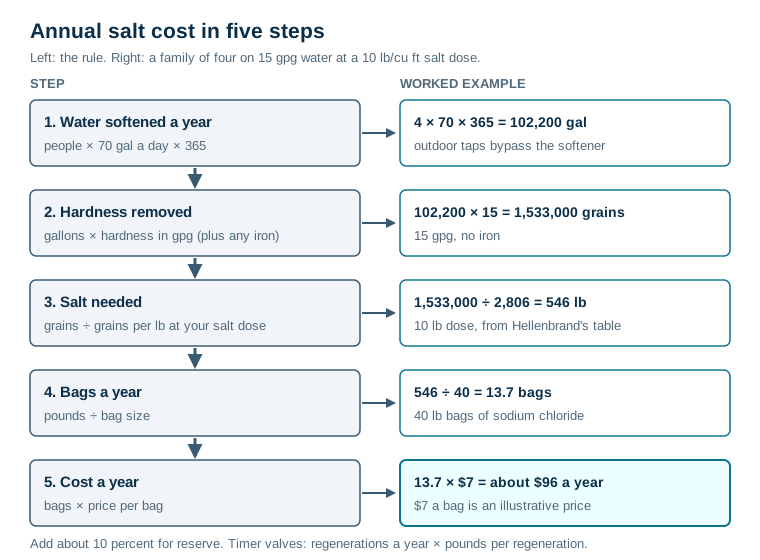
- Gallons softened a year. Use about 70 gallons per person per day if outdoor taps bypass the softener, as they usually should. It is the same starting figure the site's salt-use calculator is built on. Better still, read your softener's meter or your water bill.
- Grains of hardness removed. Multiply gallons by hardness in grains per gallon (gpg). If your report gives mg/L or ppm, divide by 17.1 first. Add any iron allowance your manual asks for.
- Pounds of salt. Divide the grains by the grains removed per pound of salt at your salt dose. This number swings the result by more than half, so it is worth getting right.
- Bags. Divide by the bag weight. Most softener salt comes in 40 lb bags, though 25 lb and 50 lb bags are common.
- Dollars. Multiply by what you pay per bag.
The grains-per-pound figure comes from the manufacturer's capacity table. The Hellenbrand ProMate 6 owner's manual prints capacity for one cubic foot of resin at each salt dose. Dividing capacity by salt gives the efficiency:
| Salt dose per cu ft of resin | Capacity per cu ft | Grains removed per lb of salt |
|---|---|---|
| 6 lb (low, the factory setting) | 22,930 grains | 3,822 |
| 10 lb (medium) | 28,060 grains | 2,806 |
| 15 lb (high, the "grain rating") | 32,310 grains | 2,154 |
The same household on the same water pays 77 percent more for salt at the high dose than at the low one. These are the same figures used in how much salt a water softener uses, which turns them into a monthly refill schedule. This article turns them into dollars.
The Calculator: Bags and Dollars at Three Salt Doses
For a household of four using 70 gallons each per day, at an illustrative $7 per 40 lb bag of sodium chloride:
| Hardness | 6 lb dose: bags / cost | 10 lb dose: bags / cost | 15 lb dose: bags / cost |
|---|---|---|---|
| 5 gpg | 3.3 / $23 | 4.6 / $32 | 5.9 / $42 |
| 10 gpg | 6.7 / $47 | 9.1 / $64 | 11.9 / $83 |
| 15 gpg | 10.0 / $70 | 13.7 / $96 | 17.8 / $125 |
| 20 gpg | 13.4 / $94 | 18.2 / $127 | 23.7 / $166 |
| 25 gpg | 16.7 / $117 | 22.8 / $159 | 29.7 / $208 |
For a different household size, scale the row by people ÷ 4. Two people on 20 gpg water at the 10 lb dose use half of 18.2, about 9 bags.
The one-line shortcut. Bags a year ≈ people × hardness in gpg × a dose factor:
- 0.17 at a 6 lb dose
- 0.23 at a 10 lb dose
- 0.30 at a 15 lb dose
Multiply by your price per bag and you have the annual figure. A family of five on 18 gpg water at the 10 lb dose: 5 × 18 × 0.23 = about 21 bags, or roughly $145 a year at $7.
Where the $7 comes from. It is an example price for plain 40 lb pellets or crystals, the same figure the site uses in its total cost of owning a water softener model. Prices vary by region, season, grade and store. Put your own receipt in step 5.
What Tuning the Salt Dose Is Worth in Cash
Most owners never touch the salt setting. Many valves ship at a moderate dose, and some installers set the maximum so the capacity matches the number on the box. Moving from a heavy dose to an efficient one is the largest saving available on the salt bill, and it costs nothing.
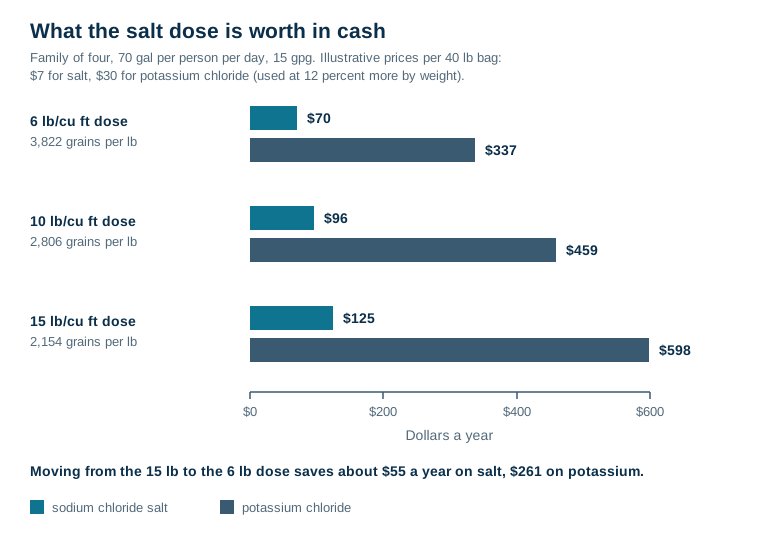
For the family of four on 15 gpg water:
| Change | Salt saved a year | Cash saved on salt | Cash saved on potassium chloride |
|---|---|---|---|
| 15 lb dose → 10 lb | 165 lb | about $29 | about $139 |
| 10 lb dose → 6 lb | 145 lb | about $26 | about $122 |
| 15 lb dose → 6 lb | 311 lb | about $55 | about $261 |
On plain salt the saving is real but modest, about the price of eight bags. On potassium chloride it is several hundred dollars a year, every year, for one menu change.
What you trade for it. A lower dose restores less capacity per regeneration, so the softener regenerates more often. That means a little more regeneration water and a little more hardness leakage at the end of each cycle. For most homes the trade is worth it. The limits are the ones set out in how to set the salt dose on a water softener: regenerations more often than every three days or so, water with iron, or a manufacturer that restricts its efficient setting are reasons to stay higher.
Two rules when you change it. Change the capacity setting to match the new dose, or the valve will think it has more capacity than the brine restores. Then test the softened water on the day before the next regeneration.
Price per Pound: Bag, Bulk and Delivery

The bag price on the shelf hides the number that matters, which is cents per pound. Bags come in 25, 40, 44 and 50 lb sizes, and the same salt can cost very different amounts depending on how you buy it.
Using the family of four at the 10 lb dose, 546 lb a year, and illustrative prices:
| How you buy | Example price | Cents per lb | 546 lb a year |
|---|---|---|---|
| Pallet or farm-store bulk | $5.50 per 40 lb | 13.8¢ | about $75 |
| Home-center 40 lb bag | $7 per 40 lb | 17.5¢ | about $96 |
| Small 25 lb "easy lift" bag | $6 per 25 lb | 24¢ | about $131 |
| Dealer delivery, carried in and poured | $15 per 40 lb | 37.5¢ | about $205 |
| Potassium chloride, 40 lb bag | $30 per 40 lb | 75¢ | about $459 (612 lb needed) |
The gap is wider than the gap between salt grades. Pellets and crystals usually differ by a dollar or so a bag. The spread between the cheapest per-pound route and delivered salt here is almost three times. None of these prices come from a survey. They show the arithmetic, so write in what your stores and dealer actually charge.
When delivery is still worth it. If lifting 40 lb bags down basement stairs is not safe for you, delivery is buying labor, not salt. Just price it as labor, and ask for it per pound.
When bulk is not worth it. A pallet of salt stored in a damp garage cakes into blocks. Lumpy salt poured into a brine tank is one of the starting points for a salt bridge. Buy only as much as you can keep dry and sealed.
What about rock salt? It is the cheapest per bag, but it carries the most insoluble grit, which means more brine tank cleanouts. Once the cleaning is counted, it usually costs more a year than pellets.
Potassium Chloride: Rerun the Numbers, Don't Scale Them
Potassium chloride changes two inputs at once.
- Price per bag. Commonly about four times the price of salt. The example here is $30 against $7.
- Pounds needed. It regenerates resin less efficiently per pound, so manufacturers tell you to raise the hardness setting. WaterBoss says multiply it by 1.12. GE says 20 percent higher. Either way, you use that much more product by weight.
For the family of four on 15 gpg water, at the 6 lb dose:
- Salt: 401 lb, about 10 bags, $70 a year.
- Potassium chloride at +12 percent: 449 lb, about 11.2 bags, $337 a year.
- Potassium chloride at +20 percent: 481 lb, about 12 bags, $361 a year.
So the premium is about $265 to $290 a year at an efficient dose, and more at a heavy one. Who genuinely gains from that premium, and the cheaper ways to keep sodium out of drinking water, are covered in potassium chloride vs sodium chloride in a softener.
Four Corrections Before You Budget
The calculator gives a clean floor. Real softeners add to it in four predictable ways.
1. Reserve. A metered valve regenerates while some capacity is still unused, so you never run out mid-shower. That held-back capacity is wasted salt. Worked through the Hellenbrand table, real use comes out about 10 to 15 percent above the simple estimate. Add 10 percent to your bag count.
2. Iron. Dissolved iron uses resin capacity as hardness does. Many manuals ask you to add 3 to 4 gpg to the hardness setting for each 1 ppm of iron. On a well with 1 ppm of iron and 15 gpg of hardness, budget at about 19 gpg, which adds roughly a quarter to the bill.
3. Timer valves. A timer regenerates on the calendar, not on use, so the formula does not apply. Use regenerations a year × pounds per regeneration instead. A timer set to every fourth night at 10 lb uses about 910 lb a year, around $160 of salt, whatever your water needs. For many small households that is several times the metered figure.
4. The day override on a small household. Even metered valves usually force a regeneration after a set number of days. One person on soft-ish water might need salt for only a few regenerations a year, but a 14-day override makes 26. At 6 lb each, that is 156 lb, about 4 bags or $27. Small households should expect a floor of a few bags a year even when the arithmetic says less.
The Department of Energy's Building America guide to water softeners gives a useful benchmark here. It lists 3,350 grains per pound of salt as the efficiency a demand-initiated softener must reach to be efficiency rated under NSF/ANSI 44. It also notes that timer-controlled units cannot be efficiency rated at all. If your real figure works out below about 3,000 grains per pound, something in the setup is costing you money.
Check the Estimate Against What You Actually Buy
An estimate is only useful if you test it.
- Log every bag. Write the date and bag count on a card taped to the brine tank lid.
- After three or four refills, work out your real bags a year.
- Compare it with the calculator figure, reserve included.
| Real use vs estimate | What it usually means |
|---|---|
| Well under the estimate, water soft | You use less water than 70 gallons per person. Nothing is wrong |
| Well under the estimate, water hard | Salt is not being drawn. Look for a bridge, mush or a blocked injector |
| Within about 20 percent | Normal |
| 1.5 to 2 times the estimate | Settings: a high dose, hardness entered too high, or a short day override |
| More than twice the estimate | A fault: hardness entered in ppm, a brine tank that keeps filling, or a leak the meter counts |
Hardness entered in ppm is the most common of these. It tells the valve the water is about 17 times harder than it is, and the salt bill follows.
What a Salt Budget Does Not Include
- Regeneration water. Every regeneration also sends water to drain. The EPA's page on cation exchange water softeners puts it at "25 gallons of water or more per day, or up to 10,000 gallons per year". On a metered water and sewer bill, that often costs about as much as the salt.
- Brine tank cleaning, repairs and resin. Salt is one line of several. The other lines are in the total cost of ownership model linked above.
- Whether the water is actually soft. A softener with a salt bridge has a very low salt bill and softens nothing. A low figure is only a saving if a hardness test on softened water reads near zero.
- Anything about a salt-free conditioner. Those use no salt, but they do not remove hardness either, so none of this applies to them.
- Sodium in your drinking water. That depends on the hardness removed, not on the salt you buy. A leaner dose saves money but does not change it.
Frequently Asked Questions
How much does it cost a year to run a water softener on salt?
For most households, roughly $45 to $210 a year for sodium chloride at an illustrative $7 per 40 lb bag. A family of four on 15 gpg water spends about $70 a year at an efficient 6 lb salt dose and about $125 at the 15 lb maximum. Very hard water, a timer valve or potassium chloride can push the figure several times higher.
How many bags of salt does a water softener use a year?
Most homes use between about 7 and 25 bags of 40 lb a year. A quick estimate is people × hardness in gpg × 0.17 at a 6 lb dose, × 0.23 at 10 lb, or × 0.30 at 15 lb. A family of four on 15 gpg water uses about 10 bags at 6 lb and 18 at 15 lb. Add about 10 percent for reserve.
Is it cheaper to buy water softener salt in bulk?
Usually, yes. A pallet or farm-store price can take a few cents off every pound. The bigger gap runs the other way, though. Dealer delivery, where the salt is carried in and poured for you, can cost two to three times the store price per pound. Compare prices per pound, not per bag, because bag sizes vary. And only buy in bulk if you have somewhere dry to store it.
Why is potassium chloride so much more expensive to use than salt?
Two reasons stack up. A bag commonly costs about four times as much, and you need 12 to 20 percent more of it to remove the same hardness, because it regenerates resin less efficiently per pound. For a family of four on 15 gpg water, the illustrative figures here are about $337 to $598 a year for potassium, against $70 to $125 for salt, depending on the dose.
Does a bigger water softener use less salt?
Not by itself. Salt use follows the hardness you remove and the salt dose per cubic foot of resin, not the size of the tank. A larger softener run at the same dose uses about the same salt a year. It can use more if a day override forces it to regenerate before its capacity is used, which is common when a big unit serves a small household.
How can I lower my water softener salt cost?
Check that the hardness setting matches a recent test, in gpg rather than ppm. Then lower the salt dose to around 6 lb per cubic foot if your valve allows it, and make sure the valve is metered rather than on a timer. After that, buy by the pound, in the largest bags you can store dry. Switching from pellets to cheaper rock salt usually saves less than it costs in tank cleaning.
