
How Much Water Does a Water Softener Use Each Year?
How much water does a softener use per year? A metered softener in a typical home uses about 2,500 to 3,500 gallons a year for regeneration, and a timer-controlled unit commonly uses 5,000 to 7,000. For most households that is 2 to 6 percent of total water use. It is also less than the average home loses to leaks. The one change that moves the number most is how the softener decides when to regenerate.
The objection that softeners "waste thousands of gallons" is true as a raw number and misleading in context. This page shows the arithmetic, sets it against the rest of the house, and points to the settings that matter.
How Much Water Does a Softener Use per Year? The Two-Number Formula
Annual regeneration water is two numbers multiplied together:
Gallons per year = regenerations per year × gallons per regeneration
Everything else, including hardness, household size, resin volume and salt setting, only changes one of those two numbers.
Here is a worked example. Every input is stated, so you can swap in your own.
| Input | Value | Where it comes from |
|---|---|---|
| Water softened | 210 gallons a day | 70 percent of the 300 gallons a day EPA WaterSense gives for an average family. Outdoor use is usually left off the softener |
| Hardness | 15 gpg | A common "very hard" city or well supply |
| Daily hardness load | 3,150 grains | 210 × 15 |
| Resin | 1 cubic foot at 6 lb of salt | About 22,930 grains of capacity in the Hellenbrand H125 table |
| Reserve | One day, 3,150 grains | Usual setting on a metered valve |
| Water per regeneration | 50 gallons | Rounded from the manufacturer figure below |
A metered valve regenerates when the usable capacity is gone, so each cycle covers 22,930 − 3,150 = 19,780 grains. Over a year the home removes 3,150 × 365 = 1,149,750 grains:
- 1,149,750 ÷ 19,780 = 58 regenerations a year
- 58 × 50 gallons = about 2,900 gallons a year
That is under 2.5 gallons per 1,000 grains removed, comfortably inside the 5.0 gallon ceiling for an efficiency-rated softener under NSF/ANSI 44.
Where the 50 Gallons per Regeneration Come From
A regeneration is four or five stages, and each one sends water to the drain. The Hellenbrand H125 owner's manual publishes the factory settings stage by stage. For the one cubic foot model:
| Stage | Minutes | Gallons |
|---|---|---|
| Backwash | 8 | 17.6 |
| Brine draw and slow rinse | 60 | 19.2 |
| Fast rinse | 4 | 8.8 |
| Brine tank refill | 6.7 | 3.4 |
| Total | 48.9 |
Penn State Extension's water softening guide gives a similar estimate of "about 50 gallons" per cycle. Bigger tanks use more, mostly because backwash flow rises with tank diameter. The same manual lists 53.6 gallons for the 1.5 cubic foot model and 100.6 for the 2 cubic foot model.
Two things follow. First, a regeneration costs roughly the same water whether the bed was nearly exhausted or barely used, so how often matters far more than any single cycle. Second, stage times are adjustable on most valves, and trimming them is not free. How each stage works, and what shortening them risks, is covered in how much water does regeneration use.
Put It Next to the Rest of the House
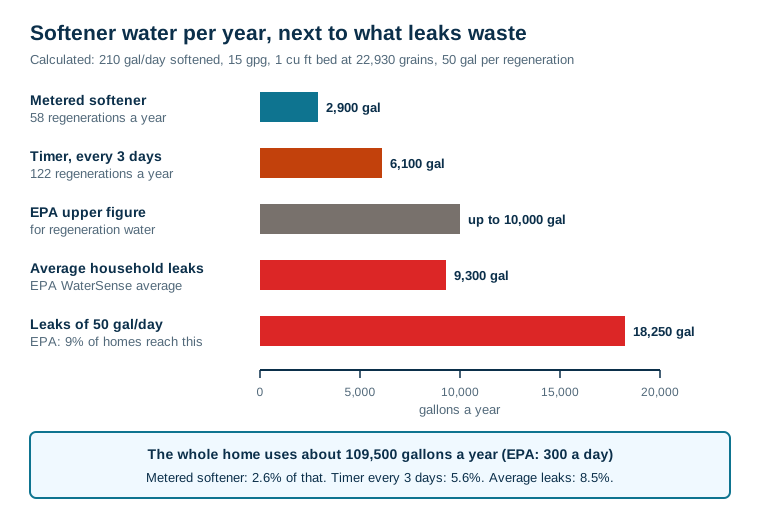
EPA WaterSense puts the average American family at more than 300 gallons a day at home, which is about 109,500 gallons a year. Against that:
- Metered softener in the example: 2,900 gallons, or 2.6 percent.
- The same softener on a three-day timer: 6,100 gallons, or 5.6 percent.
- EPA's own upper figure: WaterSense's page on cation exchange water softeners says regeneration "can use 25 gallons of water or more per day, or up to 10,000 gallons per year". That is the high end, and it describes a softener that regenerates often.
The softener is a real line item. It is not a large one unless something is set badly.
The Leak Comparison Most Objections Miss
Most people who object to a softener's water use have never measured their leaks. EPA's Fix a Leak Week figures are blunt:
- The average household's leaks waste more than 9,300 gallons a year.
- Nine percent of homes have leaks wasting 50 gallons or more a day. That is at least 18,250 gallons a year.
- A worn toilet flapper can "silently leak thousands of gallons a year."
So the average home's leaks use about three times what a metered softener does. A home with a 50 gallon-a-day leak loses more than six times as much.
The two are also linked. A metered softener counts leaked water as softened water. A toilet running quietly all day adds to the meter's count, so the softener regenerates sooner and uses more salt and water for water nobody used. If your softener's regeneration count creeps up with no change in the household, check the toilets before the softener. A dye tablet in the cistern, with no flushing for 15 minutes, shows a leaking flapper when colour appears in the bowl.
Timer vs Metered: The Change That Actually Moves the Number
The biggest lever is not the tank, the salt or the brand. It is what triggers regeneration. Same house, same water, same resin, only the control changed:
| Control | Regenerations a year | Gallons a year | Share of household use |
|---|---|---|---|
| Metered, one-day reserve | 58 | 2,900 | 2.6% |
| Timer, every 5 days | 73 | 3,650 | 3.3% |
| Timer, every 3 days | 122 | 6,100 | 5.6% |
| Timer, every night | 365 | 18,250 | 16.7% |
A timer has to be set for the household's heaviest week, so in every other week it regenerates resin that still had capacity. The three-day setting is common because it keeps water soft through a busy weekend. It also doubles the water. A nightly setting is rarer, but it turns up in homes where a unit was set up for a bigger family, or never set up at all.
The US Department of Energy's Building America guide notes that time-clock units "typically" regenerate every four days to weekly, and that they cannot qualify for the NSF/ANSI 44 efficiency rating at all. The full comparison, including payback on the price difference, is in metered vs timer-based water softeners.
Work Out Your Own Number in Four Steps
- Grains a year. Raw hardness in gpg × gallons a day softened × 365. Take gallons a day from a winter water bill, when irrigation is off.
- Grains per regeneration. Take the capacity at your salt setting from the manual, then subtract the reserve. On a timer, use the grains actually removed between regenerations instead: gallons a day × hardness × days between regenerations.
- Regenerations a year. Step 1 ÷ step 2. On a timer, it is simply 365 ÷ days between regenerations.
- Gallons a year. Step 3 × gallons per regeneration from your manual's specification table. If the manual has none, 50 gallons per cubic foot of resin is a reasonable first estimate.
Then check the result against the ceiling. Gallons a year ÷ (grains a year ÷ 1,000) should be under 5. If yours is well above that, the softener is regenerating more often than the hardness requires.
Measure It Instead of Estimating It
The formula gives a good estimate. Your own meter gives the real figure, and it takes one evening.
- Read the per-regeneration volume. Choose a time when nobody will use water for two or three hours. Note the house water meter reading, start a manual regeneration, and read the meter again when the valve returns to service. The difference is your gallons per regeneration. Most meters read in cubic feet; multiply by 7.48 for gallons.
- Count regenerations. Many metered valves keep a history, often in a diagnostic menu, with the number of regenerations since installation or over the last month or year. The manual shows where. On a timer, it is simply the programmed schedule.
- Multiply. Gallons per regeneration × regenerations a year.
Two cross-checks catch a softener that is misbehaving. If the measured volume per regeneration is far above the manual's figure, a stage time has been lengthened or the drain flow control is missing. If regenerations are far more frequent than the hardness and household size would explain, look at the hardness setting, the reserve and the toilets, in that order.
Record the result in the same log as the monthly salt check. A rising regeneration count with no change in the household is one of the earliest signs of a leak or a failing resin bed.
Bigger Households and Twin-Tank Units
The formula scales, but two details change for larger systems.
- A bigger resin tank uses more water per cycle but regenerates less often. In the H125 table, going from one to two cubic feet roughly doubles the water per regeneration, from 48.9 to 100.6 gallons. For the same household it also roughly halves the regenerations. The annual total lands in a similar place, a little higher because of the larger backwash.
- Twin-tank units regenerate one tank while the other serves the house. They usually regenerate a smaller bed more often, so the water per cycle is lower and the count is higher. Use the same two-number formula with the manufacturer's per-tank figures.
What Cuts It Further, and What Does Not
Changes that reduce the water:
- A current hardness setting. A valve set to 25 gpg on 15 gpg water regenerates about two-thirds more often than it needs to. Test raw water once a year.
- Outdoor taps off the softener. Irrigation water does not need softening, and on a metered unit it counts against capacity.
- A sensible reserve. A large fixed percentage left at a factory default gives away part of the metering benefit.
- A higher salt dose, within limits. This one surprises people. The H125 table rates one cubic foot at about 22,930 grains with 6 lb of salt and about 28,000 with 10 lb. More capacity per cycle means fewer cycles, so the example drops from 58 regenerations to about 46, saving around 600 gallons. The catch is salt: 46 × 10 lb is 460 lb a year against 348 lb at 6 lb. Water efficiency and salt efficiency pull in opposite directions. The balance is covered in how to optimize a softener for salt and water efficiency.
Changes that do not help:
- Shortening backwash to save water. It saves a few gallons per cycle and lets sediment and fines build up in the bed, which cuts capacity and brings regeneration round sooner.
- Turning the softener off at night or bypassing it now and then. A metered unit only regenerates for water it treats. Bypassing it saves nothing, and hard water gets into the plumbing.
- A larger softener on its own. Fewer cycles, but each uses more water. The saving is smaller than the price difference suggests.
What the Annual Figure Leaves Out
- It assumes the valve is healthy. A valve stuck in a regeneration position, or with worn seals, can run water to drain around the clock. That is a fault costing thousands of gallons a month, not normal use. The bill is often the first sign, as covered in does a water softener increase your water bill.
- It does not measure what the water carries. Regeneration water leaves as brine, with chloride that municipal treatment plants generally do not remove. For many places that is the bigger environmental question than the gallons. That side of the question has its own page in this guide, on the environmental impact of water softeners.
- On a well, the water is yours, not metered. The gallons still come from the aquifer and go to the septic system, where the volume and timing matter more than the cost.
- It does not include what a softener cannot do. Softening removes calcium and magnesium. It does not remove bacteria, nitrate, lead or most other health-related contaminants, so it is not a substitute for testing or for treatment aimed at those.
The practical order is simple. Find and fix leaks first, because they are usually bigger. Then make sure the softener is metered and set to the hardness you actually have. After that, how much water a softener uses per year is a small, predictable number you can check against your own meter.
Frequently Asked Questions
How many gallons of water does a water softener use per year?
A metered softener in a typical three- to four-person home on moderately hard water uses about 2,500 to 3,500 gallons a year for regeneration. A timer unit set to regenerate every few days commonly uses 5,000 to 7,000 gallons, and a unit set to regenerate every night can pass 18,000. The EPA's WaterSense program says regeneration can use up to 10,000 gallons a year.
How much water does a water softener use per regeneration?
A residential unit with one cubic foot of resin uses about 50 gallons per regeneration. Hellenbrand's H125 manual lists 48.9 gallons for its one cubic foot model at factory settings, and Penn State Extension estimates about 50 gallons per cycle. Larger tanks use more: the same manual lists about 101 gallons for a two cubic foot model.
Does a water softener waste a lot of water?
Not when it is metered and set to the real hardness. In a worked example on this page it uses about 2.6 percent of household water. The waste comes from timer units that regenerate on a schedule whether the resin needs it or not, from hardness settings far above the real water, and from faults that leave the valve running to drain.
Is a softener's water use more than a leaking toilet?
Usually less. EPA WaterSense says the average household's leaks waste more than 9,300 gallons a year, and that 9 percent of homes have leaks wasting 50 gallons or more a day, which is over 18,000 gallons a year. A metered softener on 15 gpg water uses about 2,900 gallons a year in the example here.
Does a water softener increase water usage in the house?
Only by the regeneration water. A softener does not change how much water your taps, shower or appliances use. Some households use a little less detergent or rinse water with soft water, but the regeneration water is a real addition that shows on the meter and, on most city bills, on the sewer charge as well.
How can I reduce the water my softener uses?
Switch a timer to metered (demand-initiated) control, set the hardness to a current test result rather than a guess, keep outdoor taps off the softener, and make sure the reserve is not left at a large factory default. Fixing a running toilet also helps twice, because a metered softener counts leaked water as softened water and regenerates for it.
