
How to Optimize a Water Softener for Salt and Water Efficiency
The water softener efficiency settings that matter are four: the hardness you enter, the salt dose, the backwash length and how regeneration is triggered. Change them one at a time, testing the water after each full cycle, and a typical softener uses a third to half less salt with no loss of soft water. Push the dose too low, though, and it starts wasting water and letting hardness through.
This guide tunes one example setup through each stage, using the manufacturer's own capacity and water figures, and shows where the savings stop.
The Water Softener Efficiency Settings You Are Tuning
A softener's running cost is set by two numbers, and each setting moves them in different directions:
| Setting | Salt | Water | Risk if pushed too far |
|---|---|---|---|
| Hardness entered | Down when corrected | Down when corrected | Entered too low, the resin runs out before regeneration |
| Salt dose per regeneration | Down sharply | Up (more frequent regenerations) | Hardness leakage, very short cycles |
| Backwash length | None | Down | Grit and fines left in the bed |
| Trigger (timer, meter, override) | Down with metering | Down with metering | Override set too short turns a meter back into a timer |
That middle row is the trade-off most tuning advice skips. A lower salt dose gives more softening per pound, but it also means less capacity per regeneration, so the softener regenerates more often. Every extra regeneration costs a full backwash, rinse and refill in water. Salt savings eventually turn into water losses.
The EPA's WaterSense fact sheet on water softeners sets out what an efficient unit looks like under the voluntary NSF/ANSI 44 efficiency rating: 5.0 gallons of water or less per 1,000 grains of hardness removed, and more than 3,350 grains of hardness removed per pound of salt. Those two numbers make a useful target for your own setup.
The Example Softener, Before Tuning
To keep this honest, every figure below is calculated, not measured. It comes from one manufacturer's published tables, applied to one plausible household. The Hellenbrand ProMate 6.0 owner's manual prints both capacity at each salt dose and the water used in each regeneration stage. That is rare, and it makes the arithmetic checkable.
The softener: a 1 cubic foot metered unit (the PM6-32 on Hellenbrand's table).
| Salt dose | Capacity | Grains per pound of salt |
|---|---|---|
| 3.3 lb (efficient) | 13,952 | 4,228 |
| 6 lb (low, factory setting) | 22,930 | 3,822 |
| 10 lb (medium) | 28,060 | 2,806 |
| 15 lb (high) | 32,310 | 2,154 |
Water per regeneration, from the same table: backwash 8 minutes at 1.7 gpm (13.6 gallons), brine draw and slow rinse 16.2 gallons, fast rinse 6.8 gallons, plus the refill. Refill water is roughly 1 gallon for every 3 lb of salt it has to dissolve.
The household: three people, 210 gallons a day through the softener, water tested at 14 gpg. That is 2,940 grains of hardness to remove every day, or 88,200 grains a month.
As installed: hardness entered as 20 gpg "to be safe," salt set to the 15 lb high dose, factory 8-minute backwash, and a reserve of one day's water.
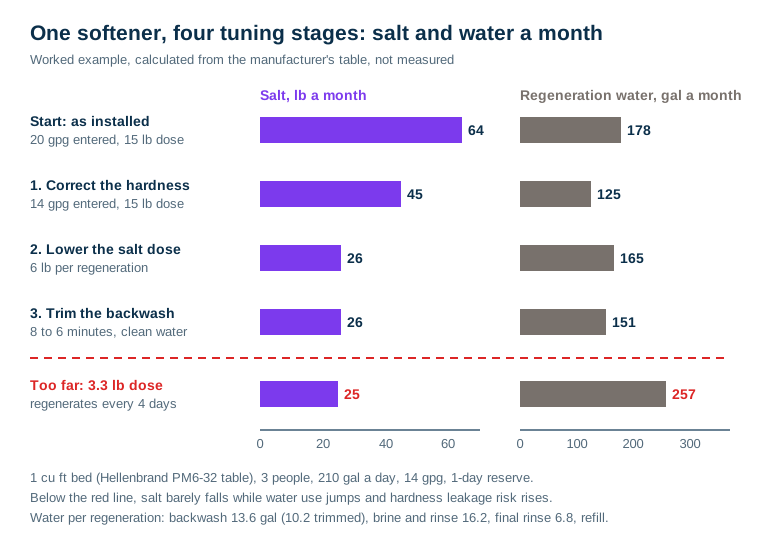
At those settings the valve thinks it can soften 32,310 ÷ 20 = 1,615 gallons. Holding back a day's reserve, it regenerates every seventh night. That is 4.3 regenerations a month, 64 lb of salt and 178 gallons of regeneration water. It removes only 1,372 grains per pound of salt, well under half the EPA benchmark.
Nothing is broken. The water is soft. It is simply set up for the least efficient point on the manufacturer's own table.
Stage 1: Enter the Hardness You Actually Have
Change the hardness from 20 to the tested 14 gpg and leave everything else alone.
The valve now calculates 32,310 ÷ 14 = 2,308 gallons of capacity. It regenerates every tenth night instead of every seventh.
- Salt: 64 lb → 45 lb a month
- Water: 178 → 125 gallons a month
This is the only change that cuts both salt and water, and it costs nothing. The common mistake runs the other way too: a hardness entered in ppm instead of gpg makes the valve think the water is about 17 times harder. That fault is covered in why a water softener uses too much salt.
Where to stop: enter your real hardness, not a lower number. If you have dissolved iron, many manufacturers tell you to add to the hardness entry to cover it. That addition is correct, not waste.
Stage 2: Lower the Salt Dose
Now drop the dose from 15 lb to the 6 lb setting. Capacity falls to 22,930 grains, or 1,638 gallons at 14 gpg, so the softener goes back to regenerating every seventh night.
- Salt: 45 lb → 26 lb a month
- Water: 125 → 165 gallons a month
Salt falls by more than 40 percent. Water rises, because there are more regenerations. This is the step where most "save salt" advice stops looking, and it is why you log both numbers.
The softener now removes about 3,430 grains per pound of salt, above the EPA's 3,350 benchmark. Water use is 1.9 gallons per 1,000 grains, well inside the 5.0 limit. Real-world efficiency is lower than the table's 3,822 because the valve regenerates with a day's reserve still unused.
How to find and change the dose on your valve, whether it is a menu setting or a float height, is covered in how to set the salt dose on a water softener. Any dose change also changes capacity, so the capacity entry has to follow it. Most electronic valves recalculate automatically. Older and mechanical ones need you to change it by hand.
Stage 3: Trim the Backwash, If Your Water Allows It
Backwash is the single largest water use in this regeneration: 13.6 of about 39 gallons. Its job is to lift and loosen the bed and flush out fines and grit. It does no softening.
On clean municipal water with no iron and no sediment, cutting it from 8 to 6 minutes saves 3.4 gallons per regeneration.
- Salt: unchanged at 26 lb
- Water: 165 → 151 gallons a month
This is the smallest saving of the four stages, and the one with the narrowest margin. Do not trim the backwash on well water with iron, manganese or sediment. Those are exactly what backwash is there to clear, and a bed that stays dirty loses capacity, which costs salt. Stay within the range your valve's manual allows. If you cannot find it there, leave the default.
Stage 4: Check the Trigger
The example is already metered, so there is nothing to gain here. On many real systems this is the biggest step of all.
- Timer valves regenerate on a calendar set for the busiest week, every week. The EPA fact sheet recommends choosing demand-initiated regeneration instead. A timer can be tuned by recalculating the interval from your real usage, but a metered head saves more. The full comparison is in metered vs timer-based water softeners.
- Day override forces a regeneration after a set number of days whatever the meter says. Hellenbrand ships at 14. An override set to 3 or 4 days on a low-use house quietly turns a metered softener back into a timer.
- Reserve. A fixed reserve larger than a day's use throws away capacity every cycle. Valves that learn reserve from usage history avoid most of that.
- Proportional brining, on valves that offer it, refills only enough water to make the brine for the capacity actually used. Whether it helps your household pattern is covered in proportional brining vs fixed salt dosing.
The Boundary: Where Efficiency Starts Costing Soft Water
Keep going and set the 3.3 lb "efficient" dose. It is the highest grains-per-pound figure on the table, so it looks like the obvious final step.
Capacity drops to 13,952 grains, or 996 gallons. With a day held in reserve, the softener now regenerates every fourth night.
| Stage | Salt a month | Water a month | Grains per lb delivered | Gallons per 1,000 grains |
|---|---|---|---|---|
| As installed | 64 lb | 178 gal | 1,372 | 2.0 |
| 1. Hardness corrected | 45 lb | 125 gal | 1,960 | 1.4 |
| 2. 6 lb dose | 26 lb | 165 gal | 3,432 | 1.9 |
| 3. Backwash trimmed | 26 lb | 151 gal | 3,432 | 1.7 |
| Too far: 3.3 lb dose | 25 lb | 257 gal | 3,564 | 2.9 |
Salt falls by about 1 lb a month. Water rises by 106 gallons. On a metered water bill, that extra water and sewage can easily cost more than the salt saved.
The boundary has three signs, and any one of them means you have gone a step too far:
- The salt saving collapses while the water cost climbs. In the table, the last step saves about 4 percent of the salt and adds 70 percent to the water.
- Cycles get short. Regenerating every three or four days is a sign the dose is too low for the bed. Sizing guides generally aim for about 3 to 7 days between regenerations.
- Hardness starts leaking through. In a downflow softener, brine enters at the top and is weakest by the time it reaches the bottom of the bed. A very light dose leaves the lower resin less fully regenerated, and that is the resin the water passes through last. Hellenbrand's own note says its efficient setting is "intended for clean water (iron <0.5 ppm)". It also says that efficiency was tested at a maximum service flow of 8 gpm per cubic foot, below the 13 gpm this unit is rated to deliver. On iron water or in a busy house with high flows, that setting is outside the conditions it was rated under.
This is why the tuning loop ends with a hardness test, not a salt count.
The Tuning Protocol, Step by Step
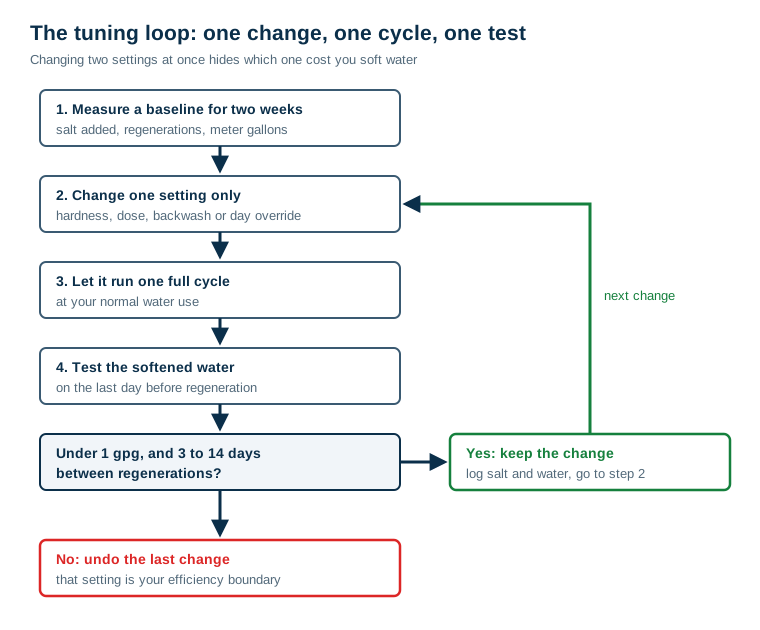
1. Record a two-week baseline. Write down the valve's current settings (hardness, salt dose, capacity, reserve, override, backwash time). Then note:
- Salt: bring the tank down to about a third full, add a weighed amount (whole bags), and mark the level with tape.
- Regenerations: most electronic valves keep a count or show days since the last one in a diagnostic menu.
- Gallons: the valve's meter total, or your house water meter read on the same day each week.
2. Change one setting. Work in this order: hardness first, then dose, then trigger, then backwash. Hardness is free and cuts both salt and water. Backwash saves the least and carries the most risk.
3. Let it run at least one full cycle, at normal use. A change made on Friday and judged on Sunday tells you nothing.
4. Test the softened water on the last day before a regeneration, when the bed is most exhausted. Use a cold tap on the softened line and a drop-count kit that reads to 1 gpg. Many strips cannot tell 0 from 2.
5. Keep it or undo it. If the water tests under 1 gpg and the cycle is still 3 to 14 days, log salt and water and make the next change. If not, go back to the previous setting. You have found your boundary.
6. Re-check once a year, and again whenever something changes: a new person in the house, a new water source, iron showing up, or a hardness result that has moved.
The water side of this is covered in detail in how much water regeneration uses. How manufacturers rate salt efficiency, and why you rarely get the tested figure at home, is in water softener salt efficiency.
What the Example Saved, in Plain Numbers
From the as-installed settings to the end of stage 3:
- Salt: 772 lb a year down to 309 lb. At an example price of $7 per 40 lb bag, that is about $135 down to $54.
- Regeneration water: about 2,140 gallons a year down to 1,810.
- Softness: unchanged, so long as the end-of-cycle test stays under 1 gpg.
Your figures will differ with hardness, household size and valve. The pattern holds, though. Most of the saving comes from the first two stages, and the last possible pound of salt is rarely worth chasing. The same logic applies if you are buying for efficiency: the SoftPro Elite review models where an upflow softener's salt savings repay its price premium, and where they never do.
What Tuning Cannot Do
- It cannot fix an undersized softener. If a correct hardness entry and the factory dose still give regenerations every one or two days, the bed is too small for the house.
- It cannot make up for iron fouling. Iron coats the resin and eats capacity. Tuning a fouled bed just finds a new, worse boundary. Clean the resin and deal with the iron first.
- It cannot repair a leaking brine valve or a stuck float. If salt use per regeneration is far above the dose setting, the refill is the fault, not the settings.
- It cannot make softened water fit for everything. Penn State Extension's water softening guide notes that softening adds sodium in proportion to the hardness removed. A leaner salt setting does not change that, because the sodium comes from the exchange itself.
- It cannot beat the laws of the resin. Below a certain dose every softener, however well programmed, trades salt for water and softness. The goal is the point just before that trade begins, not the lowest number on the menu.
Frequently Asked Questions
What is the most efficient salt setting for a water softener?
On most residential valves it is a low dose of roughly 4 to 6 lb of salt per cubic foot of resin. Hellenbrand's table, for example, gives 3,822 grains of capacity per pound of salt at 6 lb per cubic foot and only 2,154 at 15 lb. The very lowest settings squeeze out a little more per pound, but they shorten the cycle so much that the extra regenerations use more water than they save in salt. On water with iron, stay at or above the manufacturer's standard dose.
Does lowering the salt setting make water less soft?
It can, in two ways. A lower dose means less capacity, so if the hardness setting and reserve are not right the softener can run out before it regenerates. And in a downflow softener a light dose regenerates the bottom of the bed less fully, so a little more hardness can slip through at the start of each run. Test the softened water on the last day before a regeneration after any dose change. If it reads above 1 gpg, go back one step.
Can I shorten the backwash on my water softener?
Sometimes, on clean city water with no iron or sediment, and only within the range your valve's manual allows. Backwash is often the largest single use of water in a regeneration. On a 1 cubic foot Hellenbrand unit it is 13.6 of about 39 gallons. Cutting it too short leaves grit and fines in the bed, which costs capacity. On well water with iron or sediment, leave it at the default or longer.
How often should an efficient water softener regenerate?
Most sizing guides aim for every 3 to 7 days, and there is no efficiency gain in stretching beyond about two weeks. Regenerating every day or two usually means the dose is too low or the unit is too small. Much longer than two weeks lets the bed sit in still water, which is why many valves have a day override that forces a regeneration anyway. Hellenbrand ships its override at 14 days.
Is a metered softener more efficient than a timer?
Yes, in nearly every household. A metered, demand-initiated valve regenerates only after it has softened a set number of gallons, so quiet weeks cost nothing. A timer regenerates on a schedule set for your busiest week. The EPA WaterSense fact sheet on water softeners recommends demand-initiated regeneration for this reason. If you have a timer, converting to a metered control head is often the biggest single saving available.
How do I know how much salt my softener should use?
Multiply people by gallons per person per day and by hardness in grains per gallon to get grains a day. Divide by the grains per pound your salt setting delivers, often 3,000 to 4,000 at efficient settings, and multiply by 30 for a monthly figure. A household of three using 210 gallons a day at 14 gpg removes 2,940 grains a day, which works out to about 23 lb a month at 3,822 grains per pound, before reserve losses.
