
How to Verify a Softener Certification and Performance Claim

To verify water softener certification, search the certifier's public database for the exact model number, not the brand. NSF, WQA and IAPMO R&T all publish free listings. A softener is certified only if its exact model appears against NSF/ANSI 44 with the claims the seller is making. A logo on a box or website proves nothing until that listing matches, and it takes about five minutes to check.
What each claim on a listing actually proves is covered in what NSF/ANSI 44 means for water softeners. This page is the practical side: where to search, what to type, how to read the result, and how to catch the traps.
Before You Search: Copy the Exact Model Number
Certification is granted to a model, not a brand. Before you open any database, get the full model number from one of these, in order of reliability:
- The data plate or label on the control valve or tank, if you can see the unit.
- The manufacturer's specification sheet or owner's manual, not the retailer's product page.
- The quote or invoice, which should name the model exactly.
Copy every character, including suffixes and dashes. "48A", "48A-HE" and "48B" can be three separate products with three separate listing statuses. Write down the claims you want to check as well, such as grain capacity, "high efficiency" and any contaminant reduction.
How to Verify Water Softener Certification in the NSF Database
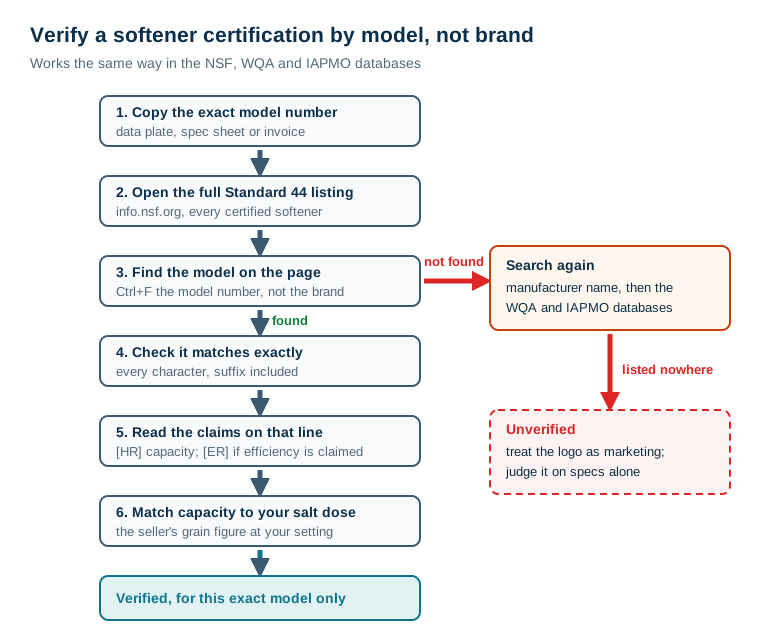
NSF's listings live at info.nsf.org, separate from the main NSF website. The search form for drinking water treatment units has fields for manufacturer, brand or model, product standard, product type, facility location and reduction claim. Here is the method that works best.
Step 1. Open the full Standard 44 list. Rather than guessing at a company name, go straight to NSF's complete NSF/ANSI 44 listing for cation exchange water softeners. It shows every certified softener and component on one page. On 26 September 2026 it held 13 manufacturers and 313 products.
Step 2. Search the page for the model number. Use your browser's find function (Ctrl+F, or Cmd+F on a Mac) and type the model number, or its most distinctive part. This finds the model whichever company it is listed under.
Step 3. If that fails, search by brand and by manufacturer. Try the brand name on the page. Then try the name of the company that actually makes the unit. Listings are filed under the certified manufacturer, and brands are often built by someone else. In the September 2026 listing, for example, Ecodyne and Ecopure models appear under the company Water Channel Partners. How to identify the real maker behind a rebadged unit is covered in how to compare water softener spec sheets.
Step 4. Confirm the match is exact. Check every character of the model number against your note. A listing for "ProSeries 51PS" is a separate line from "ProSeries 51PS-B". One does not cover the other.
Step 5. Read the claims on that line. You want Hardness Reduction [HR], which means the capacity ratings were verified. If the seller says "high efficiency", you also want Efficiency Rated [ER]. Check the footnote markers next to the model and the company as well. The next section explains each one.
Step 6. Match the capacity to the literature. The listing verifies the capacity ratings the manufacturer publishes. Those ratings sit in the certified literature, the spec sheet or manual, which gives capacity at each salt setting. Make sure the seller's grain figure is the one at the salt dose you plan to use, not the highest one.
NSF adds its own warning at the top of the listing page: it is "concerned about fraudulent downloading and manipulation of website text" and asks readers to confirm information on the live page. A screenshot or PDF of a listing sent by a seller is not proof. Look it up yourself.
Searching the WQA Gold Seal and IAPMO Directories
If the model is not on NSF's list, it may be certified by someone else. Standard 44 is a public standard, and NSF is not the only accredited body that certifies to it.
WQA Gold Seal. The Water Quality Association's certified product search lets you search by manufacturer, brand or model, and filter by product category, contaminant and product standard. Choose the water softener category or NSF/ANSI 44 as the standard, then enter the model. Each result shows the manufacturer, standard, category, product type, reduction claims, brand and model. WQA says only products that pass testing and annual facility audits appear in it.
IAPMO R&T. IAPMO's product listing directory covers its certifications, which include NSF/ANSI 44, 61 and 372 for water treatment products. Search by company or product name, then check that the listing names Standard 44 and your exact model.
The same rules apply in every database. Find the exact model, confirm the standard is 44 for any softening claim, and read the claims attached to that model.
Reading a Listing Entry Line by Line
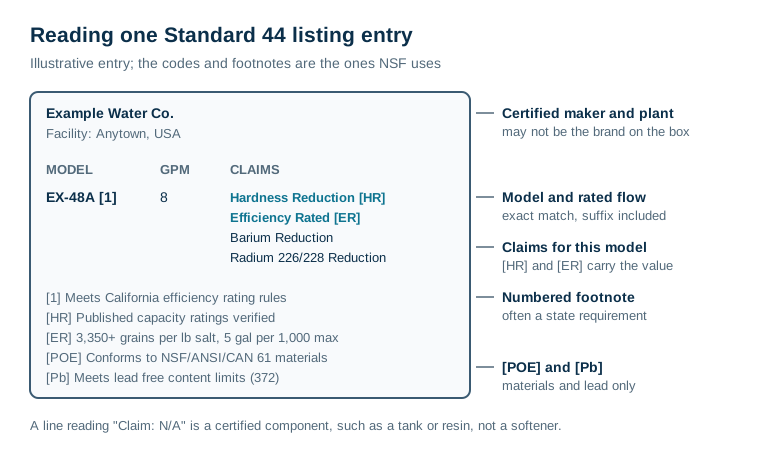
A Standard 44 entry on NSF's site packs a lot into a few lines. The example in the diagram is illustrative, but the codes and footnotes are the ones NSF uses.
| Part of the entry | What to check |
|---|---|
| Company and facility | The certified manufacturer and the plant that makes the unit. It may not match the brand on the box |
| Brand, trade name or model | Must match your model exactly, suffix included |
| Flow rate (gpm) | The rated service flow the unit was tested at. Your peak household flow should not exceed it |
| Hardness Reduction [HR] | The published capacity ratings were verified |
| Efficiency Rated [ER] | At least 3,350 grains per pound of salt and 5 gallons or less of regeneration water per 1,000 grains. Optional |
| Barium, Radium 226/228 | Optional reduction claims, tested for this model |
| [POE] | Conforms to NSF/ANSI/CAN 61 health effects requirements for materials |
| [Pb] | Meets the weighted average lead content limits of "lead free" plumbing law |
| Numbered footnotes | Often a state-specific note, such as compliance with California's efficiency rating requirements |
| "Claim: N/A" or a component note | A certified part such as a tank or resin, not a softener system |
The Model-Range Trap and Four Others
The listing shows what is certified. The traps are in how marketing describes it.
1. One model in the range is certified. A brochure covers a whole series, say 32,000, 48,000 and 64,000-grain sizes, with one certification logo on the cover. The listing shows only the 32,000-grain model. Nothing says the others are certified. The reader assumes the whole line is. This is the most common trap because nothing on the page is literally false. Check the size you are buying.
2. The brand is certified, but not this product. A company with some Standard 44 listings puts its logo on every product page, including a salt-free conditioner or a filter. A company having listings proves nothing about a product that is not on them.
3. A different standard. "NSF certified" next to a softener, where the listing is for NSF/ANSI 61 or 372 only. The materials are verified. The softening is not. See the ladder in what NSF/ANSI 44 means.
4. A certified component. "Made with NSF certified resin" or a certified tank. The part is listed. The softener as a system has not been tested, and its capacity rating is the maker's own figure.
5. Pending, tested to, or designed to meet. None of these is a certification. "Tested to NSF/ANSI 44 standards" can mean the maker ran its own test using the standard's method, with no independent certifier involved. Until the model is in a public listing, treat these phrases as no certification.
How to Read a Manufacturer's Own Lab Report
Uncertified products often come with a test report instead, and salt-free and electronic devices almost always do, because Standard 44 does not apply to them. A report can be real evidence. It can also be a single favourable run described in the best possible light. Check it against this list.
| Question | Good sign | Warning sign |
|---|---|---|
| Who ran the test? | An independent lab, named, with its accreditation stated (for example ISO/IEC 17025) | The manufacturer's own lab, a lab that is not named, or a university that is only "associated" |
| Which method? | A named standard, such as NSF/ANSI 44 methods for softeners or DVGW W 512 for scale-reduction devices | "Proprietary protocol" or no method described |
| Which product? | The exact model you are buying, with a date | A prototype, an earlier model or "a representative unit" |
| What water? | Hardness, pH, temperature, flow and duration all stated | Unstated conditions, or water much softer or cooler than yours |
| How many? | Several units or repeated runs, with the spread of results | One unit, one run, one number |
| What was measured? | The thing claimed, such as hardness removed, or scale mass under heat | A proxy, such as a hardness test strip used to "prove" scale prevention |
| Full report or summary? | The full report with raw data | A one-page summary, a chart without numbers, or "available on request" that never arrives |
A report that passes most of these is worth weighing. One that fails most of them is marketing on letterhead. For salt-free and "maintenance-free" products, the claim-by-claim version of this check is in how to evaluate maintenance-free and salt-free marketing claims.
What to Do When There Is No Listing
No listing does not prove a softener is bad. Many units use the same valves and resins as certified ones and were never submitted for system testing. It does mean the performance claims are the manufacturer's alone, so compare the product on things you can check:
- Resin volume in cubic feet and capacity at a stated salt dose, which you can compare directly. The gap between the box number and real capacity is explained in advertised vs usable softener capacity.
- The control valve maker and model, which tells you what is inside and whether parts are available.
- Service flow rate and pressure drop from the spec sheet.
- The warranty terms on tank, valve and resin.
If a seller insists a product is certified and you cannot find it in any of the three databases, ask for the certifier, the standard and the listing link. A certified product has all three, and a seller should be able to give them in one sentence. For this check applied to one brand's whole range, the Pelican review runs its salt-based softener through the NSF listing and its salt-free conditioner's DVGW claim before weighing whether either is worth buying.
If you would rather shortlist only certified units, start by choosing from softeners already checked model by model against the NSF listing.
Frequently Asked Questions
How do I check if a water softener is NSF certified?
Go to NSF's public listings at info.nsf.org, open the Drinking Water Treatment Units search, and choose Standard 44 for water softeners. Then look for the exact model number from the unit's data plate or spec sheet. If the model is listed against Standard 44 with Hardness Reduction, its capacity has been verified. If you cannot find it, the logo is not confirmed.
Why can't I find my softener brand in the NSF database?
Listings are filed under the certified manufacturer, which is often not the brand on the box. Many brands are built by another company. Open the full Standard 44 listing and search the page for the model number instead of the brand name. If it still does not appear, check WQA and IAPMO, which also certify to Standard 44.
Does certification of one model cover the whole product line?
No. Each listing covers the specific model numbers shown. A 32,000-grain model can be certified while the 48,000 and 64,000-grain versions in the same line are not. Suffixes matter too, because a listing for one suffix does not cover another. Check the exact model you are buying.
Is WQA Gold Seal certification legitimate?
Yes. WQA states it is accredited by ANAB and SCC to certify products to NSF/ANSI standards, and a Gold Seal listing to NSF/ANSI 44 proves the same things as an NSF listing to the same standard. As with NSF, confirm the exact model and the standard in WQA's public product search.
What should a manufacturer's lab report include?
The lab's name and accreditation, the test method or standard used, the exact model tested, the test water conditions such as hardness, pH, temperature and flow, the number of units and runs, the dates, and the raw results rather than just a summary. A report that is missing most of these is marketing, even if it is printed on lab letterhead.
What does 'certification pending' mean?
It means the product is not certified. Testing may be under way, or it may never finish. Treat 'pending', 'tested to' and 'designed to meet' the same as no certification until the model appears in a public listing.
