
How to Evaluate Maintenance-Free and Salt-Free Marketing Claims
Most salt free water softener claims are true in a narrow sense and misleading in the sense a buyer takes them. A salt-free conditioner does not soften water. The best ones reduce scale formation, and that is a different result. "Maintenance-free" usually means no salt, but the media, prefilters and carbon still need replacing on a schedule. Salt-based marketing has its own stretched claims too, and this guide checks both with the same tests.
The fair way to read any water treatment ad is to translate each phrase into something you could measure, then ask whether the seller has measured it. That approach is not hostile to salt-free products. For water heater protection, a good template assisted crystallization (TAC) unit has respectable independent evidence behind it. It is hostile to vague language, whichever side uses it.
Why Salt Free Water Softener Claims Need Decoding
The confusion starts with one word. Softening means removing the calcium and magnesium that make water hard. Ion exchange does that, and a hardness test after a working softener reads close to zero. Conditioning means changing how hardness behaves, usually so it forms less scale on hot surfaces. The hardness is still in the water, and a hardness test reads about the same before and after.
Calling a conditioner a "salt-free softener" borrows the reputation of the first result for a product that delivers the second. A buyer expecting spot-free glass, better lather and the slippery feel of soft water gets none of those. The full comparison of what each technology does to the water is in does a salt-free system actually soften water.
US advertising law is on the reader's side here. The FTC's policy statement on advertising substantiation requires advertisers to have "a reasonable basis" for objective claims before they make them. When a claim says "tests prove" or "studies show", the FTC expects the advertiser to have at least the level of support it describes. You are entitled to ask for that support, and a seller who cannot produce it has told you something.
The Claim Decoder: Salt-Free and Conditioner Phrases
| The phrase | What it measurably means | The test you can run |
|---|---|---|
| "Salt-free water softener" or "softens without salt" | A conditioner. Hardness stays in the water | Hardness test before and after the unit. Expect about the same reading. A large drop needs an explanation |
| "Removes hardness" or "reduces hardness by X%" | For TAC media, this is not what the technology does. It may refer to a chelating additive or a sampling artefact | Ask for the test method. A hardness kit on a fresh sample is the check |
| "Prevents scale" or "up to X% scale reduction" | A result from a heated scale test, under lab conditions | Ask which protocol. DVGW W 512 is the recognised one. An independent WateReuse study using it measured TAC at more than 88 percent |
| "Maintenance-free" or "no maintenance" | No salt, regeneration, drain or power. Media, prefilter and carbon still need replacing | Ask for the media interval, the prefilter interval and the replacement cost, in writing |
| "Lasts 6 years" or "1,000,000 gallons" | A media life under the maker's assumed water and usage | Check the assumptions: hardness, chlorine, iron and flow limits against your test report |
| "Keeps healthy minerals" | True: the calcium and magnesium stay | Not a test. Hardness was never a health hazard, so this is a benefit only if you want to avoid the added sodium of ion exchange |
| "No chemicals, no waste water" | No brine discharge and no regeneration water | True for TAC. Confirm there is no backwash cycle or drain requirement in the manual |
| "Removes existing scale" | Occasional reports of old scale loosening, not a measured result | Descale heavily scaled equipment first. Judge the unit on whether new scale forms |
| "Certified" or "NSF certified" | Often NSF/ANSI 61 or 372, which cover materials and lead content, not performance | Look it up. See how to verify a softener certification |
Two rows need a closer look.
The scale-reduction percentage. The strongest independent test of salt-free devices is WateReuse Research Foundation project 08-06. It used the German DVGW W 512 heated protocol and found that TAC reduced scale formation by more than 88 percent. Electromagnetic and electrically induced devices reduced it by about 50 percent. Use those figures to calibrate an ad. A TAC claim close to the independent result is plausible. A coil or magnet claiming TAC-level results, or any device claiming near-total scale prevention with no named protocol, needs its full report. Coils and magnets are a separate technology from TAC media, with weaker independent results.
"Maintenance-free." This is the category's most misleading phrase, because the chores it removes are real and visible, and the ones it keeps come later. What the schedule actually looks like, month by month and in dollars, is set out in what maintenance a salt-free system needs.
The Claim Decoder: Salt-Based Softener Phrases
A page that only questioned salt-free claims would be doing the same thing it criticises. Ion exchange softeners have their own stretched language, and the same method applies.
| The phrase | What it measurably means | The test you can run |
|---|---|---|
| "48,000-grain softener" | Capacity at the highest salt dose, usually 15 pounds per cubic foot. Real-world capacity at an efficient setting is much lower | Ask for capacity at each salt setting. See advertised vs usable softener capacity |
| "High efficiency" | Defined only if the model is listed as Efficiency Rated under NSF/ANSI 44: at least 3,350 grains per pound of salt and 5 gallons or less per 1,000 grains | Check the listing for the exact model |
| "Uses 75% less salt" | Less than an unstated baseline, usually an old timer-based unit set at the maximum dose | Ask "less than what?" Compare pounds of salt per 1,000 grains removed |
| "WaterSense" anything | EPA decided not to proceed with a WaterSense label for softeners. There is no WaterSense-labeled softener | Treat the claim as a red flag about the seller |
| "Removes iron up to 10 ppm" | The maker's own figure. The Standard 44 listing does not certify iron | Compare with your iron result. Above a few ppm, plan an iron filter first |
| "Healthier water" or "better for eczema" | Not supported. A randomised trial of softeners for childhood eczema found no added benefit | No test needed. Softening is a scale and soap benefit |
| "Pays for itself in X years" | Depends entirely on the assumed savings on soap, energy and appliances | Ask for the assumptions and replace them with your own hardness, water use and salt price |
| "Lifetime warranty" | Often the tanks only. The valve and electronics usually carry much shorter terms | Read the warranty by component |
| "Our free water test shows your water is unsafe" | A hardness or TDS reading, which says nothing about safety | Get an independent lab test if you are worried about safety |
Three Tests That Settle Most Claims
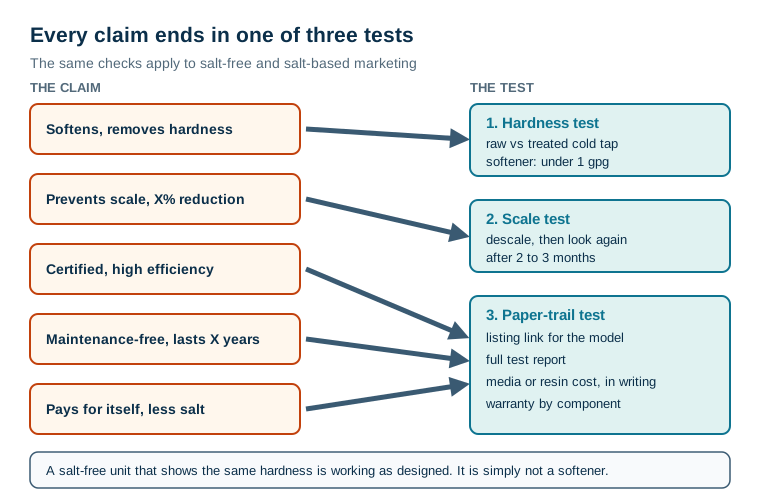
Almost every claim in both tables comes down to one of three checks.
1. The hardness test. It settles any claim about softening or hardness removal. Test at a cold tap before the equipment, or with it in bypass, and at a treated cold tap after running it for two minutes. A working salt-based softener should read under 1 gpg. A salt-free conditioner should read about the same as the raw water. That is not a failure. It only shows that the unit is not a softener, whatever the ad calls it.
2. The scale test. It settles claims about scale prevention, and it is slow. Descale the kettle, a showerhead or faucet aerator, and the water heater drain area before installation. Look again after two to three months and compare. Less new hard crust than before is the sign to look for. A guarantee shorter than about a year expires before this test can finish.
3. The paper-trail test. It settles claims about certification, efficiency, lifespan and cost, and it takes minutes. Ask for four things in writing: the certification listing link, the full test report behind any percentage, the media or resin replacement interval with its price, and the warranty terms by component. A seller making careful claims can supply all four. Missing answers tell you which claims are stretched.
Red Flags in How the Claim Is Sold
Sometimes the sales process tells you more than the claim does. Both salt-free and salt-based products are sold door to door and through in-home demonstrations, and the warning signs are the same for both.
- A dramatic kitchen-table water test. Color-change demos and TDS meters show that your water contains minerals. They do not show that it is unsafe, and they do not show that the product in the van fixes anything.
- A price that is only good today. A genuine product is still worth buying next week, after you have checked the listing and read the manual.
- Financing you do not fully understand. The FTC took action against a water treatment lender whose dealers misled people about financing terms and pressured them to sign. The FTC's advice is to get the interest rate, APR and loan length in writing before you sign anything.
- Answers that change when you ask for them in writing. A claim a seller will say out loud but will not write on the quote is a claim the seller does not stand behind.
For one dealer-sold brand put through these checks, see what to get in writing before signing a RainSoft quote, including how its lifetime warranty is conditioned.
When a Marketing Claim Is Probably True
Decoding is not the same as disbelieving. These signs mark a claim you can reasonably rely on:
- It names what was measured, such as scale mass under a stated protocol or grains removed per pound of salt, rather than an adjective.
- It points to a public listing or a full report, not a logo or a summary.
- It matches independent results. A TAC scale-reduction figure near the WateReuse finding, or a softener capacity quoted at a stated salt dose, is in line with what testing shows.
- It states its own limits. A salt-free seller who says "this will not stop spots on glass", or a softener seller who quotes the salt setting behind the capacity number, is usually being straight about the rest.
Those four signs are how to shortlist actual products. Choosing a salt-free conditioner by its published scale evidence and water limits grades units on them, and comparing TAC media with a citric-acid system on scale control and cartridge cost shows the same checks applied to two very different designs.
What No Marketing Claim Changes
Whatever the brochure says, a few facts stay fixed.
- A salt-free conditioner does not remove hardness, so it cannot give the lather, spot-free glass or slippery feel of softened water.
- A salt-based softener does remove hardness, but it adds sodium, needs salt, uses water to regenerate, and needs a drain.
- Neither one removes bacteria, lead, PFAS or nitrate. Neither is a health device.
- Both have running costs. For one it is salt. For the other it is media, prefilters and carbon.
Choose the goal first, softening or scale reduction, then judge each product's claims against that goal with the three tests above. A claim that survives them is worth paying for.
Frequently Asked Questions
Is a salt-free water softener really a softener?
No. Softening means removing calcium and magnesium, and a salt-free conditioner leaves them in the water. The best of them, template assisted crystallization units, reduce scale formation. In an independent WateReuse study using the DVGW W 512 heated test, TAC cut scale by more than 88 percent. That is scale prevention, not softening, and a hardness test will read about the same after the unit as before it.
Are salt-free water conditioners really maintenance-free?
No. They need no salt, regeneration, drain or electricity, but the media wears out and needs replacing on the maker's schedule. Most also need a sediment prefilter, and on chlorinated water often a carbon stage, and both need regular cartridge or media changes. Ask for the replacement interval and cost in writing.
How can I test if a salt-free system is working?
Not with a hardness test, because the hardness stays. Check for scale instead. Descale the kettle and a showerhead aerator, then look again after two to three months. At the water heater, drain a few gallons at the service interval and compare the sediment with what you saw before. Scale results take months, which is why a short guarantee is of little use.
What does 'high efficiency' mean for a salt-based softener?
It has a defined meaning only if the model carries the Efficiency Rated claim on its NSF/ANSI 44 listing. That requires at least 3,350 grains of hardness removed per pound of salt and 5 gallons or less of regeneration water per 1,000 grains. Without the listing, 'high efficiency' is the seller's own description.
Is there a WaterSense label for water softeners?
No. EPA says it decided not to proceed with a WaterSense labeling specification for softeners. A softener advertised as 'WaterSense certified' or 'WaterSense labeled' is misusing the name. EPA does publish consumer guidance on water-efficient softeners, which is a different thing from a label.
Do salt-free systems remove existing scale?
Some owners report old scale slowly loosening, but it is not a reliable or measured result, and loose scale can clog aerators and valves while it happens. If a heater or tankless unit is heavily scaled, descale it before installing any treatment, then judge the system on whether new scale forms.
