
How to Inspect an Existing Softener After Moving In

To inspect a water softener in a new house, check four things in about 30 minutes. Find its approximate age, look it over for leaks and salt problems, compare the programmed hardness with your actual water, and run one manual regeneration to see that it works. Those results tell you whether to keep it, service it or price a replacement, before you spend money on salt or repairs.
An inherited softener comes with no history. You do not know when it was serviced, whether the resin is fouled, or what water it was set up for. The last question matters most, because a lot of softeners were programmed years ago for water that has since changed.
How to Inspect a Water Softener in a New House in 30 Minutes
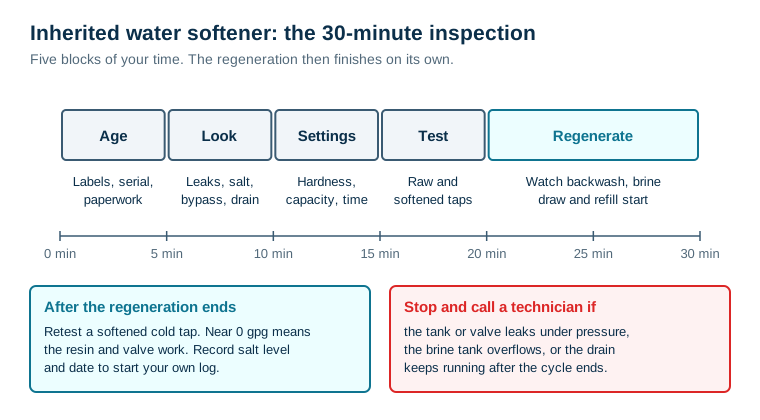
What you need:
- a hardness test kit, drop count or strips (a drop count kit is more precise)
- a phone to photograph labels and settings
- a flashlight
- a bag of the salt type the unit uses, if the brine tank is low
- the manual if the seller left one. If not, search for the control valve's make and model and download it
The five blocks are in a useful order. Photograph everything before you touch anything, so you can put settings back if needed. Test the water before you regenerate, so you know how it performs in the state you inherited it.
Step 1: Work Out How Old It Is
Age decides how much you should spend on an old softener, and it is rarely written anywhere obvious. Check these places:
| Where | What to look for |
|---|---|
| Mineral tank label | Some fiberglass tanks carry a manufacturing date or date code on the label |
| Control valve | A model and serial label, usually on the back or under the cover |
| Brine tank | A molded date or a sticker, sometimes on the underside or inside the lid |
| Inside the salt lid or on the wall | Installer's sticker with an install date and phone number |
| Paperwork left behind | Manual, warranty card or a job specification sheet |
| Home paperwork | Seller disclosures, the home inspection report, the dealer's service records |
| Your city | Plumbing permit records, where permits were required |
Serial numbers: each manufacturer uses its own format, and most do not publish how to decode them. Do not trust a decoding rule from a forum unless the manufacturer confirms it. Call the manufacturer or its dealer with the model and serial number. They can often tell you the build date and whether any warranty is still active. If the softener was installed by a local dealer, an installer sticker often leads to its service history.
The most useful document to find is the job specification sheet. Fleck's 5600SXT manual, for example, opens with one for the installer to fill in: the water hardness it was set for, capacity, tank size, salt setting and whether the valve is a time clock or meter-initiated. If you find one, you know what water the unit was set up for.
If you cannot pin the age down, a rough estimate is enough. How old is the house plumbing near it, what brand of valve is it, and does the display look current? The age question ends with "fairly new", "middle-aged" or "old". What those mean for repair costs is covered in should you repair or replace an old water softener.
Step 2: Look It Over
Five minutes with a flashlight catches most of the expensive problems.
- Leaks. Look for water, white crust or rust stains at the valve body, the bypass, the inlet and outlet fittings, the base of the mineral tank and around the brine tank. A drip at a fitting is minor. A wet, bulging or cracked mineral tank is not.
- Bypass position. Check that the bypass is in service. Softeners get left in bypass after a repair or during a sale, and the house has had hard water ever since.
- Salt. Is there any? Lift the lid. A hard crust with a hollow underneath is a salt bridge; push a broom handle down to check. A mushy layer at the bottom is salt mushing. Either stops brine forming.
- Water in the brine tank. Many softeners keep a few inches of water below the salt. A tank nearly full of water, or with water above the salt, points to a refill or brine draw problem.
- Drain line. Follow it to the drain. It should end with an air gap, not pushed down into a pipe, and it should not be kinked or crushed.
- Power. Check the valve is plugged in, the display is on and the time is right. A wrong time means regenerations happen in the middle of the day.
- Outdoor taps and kitchen tap. Note which taps are softened and which are not. You will need an unsoftened tap for the next step.
Step 3: Read the Settings the Last Owner Left
Photograph every setting before you change any of them. On most digital valves you step through the programming screens with the arrow and set buttons. The manual gives the sequence.
| Setting | What to record | Why it matters |
|---|---|---|
| Valve type | Metered or time clock | A timer regenerates on a schedule whether you use water or not |
| Hardness | Number and unit, usually gpg | Compared in step 4 |
| Capacity or salt dose | Grains or pounds per regeneration | Decides salt use per cycle |
| Reserve | Gallons or percentage | Too large a reserve regenerates early |
| Regeneration time | Usually 2 a.m. | Must fall when no one uses water |
| Day override | Maximum days between regenerations | Backstop for low use |
A timer valve has no hardness setting. It regenerates every set number of days. The question then is whether that number of days suits the water you use and your household's size.
Step 4: Check the Programmed Hardness Against Your Actual Water
This is the check that most often turns up a problem. The hardness entered when the softener was installed may be for water that no longer exists. Common reasons:
- The source changed. The house was switched from a well to city water, or the reverse.
- The utility changed its source or blend. Cities change wells or mix surface and ground water.
- The well changed. Well chemistry can drift over years.
- It was never set properly. A factory default or a guess that nobody checked.
Get the current number. On city water, your utility's annual water quality report, the Consumer Confidence Report, often lists hardness. The EPA explains how to find your Consumer Confidence Report. Better still, test an unsoftened tap yourself, such as an outdoor spigot, so the result is for your water today. On a private well, test it yourself, and consider a full lab test at the same time. The EPA's private well guidance says private well owners are responsible for delivering safe drinking water to their households, and a newly bought well is the time to start testing.
Why a mismatch matters. A metered valve works out how many gallons it can treat by dividing its capacity by the hardness you entered, then subtracting the reserve. That is how the Fleck 5600SXT manual describes its metered controls, and other metered valves work the same way. So:
| Programmed | Actual water | Gallons between regenerations (24,000-grain capacity, before reserve) | Result |
|---|---|---|---|
| 25 gpg | 12 gpg | 960 instead of 2,000 | Regenerates about twice as often as needed. Roughly double the salt and regeneration water |
| 10 gpg | 18 gpg | 2,400 instead of 1,333 | Runs well past exhaustion. Hard water for the last part of every cycle |
| 18 gpg | 18 gpg | 1,333 | Correct |
The first case is the more common one after a switch from a hard well to softer city water. The second is common where a softener was set up years ago with a low guess. How to enter the right number, including the iron allowance, is covered in how to set water hardness on a control valve.
Step 5: Test, Then Run One Manual Regeneration
Test first. Test the unsoftened tap and a softened cold tap before you regenerate anything. This tells you how the softener performs as you inherited it.
- Softened tap near 0 gpg: the softener is working now.
- Softened tap equal to the raw water: the softener is in bypass, out of salt, not regenerating, or the resin is exhausted or fouled.
- Softened tap partly hard: it may be regenerating too rarely for the hardness, the resin may be fouled or ageing, or the bypass may be leaking.
The different readings and what they mean are covered in how to check if a water softener is working.
Then regenerate. A manual regeneration is the one functional test of the valve, the injector and the drain. It is also the best way to reset an inherited softener that has been sitting. On a Fleck 5600SXT, an immediate regeneration starts by holding the Extra Cycle button for five seconds. Other valves use a regen button or a menu item. How to do it on the common valves is in how to manually regenerate a water softener.
Watch the first ten minutes. You are checking three things:
- Backwash: water flows steadily from the drain line. Fleck's own start-up checks look for steady drain flow until the water runs clear. Dirty water at first is normal in a softener that has sat.
- Brine draw: as the valve moves to brine draw, the water level in the brine tank should start to fall. Fleck's start-up step is to make sure the unit draws water from the brine tank. If the level does not drop, suspect a plugged injector or a problem in the brine line.
- Refill: at the end of the cycle, water flows back into the brine tank and then stops.
You do not have to watch the whole regeneration. When it has finished, retest the softened cold tap. A result near zero means the valve and resin are working. If the drain keeps running after the cycle should have ended, or the brine tank overflows, stop and call a technician.
For Buyers: Checking Before You Close
The same inspection works before you buy, with a few changes.
- A standard home inspection usually looks, but does not test. The inspector may note a softener and any leaks. Ask whether the inspection includes testing softened water. It usually does not.
- Ask the seller for the manual, the install date, the service history, the salt type used and the water source when it was installed.
- Ask to test the water at a softened tap and an unsoftened tap during the inspection or final walk-through.
- Ask whether it is included. Some softeners are rented or financed, not owned, and the contract may not transfer. A rented unit may be removed at sale.
- If it is old and fails a check, that can go into the negotiation along with the other inspection results.
Keep, Service or Replace
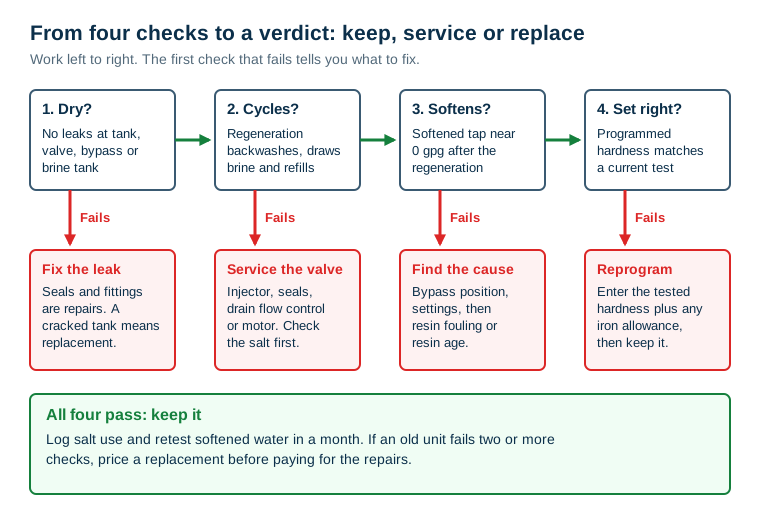
Put the results together in this order:
- Dry. A cracked mineral tank means replacement. Leaking seals and fittings are repairs.
- Cycles. If the regeneration did not backwash, draw brine or refill, the valve needs service: the injector, seals, drain flow control or motor. Check the salt and the brine tank first.
- Softens. If softened water is still hard after a good regeneration, check the bypass and the settings. Then suspect fouled or ageing resin.
- Set right. If the programmed hardness does not match your test, reprogram it. This is the most common finding and costs nothing.
If all four pass, keep it. Start a salt log and retest in a month. If an old unit fails two or more checks, get a price for replacement before you pay for repairs.
What This Inspection Cannot Tell You
- It cannot measure how much resin capacity is left directly. A near-zero result after regeneration shows the resin works today. Declining capacity shows up over weeks, as hardness returning earlier in the cycle.
- It cannot see inside the mineral tank. Broken distributor tubes, channeling and fouled resin show up only as symptoms.
- It does not test for anything but hardness. A softener removes hardness and a small amount of dissolved iron. It does not treat bacteria, nitrate, lead or arsenic. A new well owner should test for those separately.
- It cannot tell you about a rental or finance contract. Ask the seller or the dealer.
Photograph the labels and the settings, test the water at a raw tap and a softened tap, and run one regeneration. That is enough to decide whether the inherited softener stays.
Frequently Asked Questions
How do I know how old my water softener is?
Look for a date on the mineral tank label, the control valve label and the brine tank, and for any installer sticker, manual or job specification sheet left with the unit. Serial number formats vary by manufacturer and are rarely published, so if there is no printed date, call the manufacturer with the serial number. Seller disclosures, the home inspection report and local permit records can also narrow it down.
Should I keep the water softener that came with my house?
Keep it if it passes four checks: no leaks, a manual regeneration that backwashes, draws brine and refills, softened water near 0 gpg afterwards, and a hardness setting that matches a current test of your water. If an old unit fails two or more of those, price a replacement before paying for repairs.
How do I check the hardness setting on my softener?
On most digital valves, the hardness is one of the first programming screens and is shown in grains per gallon. Compare it with a current hardness test, or with your water utility's annual water quality report. If they differ, enter the tested figure plus any iron allowance the manufacturer specifies. Timer valves have no hardness setting; they regenerate on a schedule.
Does a home inspection check the water softener?
Usually only visually. An inspector may note that a softener is present, whether it leaks and whether it is connected, but a standard inspection rarely tests softened water or runs a regeneration. Ask the seller to demonstrate a regeneration, or test the water yourself before closing.
How do I test if my inherited water softener works?
Test a cold tap that is fed by the softener and compare it with an unsoftened tap such as an outdoor spigot. Then run one manual regeneration, watching that it sends water to the drain, draws brine down, and refills the brine tank. Retest the softened tap after it finishes. Near 0 gpg means the resin and valve are working.
What should I do with a softener that has been sitting unused?
Clean out any mushy or bridged salt, add fresh salt, check the brine tank for standing water, then run a manual regeneration before relying on it. A bed that sat idle may also need sanitizing. If the house was vacant for a long time, run the cold taps before testing.
