
Is a Higher Grain Rating Always Better?

Is a higher grain water softener better? No, not by itself. The grain number on the box is usually the unit's capacity at its highest salt setting, where each pound of salt removes the least hardness. A bigger rating helps only when the extra resin is programmed for an efficient salt dose and still regenerates within about a week. Otherwise it costs more to buy, uses more salt, and leaves the resin sitting idle.
This page works through one manufacturer's published capacity table. It shows where the grain rating comes from, what each extra grain costs in salt, and how five setups compare for the same household.
Is a Higher Grain Water Softener Better? Where the Number Comes From
Softener model names are usually capacity figures, and the capacity they quote is the highest one on the table. The Hellenbrand residential softener manual prints its full table, which makes it a clear example:
| Model | Resin | Efficient (3.3 lb/cu ft) | Low (6 lb/cu ft) | Medium (10 lb/cu ft) | High (15 lb/cu ft) |
|---|---|---|---|---|---|
| PM6-32 | 1 cu ft | 13,952 | 22,930 | 28,060 | 32,310 |
| PM6-48 | 1.5 cu ft | 20,928 | 34,400 | 42,090 | 48,460 |
| PM6-64 | 2 cu ft | 27,904 | 45,860 | 56,120 | 64,620 |
The "32," "48" and "64" in the model names are the high-salt capacities. The factory ships the valve set to Low, where the "32" softener delivers 22,930 grains. It is the same unit with the same resin. Only the salt dose differs.
The rating is also measured under easy conditions. Under NSF/ANSI 44, capacity is tested with 20 gpg feed water at half the rated service flow, and a run ends when the output reaches 1 gpg. NSF's Rick Andrew sets this out in NSF/ANSI 44 requirements for water softeners. Hellenbrand's own note says the operating efficiency you get at home "is typically less than the tested efficiency."
So a 48,000-grain rating means 48,000 grains at maximum salt, at half flow, on clean water. That is the least economical way the unit can run.
What Each Extra Grain Costs in Salt
Divide each capacity by the salt that produced it and you get the salt efficiency, in grains of hardness removed per pound of salt:
| Setting | Salt per cu ft | Capacity per cu ft | Grains per lb of salt |
|---|---|---|---|
| Efficient | 3.3 lb | 13,952 | 4,228 |
| Low (factory) | 6 lb | 22,930 | 3,822 |
| Medium | 10 lb | 28,060 | 2,806 |
| High (the rating) | 15 lb | 32,310 | 2,154 |
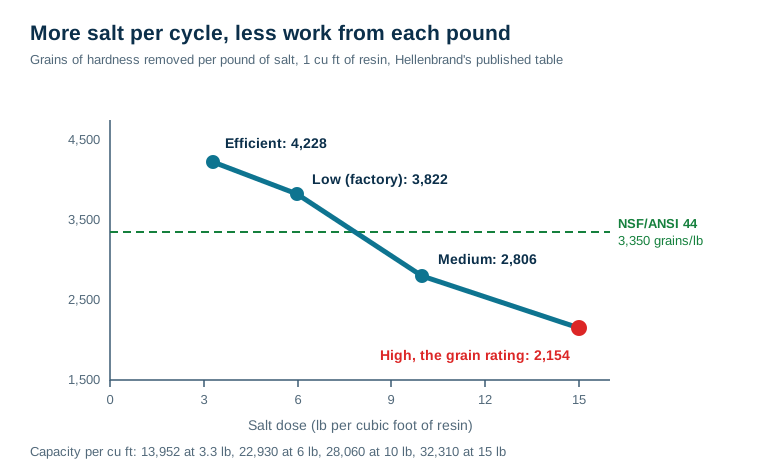
Going from the low setting to the high one adds 41 percent more capacity for 150 percent more salt. The last 4,250 grains per cubic foot, from medium to high, cost 5 lb of salt. That works out to about 850 grains per extra pound, a fifth of what the first pounds achieve.
The efficiency-rating rule in NSF/ANSI 44 draws the same line. A softener qualifies only at settings that remove at least 3,350 grains per pound. On this table, the efficient and low settings qualify. Medium and high, the settings the model names come from, do not.
Same House, Five Setups
Take one household: four people using a measured 60 gallons per person per day indoors, on 15 gpg water. That is 240 gallons × 15 gpg = 3,600 grains a day. The table below runs it through three bed sizes at different doses. Reserve capacity is left out to keep the arithmetic readable, and the day override is set to Hellenbrand's factory 14 days.
| Setup | Capacity | Days per cycle | Regenerations a year | Salt a year |
|---|---|---|---|---|
| A. 1 cu ft ("32") at low | 22,930 | 6.4 | 57 | 344 lb |
| B. 1 cu ft ("32") at high | 32,310 | 9.0 | 41 | 610 lb |
| C. 2 cu ft ("64") at high | 64,620 | 17.9, cut to 14 by the override | 26 | 782 lb |
| D. 2 cu ft ("64") at low | 45,860 | 12.7 | 29 | 344 lb |
| E. 2 cu ft ("64") at efficient | 27,904 | 7.8 | 47 | 311 lb |
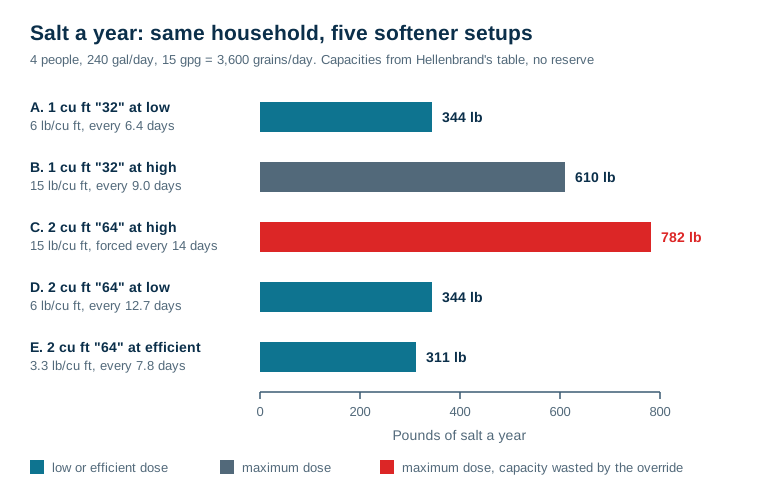
Three things stand out:
- The largest grain rating run as advertised (C) uses the most salt, more than twice setup A. The unit is not faulty. It runs at maximum dose, and the override regenerates it with about a fifth of its capacity still unused.
- The same large unit (E) is the cheapest to run once it is set to the efficient dose. More resin let it use a low dose and still last about a week.
- A and D use the same salt. At the same dose per cubic foot, bed size does not change salt use. It only changes how long each cycle lasts.
So the honest answer is that the rating tells you very little about running cost. The dose you program decides that, and the bed size decides how long each cycle lasts.
The Stagnation Problem in a Bed That Regenerates Twice a Month
The salt bill is the visible cost of setup C. The other cost is time. Left to itself, setup C would go almost 18 days between regenerations. For most of that time the lower part of the bed sits in still water.
This is why valves include a day override. Hellenbrand's ships at 14 days, so the unit regenerates at least every two weeks whether the meter calls for it or not. Penn State Extension's water softening guide notes that bacteria and fungi can form mats in resin that reduce how well it works, and recommends periodic cleaning. A bed that regenerates rarely gets flushed rarely.
An oversized bed can be handled in one of two ways, and both cost something:
- Leave the override long and accept long idle periods.
- Shorten the override and throw away unused capacity, along with the salt that restored it, every cycle. That is what drove setup C to 782 lb.
The way out is the one setup E shows: lower the dose until the bed runs out naturally in about a week. On iron water the target is shorter, about three days, because iron left on the bed between cycles eats into the next cycle's capacity. The idle-time side of this, with more household sizes, is covered in can a water softener be too large.
When More Resin Really Does Help
A bigger bed is not always a mistake. It helps in these cases:
- Peak flow. More resin in a wider tank passes more water before the pressure drop becomes a nuisance. Hellenbrand lists 13.0 gpm for its 1 cu ft unit and 18.2 gpm for the 2 cu ft unit at a 15 psi drop. For a house with several bathrooms running at once, that can matter more than capacity.
- Room to use a low dose. As setup E shows, extra resin lets you run at the efficient end of the curve and still get a sensible cycle length.
- Very hard water or large households. If your daily load is high enough that a small bed would regenerate every two days at any dose, stepping up is simply correct sizing.
In every one of those cases the reason is resin volume or flow. The grain rating on the box does not come into it.
How to Read a Grain Rating Before You Buy
Ask for, or look up, five numbers. A dealer who cannot give them is quoting a model name, not a specification.
- Resin volume in cubic feet. This is the only figure that compares cleanly across brands. What a grain figure means, and how to convert between the two, is in what grain capacity means on a water softener.
- The salt dose behind the rated capacity. If the rating is at 15 lb per cubic foot, expect roughly 70 percent of it at 6 lb.
- Capacity at the dose you will actually use. The table should list several salt settings.
- Service flow rate at a stated pressure drop.
- The day override setting and whether you can change it.
Then do the sizing from your own hardness and measured water use. How to size a water softener walks through the arithmetic, and advertised vs usable softener capacity covers the rest of the gap between the box and your basement.
What a Bigger Softener Cannot Do
- It cannot fix a wrong hardness setting. If the valve is programmed below your real hardness, a bigger bed just runs out later and more quietly.
- It cannot handle iron or manganese beyond its rating. More resin gives iron more places to build up. Pretreatment is the fix.
- It cannot soften water faster than its resin allows. Leakage depends on dose and flow, not on the number on the label.
- It cannot make up for a hard-water branch. Taps plumbed before the softener stay hard whatever its size.
Frequently Asked Questions
Is a 48,000 grain water softener better than a 32,000?
It has 50 percent more resin, typically 1.5 cubic feet against 1. More resin gives you more room to use an efficient low salt dose, and a bit more flow. It is only better if you program it that way. Run a 48,000-grain unit at its maximum salt setting on a small household and it uses more salt per grain removed and regenerates so rarely that the bed sits in still water for up to two weeks.
What happens if my water softener is too big?
Three things. It regenerates rarely, so the resin sits for long stretches between cycles. If a day override forces a regeneration before the capacity is used, the unused capacity and the salt that restored it are wasted. And if it is set at its maximum salt dose to match the grain rating on the box, every pound of salt removes fewer grains than it would at a lower dose. Programming it for a lower dose fixes the first and third problems.
Does a higher grain softener use more salt?
Not necessarily. Salt use depends on the dose per cubic foot of resin and how much hardness you remove. On Hellenbrand's table, a 1 cubic foot bed and a 2 cubic foot bed both remove 3,822 grains per pound of salt at the low setting. The bigger unit uses more salt only when it runs at a higher dose, or when a day override regenerates it before its capacity is used.
How many days should a water softener go between regenerations?
Most sizing guides aim for about 3 to 7 days. Penn State Extension's worked example lands at 6 to 7 days. Many metered valves ship with a day override that forces a regeneration after a set number of days anyway. Hellenbrand's factory setting is 14. With iron in the water, aim for about 3 days so iron does not build up on the resin.
Should I buy a bigger softener to allow for future family growth?
A modest step up is reasonable, but rely on programming rather than size. A bed with room to spare can run at a low salt dose now and a higher dose later without being replaced. That only works if the larger bed still regenerates at least every week or two at your current water use. Buying two sizes up for a household that may never arrive is how softeners end up regenerating every three weeks.
