
Is Softened Water Safe to Drink?

Is softened water safe to drink? For most people, yes. A salt-based softener swaps calcium and magnesium for a modest amount of sodium. The EPA's sodium advisory says drinking water "does not play a significant role in sodium exposure for most individuals." The documented exceptions are specific: very low sodium diets, sodium-sensitive high blood pressure, and babies on formula.
That is the whole answer for a healthy household. The rest of this page is for the people it does not cover. It shows how large the sodium is as a share of a restricted diet, and it marks the point where the decision belongs to a doctor rather than to anyone selling or writing about softeners.
Is Softened Water Safe to Drink for the General Population?
The public health sources we checked agree that softening does not make drinking water unsafe. None of them treats the added sodium as a hazard for the general population.
- EPA set its sodium guidance for a narrow group, not for everyone. The 20 mg/L guidance level "was developed for those individuals restricted to a total sodium intake of 500 mg/day and should not be extrapolated to the entire population," in the words of the sodium advisory.
- The Minnesota Department of Health confirms that a salt softener "increases the amount of sodium in the water you drink at home." It treats that as a question for particular people, not as a general warning. Its home water softening fact sheet also says the calcium and magnesium removed "are not harmful and may be beneficial sources of essential elements."
- Penn State Extension describes softening as removing minerals that are "a nuisance and not a threat to human health." It names the risk for people on low sodium diets as the main drawback.
So the general answer is not in doubt. What varies from house to house is how much sodium gets added, and who is drinking it.
What a Softener Changes in Your Drinking Water, and What It Leaves Alone
A softener changes three things about the water in your glass:
- Calcium and magnesium go down to near zero. Those are the hardness minerals, and removing them is the whole job.
- Sodium goes up in proportion to the hardness removed. Penn State puts it at 7.5 mg per quart for each grain per gallon (gpg) removed, which is about 7.9 mg per litre. Harder water means more sodium.
- If the softener uses potassium chloride instead of salt, potassium goes up instead of sodium. The exchange is the same. Only the ion changes.
Almost everything else goes straight through. The CDC's page on home water treatment says plainly that water softeners do not remove parasites, bacteria or viruses. A softener cannot make an unsafe supply safe. If your well has never been tested for bacteria and nitrate, that test matters far more than the softener question. The full list of what ion exchange leaves in the water is in what a water softener does not remove.
The Documented Exceptions
The sources do not say "softened water is bad for some people." They say that certain people should think about the sodium, or the potassium, and several of them say who should make that call.
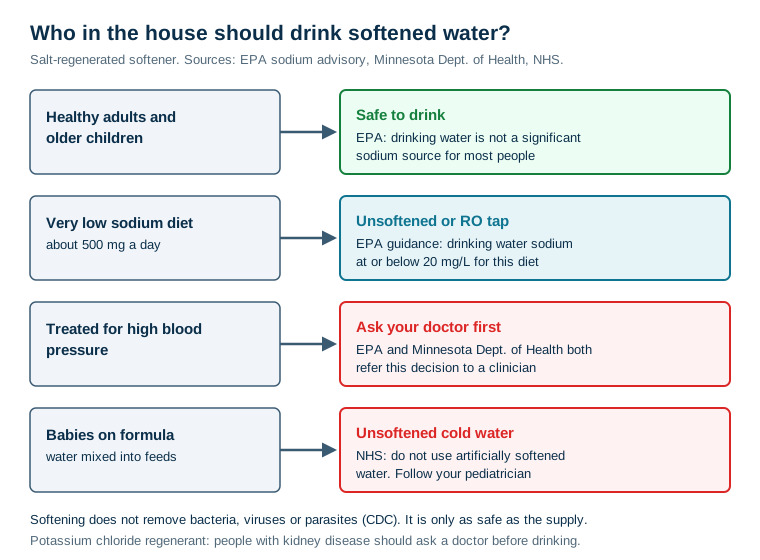
Very low sodium diets. EPA's guidance level of 20 mg/L exists for people on a 500 mg per day sodium diet. At 7.9 mg/L added per gpg, softening any water harder than about 2.5 gpg exceeds 20 mg/L from the softener alone, before counting the sodium already in the supply. For this group the practical answer is almost always a separate tap.
Sodium-sensitive high blood pressure. EPA says people "under treatment for sodium-sensitive hypertension should consult with their health care provider regarding sodium levels in their drinking water supply and the advisability of using an alternative water source or point-of-use treatment." The Minnesota Department of Health says the same for anyone with a history of high blood pressure. Neither source tells these people to stop drinking softened water. Both send the question to a clinician.
Babies on formula. Infants are the clearest exception. EPA's advisory notes that the kidneys of immature individuals "are not as effective in controlling sodium levels" as adult kidneys. The UK's NHS formula guidance tells parents plainly not to use artificially softened water for formula. This has its own page: softened water and baby formula.
Potassium chloride and kidney disease. A softener regenerated with potassium chloride adds potassium instead of sodium. That solves the sodium problem, but it is not automatically safe for people who have been told to limit potassium, which often includes people with kidney disease. The trade-off is covered in potassium chloride vs sodium chloride in a softener. If this applies to you, a nephrologist should decide.
The Low-Sodium Diet Case, Worked as a Share of Your Limit
A common answer to "is softened water safe to drink" compares the sodium with a slice of bread. That is fine for someone eating 3,400 mg a day. It is no use to someone whose doctor has set a limit of 500 mg. The useful number is the percentage of your limit.
EPA's advisory lists the sodium-restricted diets used in practice at 250, 500, 1,000 or 2,000 mg a day. The FDA Daily Value for the general population is less than 2,300 mg. The table below assumes 2 litres of softened drinking water a day and counts only the sodium the softener adds.
| Hardness removed | Sodium added in 2 L | Share of 250 mg | Share of 500 mg | Share of 1,000 mg | Share of 2,000 mg | Share of 2,300 mg |
|---|---|---|---|---|---|---|
| 5 gpg | 79 mg | 32% | 16% | 8% | 4% | 3% |
| 10 gpg | 158 mg | 63% | 32% | 16% | 8% | 7% |
| 20 gpg | 317 mg | 127% | 63% | 32% | 16% | 14% |
| 30 gpg | 475 mg | 190% | 95% | 48% | 24% | 21% |
Calculated from Penn State Extension's 7.5 mg per quart per gpg. Water you use for cooking adds to these figures. Sodium already in your raw water adds on top again.
Read across your own row. On a 2,000 mg diet with 10 gpg water, drinking water uses 8% of the allowance. That is real but manageable, and something to mention to your doctor. On a 500 mg diet with 20 gpg water, softened drinking water would use nearly two-thirds of the day's sodium before any food. For that person, it is not a reasonable drinking source.
Two numbers make the table personal:
- Your hardness. Use the raw water figure from a lab report or your utility's water quality report, not the softened figure.
- The sodium already in your supply. Utility reports often list sodium, and a well lab test can include it. EPA found a median of 16.4 mg/L across public systems sampled, with some far higher. Add it to the softener's contribution.
For how the per-grain figure is derived, what potassium chloride changes, and food comparisons for the general population, see how much sodium a water softener adds. This page stops at the restricted-diet percentages on purpose.
Where a Clinician Should Decide, Not a Water Website
This is where our advice stops. Take the question to your doctor, pediatrician or dietitian if any of these apply:
- You have been given a specific sodium limit in milligrams. The table above tells you what the water contributes. Whether that fits your plan is a clinical decision.
- You are being treated for high blood pressure, heart failure or kidney disease. EPA and the Minnesota Department of Health both send this group to a health care provider.
- Someone in the house has been told to limit potassium, and you are thinking of switching the softener to potassium chloride.
- You are feeding an infant formula made with tap water.
- You have a medical condition affected by fluid or electrolyte balance and your care team has not mentioned drinking water.
Bring the numbers with you: raw water hardness in gpg, the regenerant (salt or potassium chloride), the sodium on your water report if listed, and roughly how much tap water you drink and cook with. Those four facts let a clinician answer in a minute. "I have a water softener" on its own does not.
We do not have an answer for these cases, and we would be wary of any water treatment company that says it does.
Three Ways to Keep the Drinking Water Off the Softener
If someone in the house falls into one of the exceptions, the fix is plumbing, not giving up soft water everywhere.
| Option | What reaches the glass | Good for | Watch for |
|---|---|---|---|
| Unsoftened cold kitchen tap | Original hard water, no added sodium | Low-sodium diets, formula | Kettle and coffee maker scale return |
| Reverse osmosis faucet after the softener | Very low sodium and very low minerals | Low-sodium diets, flat taste lovers | Membrane and filter upkeep, some wastewater |
| Potassium chloride regenerant | Potassium in place of sodium | Sodium limits without re-plumbing | Several times the cost of salt. Not for potassium limits |
The University of Nebraska–Lincoln's NebGuide on water softening notes that softened drinking and cooking water "is often avoided by having a cold water line to the kitchen tap that bypasses the water softener." The same NebGuide advises people on restricted sodium diets to "consult their physician." The design choices, including the flaw in a bypassed tap, are compared in should a kitchen tap bypass the softener. The RO route is laid out in reverse osmosis and a water softener together.
Taste Is Not a Safety Signal
People often decide whether softened water is safe by how it tastes. That test fails in both directions.
A working softener at ordinary hardness usually adds sodium below what most people can taste. EPA puts the threshold at roughly 30 to 60 mg/L for taste-sensitive people. At 7.9 mg/L per gpg, that range starts at about 4 to 8 gpg of hardness removed. So some households notice a faint softness or flatness, and many notice nothing. Neither tells you anything about safety.
Water that tastes clearly salty is a different matter. It usually means brine is not rinsing out after regeneration, which is a fault. That is worth fixing even for healthy adults, because the sodium level can be far above the normal figure. The causes and checks are in why softened water tastes salty.
What a Softener Cannot Do for Drinking Water
- It cannot disinfect. CDC lists bacteria, viruses and parasites among the things softeners do not remove.
- It cannot lower sodium. Every salt-based softener adds sodium. Only reverse osmosis or a separate tap takes it away.
- It is not a health treatment. No public health source we found recommends softening for health. The calcium and magnesium it removes are nutrients, not contaminants.
- It cannot fix lead or copper problems, and on acidic supplies softening can make the water more corrosive, which can water be too soft explains. If you have older plumbing, test at the tap.
What to Do Next
- Find your raw hardness in gpg, and the sodium figure on your water report if there is one.
- Ask who drinks the water. If it is healthy adults and older children only, you are done. Softened water is fine to drink.
- If anyone falls into an exception, read your row in the table, write down the numbers, and take them to the person's doctor or pediatrician.
- If the answer is "keep the sodium off the drinking water", choose between a bypassed cold tap, an RO faucet and potassium chloride. For most houses with a baby or a low-sodium diet, the separate tap is the cheapest and clearest option.
Frequently Asked Questions
Is it OK to drink softened water every day?
For most healthy adults and older children, yes. A salt-based softener adds about 7.5 mg of sodium per quart for each grain per gallon of hardness it removes, according to Penn State Extension. At typical hardness that is a small share of a normal diet, and EPA's sodium advisory says drinking water does not play a significant role in sodium exposure for most people. The exceptions are very low sodium diets, sodium-sensitive high blood pressure and infant formula.
Can you drink softened water if you have high blood pressure?
Ask your doctor. EPA's sodium advisory says people under treatment for sodium-sensitive hypertension should consult their health care provider about sodium in their drinking water, and the Minnesota Department of Health gives the same advice for anyone with a history of high blood pressure. Until you have that answer, drink from an unsoftened tap or a reverse osmosis faucet, which is cheap and easy to arrange.
Is softened water bad for your kidneys?
We could not find a public health source that says softened water harms healthy kidneys. The concern runs the other way: people with kidney disease often have to limit sodium or potassium, and softened water adds one or the other depending on the regenerant. If anyone in the house has kidney disease, their nephrologist should decide which tap they drink from.
Can babies drink softened water?
Use unsoftened water for babies. The UK's NHS tells parents not to use artificially softened water when making up infant formula, and EPA's sodium advisory notes that infant kidneys control sodium less well than adult kidneys. Draw formula water from an unsoftened cold tap and follow your pediatrician's advice on whether it needs boiling.
Does softened water taste salty?
Normally, no. Most people cannot pick out the sodium a working softener adds at ordinary hardness. EPA puts the taste threshold for sodium at roughly 30 to 60 mg/L. Water that tastes clearly salty usually points to a fault, such as brine not rinsing out after regeneration, rather than normal operation.
Is softened water better or worse than hard water for health?
Neither is a health treatment. The Minnesota Department of Health says the calcium and magnesium a softener removes are not harmful and may be useful dietary sources of essential elements. Softened water trades those minerals for sodium. For most people both are safe to drink, and the choice is about taste, cost and appliances rather than health.
