
Why Water Pressure Drops After a Softener
Low water pressure after water softener installation is partly expected: every softener costs a few psi, because water must pass through the control valve and the resin bed. At normal household flows that loss should be small — roughly 2 to 6 psi. A drop you can clearly feel, or one that grows over time, means a fault: a partly closed bypass, debris, fouled resin or an undersized unit.
The useful question is not "does my softener reduce pressure?" It does. The question is how much it should, and whether yours is inside that number.
How Much Pressure a Softener Is Supposed to Cost
A softener is a restriction, and restrictions obey a simple rule: pressure drop rises with the square of the flow. Double the flow and the drop roughly quadruples. That is why the same softener is invisible at a bathroom tap and noticeable when two showers and the washing machine run together.
Manufacturers publish the number you need. Valve makers rate their valves by the flow they pass at a set pressure drop, and they also publish a Cv — the flow in gallons per minute that produces a 1 psi drop. The Fleck 5600SXT specification sheet, for one of the most common residential valves, lists a continuous flow of 20 gpm at a 15 psi drop and a Cv of 5.0. Pentair's Fleck 7000 specification sheet lists 28 gpm at 15 psi for its larger valve, with a Cv of 7.1.
From those published Cv figures, the drop across the valve alone works out like this:
| Household flow | What is running | 5600SXT valve (Cv 5.0) | 7000 valve (Cv 7.1) |
|---|---|---|---|
| 3 gpm | One tap or one low-flow shower | 0.4 psi | 0.2 psi |
| 6 gpm | Shower plus kitchen tap | 1.4 psi | 0.7 psi |
| 9 gpm | Two showers plus a tap | 3.2 psi | 1.6 psi |
| 12 gpm | Two showers, washer filling, tap | 5.8 psi | 2.9 psi |
| 15 gpm | Large house, peak demand | 9.0 psi | 4.5 psi |
These figures are the valve only, calculated from the published Cv. The resin bed, the distributor tube, the bypass and the connecting fittings all add to them. That is why complete systems are rated separately: a softener's spec sheet gives a service flow rate, usually quoted at a 15 psi drop across the whole unit. A small one-cubic-foot system may be rated around 10–12 gpm; a two-cubic-foot system on a larger valve can be rated at 15–20 gpm or more. Your own number is on your unit's data sheet or the label on the tank.
How to use your rating. Take the system's rated flow at 15 psi and scale by the square of the flow ratio. A system rated 12 gpm at 15 psi should cost about 3.75 psi at 6 gpm (half the flow, a quarter of the drop) and about 1 psi at 3 gpm. If you are losing ten psi at a single shower on that unit, something is wrong, and the rest of this article is about finding it.
What "normal" feels like. A single fixture should feel the same with the softener in service and in bypass. A slight softening of flow when several fixtures run at once is expected engineering, not a fault. Most people never notice it — which is exactly what a correctly sized unit is designed to achieve.
The Myth That a Softener Can Increase Pressure
This comes up constantly, usually from someone whose shower feels stronger six months after installation.
A softener cannot add pressure. It has no pump and no stored energy. Water pushes through it at the pressure the main or the well tank supplies, and it arrives on the other side with slightly less. There is no mechanism by which a tank of resin makes water leave faster than it entered.
What people are actually noticing is recovered flow at the fixture. Hard water deposits scale in the narrowest places first — aerator screens, showerhead nozzles, cartridge valves and the inlet screens on appliances. Those restrictions build up so slowly that nobody notices the loss. After softening, new scale stops forming, and once old aerators and showerheads are cleaned or replaced, the flow comes back. The pipe pressure did not change; the restriction at the end of it came out. The mechanism is covered in how scale reduces water pressure.
Why the claim matters for troubleshooting. If you expect a softener to improve pressure, a perfectly normal three-psi loss can look like a fault. And if a salesperson promised better pressure, the normal loss can look like a broken promise. Neither is a reason to open the valve.
What a softener cannot do, stated plainly: it cannot raise low street or well pressure, fix a failing pressure-reducing valve, or clear scale that is already inside your pipes. Softened water can slowly dissolve some existing scale over a long period, but that is not a pressure fix you can plan around.
The Gauge Test: Before and After at Several Flows
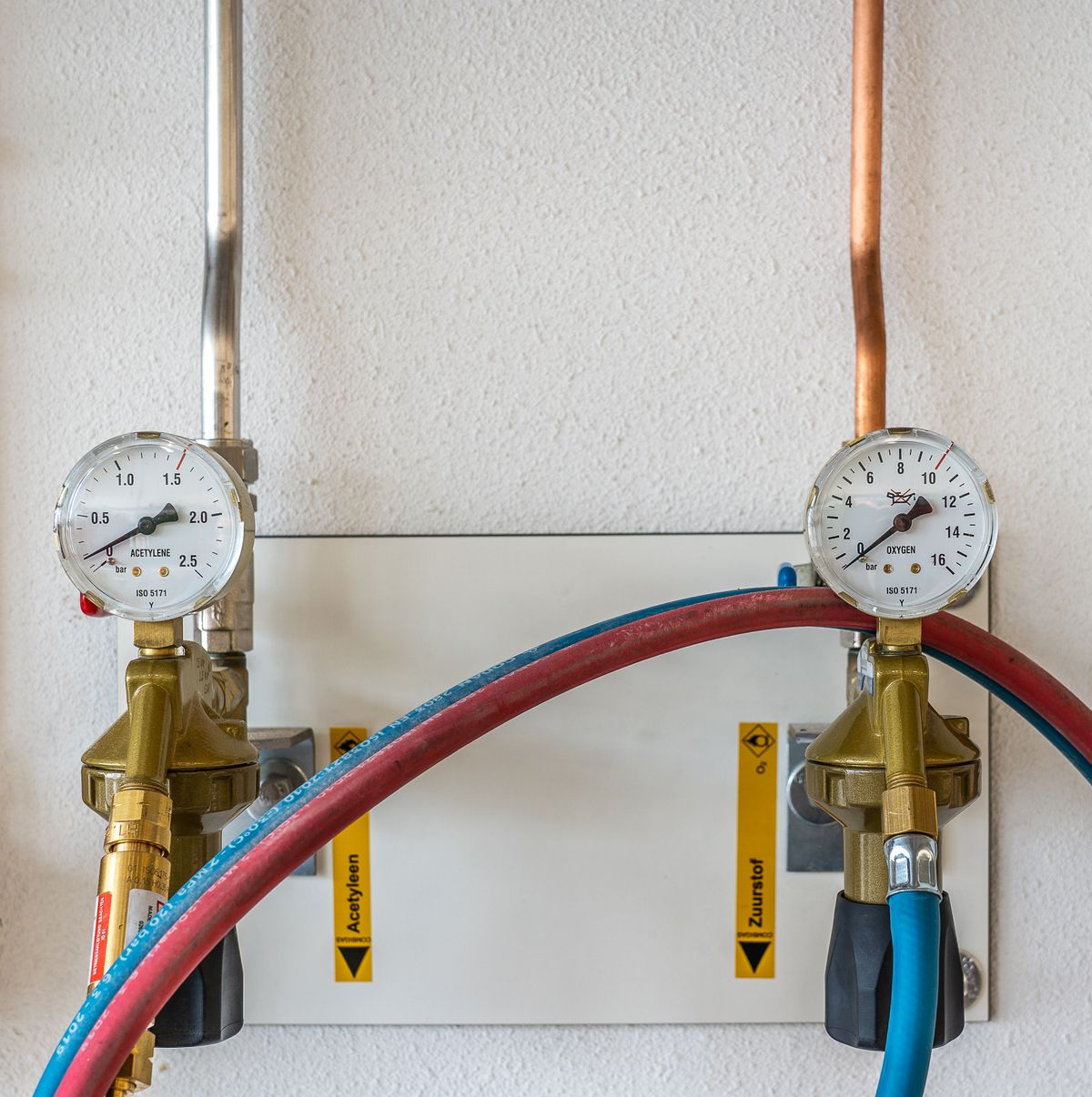
Feel at the tap is unreliable. Two readings — one before the softener, one after — turn the question into a number.
What you need. Two inexpensive pressure gauges with a 0–100 psi range and a way to connect them. The cleanest setup is a gauge on a hose-thread adapter at a hose bib before the softener, and another on a tee or test port after it. Many installers fit a test port or a hose bib on each side of the unit for exactly this reason. If yours has neither, a single gauge moved between a hose bib upstream and a laundry tap downstream gives a rougher but usable picture.
The procedure:
- Record static pressure with no water running anywhere. Both gauges should read the same. If they differ at zero flow, one gauge is wrong — swap them and recheck.
- Open one fixture fully downstream of the softener, such as a tub spout. Time how long it takes to fill a five-gallon bucket to get the flow in gpm. Read both gauges.
- Add a second fixture, time the combined flow if you can, and read both gauges again.
- Add a third — a second shower or the washing machine filling — and read again.
- Put the softener in bypass and repeat step 4. This isolates the softener from everything else in the house.
What healthy readings look like. Here is a worked example for a house with 60 psi static pressure and a softener rated 12 gpm at 15 psi, using the square-law scaling above. It is a calculation, not a field record — your readings will differ with gauge accuracy and plumbing — but the pattern is what matters:
| Flow | Gauge before softener | Gauge after softener | Drop across unit |
|---|---|---|---|
| 0 gpm (static) | 60 psi | 60 psi | 0 psi |
| 3 gpm | 58 psi | 57 psi | about 1 psi |
| 6 gpm | 55 psi | 51 psi | about 4 psi |
| 9 gpm | 52 psi | 44 psi | about 8 psi |
| 12 gpm | 48 psi | 33 psi | about 15 psi |
Notice that the before gauge also falls as flow rises. That is the supply pipe, meter and main valve losing pressure — nothing to do with the softener. Only the difference between the two gauges belongs to the unit.
Reading your results:
| What you see | What it means |
|---|---|
| Drop across the unit roughly matches the square-law estimate | Normal. The softener is working as designed |
| Drop is large even at 3 gpm | A fixed obstruction — debris, a partly closed valve, a kinked connector |
| Drop is fine at low flow but climbs steeply beyond your rating | Undersized for your peak demand |
| Drop has grown since the last time you measured | Fouling, fines or channeling in the resin bed |
| Before-gauge is already low and falling fast | The problem is upstream of the softener |
| Pressure is still low with the unit in bypass | Not the softener at all |
Keep the numbers. A dated note of the drop at 6 gpm is the single best early warning of a fouling bed. Measure again in a year and compare.
7 Causes of Low Water Pressure After Water Softener Installation
Once the gauge test says the loss is excessive, these are the causes, roughly in the order they turn up.
1. The bypass or an isolation valve is partly closed. The most common fault after any installation or service. Single-lever and push-pull bypass valves can sit between positions, and gate valves on the inlet and outlet are frequently left a turn or two short of fully open. The signature is a fixed restriction: a big drop even at low flow. Move each valve fully through its travel and back to the correct position. If a bypass has started weeping after being moved, see why a water softener bypass valve leaks.
2. Debris at the control valve inlet. Solder, PTFE tape, pipe shavings and loosened scale travel downstream after any plumbing work and lodge in the first narrow passage they meet. Pentair's Fleck 5600SXT service manual lists an inlet plugged by "foreign material broken loose from pipes by recent work done on plumbing system" among its troubleshooting causes, with removal of the piston and cleaning of the control as the correction. If pressure dropped immediately after the unit went in or after main-line work, suspect this first.
3. The system is undersized for peak flow. A softener chosen on grain capacity alone can be hydraulically too small for a large house. The gauge pattern is distinctive: fine at one or two fixtures, then a steep fall beyond the rated service flow. There is no repair for this — only a larger valve and tank, or accepting the loss at peak.
4. Iron or silt fouling of the resin bed. Iron that exceeds what the softener can handle coats the beads and cements the bed together; sediment fills the spaces between them. Both raise the drop gradually and usually degrade softening at the same time. The mechanism and the cleaning options are in what is water softener resin fouling.
5. Resin that has broken down into fines. Chlorinated city water slowly oxidises resin. The beads swell, soften and fragment, and the fragments pack into a dense mass that water struggles to pass. This is a long-term cause — typically in older units on municipal water — and the only fix is new resin.
6. A clogged sediment prefilter. If a cartridge filter sits ahead of the softener, it is part of the pressure budget. A loaded cartridge can cost more than the softener itself. Look at it before blaming the resin, and read whether you need a sediment prefilter before a softener for how often to change it.
7. A cracked distributor tube or failed bottom screen. When the distributor breaks, resin beads escape into the house plumbing and collect in aerators, showerheads and appliance inlet screens. The restriction then appears at fixtures rather than at the softener. Unscrew an aerator: small amber or brown beads confirm it. The full picture is in resin beads in household plumbing.
One non-fault that looks like a fault. Low pressure at night during a regeneration is expected. Most single-tank valves pass untreated water through a smaller internal bypass while the bed is backwashing and rinsing, and the drain flow competes for the same supply. If the unit is regenerating when the household is awake, fix the clock rather than the plumbing.
When the Softener Is Not the Problem

A new softener is the obvious suspect because it is the most recent change. It is frequently innocent.
Pressure is low in bypass too. Then look upstream: the main shutoff, the street supply, the pressure-reducing valve, the water meter, or the well system. On a well, check the pressure switch settings and the gauge on the pressure tank. A 30/50 switch will always feel weaker than city water at 70 psi, softener or not.
Only one fixture is weak. A softener restriction affects every fixture downstream of it. A single weak shower is a clogged showerhead or a failing cartridge. The same goes for a single low faucet: unscrew the aerator and look for scale or debris on the screen before suspecting anything upstream.
Only hot water is weak. The softener feeds hot and cold alike. A problem confined to hot water points at the water heater, its inlet dip tube, or a mixing valve.
The installer changed the pipe size. A softener loop plumbed in 1/2-inch pipe or with narrow push-fit fittings on a 1-inch main can cost more than the softener. So can long flexible connectors with small internal bores. The gauge test catches this: the "after" reading falls even with the unit in bypass, because the bypass sits inside the restrictive loop.
The drop began months after installation and softening still works. Look at the prefilter and at fixture aerators before the resin. Gradual restriction at the fixtures is common as scale that was already in the pipes loosens and travels.
The Limits of This Diagnosis
The gauge test tells you where pressure is lost, not always why. It cannot see inside the resin tank, distinguish iron fouling from fines without a look at the resin, or tell you whether a restriction is in the valve body or in the bypass. At that point you need to open the control valve, inspect the piston and seals, or pull a resin sample — work that is often worth handing over. The judgement call is laid out in when to call a water softener technician.
Two other honest limits. First, cheap gauges can disagree by two or three psi, so do not chase a one-psi difference. Second, the square-law estimate is an approximation; real resin beds and fittings do not follow it perfectly. Treat the table as a yardstick, not a specification.
Recovering Pressure, In Order
- Compare in service and in bypass at a single full-flow fixture.
- If bypass is also weak, the problem is upstream — stop here and look there.
- Find your unit's rated service flow at 15 psi drop on its data sheet.
- Fit gauges before and after and read them at one, two and three fixtures.
- Compare the measured drop to the square-law estimate for your rating.
- A large drop at low flow: open every valve fully, then check for inlet debris.
- A steep drop only at high flow: the unit is undersized for your peak demand.
- A drop that has grown over time: check the prefilter, then the resin for fouling or fines.
- Beads in aerators: stop, bypass, and have the distributor tube inspected.
- Write down the drop at 6 gpm and measure it again next year.
Low water pressure after water softener installation is only a fault when it is bigger than the engineering says it should be. A healthy softener costs a few psi at normal flows and a little more at peak, and nothing you do to it will ever make it add pressure. Measure first, compare against the rating, and you will know within an hour whether you need a wrench, a new resin bed, or simply a clearer idea of what normal looks like.
Frequently Asked Questions
Is it normal to lose water pressure after installing a water softener?
A small loss is normal. Water has to pass through the control valve and the resin bed, and both are restrictions. Residential softeners are commonly rated at a 15 psi drop at their maximum service flow, so at the modest flows a house actually uses most of the time the loss should be a few psi. You should barely notice it at a single tap. A drop you can clearly feel at a single shower, or one that appeared months after installation, is not normal and points to a fault.
How do I know if my water softener is causing low water pressure?
Put the softener in bypass and compare. If pressure recovers at the fixtures in bypass, the softener or its connections are the restriction. If pressure stays low in bypass, the problem is upstream: the main valve, a pressure-reducing valve, a clogged sediment filter, the well system or the street supply. For a precise answer, read a gauge before and after the unit while running a known flow.
Can a water softener increase water pressure?
No. A softener is a passive restriction with no pump, so it can only subtract pressure, never add it. People report stronger flow months after installing one because soft water stops new scale forming, and scale that was narrowing aerators, showerheads and valve cartridges gets replaced or cleaned. That is recovered flow at the fixture, not added pressure in the pipe.
Why is my water pressure low only during softener regeneration?
During regeneration the valve diverts water to the drain for backwash and rinse. Most single-tank valves send untreated water to the house through an internal bypass while this happens, but that internal passage is smaller than the service path and the drain flow is competing for the same supply. Lower pressure and hard water during a 2 a.m. regeneration is expected. It is only a problem if the unit is regenerating at a time people use water, which is a clock or programming issue.
Can a clogged resin bed cause low water pressure?
Yes. Iron fouling, silt, and resin that has broken down into fine fragments after years of chlorinated water all pack the bed tighter and raise the pressure drop through it. The pattern is gradual: pressure falls slowly over months, usually alongside softening performance. Fouling can sometimes be cleaned; broken-down resin has to be replaced.
What size water softener do I need to avoid pressure loss?
Size by peak flow as well as by grain capacity. Add up what can run at the same time — two showers, a washing machine, a kitchen tap — and choose a system whose service flow rating at 15 psi drop comfortably exceeds that number. A unit chosen only on grains per day can be too small hydraulically for a large house even when its capacity looks generous.