
On The Go Portable Water Softener Review: A Trip Planner for Real Campsite Water
This On The Go portable water softener review comes down to one number: the gallons you get between regenerations at the water you actually camp on. On The Go rates its 16,000-grain double at 640 to 1,600 gallons per regeneration, and that is true only if two boxes of table salt restore the full 16,000 grains. They restore closer to two-thirds. For two people using 40 gallons a day, that means a regeneration about every 28 days at 10 gpg, every 14 days at 20 gpg and every 9 days at 30 gpg. With no power, no tools and a one-year warranty, it is a sound RV softener. Just plan your trip on the adjusted numbers, not the box.
Disclosure: Hard Water Solved may earn a commission if you buy through links on this page, at no extra cost to you. It does not change which products we include or how we rank them. Read our disclaimer.
On The Go Portable Water Softener Review: The Verdict in Brief
- What it is: a 22-inch, 32 lb tank of softening resin with garden-hose fittings that sits between the campground spigot and your RV's fresh-water inlet.
- What it does well: softens the water heading for your water heater and fixtures at up to 3 gpm, with no electricity, and regenerates with grocery-store salt.
- Limit 1, capacity: the 640 to 1,600 gallon range is a ceiling. Two boxes of salt give back roughly 11,100 of the 16,000 grains.
- Limit 2, time: the listing says regeneration takes less than 30 minutes. The maker's own rinse times for the double add up to 30 to 38 minutes before you drain, add salt or test.
- Limit 3, cover: one year of warranty, voided by alterations such as fitting it to a shower.
How this review was built. Nothing here was physically tested. The evidence is On The Go's product pages, its setup, regeneration, back-flush, storage and warranty pages, the Amazon listings, and a trip planner built from published resin performance at a stated salt dose. Prices are not listed here because they change often. Use the buttons to see the current price on Amazon.
What You Get for the Money
On The Go sells the double in three forms that matter to buyers. All three use the same 16,000-grain tank.
| Version | What differs | Amazon |
|---|---|---|
| Double Standard, OTG4-DBLSOFT | Plastic hose adapters | Check price on Amazon |
| Double Standard (Brass), OTG4-VM-DBLSOFT | Brass inlet and outlet hose adapters | Check price on Amazon |
| Double Softener and Salt Regeneration Kit | Adds a 10 x 2.5 in housing with carbon cartridge, salt dispenser basket, stand and 4 ft hose | Check price on Amazon |
The maker's product page lists the core specification: 16,000 grains, 0.52 cubic feet of resin, 3 gpm, 22 inches tall by 9.5 inches across and 32 lb. In the box are hardness test strips, inlet and outlet caps, a carrying handle, hose adapters, a back-flush adapter, a 4-foot white drinking-water hose and a base cradle that keeps it level on uneven ground. The Amazon listing adds that it is assembled in Indiana.
The brass version's Amazon title calls the fittings "drinking water safe". On The Go's own page for it makes no lead-free or certification claim. If that matters to you, ask the seller for the fitting specification.
The 640 to 1,600 Gallon Range, Decoded
On The Go's capacity figures are simple arithmetic: 16,000 grains divided by the hardness of the water. Its table for the double reads:
| Water hardness | Gallons per regeneration (maker) |
|---|---|
| 5 gpg | 3,200 |
| 7 gpg | 2,285 |
| 11 gpg | 1,454 |
| 15 gpg | 1,066 |
| 25 gpg | 640 |
| 58 gpg | 275 |
The headline "640 to 1,600 gallons" is the 25 gpg row and a 10 gpg figure. Both assume every regeneration puts back all 16,000 grains.
That is unlikely on two boxes of salt. Two 26 oz boxes are about 3.25 lb of salt on 0.52 cubic feet of resin, roughly 6.25 lb per cubic foot. At that dose, standard softener resin restores about 21,000 grains per cubic foot, which is why the guide to advertised vs usable softener capacity treats any box rating as a ceiling. On 0.52 cubic feet that comes to about 11,100 grains, so plan on roughly 1,110 gallons at 10 gpg, 555 at 20 gpg and 370 at 30 gpg.
The maker's own frequency guide even hints at the gap. It says that if you leave regeneration too long, the strips "will not test between 0-3 GPG at the output" after you regenerate, and it prescribes a special regeneration with double the salt and double the rinse time. More salt restores more capacity. A third box gets you closer to the table.
Trip Planner: Days Between Regenerations for Two People
Hardness changes from park to park, so plan for the hardest stop on the route. The table uses 40 gallons a day for two people on a full hookup, and 60 gallons a day for two people who shower daily and run a washer.
| Campsite hardness | Gallons, maker | Gallons, salt-adjusted | Days at 40 gal/day, maker | Days at 40 gal/day, adjusted | Days at 60 gal/day, adjusted |
|---|---|---|---|---|---|
| 10 gpg | 1,600 | ~1,110 | 40 | ~28 | ~18 |
| 20 gpg | 800 | ~555 | 20 | ~14 | ~9 |
| 30 gpg | 533 | ~370 | 13 | ~9 | ~6 |
Adjusted figures are illustrative, based on about 11,100 grains restored by two boxes of table salt. Your result depends on resin condition and how evenly the salt dissolves.
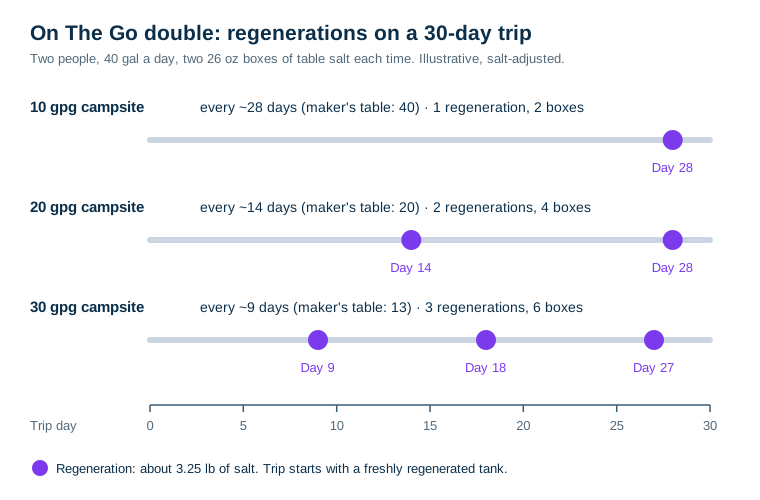
The practical reading:
- Soft to moderate water, 10 gpg or less. One regeneration covers a two-week trip easily, and usually a month.
- Typical hard-water parks, about 20 gpg. Plan one regeneration in the middle of a two-week trip.
- Very hard sites, 30 gpg and up. Expect to regenerate every week or so, and carry salt for it.
Test before you trust a park's description. The strips in the box take a minute. If you want a better reading, the comparison of hardness test strips vs drop test kits explains which to carry. Test the softener's output, too: when it climbs above 3 gpg, it is time to regenerate, whatever the planner says.

Salt Cost per Trip
Each regeneration of the double takes two full 26 oz boxes of iodised or non-iodised table salt, according to the maker's regeneration instructions. The salt bill is small, but it scales with hardness, and the boxes take up pantry space.
| 30-day trip, two people | Regenerations | Boxes of table salt | Or pellets in the regeneration kit |
|---|---|---|---|
| 10 gpg | 1 | 2 | about 3.25 lb |
| 20 gpg | 2 | 4 | about 6.5 lb |
| 30 gpg | 3 | 6 | about 9.75 lb |
Illustrative. The pellet column assumes the same 3.25 lb per regeneration as two 26 oz boxes, which On The Go does not state for the kit. Pellets bought by the 40 lb bag cost far less per pound than boxed table salt.
Either way, salt is a rounding error next to the price of the unit. The real cost of hard water on the road is scale in the water heater, which is what the softener is protecting.
Potassium chloride also works. On The Go says it "works in softeners the same way sodium chloride does", but it costs more and is less efficient, so you may need to regenerate more often.
Setup and Regeneration Time, by the Maker's Own Numbers
Setup is quick. Turn off the spigot, connect the source hose to the softener's inlet, stand it upright, and flush to a drain for 4 to 6 minutes before connecting the outlet to the RV. The maker says the resin needs no salt or regeneration before first use.
Regeneration takes longer than the listing suggests. The Amazon copy says the double "regenerates with 2 boxes of common table salt in less than 30 minutes". The maker's step-by-step instructions give these times for the double:
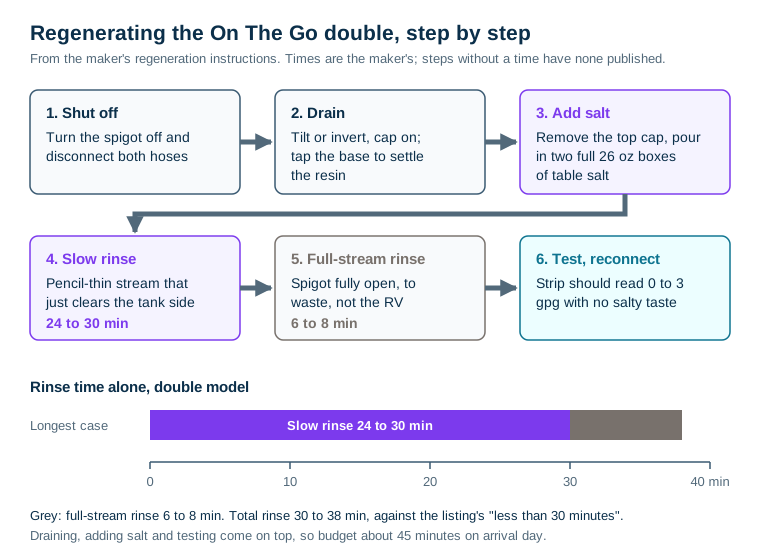
The slow rinse is the step that matters. The instructions call for a "pencil-stream" flow that should "just clear the side of the tank", which gives the brine time in contact with the resin. Rushing it with a full stream sends the salt to waste before it has done its job. The maker also warns, in capitals, not to dump the resin out of the tank when draining.
Plan regeneration for arrival day, when you are hooked up and have an hour, not for the morning you pull out.
Two other routine jobs:
- Back-flush every three months for 5 to 10 minutes on the double, using the female-to-female adapter on the outlet. It lifts sediment out of the resin.
- Watch for resin beads in the RV's faucet strainers. On The Go's FAQ says beads leave the tank when the distribution tube inside it is damaged or cracked, and the fix is a replacement tube.
Which Version Is Worth Buying
The standard double is the value pick. It has everything the softener needs.
The brass version cost only a few dollars more at On The Go when we checked. Brass adapters are harder to cross-thread or crack at a spigot you connect to every few days. That is worth a small premium. Check that an Amazon seller is not charging much more than the maker.
The regeneration-kit bundle changes how you regenerate. Salt sits in a dispenser basket inside a filter housing, so the resin never contacts the salt directly, and the basket accepts table salt or softener pellets. The kit also adds a carbon cartridge for taste and odour. If you regenerate often on hard water, pellets bought by the 40 lb bag make the kit pay back slowly. If you camp mostly on moderate water, the extra cost buys convenience, not savings.
If you travel solo with limited storage, On The Go's 8,000-grain standard model is about half the size. It also needs regenerating twice as often.
Living With It: Storage, Freezing, Resin Life and Warranty
Storage. Before laying the unit up, the maker's storage instructions say to back-flush, regenerate and drain the water out, without dumping the resin. After storage, the maker sanitises with its Sani-System solution: two gallons of mixed solution for the double, left for no more than 60 seconds, then a full 10-minute flush and a regeneration.
Freezing. On The Go says freezing temperatures "could cause the tank or distribution tube to crack". Drain it, or keep it in an insulated box with heat tape if you camp in the cold.
Resin life. The maker's FAQ says the resin "is good for 7 to 10 years". Chlorinated park water and iron shorten that, as with any softener.
Warranty. On The Go's warranty covers defects in materials and workmanship for one year from purchase, when bought from an authorised dealer. It excludes misuse, negligence, lack of maintenance and "repairs or alterations outside our facility". The Amazon listing says that breaking the head while changing fittings to install it on a shower is not covered, and that the unit is not made for showers or for under a kitchen sink.
How It Compares With the Flow-Pur RV-Pro 10,000
The other name RVers compare is the Flow-Pur RV-Pro 10,000 (M7002). It is a 10,000-grain unit, 20.25 inches tall and 24 lb, with garden-hose connections and a multi-port drain valve, and it also regenerates with table salt. On 2 October 2026 one outdoor retailer listed it but was sold out, and we could not confirm current stock elsewhere.
On paper the comparison is short. The On The Go double holds 16,000 grains against 10,000, so it goes about 60 percent longer between regenerations, and it cost less at its maker's sale price when we checked. The RV-Pro is lighter and slightly shorter. Unless storage is the deciding factor, the double is the better buy, and that is before availability.
Who the On The Go Softener Is Wrong For
- Anyone living on one site for months. At household water use it needs salt every few days. A small installed softener costs less to run. The trade-offs, including rented exchange tanks, are in portable exchange tank vs installed softener.
- Households that want it on a house shower or under a sink. The maker says it is not made for that, and the warranty does not cover refitting it.
- Campers who mostly stay at soft-water parks. Below about 3 or 4 gpg there is nothing to soften.
- Sites with iron, a sulfur smell or cloudy water. A small resin bed fouls quickly. Filter first, or skip softening at that stop.
- Anyone hoping a softener will remove chlorine or contaminants. It removes hardness. The carbon cartridge in the kit helps with taste, and salt-free "conditioners" do something different again, as explained in salt-based vs salt-free water treatment.
For everyone else, the On The Go double does its one job well. Buy the standard or the brass version, and plan your regenerations on about 555 gallons at 20 gpg, not 800. Carry two spare boxes of salt in the bay.
Frequently Asked Questions
How many gallons does an On The Go water softener make?
On The Go rates the 16,000-grain double at 640 to 1,600 gallons per regeneration, which is 16,000 divided by water hardness of 25 down to 10 gpg. Its own table runs from 3,200 gallons at 5 gpg to 275 gallons at 58 gpg. Those figures assume the full 16,000 grains come back each time. On two boxes of table salt, a realistic estimate is about two-thirds of that: roughly 1,110 gallons at 10 gpg and 555 at 20 gpg.
How long does the On The Go double last between regenerations?
For two people using about 40 gallons a day, roughly four weeks at 10 gpg, two weeks at 20 gpg and nine days at 30 gpg on our salt-adjusted estimate. The maker's own table gives 40, 20 and 13 days for the same water. Heavier users at 60 gallons a day get about a third less time. Check the output with a hardness strip and regenerate when it climbs above 3 gpg.
How long does it take to regenerate an On The Go portable softener?
The Amazon listing says less than 30 minutes, but the maker's regeneration instructions give a slow rinse of 24 to 30 minutes and a full-stream rinse of 6 to 8 minutes for the double, so the rinses alone take 30 to 38 minutes. Add draining, pouring in two boxes of salt and testing, and about 45 minutes is a safer plan.
What is the warranty on an On The Go water softener?
One year from the date of purchase against defects in materials and workmanship, when bought from an authorised dealer. The warranty excludes misuse, lack of maintenance and repairs or alterations made outside On The Go's facility, and the Amazon listing says changing the fittings to install the unit on a shower is not covered. The maker says the resin itself lasts 7 to 10 years.
Can you use water softener salt pellets instead of table salt?
Not in the tank itself, which is designed around boxes of table salt poured through the top. The On The Go salt regeneration kit, sold separately and in a bundle with the double, holds salt in a dispenser basket and accepts either table salt or softener pellets, so the resin never touches the salt directly. Pellets cost far less per pound than boxed table salt.
