
One Softener for Multiple Units: Duplex and Apartments

Yes, one water softener can serve a duplex or a small apartment building, provided every unit is fed from a supply line you can route through it. The mistake is sizing it as one house multiplied by the number of units. Grain capacity does scale with the number of people. Peak flow does not: two typical units need about 17.8 gpm at peak, not 25. The bigger risks are usually not technical. Salt, access and tenant turnover need settling before the softener goes in.
This page works the sizing both ways, flow and capacity, for 1 to 8 identical units, checks the answers against a real manufacturer's rating table, and then covers the arrangements that decide whether a shared softener keeps working.
Why Peak Flow Does Not Add Up Unit by Unit
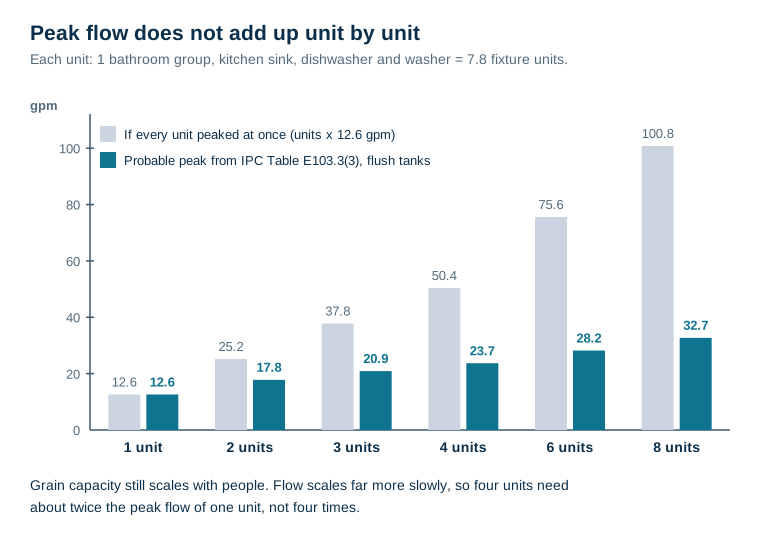
Every household has a busy moment, a shower running while the washer fills and someone uses the kitchen tap. Put four households on one pipe and their busy moments rarely line up. Engineers call this the diversity factor: the more fixtures a system has, the smaller the share of them likely to run at once.
Plumbing codes build this in. The International Plumbing Code gives each fixture a water supply fixture unit (WSFU) value, and then converts the building's total into a probable peak flow with a demand table. The values below are from IPC Appendix E, Tables E103.3(2) and E103.3(3), for systems with flush-tank toilets. Check which edition your state adopted before relying on it for pipe sizing.
A typical small apartment has one bathroom group (toilet, lavatory and tub or shower) at 3.6 WSFU, a kitchen sink at 1.4, a dishwasher at 1.4 and a clothes washer at 1.4. That is 7.8 WSFU per unit.
| Units | Total WSFU | Probable peak (code) | One unit's peak x units | Ratio |
|---|---|---|---|---|
| 1 | 7.8 | 12.6 gpm | 12.6 gpm | 100% |
| 2 (duplex) | 15.6 | 17.8 gpm | 25.2 gpm | 71% |
| 3 | 23.4 | 20.9 gpm | 37.8 gpm | 55% |
| 4 (fourplex) | 31.2 | 23.7 gpm | 50.4 gpm | 47% |
| 6 | 46.8 | 28.2 gpm | 75.6 gpm | 37% |
| 8 | 62.4 | 32.7 gpm | 100.8 gpm | 32% |
Probable peaks are interpolated from the code's demand table. The same curve is used for a single house in grain capacity vs peak flow rate. Here it is extended to a whole building.
Two cautions:
- The code figure is an upper bound. The method dates from before low-flow fixtures and is generally regarded as conservative. It is the right number for "will the building choke at its worst moment", not for everyday use.
- Shared laundry changes the count. If the building has a laundry room instead of washers in each unit, take the washers out of the unit count and add the laundry room's machines once.
Why Capacity Does Add Up
The softener's grain capacity is a different question. It depends on how much water passes through it in a day, and daily use scales directly with people. Four households of two use about four times the water of one household of two, whatever their busy moments do.
Using the Water Research Foundation's measured average of 58.6 indoor gallons per person per day, explained in how to calculate the right water softener size, and 15 grains per gallon of hardness:
| Building | People | Gallons a day | Grains a day | Salt a year at 3,822 grains/lb |
|---|---|---|---|---|
| Duplex | 4 | 234 | about 3,500 | about 335 lb |
| Fourplex | 8 | 469 | about 7,000 | about 670 lb |
| 8 units | 16 | 938 | about 14,100 | about 1,340 lb |
That is the whole of the multi-unit sizing problem. Capacity scales with people. Peak flow scales far more slowly. A softener picked from a capacity chart for "four households" can be big enough on grains and still too small on flow, or be picked on flow and far too big on grains.
Sizing One Water Softener for a Duplex or Small Building
Size each number separately, then choose a unit that passes both.
- Count people across all units. Use full occupancy, not today's tenants. A vacant unit will not stay vacant.
- Daily grain load = people x gallons per person x compensated hardness in gpg. Add iron compensation if the supply has iron.
- Capacity needed = daily load x days between regenerations, plus one day's reserve. Aim for 4 to 7 days between regenerations.
- Total WSFU = sum of every fixture the softener feeds. Leave out outdoor taps if they bypass it.
- Probable peak = the code demand table value for that total.
- Practical peak = what really runs together at the building's busiest time. Count showers at 2.0 to 2.5 gpm, a filling washer at about 3 gpm and a kitchen tap at about 1.5 gpm.
- Choose a unit whose rated service flow covers the practical peak comfortably and is close to the code figure at no more than 15 psi pressure drop. Then set its salt dose so it still regenerates within about a week.
Worked example: a duplex
Four people, 15 gpg. Daily load about 3,500 grains. Five days plus a day's reserve comes to about 21,000 grains.
The Hellenbrand ProMate 6.0 manual lists its 1 cubic foot model at 22,930 grains on the low salt setting, 6 pounds of salt. Capacity passes.
Flow is the check that fails. The same table rates that model at 13.0 gpm at a 15 psi drop. A practical duplex peak is two showers, a washer and a kitchen tap, about 8.5 gpm, and that passes. The code estimate of 17.8 gpm does not. The 2 cubic foot model is rated at 18.2 gpm, which covers it. Run the bigger unit on its efficient salt setting, 27,904 grains, and it regenerates about every 8 days. That is a little long, so set a 7-day day override. The duplex needs the bigger softener for flow, not for grains.
Worked example: a fourplex
Eight people, 15 gpg. Daily load about 7,000 grains. The 2 cubic foot model at low salt, 45,860 grains, runs about 6.5 days. Capacity passes.
The code peak is 23.7 gpm. In the Hellenbrand table the largest single-tank residential model, 6 cubic feet, is rated at 23.1 gpm at 15 psi, and the 2 cubic foot unit at 18.2. A practical fourplex peak, say four showers, two washers and two kitchen taps, is about 17 gpm. That fits the 2 cubic foot unit, but with little margin. At this size the options are:
- a softener with a larger commercial valve, such as 1.5 inch, rated for the code peak
- two softeners in parallel, each carrying half the flow
- one softener per pair of units, if the plumbing already splits that way
Beyond about four units, bring in a water treatment dealer who designs commercial systems, and ask your local permit office whether the work counts as residential or commercial. The arithmetic is the same, but the equipment moves out of the residential range.
Regeneration With Several Households on One Softener
A single-tank softener cannot soften while it regenerates. Most valves pass untreated water to the building during the cycle, which is routine for a single-tank valve. In one house you schedule regeneration for 2 a.m. and nobody notices. In a building, someone works nights, someone showers at 5 a.m., and a shift worker's washing machine runs at 2 a.m.
The fixes, in order of cost:
- Pick the quietest real hour and tell tenants, so hard water during regeneration is expected rather than reported as a fault.
- Use a metered valve, never a timer. A meter regenerates only when the building has used the capacity, which also handles changes in occupancy on its own. A timer set for a full building wastes salt whenever a unit is empty.
- Use a twin-alternating softener, which keeps one tank in service at all times. The trade-offs are in single-tank vs twin-tank water softeners.
Salt, Access and Turnover: The Problems That Derail These Installs
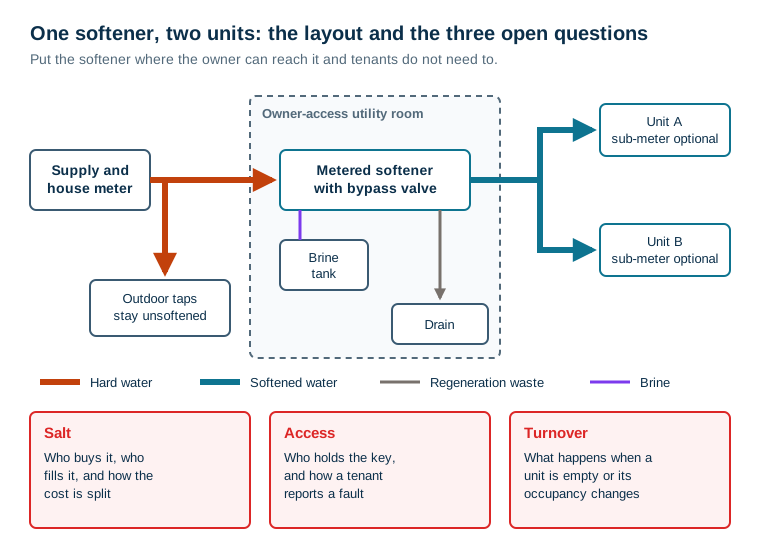
The plumbing for a shared softener is simple. The supply comes in through one meter. Outdoor taps are teed off before the softener. The softener sits in a room the owner controls, and the softened line splits to each unit. What goes wrong is almost always an arrangement nobody made.
Salt: who buys it, who fills it and who pays. A shared softener that runs out of salt stops softening for every tenant at once. The workable options are:
| Arrangement | How it works | Watch for |
|---|---|---|
| Owner supplies salt, built into rent | The owner or a service company fills it on a schedule | The simplest to run. The owner carries the cost of heavy users |
| Split by occupants | Salt cost divided per person or per unit | Needs a written formula and updating when occupancy changes |
| Split by sub-metered water | Sub-meters after the softener, cost shared by gallons | Rules on billing tenants for utilities vary by state and city. Check before billing |
| Salt delivery service | A dealer fills it and bills the owner | Adds cost. Good for owners who do not live on site |
Access: who holds the key. The softener belongs in a space the owner can reach without entering a unit, such as a basement mechanical room, a garage or a locked closet. If it sits inside one tenant's unit, the owner needs that tenant's cooperation, and notice under the lease, for every salt fill and repair. The other tenants then depend on one household for their soft water. Give tenants a way to report a fault, since they will notice hard water or low pressure before you do.
Turnover: what happens between tenants. A metered valve adjusts itself when occupancy changes. A timer does not, so a timer set for a full building keeps regenerating for tenants who have left. During a vacancy, check the salt level at the unit inspection. When the building's occupancy changes a lot, check that the regeneration interval still makes sense. Each tenant's lease should say that the softener is building equipment, and that tenants must not adjust or bypass it. How those responsibilities are usually divided is covered in water softeners in rental properties.
One Shared Softener or One per Unit
| Factor | One shared softener | One per unit |
|---|---|---|
| Equipment cost | One unit, one installation | One unit per dwelling |
| Plumbing needed | Every unit fed from one line through the softener | Works where units already have separate service lines |
| Salt and running cost | One bill to split | Each household pays its own |
| A fault or an empty salt tank | Affects everyone | Affects one unit |
| Access | Owner-controlled room | Usually inside each unit |
| Sizing | Diversity helps flow sizing | Each unit sized as a small home |
| Tenant-set salt levels | No | Possible, which varies results |
Where the units share one service line and one meter, a shared softener is usually the cheaper and tidier choice. Where each unit already has its own meter and service line, separate softeners avoid the cost-sharing question entirely.
What a Shared Softener Cannot Do
- It cannot soften water it does not see. Any unit or fixture fed from a separate line, such as a separately metered unit or a line teed off before the softener, stays hard.
- It cannot avoid regeneration downtime unless it is a twin-tank unit.
- It does not treat anything except hardness and a little dissolved iron. It does not deal with lead from old service lines, bacteria or nitrate, and it is not a substitute for testing a well that serves several households.
- It cannot settle a dispute. The lease has to do that.
Get the hardness figure and a count of fixtures and people. Run the capacity and flow checks separately, choose a metered unit that passes both, and put the salt, access and turnover arrangements in writing before the first tenant moves in.
Frequently Asked Questions
Can one water softener serve two houses or a duplex?
Yes, if both units are fed from one supply line that you can route through the softener. Size grain capacity on the total number of people, and size flow on the combined probable peak, which for two typical units is about 17.8 gpm rather than double one unit's 12.6 gpm. Then agree who pays for salt, who has access and who handles faults.
What size water softener do I need for a duplex?
Work it out from hardness and people rather than a chart. Four people at 58.6 gallons a day and 15 gpg need about 3,500 grains a day, which a 1 cubic foot unit covers. Flow is the tighter check: the code estimate for two one-bath units is about 17.8 gpm, which points to a 2 cubic foot unit or a larger valve even though capacity alone would not.
Is it better to have one softener per unit?
Separate softeners keep salt, costs and faults with each tenant and make each unit's water independent. One shared softener costs less to buy and maintain and keeps equipment out of tenants' spaces, but it needs a shared supply line, owner access and an agreed way to split the salt cost. Separate units are usually simpler when the units already have separate water service lines and meters.
Who pays for salt with a shared softener?
Whoever the lease says. The cleanest arrangements are the owner buying salt and building it into rent, or a written split by occupants or by sub-metered water use. Put it in writing before tenants move in, because a shared softener that nobody refills stops softening for everyone.
Does a shared softener need a twin-tank unit?
Not always, but it helps. A single-tank softener usually sends unsoftened water to the building while it regenerates, which is easy to schedule in one house and harder with several households on different hours. A twin-alternating unit keeps one tank in service at all times.
How much salt will a shared softener use?
At 15 gpg with four units of two people each, the daily load is about 7,000 grains. At a salt efficiency of about 3,800 grains per pound, that is roughly 670 pounds a year. Your number moves with hardness, water use and the salt setting.
