
Water Softeners in Rentals: Landlord and Tenant
In a water softener rental property arrangement, the usual split is simple. The tenant keeps the salt topped up, the landlord repairs and replaces a softener the landlord supplied, and a tenant needs written consent before plumbing one in. The awkward part is move-out. A softener a tenant has permanently plumbed in can be treated as a fixture that stays with the property unless both sides agreed otherwise in writing.
This page covers both sides of the same relationship, because most disputes come from the two sides assuming different things. It is general information, not legal advice. Landlord-tenant law is set by each state, and sometimes by city ordinance, and your lease can change the defaults described here. Where it matters, check with your state's consumer protection office or a local attorney.
The Usual Split for a Water Softener in a Rental Property
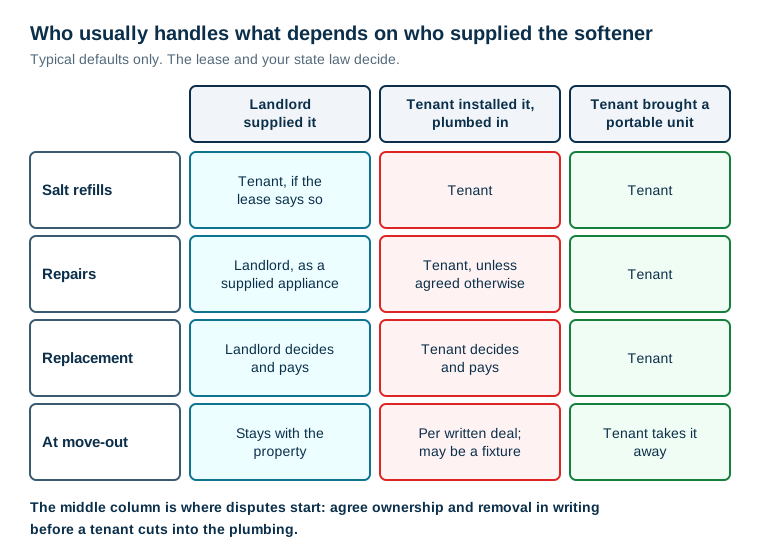
The first question is always the same: who supplied the softener? Most of the other answers follow from that.
If the landlord supplied it, it is part of the rental, like a water heater or a dishwasher that came with the unit. Many state handbooks treat supplied appliances the same way. The Georgia Landlord-Tenant Handbook, published by the state, says a landlord must keep plumbing in working order. It says landlords are not responsible for appliances, except that a landlord who provides them is responsible for repairing them. A softener the landlord installed falls in that "provided" category.
If the tenant supplied it, it is the tenant's equipment. The tenant maintains and repairs it, and the landlord is responsible only for the house plumbing it connects to.
Salt sits between the two. It is a consumable, like light bulbs or a furnace filter, and most leases that mention it make it the tenant's job. If the lease says nothing, do not assume. Ask in writing.
Here is the typical pattern in one table.
| Task | Landlord supplied the softener | Tenant installed it, plumbed in | Tenant's portable unit |
|---|---|---|---|
| Salt refills | Tenant, if the lease says so | Tenant | Tenant |
| Hardness settings, clock | Landlord sets up; tenant resets clock after an outage | Tenant | Tenant |
| Repairs | Landlord | Tenant, unless agreed otherwise | Tenant |
| Replacement | Landlord decides and pays | Tenant decides and pays | Tenant |
| Damage caused by the softener | Depends on cause; landlord's equipment | Tenant's equipment, tenant's exposure | Tenant |
| At move-out | Stays with the property | Per the written agreement; may be a fixture | Tenant takes it |
One grey area is a failure caused by neglect. If the lease made salt the tenant's job and the softener was run dry for months until the resin fouled with iron, a landlord may argue the damage was caused by the tenant rather than by normal wear. Age, a worn seal or a failed circuit board is ordinary wear. Keep a note of salt top-ups. It is the evidence either way.
For Landlords: Supplying and Running a Softener
A softener protects things the landlord owns: the water heater, fixtures, and supplied appliances like the dishwasher. In hard-water areas, that can justify putting one in. It also adds a maintenance item that you depend on the tenant to feed.
Set it up so the tenant's part is as small as possible:
- Choose a metered valve, not a timer. A metered softener adjusts to how many people actually live there. A timer set for a family of five wastes salt for a single tenant, and a timer set for one person runs out of capacity for a family.
- Program it yourself for the actual hardness, and write the settings on a label on the valve.
- Put a one-page guide beside it covering what salt to buy, how full to keep the brine tank, where the bypass valve is and who to call.
- Write the split into the lease: who buys salt, how often to check it, how to report a problem, and whether you or your contractor need access for service.
- Keep the outdoor taps on hard water. It saves salt and keeps softened water off the lawn.
- Check it at every unit inspection and turnover. Look at the salt level, check for leaks and test a softened tap. A salt bridge or an empty tank is easy to fix before it becomes a hardness complaint.
If you would rather not own the unit at all, a dealer rental moves repairs onto the dealer; what a Culligan rental costs each month and what the agreement covers shows when that beats buying.
In a multi-unit building, a single shared softener changes the arrangement. The owner usually buys the salt, and the softener lives in an owner-access room. That setup, and how to size it, is covered in one softener for multiple units.
For Tenants: What You May Install
The general rule is that a tenant cannot substantially or permanently alter the rental without the landlord's consent. The Georgia handbook puts it that way, and adds that a tenant must return the premises in the same condition as when received, apart from normal wear and tear. Cutting into the main water line, adding a bypass loop and running a drain line is a permanent alteration by any reading.
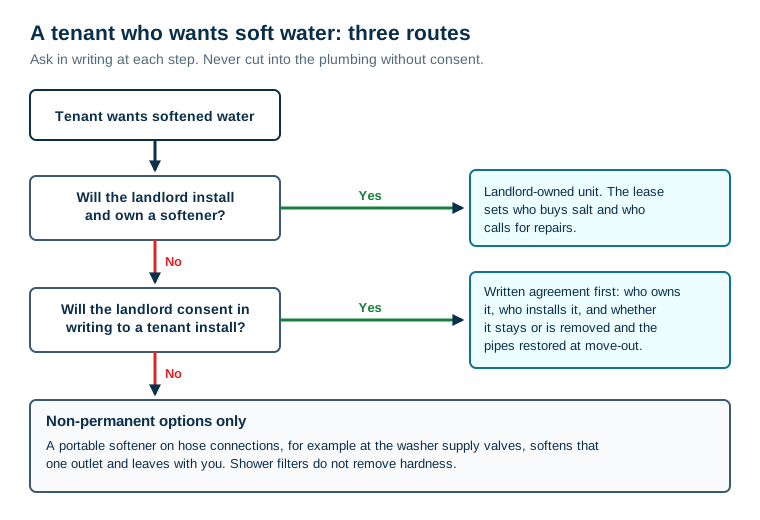
That leaves three routes.
1. Ask the landlord to install one. It is the simplest route, because the softener becomes the landlord's appliance and the landlord's repair. Point out that it protects the water heater and fixtures they own. Some landlords will split the cost or raise the rent slightly.
2. Get written consent to install your own. If the landlord agrees to a tenant installation, get it in writing, and make sure the agreement answers four questions:
- Who owns the softener? Spell out that it remains the tenant's property.
- Who installs it? Many landlords will require a licensed plumber, and a permit where your city requires one.
- What happens at move-out? Either it stays, with or without payment, or the tenant removes it and restores the plumbing, typically by fitting a straight pipe where the loop was. Say which.
- Who is responsible if it leaks? Discuss insurance and whether your renter's policy covers damage from your own equipment.
3. Use a non-permanent option. If the landlord says no, or you do not want the cost of a plumbed installation you will leave behind, stay with things that connect without cutting pipe. These are covered in the next section.
The condo or apartment version of this question has one more layer, the association's rules on top of the lease. That is covered in water softeners in condos, apartments and HOA properties.
Non-Permanent Alternatives a Tenant Can Take Along
Honesty first: nothing that avoids the plumbing softens the whole house. A whole-house softener has to sit on the main supply line, and that means a plumbing change. What a tenant can do without one is soften particular outlets.
| Option | What it does | Limits |
|---|---|---|
| Portable softener on hose connections | A small cation exchange softener, of the kind sold for RVs, connected with hoses, for example between the washing machine supply valves and the washer | Softens only that outlet. Regenerated by hand with table salt. Needs somewhere to drain the rinse |
| Portable exchange tank service | A dealer swaps a pre-charged tank on a schedule, so there is no brine and no drain | Still needs a connection to the supply line, so it needs consent unless a loop already exists. Costs compared in portable exchange tank vs installed softener |
| Using an existing softener loop | Some rentals already have a loop with a bypass from an earlier softener | Connecting to an existing loop is far less invasive, but still ask first |
| Shower filter | Removes chlorine, sometimes sediment | Does not remove hardness. It is not a softener |
| Descaling routine | Vinegar or citric acid on showerheads, kettles and aerators | Treats the symptom; hardness stays |
If washing is the main complaint, the washer hose connection is often the most useful single spot. Laundry and detergent use benefit most from soft water, and the connection is standard. If the drinking water is the complaint, a plug-in countertop reverse osmosis unit treats it with no plumbing and leaves with you; comparing countertop RO units for renters covers what each certification covers and what the filters cost. If the complaint is spotting and scale everywhere, only a whole-house unit fixes it, which means routes 1 or 2, and compact softeners scored for renters shows what fits.
The Fixture Question at Move-Out

This is where most softener disputes happen, and it is why the written agreement matters.
In property law, something permanently attached to a building can become a fixture, which is treated as part of the property rather than as the tenant's belongings. A softener plumbed into the main supply line, with a drain line and a bypass valve, is attached in a way a portable unit is not. Without an agreement, a landlord may argue that it stays. And if a tenant removes it, the tenant has to leave the plumbing in working condition, not with capped, open or leaking pipes where the loop was.
How a particular state treats tenant-installed equipment varies, and so do the tests courts use. General points that hold up well:
- An agreement beats the default. A written note saying "tenant-owned softener; tenant will remove it and restore the line with a straight connection at move-out" answers the question before it is asked.
- Removal must leave working plumbing. Budget for a plumber to install a straight pipe or a jumper at the loop.
- Unauthorised alterations are risky for the tenant. If a softener was installed without consent, the landlord may treat the change as damage to be restored at the tenant's cost, or claim the improvement stays.
- Take photographs of the plumbing before installation and after removal.
For landlords, the same logic runs the other way. If you want a tenant's softener to stay, agree a price in writing. It is not automatically yours.
Lease Wording Checklist
Neither side should rely on the lease being silent. A short softener clause covers most of it. As a starting point to adapt with your own attorney or state rules:
- Ownership: whose softener it is.
- Salt: who buys it, what type, how full to keep the brine tank.
- Access: how much notice the landlord gives before servicing it.
- Reporting: that the tenant reports leaks, error codes or hard water promptly and in writing. The Georgia handbook, for example, stresses written notice of repair problems.
- Settings: that the tenant does not change hardness or salt settings without asking, apart from resetting the clock.
- Move-out: whether the softener stays or is removed, and the condition the plumbing must be left in.
- Damage: who pays if the softener leaks, and that neglect of agreed duties is not normal wear.
What a Rental Softener Arrangement Cannot Do
- It cannot override the law. A lease clause that conflicts with a state's rules on repairs or habitability may not hold. This page is not legal advice.
- A softener does not fix unsafe water. It removes hardness and a little dissolved iron. It does not treat lead, bacteria or nitrate. If a tenant is worried about water safety, that is a question for the landlord and the local water utility or health department, not for a softener.
- A portable unit is not whole-house softening. It helps one outlet.
- Salt duties only work if someone checks. The best lease clause fails if nobody looks in the brine tank.
Before anything is installed, answer one question in writing: who owns this softener, and does it stay when the tenant leaves? Most of the other arrangements follow from that answer.
Frequently Asked Questions
Is the landlord responsible for the water softener?
Usually for repairs, if the landlord supplied it. Georgia's landlord-tenant handbook, for example, says landlords are not responsible for appliances unless they provide them, and a landlord who provides them is responsible for repairing them. Routine salt refills are normally the tenant's job if the lease says so. Check your lease and your state's rules, because they vary.
Who pays for water softener salt in a rental?
The tenant, in most leases that mention it, because salt is a consumable like a furnace filter. If the lease says nothing, ask the landlord in writing and get the answer back in writing. With a shared softener in a multi-unit building, the owner usually supplies salt and builds it into the rent.
Can a tenant install a water softener?
Only with the landlord's permission if it means changing the plumbing. As a general rule, tenants cannot substantially or permanently alter the premises without consent, and must return the premises in the condition they received them, apart from normal wear and tear. Get written consent that also says who owns the softener and what happens at move-out.
Can I take my water softener when I move out of a rental?
A portable unit on hose connections, yes. A plumbed-in unit depends on your written agreement. Without one, something permanently attached to a building can be treated as a fixture that stays with the property, and removing it can leave you responsible for restoring the plumbing. Settle it in writing before installation.
Can a landlord charge a tenant for a broken water softener?
Generally only for damage the tenant caused beyond normal wear and tear, such as running it without salt until something failed if the lease made salt the tenant's job. Age-related failures of a landlord-supplied unit are normally the landlord's cost. The lease and state law decide the details.
Should a landlord install a water softener in a rental?
In very hard water areas it can protect the water heater, fixtures and appliances the landlord owns. It also adds a maintenance item. If you install one, choose a metered valve, write salt and access duties into the lease, and put a written guide next to the unit.
