
Standard vs Fine-Mesh Softener Resin: When Fine Mesh Wins

A fine mesh resin water softener uses the same softening resin as a standard unit, in beads roughly half the size. The smaller beads take up and release dissolved iron faster, so they suit clear-water iron on a well. They also trap any iron that has already rusted, restrict flow more, and need a gentler backwash.
Fine mesh wins only when the iron is dissolved, air is kept out upstream, and the well can supply the regenerations that iron duty demands.
Standard vs Fine Mesh Resin: What Actually Differs
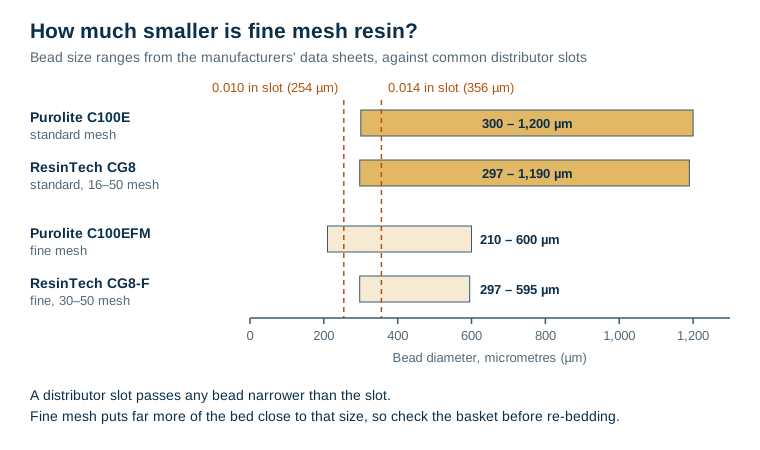
The difference is bead size, not chemistry. Two manufacturers' figures make the point:
| Resin | Grade | Bead size | Total capacity |
|---|---|---|---|
| Purolite C100E | Standard | 300–1,200 µm | 1.9 eq/L |
| Purolite C100EFM | Fine mesh | 210–600 µm | 1.9 eq/L |
| ResinTech CG8 | Standard, 16–50 mesh | 297–1,190 µm | 2 meq/mL |
| ResinTech CG8-F | Fine mesh, 30–50 mesh | 297–595 µm | 2 meq/mL |
Both grades are gel polystyrene crosslinked with divinylbenzene, carrying the same sulfonic acid exchange sites. The total capacity per litre is the same. A cubic foot of fine mesh does not hold more hardness than a cubic foot of standard resin.
What changes is how quickly the bead works. A smaller bead has more surface per litre, and the exchange sites at its centre are closer to that surface. Purolite lists "superior kinetic performance", "superior regeneration" and "lower rinse volumes" among the C100EFM's advantages. ResinTech says its CG8-F offers "faster kinetics and improved regeneration efficiency compared to similar resins with larger beads."
Faster kinetics matter most in two situations: high flow rates, where water spends little time in the bed, and ions that are slow to come back off at regeneration. Iron is one of those.
Why Fine Mesh Is Chosen for Iron
A softener can remove dissolved (ferrous) iron the same way it removes calcium: the iron exchanges onto the resin and is flushed off by brine at regeneration. The problem is the second half. Iron holds on more tightly than hardness, and whatever the brine fails to remove stays on the bead. Over months that residue builds, capacity falls, and the bed discolours.
Faster kinetics help the brine strip iron more completely each cycle. That is the genuine case for fine mesh on iron-bearing water. It gives the same capacity, with less iron left behind after each regeneration.
It does not raise the amount of iron a softener can handle. Retail listings often quote 5 to 10 ppm for fine mesh. Neither Purolite's nor ResinTech's data sheet gives an iron ceiling by resin grade. The limits that do exist come from extension services and softener manufacturers, and they depend on water conditions, not bead size. They are compared in can a water softener remove iron from well water. Water Conditioning and Purification's review of iron removal by softening resins adds a useful caution: resin cleaners "cannot compensate for more than one or two mg/L of iron." The same review suggests adding two or three grains of hardness compensation for every ppm of soluble iron.
The Water Conditions Where Fine Mesh Is Worth It
Fine mesh earns its drawbacks only when all of these hold:
| Condition | Why it matters | How to check |
|---|---|---|
| Iron is dissolved (ferrous) | Only dissolved iron exchanges. Rust particles are filtered, not exchanged | Water runs clear from the tap and turns orange after standing |
| No air or oxidiser reaches the water first | Air or chlorine converts dissolved iron into rust before or inside the bed | No aerator, cascading well, open storage tank or chlorinator ahead of the softener |
| pH in the workable band | Penn State Extension looks for pH above 6.7 for softener iron removal, while WC&P notes ferrous iron "is more stable when pH is less than 7" | Lab test of pH alongside iron |
| Iron is within the softener's own rating | Resin grade does not raise the rating | Manufacturer's manual |
| Manganese and iron bacteria have been ruled out | Both foul resin, and bacteria are not treated at all | Lab test, and a look for slime in the toilet tank |
| Pressure has margin to spare | Fine beads add pressure drop | Dynamic pressure at the softener inlet |
If the iron is already oxidised, or bacteria are present, the answer is iron filtration ahead of the softener, not a different resin.
The Backwash Question: Gentler, Not Stronger
One widespread claim is that fine mesh "needs a stronger backwash to stay clean." The physics runs the other way. Smaller beads lift at lower flow. Every resin maker's backwash guidance aims for a set bed expansion, commonly 50 to 70 percent. Smaller beads reach that expansion at a lower upflow rate than larger ones.
In practice that means:
- A lower drain line flow control (DLFC) rate for the same tank diameter. The DLFC is the small restrictor in the drain fitting that sets backwash flow. One sized for standard resin can over-expand a fine mesh bed and carry beads out to the drain. Amber beads in the drain line, or a bed that gets shallower each year, are the signs.
- Enough freeboard. Fine mesh needs room above the bed to expand without reaching the top distributor.
- A full-length backwash, every time. The rate is gentler, but the job is not. Fine mesh filters more particulate than standard resin, so skipping or shortening the backwash lets it build up.
The distributor check most re-beds skip. The baskets at the top and bottom of the tank hold the resin in with slots. A 0.014-inch slot, which Kinetico's 2030s data sheet lists for its distributors, is 356 micrometres wide. A 0.010-inch slot is 254. Fine mesh puts far more of the bed near those sizes than standard resin does. Check the slot width of your baskets against the smallest beads in the resin you buy, not the average.
The Real Tension on Low-Yield Wells
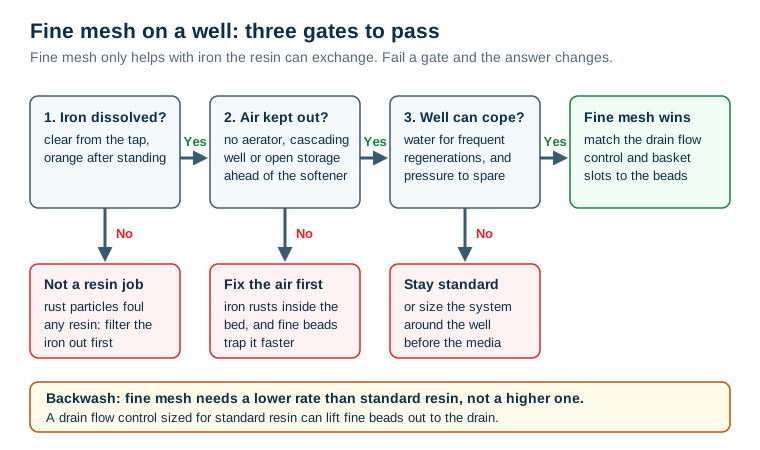
Fine mesh looks most attractive on the same kind of well where it is most likely to fail: a modest private well with a few ppm of clear-water iron. The trouble comes from the well, not the resin.
Low-yield wells let air in. When a weak well is pumped down, water can cascade into the borehole from fractures above the pumping level, picking up oxygen on the way. Pumps that short-cycle, and systems with air-charging or aeration, add more. Each of these converts some dissolved iron into rust particles before it reaches the softener, or inside the bed itself. A standard bed passes some of those particles through. A fine mesh bed catches them, and its pressure drop climbs.
Iron duty means more regenerations. Iron-bearing water is normally run with iron compensation added to the hardness setting, and softer water is not the goal. The goal is getting iron off the bed before it sets. More frequent regeneration serves that goal. Every regeneration sends water to drain, and on a low-yield well that water comes out of a supply that may already struggle. The drain flow is lower for fine mesh, which helps. The total volume per year goes up.
The pump has to cover the whole cycle. Whether your well can sustain even a reduced backwash for the full regeneration, alongside the household's own use, is the question tested in how well pump flow limits treatment backwashing. If it cannot, change the system around the well before the media. That might mean a smaller tank, staggered regeneration, or storage and a booster. The method is in sizing a softener for a low-yield well.
So the useful rule is this. On a low-yield well, fine mesh is worth it only if the iron stays dissolved all the way to the softener and the well can supply the extra regenerations. If either fails, standard resin with an iron filter ahead of it is the more robust design.
Pressure Drop: Small Beads, Tighter Bed
Water flowing through a packed bed loses pressure, and the loss rises steeply as the particles get smaller. In the standard model for packed beds it scales roughly with the inverse square of particle size. Fine mesh therefore restricts flow more than the same depth of standard resin at the same flow rate.
Two practical consequences:
- At normal household flows on a healthy system, the difference often goes unnoticed. Purolite's hydraulic data shows how strongly pressure drop climbs with flow rate even for standard resin. Peak demand, not average use, is where fine mesh shows.
- Captured particulate makes it worse. Purolite's data sheets list particulate filtered out by the bed among the causes of increased head loss. Fine mesh catching rusted iron adds restriction on top of its smaller beads.
If your pressure is marginal already, check the softener's rated pressure drop at your peak flow before switching. How pressure drop affects softener sizing shows how to read that figure. ResinTech lists the same 25 psi maximum pressure loss for CG8 and CG8-F, but that is a limit for the resin, not a comfortable operating point for a house.
Re-Bedding an Existing Softener With Fine Mesh
Swapping standard resin for fine mesh during a re-bed is common, and usually done without the checks below. Work through them first, then choose the resin grade and the volume your tank needs:
- Test the water. Confirm the iron is dissolved, check pH and manganese, and look for iron bacteria. If any of those fail, stop here and plan filtration.
- Match the DLFC. Ask the resin or valve supplier for the fine mesh flow control for your tank diameter, and fit it.
- Check both distributor baskets. Slot width against the smallest beads, and the condition of the slots. A cracked basket loses fine mesh far faster than standard resin.
- Keep the freeboard. Fill to the same bed depth, leaving the expansion space the tank was designed with.
- Reprogram. Add iron compensation to the hardness setting, commonly two to four grains per gallon per ppm of iron depending on the manufacturer. Review regeneration frequency.
- Classify the new bed. Run an extended first backwash before service. Purolite suggests about 30 minutes of expansion when a bed is first put into service.
- Watch the drain. On the first few regenerations, catch the drain water in a bucket and look for beads.
What Fine Mesh Cannot Do
- It cannot remove oxidised iron. It filters rust particles, and they foul it.
- It cannot treat iron bacteria. Bacterial slime coats any resin and needs disinfection and filtration.
- It cannot raise your softener's iron rating. The equipment's limit still applies.
- It cannot resist chlorine better. Crosslinking decides oxidation resistance, and both grades compared here are standard crosslink.
- It cannot hold more hardness per cubic foot. Total capacity per litre is the same as standard resin.
For a clean municipal supply or a well with no iron, standard resin is the right default. Fine mesh is a targeted tool for dissolved iron on water that stays air-free all the way to the tank. Used there, with the right flow control, it keeps a bed cleaner for longer.
Frequently Asked Questions
What is fine mesh resin in a water softener?
It is standard strong acid cation softening resin made in smaller beads. ResinTech's CG8-F runs 30 to 50 US mesh (about 297 to 595 micrometres) against 16 to 50 mesh (297 to 1,190 micrometres) for its standard CG8. Purolite's C100EFM runs 210 to 600 micrometres against 300 to 1,200 for C100E. The chemistry is the same. Smaller beads give more surface area, which speeds up exchange and regeneration.
Is fine mesh resin better for iron?
For dissolved (ferrous) iron, yes. Its faster kinetics let iron exchange onto the bead and come back off at regeneration more completely, so less iron stays behind to foul the bed. For iron that has already oxidised into rust particles, no. Fine beads filter those particles out and clog faster than standard resin. No manufacturer data sheet gives a higher iron ceiling for fine mesh, so work to your softener's own iron rating.
Does fine mesh resin need more backwash?
It needs a lower backwash rate, not a higher one. Smaller beads lift at lower flow, so a drain line flow control sized for standard resin can carry fine beads out to the drain. What fine mesh needs more of is diligence: a full-length backwash at the correct rate, and on iron-bearing water usually more frequent regeneration. Fit the flow control the resin supplier specifies for fine mesh in your tank diameter.
How much iron can fine mesh resin remove?
Retailers commonly quote 5 to 10 ppm, but those figures do not come from resin manufacturers' data sheets, which give no iron ceiling by resin type. Extension guidance for softeners generally runs up to about 5 mg/L of dissolved iron under good conditions, and some residential manuals rate their units at 2 ppm. Use the lowest figure that applies to your equipment, and treat the resin grade as an improvement in how cleanly iron regenerates, not a higher limit.
Can I put fine mesh resin in my existing softener?
Often, but check three things first. The drain line flow control should suit fine mesh for your tank diameter, usually a smaller one than for standard resin. The distributor basket slots must be narrow enough to hold the smallest beads. And the extra pressure drop has to be acceptable at your peak flow. Then program iron compensation into the hardness setting.
Does fine mesh resin cause low water pressure?
It can add some. Pressure loss through a packed bed rises steeply as the beads get smaller, so a fine mesh bed restricts flow more than the same volume of standard resin at the same flow rate. On a system with healthy pressure this usually goes unnoticed. On a well system cutting in at 20 psi, with an iron filter or sediment filter already taking their share, it can be the difference between adequate and weak showers.
