
Storing, Changing and Disposing of Softener Salt
How to store water softener salt: keep the bags sealed, off the floor and in a dry, well-ventilated space where the humidity stays below about 70 percent. Salt does not expire, but it pulls moisture out of damp air and cakes into hard lumps. Those lumps go on to fuse into a salt bridge once they are in the brine tank. When you change salt types, run the tank down first rather than layering one grade on another.
Storage sounds like housekeeping. It is really the first step in preventing the two most common brine tank faults.
How to Store Water Softener Salt: Five Rules
Salt is hygroscopic, which means it draws water out of the air. Cargill's safety data sheet for its softener pellets is specific about what that means for storage. It says "Store in original tightly closed container. Store in a well-ventilated place," and warns that the product "becomes hygroscopic at 70-75% relative humidity. Avoid humid or wet conditions as product will cake and become hard."
Those three sentences turn into five rules:
- Keep bags sealed until you pour them. The bag is the moisture barrier. If you only use half a bag, fold the top over and clip it, or tip the rest into a lidded plastic tote.
- Get them off the floor. Concrete wicks moisture and stays cold, so the bottom bag in a stack is always the one that cakes. A pallet, a scrap of plywood on two boards, or a low shelf is enough.
- Choose the driest corner, not the nearest one. Stay away from the sump pit, the water heater drain pan, a dryer vent and the laundry sink. A dehumidifier that keeps a basement below about 60 percent protects the salt along with everything else.
- Avoid big temperature swings. An unheated garage that is warm by day and cold at night puts condensation on the bags daily. A space at a steady room temperature is better than a cold one that swings.
- Buy what you can store dry. A pallet at a bulk price is only a saving if the last bag is as loose as the first. If you do not have a dry spot for fifty bags, buy five at a time.
Label and separate. Softener salt, ice melt and road salt often come in similar bags and can end up stacked together in a garage. Ice melt and road salt do not belong in a softener. Keep them on a different shelf, well apart.
How long does it keep? Stored dry, indefinitely. The producer's data sheet describes the product as stable under normal storage. The only clock that matters is the humidity.
Why Storage Decides Whether Your Tank Bridges or Mushes
Most brine tank faults are blamed on the tank. Many start on the storage shelf, weeks before the salt is poured.
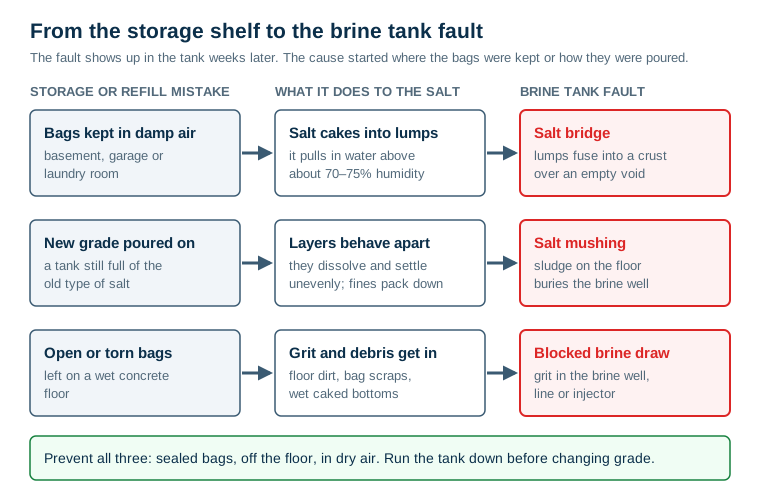
Damp storage leads to bridging. Caked salt goes into the tank as lumps. Lumps leave gaps and interlock, and the same damp-dry cycling that caked them in the bag keeps working in the tank. The result is a crust spanning wall to wall with an empty void under it, so the water never touches the salt. How to find and break one is covered in how to identify and break a salt bridge.
Layered grades lead to mushing. Pour fine crystals onto a half-used tank of pellets, and the two dissolve and settle at different rates. Fines work down through the pile and pack into a dense layer on the floor, over the openings the brine is drawn through. The full mechanism, and the cleanout, are in what causes salt mushing in a brine tank.
Open bags lead to a blocked brine draw. A torn bag on a wet floor picks up grit, concrete dust and bag scraps. Poured in, that debris ends up where the brine is drawn from, and the finest of it can reach the injector.
None of these show at first. Each can take weeks to turn into hard water, which is why the storage habit rarely gets the blame.
Caked or Spoiled Bags: Break It, Use It or Throw It Out?
Not every caked bag is ruined. What spoiled it decides the answer.
| Condition | What to do | Why |
|---|---|---|
| Lightly caked, clean and dry | Break it up in the bag and use it | Still pure salt. Loose again once broken |
| Set into a solid block, clean | Break it into pieces no bigger than your fist | Large chunks seed a bridge |
| Wet from a leak or flood, clean water | Let it dry spread out, then break up and use | The water leaves; the salt stays |
| Wet with dirty water, sewage or floodwater | Bag it and throw it out | Contamination goes straight into the brine |
| Oil, fuel, fertilizer or chemicals on it | Bag it and throw it out | Nothing you want drawn into the resin tank |
| Mixed with ice melt or road salt | Throw it out, or use it on a walkway | Unknown additives and grit |
| Mouse or insect droppings | Throw it out | It goes into the water everyone drinks |
Breaking a caked bag. Leave it sealed, lay it flat on concrete and drop it a few times from knee height, turning it between drops. A rubber mallet works on stubborn blocks. Open it, and pick out anything bigger than your fist before pouring.
The Refill Habit That Prevents Both Faults
How you pour matters as much as where you store. The habit that works:
- Wait until the tank is about a third full, or at least a few inches of salt still sits above the water line. Do not top up little and often, which leaves an old layer at the bottom that never gets used.
- Break the surface before you pour. Thirty seconds with a broom handle breaks any crust that has formed and shows you a bridge before it becomes a problem.
- Pour one grade, from one bag at a time, and check it as it goes in. Lumps and debris should come out, not go down.
- Stop at about two thirds full. A brim-full tank compacts the lower salt and gives bridges more material to build from. Hellenbrand's manual, for example, asks for a minimum of 12 inches of salt, not a full tank.
- Replace the lid. It is not a seal, but it keeps most of the room's moisture and dust off the salt.
One grade per tank, always. Manufacturers are consistent about this. The WaterBoss owner's manual says plainly "do not mix different types of salt." That applies to pellets and crystals, to two different pellet brands if one has mushed on you before, and above all to salt and potassium chloride.
Changing Salt Types Without Setting Up a Fault
There are good reasons to switch: pellets that keep mushing in your tank, a move from rock salt to a purer grade, iron in the water that calls for an iron-fighting pellet, or a sodium restriction that points to potassium chloride. The chemistry of each option is compared in water softener salt types compared. This section is about getting from one to the other without a bridge or a layer of mush.
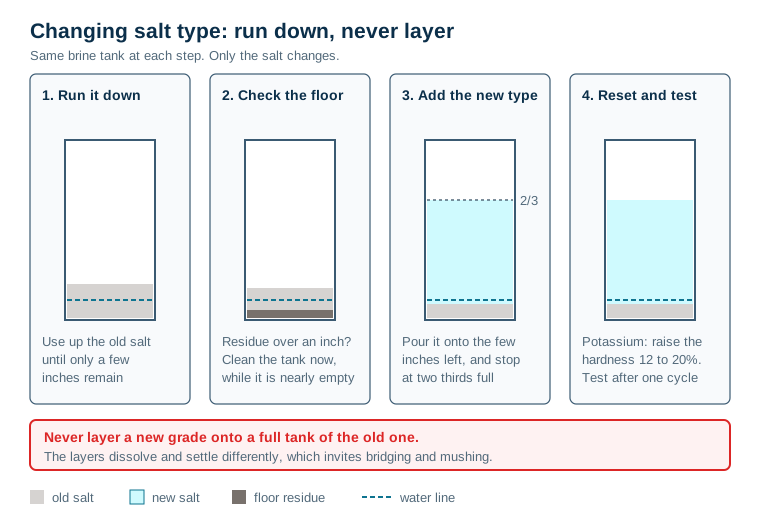
1. Run the old salt down. Stop buying the old grade and let the level fall until only a few inches remain above the water. At normal use that takes a few weeks. Keep checking that the water stays soft while the level is low.
2. Check the floor while it is nearly empty. Push a broom handle to the bottom. If it stops in soft grey paste more than an inch deep, this is the cheapest moment you will ever have to clean the tank. There is almost no salt to scoop out. The full procedure is in how to clean a water softener brine tank.
3. Add the new type on top of the last few inches. A few inches of the old grade at the bottom will be used up in the next regenerations. What you are avoiding is a thick band of it under the new salt. Fill to no more than two thirds.
4. Change the setting if the chemistry changed. Moving between grades of sodium chloride needs no setting change. Moving to potassium chloride does. Potassium regenerates resin less efficiently per pound, and WaterBoss says to multiply the hardness setting by 1.12. Other brands ask for up to 20 percent. Some valves have a salt-type menu that does it for you. Switching back means reversing the change.
5. Check the first month. Test the softened water on the day before a regeneration, after the first full cycle on the new salt. Mark the salt level on the tank wall and confirm it is falling over the next two weeks. A new grade can bridge or mush in a tank where the old one never did.
One switch to avoid. WaterBoss also says not to use potassium chloride when the water contains iron. If a well carries iron, deal with that before moving to potassium.
Disposing of Spoiled Salt, Tank Sludge and Brine
Salt is not hazardous waste, but it is not harmless either. Sodium and chloride damage soil, lawns and plants, and chloride does not break down in streams. The data sheet's disposal line is the general rule: dispose of it in accordance with local regulations.
| What you have | Where it goes | Where it does not go |
|---|---|---|
| Clean dry salt you no longer need | Give it to a neighbor with a softener, or use it up | The trash, if someone can use it |
| Contaminated or mixed salt | Sealed bag in household trash | Lawn, garden beds, a storm drain |
| Sludge scraped from the tank floor | Drain it, then bag it for the trash | Down a sink or toilet as solids |
| Liquid brine from a tank you are emptying | A floor drain or laundry sink on the sanitary sewer | A lawn, garden bed, ditch or storm drain |
| Salt from a flooded basement | Trash, once drained | Back into the brine tank |
On sewer, brine belongs in the sanitary drain. That is where every regeneration sends it anyway. A tank's worth of brine is small beside what the softener discharges over a year.
On a septic system, pour brine in slowly. Letting a few gallons down a drain over a day is gentler than one slug. Solids go in the trash, never into the septic tank.
Using spare clean salt on ice. Softener salt is sodium chloride, the same material as most road salt, so it will melt ice on a step or path. Use it sparingly and keep it off grass, planting beds and new concrete, which sodium salts damage. Salt that has come out of a brine tank is wet, gritty and not worth trying.
What Good Storage Cannot Fix
- A tank that has already bridged or mushed. Storage prevents the next fault. The current one has to be broken or cleaned out.
- Residue already on the tank floor. Changing to a purer salt stops new grit building up quickly. It does not dissolve what is there.
- Orange or rust-coloured deposits. Those usually come from iron in the water reaching the brine tank, not from the bag. Better storage will not change them.
- Hard water from a softener fault elsewhere. If the salt is loose, the level is falling and the water is still hard, the problem is in the valve, the injector or the resin, not in the salt.
- The salt bill. Storage saves money only by preventing waste and service calls. The size of the bill is set by your hardness, your water use and the salt dose on the valve.
Frequently Asked Questions
Can water softener salt be stored in a garage?
Yes, if the bags stay sealed, sit off the concrete on a pallet or shelf, and the garage does not get damp. Garages are often fine in summer and poor in winter, when warm days and cold nights cycle condensation onto the bags. Keep them away from the car, where snowmelt drips, and away from ice melt, so the two never get confused.
Does water softener salt go bad?
Not chemically. Sodium chloride does not expire. What happens is physical: salt draws in moisture from humid air and cakes, and one producer's safety data sheet says that starts at 70 to 75 percent relative humidity. Lightly caked salt still works once broken up. Salt that has been soaked, dirtied or mixed with something else is the salt to throw out.
What do I do with a bag of salt that has turned into a solid block?
If it is clean, break it up. Drop the sealed bag flat onto concrete a few times, or tap it with a rubber mallet, then check that no lump is bigger than your fist before pouring it in. Hard lumps are the starting point for a salt bridge. If it is wet with dirty water, oil or anything else, bag it and put it out with the trash instead.
Can I mix pellets and crystals in my water softener?
Manufacturers say not to. The WaterBoss manual, for one, says do not mix different types of salt. Different grades dissolve and settle at different rates, which makes bridging and mushing more likely. To switch, let the tank run down to a few inches of the old salt, check the floor for residue, then fill with the new type.
Can I use old water softener salt on my driveway?
Clean sodium chloride melts ice the same way road salt does, so a small amount on a walkway will work. It is coarse, though, and all rock and sodium salts can harm plants, lawns and concrete. Use it sparingly, keep it off grass and garden beds, and never use salt that came out of a brine tank. That salt is wet and gritty and does little on ice.
How do I get rid of the sludge from the bottom of a brine tank?
Let it drain in a bucket lined with screen or a mesh bag, then bag the solids and put them in household trash, checking local rules if you have any doubt. Pour the liquid brine down a floor drain or laundry sink, which is where regeneration water goes anyway. Do not dump it on a lawn, a garden bed or into a storm drain.
