
Water Softener Salt Types Compared

The main water softener salt types are evaporated pellets, solar crystals, rock salt, block salt and potassium chloride, plus pellets with an iron additive. For most homes, evaporated pellets are the best choice. Solar crystals are a close, cheaper second. Rock salt is cheapest per bag but leaves the most insoluble residue, which means more brine tank cleanouts.
The shape of the salt matters much less than its purity. Here is why, and what each grade actually costs once cleaning is counted.
Water Softener Salt Types at a Glance
| Type | How it is made | Insoluble residue | Suits | Watch for |
|---|---|---|---|---|
| Evaporated pellets or cubes | Brine from underground deposits is boiled off, then the salt is pressed | Lowest | Almost every softener | Can soften into mush in some tanks |
| Solar crystals | Seawater or brine evaporated by sun and wind in open ponds | Low | Most softeners | Slightly more grit than evaporated |
| Rock salt | Mined from underground deposits and crushed, not purified | Highest | Softeners whose manual allows it | Sludge, injector blockages |
| Block salt | Compressed blocks | Varies | Only softeners designed for it | Can stall brine making in tanks kept dry between cycles |
| Potassium chloride | Mined potash, refined | Low | Sodium-restricted households | Several times the price, less efficient, not for iron water |
A variation on pellets, with iron-fighting or "clean and protect" additives, is covered further down.
Purity Is the Real Difference, Not the Shape
Resin does not care what the salt looked like in the bag. It sees a solution of sodium and chloride. A pound of sodium chloride restores the same capacity whether it came from a pellet, a crystal or a lump of rock.
What differs between grades is everything in the bag that is not sodium chloride, and most of that is insoluble. Clay, silt, gypsum and fine grit never dissolve. As the salt around them goes into solution, they settle on the tank floor and build up year after year.
Refined pellets are close to pure. A Cargill safety data sheet for its Iron Fighter pellets, for example, lists 99.62 percent sodium chloride, with the rest being the iron additives. Rock salt goes into the bag with far less processing.
What the residue costs you:
- Sludge on the floor. Every 1 percent of insoluble material in 480 lb of salt a year, a typical four-person household, is about 5 lb of grit left in the tank each year.
- A blocked brine well or injector. The WaterBoss owner's manual says rock salt "is not recommended because it contains impurities that can plug up the injector assembly." An injector with a plugged throat cannot draw brine, and the water turns hard.
- A slightly bigger salt bill. A grade that is 96 percent sodium chloride delivers about 4 percent less softening per pound than a pure one.
To see how dirty your own bag is, dissolve a cup of it in a jar of warm water. The method and how to read the result are in why softener salt looks brown or dirty.
Evaporated Pellets and Cubes
The purest common grade. Underground salt deposits are dissolved into brine, pumped up and boiled off in vacuum pans, then pressed into pellets or cubes. Almost nothing insoluble survives the process.
Best for: nearly every softener, and especially one in a finished basement or a tight closet where cleaning out the tank is a nuisance.
Watch for: some pellets soften and break down in a tank that holds water for a long time, forming a mush that blocks the brine well. That is a tank-and-salt interaction, not a purity problem. If you see it, try a different brand or switch to crystals. How to recognise and clear it is in what causes salt mushing in a brine tank.
Solar Salt Crystals
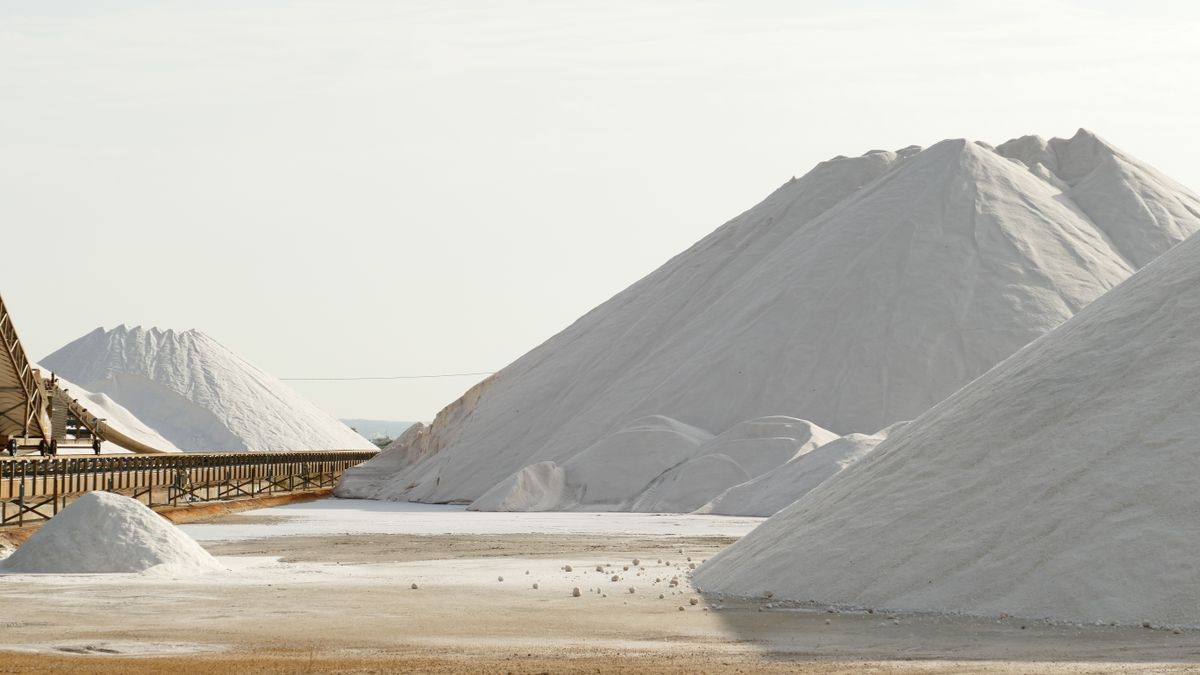
Seawater or salt-lake brine is let into shallow ponds and left for sun and wind to evaporate. The crystals are harvested, washed and bagged. They are high purity, though they usually carry slightly more insoluble material than evaporated salt.
Best for: most softeners, at a lower price per bag than pellets. The WaterBoss manual lists pellet, solar and cube salt together as the recommended types for water without iron.
Watch for: crystals are irregular, and in some tanks they are more prone to bridging than pellets. Salt of any kind absorbs moisture from humid air. The Cargill data sheet notes it becomes hygroscopic at 70 to 75 percent relative humidity, so a damp basement makes any grade more likely to crust over.
Rock Salt
Mined salt, crushed and screened but not dissolved and re-crystallised. That makes it the cheapest per bag and the least pure.
The manufacturers are fairly consistent here. WaterBoss does not recommend it, because of the injector. Morton's softener manual lists "rock salt, high in impurities" among the salts not recommended. The Water-Right owner's manual says that if pellet or rock salt is used in its dry-salt-storage tanks, the brine tank should be cleaned every six months.
If you use it anyway: check the tank floor every few months, and plan on cleaning it more often than with a refined grade. Never use road or ice-melting salt. It is rock salt with even less quality control, and it may carry additives.
Block Salt
Compressed blocks sold for a small number of softeners with brine tanks built to hold them.
Only use it if your manual says to. Many modern tanks store salt dry between regenerations, with only a little water at the bottom. The Water-Right manual warns against block salt in that design, because a block sitting above a shallow pool may not dissolve fast enough to make full-strength brine. It allows block salt only when the dry salt storage feature is not being used.
Additive Salts: Iron Fighters and "Clean and Protect"
These are refined pellets with a small amount of an additive, often citric acid, that helps release iron from the resin during each regeneration.
- Worth it: on water with dissolved iron, where they slow the build-up that eats resin capacity.
- Not worth it: on iron-free water. The additive has nothing to do.
- Not a substitute for pretreatment on high-iron water.
Which products carry which additive, and when a separate resin cleaner does more, is in what salt works best with iron in well water.
Potassium Chloride
Not salt in the kitchen sense, but it regenerates resin the same way, exchanging potassium instead of sodium into the softened water.
It costs several times more per bag and regenerates resin less efficiently, so manufacturers tell you to raise the hardness setting. WaterBoss says multiply it by 1.12. WaterBoss also says not to use potassium chloride if there is iron in the water. Who genuinely benefits, and what it really costs a year, is covered in potassium chloride vs sodium chloride in a softener.
The Cost Nobody Prices In: Cleaning the Brine Tank
Salt aisles compare price per bag. The fairer comparison is price per year including the cleanouts each grade forces on you.
A worked example, with assumptions stated. A household uses 480 lb of sodium chloride a year, which is 12 bags of 40 lb. Prices are example figures: $8 a bag for evaporated pellets, $7 for solar crystals, $6 for rock salt and $30 for potassium chloride. Rock salt needs about 4 percent more by weight for its lower purity, and potassium chloride about 15 percent more for its lower efficiency. A cleanout takes about an hour, valued at $40 of your time or a small service charge.
| Salt a year | Cleanouts a year | Cleaning cost | Total | |
|---|---|---|---|---|
| Evaporated pellets | $96 | 0.5 | $20 | $116 |
| Solar crystals | $84 | 1 | $40 | $124 |
| Rock salt | $75 | 2 (Water-Right's six-month interval) | $80 | $155 |
| Potassium chloride | $414 | 0.5 | $20 | $434 |
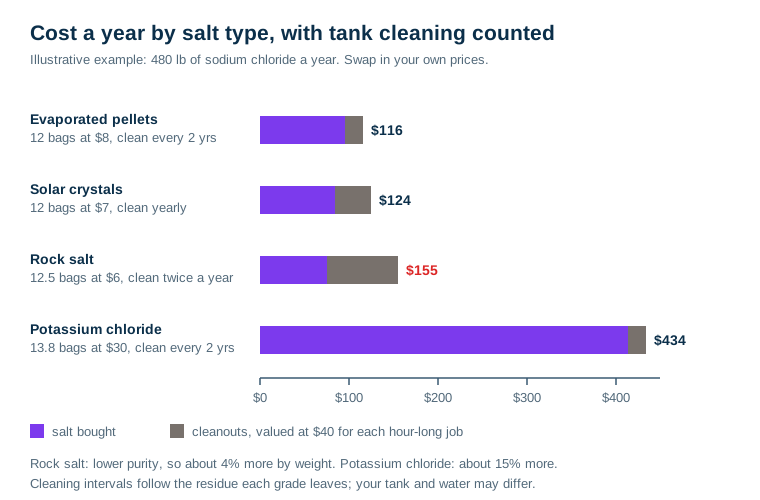
Rock salt saves about $21 a year on the bags and costs $60 more in cleaning. That is before any service call to clear a blocked injector.
The intervals here are illustrative. Where your manual gives an interval, it wins: Water-Right applies its six-month cleaning advice to pellets as well as rock salt in its tanks. How fast residue builds up depends on your particular bag, how much salt you use, and your tank. Use them as a starting point, then adjust to what you find. A useful rule is to clean when residue on the floor gets to about an inch, or sooner if the water turns hard between regenerations. The step-by-step cleanout is in how to clean a water softener brine tank.
Which Salt for Which House
| Your situation | Choose | Why |
|---|---|---|
| City water, no iron, softener in a finished space | Evaporated pellets | Least residue, fewest cleanouts |
| Tight budget, tank easy to reach and clean | Solar crystals | Cheaper per bag, still low residue |
| Well water with dissolved iron | Pellets with an iron additive | Helps keep iron off the resin; do not use potassium chloride |
| Damp basement or garage, history of bridging | Any refined grade, kept lower and topped up more often | Morton's manual advises a lower salt level in humid areas to avoid bridging |
| Pellets keep turning to mush in your tank | Try solar crystals or another pellet brand | Mushing depends on the tank as well as the salt |
| Doctor-ordered sodium limit, or sodium-sensitive soil | Potassium chloride, with the settings changed | Only reason to pay several times the price |
| Manual specifies block salt | Block salt | Only in tanks designed for it |
Reading the Bag Before You Buy
The front of the bag is marketing. The useful information is elsewhere:
- The grade. Look for "evaporated," "solar" or "rock." A bag that does not say is usually the cheapest grade.
- The safety data sheet. Producers publish one for each product, and it lists composition by percentage. That is how you know a pellet is 99.6 percent sodium chloride, or what an "iron fighting" additive actually is.
- Additives. Iron-removal and "protect" additives are listed on the bag or the data sheet. If your water has no iron, you are paying for nothing.
- What it is not. Ice melt, road salt, table salt and water softener salt can sit in the same aisle. Only buy a bag that says it is for water softeners.
Switching Salt Types Without Trouble
- Do not mix. The WaterBoss manual says plainly: "do not mix different types of salt." Different sizes and dissolving rates make a mixed tank more prone to bridging and mushing.
- Run the tank down first. Let it fall to a few inches of salt above the water, then fill with the new type.
- Change settings when switching chemistry. Going between sodium and potassium chloride means changing the hardness or salt setting, and changing it back if you switch again.
- Watch the first month. Check that the level is falling and the water stays soft. A new grade can bridge or mush in a tank where the old one never did.
What No Salt Type Can Do
- Fix a softener that is set wrong. Salt use and softness come from the hardness entry and the dose, not the grade in the bag.
- Remove iron on its own. Additive salts help keep iron off the resin. They do not turn a softener into an iron filter.
- Clean a dirty tank. Switching to pellets stops new residue building up quickly. It does not dissolve what is already on the floor.
- Change what ends up in your drinking water. With any sodium chloride grade, the sodium added depends on the hardness removed, not on how pure the salt was.
Frequently Asked Questions
What is the best type of salt for a water softener?
For most homes, evaporated salt pellets. They are the purest common grade, so they leave the least insoluble residue and need the fewest brine tank cleanouts. Solar crystals are a good, slightly cheaper second choice. Use a pellet with an iron-fighting additive if your water has dissolved iron, and potassium chloride only if you have a specific reason to avoid sodium.
Is it OK to use rock salt in a water softener?
It works chemically, but several manufacturers advise against it. The WaterBoss manual says rock salt is not recommended because its impurities can plug the injector. Rock salt carries more insoluble material than evaporated or solar salt, so it builds sludge on the tank floor faster. If you do use it, plan on cleaning the brine tank more often. Water-Right suggests every six months.
Can you mix pellets and crystals in a water softener?
Manufacturers say not to. The WaterBoss manual says 'do not mix different types of salt'. Different grades dissolve and settle differently, and a mix is more prone to bridging and mushing. If you want to switch, let the tank run down to a few inches of salt, then fill with the new type. Salt and potassium chloride can be switched this way too, with a settings change.
Are solar salt crystals or pellets better?
Both are high-purity grades, and both soften equally well per pound of sodium chloride. Evaporated pellets are usually the purest and leave the least residue. Solar crystals cost a little less and leave slightly more. Some softener manuals list pellet, solar and cube salt together as the recommended types. Choose on price and on how each behaves in your tank, and do not mix them.
Can I use table salt or de-icing salt in my softener?
No. Morton's softener manual lists table, granulated, ice-melting and ice cream salts as not recommended. Fine granulated salt packs into a solid mass at the bottom of the tank. Road and ice-melting salts are rock salts with high impurity levels, and some carry anti-caking or other additives you do not want in the brine.
Is salt with rust remover worth it?
Only if your water has dissolved iron. The additive, often citric acid, helps keep iron from building up on the resin during each regeneration. On iron-free water it does nothing useful and costs more. At higher iron levels, a separate resin cleaner or iron pretreatment does more than any salt additive.
