
How High Can a Softener Pump Its Drain Water?
Water softener drain lift height is limited by your water pressure. Each foot of rise costs about 0.43 psi, on top of friction in the tube. WaterBoss, for example, allows up to 8 feet of lift at 40 psi or more. If your pressure during regeneration cannot cover the lift and still leave the valve its minimum, a longer vertical run will not help. A drain pump will.
This guide gives you the arithmetic to check your own installation instead of guessing.
What Softener Manuals Say About Drain Lift
Few manuals give a lift figure at all, and they do not agree. This is what four of them actually print.
| Valve or softener | Lift figure | Pressure condition | Other relevant rule |
|---|---|---|---|
| WaterBoss | Up to 8 ft from the discharge | Water pressure 40 psi or more | 1/2 to 5/8 in ID; 5/8 in at 25 ft or longer |
| Clack WS1 | No figure | Pressure must remain at least 25 psi during regeneration | "Drain line too long or too high" is a listed cause of failing to draw regenerant |
| Water-Right Impression | No figure | Site requirement 30 to 100 psi | Loop at the discharge end if the line rises and then falls to a lower drain |
| Fleck 5600SXT | No figure | At least 20 psi for the valve to operate effectively | 3/4 in line above 7 gpm backwash or 20 ft length |
Sources: WaterBoss installation manual, Clack WS1 drawings and service manual, Water-Right's Impression owner's manual and Fleck's 5600SXT service manual.
The Minnesota Department of Health puts the regulatory version in one line: do not install a backwash drain line that is "excessively long, elevated, or reduced in diameter beyond the manufacturer's recommendation" (MDH water softeners fact sheet).
So the manual is the ceiling. Where it gives no number, the arithmetic below tells you how close you are.
Water Softener Drain Lift Height: What Each Foot Costs
Lifting water one foot takes 0.433 psi. That is physics, not a manufacturer setting, and it does not change with the pipe size.
| Lift | Pressure spent on lift alone |
|---|---|
| 2 ft | 0.9 psi |
| 4 ft | 1.7 psi |
| 6 ft | 2.6 psi |
| 8 ft | 3.5 psi |
| 10 ft | 4.3 psi |
| 12 ft | 5.2 psi |
| 15 ft | 6.5 psi |
Friction comes on top and depends on flow and bore. For smooth tubing at a 5 gpm backwash, the Hazen-Williams estimate is about 0.24 psi per foot in true 1/2-inch inside diameter and about 0.03 psi per foot in 3/4-inch. Elbows, barbs and any kink add more. Those three together are the back pressure the valve works against.
Measure the Pressure That Actually Matters
The number printed on your pressure regulator or pressure switch is not the one to use. What matters is the pressure at the softener while water is flowing and the softener is regenerating.
- On a well, use the pressure switch cut-in pressure, the lower of the two numbers. On a 40/60 switch, plan on 40 psi, because backwash often runs while the pump is still recovering.
- On city water, fit a gauge to a hose bib or laundry tap near the softener and read it with a tap running. Static pressure overstates what the valve sees.
- If pressure itself is marginal, fix that first. Too little inlet pressure starves backwash even with no lift at all; the limits for each valve type are in minimum and maximum pressure for a water softener.
Check Your Own Installation in Five Steps
This is a rule of thumb built from the manual figures and the arithmetic above, not a manufacturer formula. Use it to decide whether a planned route is comfortable, marginal or a non-starter.
- Find your valve's minimum pressure in its manual. Use 25 psi if you have a Clack, 20 psi for a Fleck 5600SXT, or whatever your own manual states.
- Take your working pressure as above: cut-in pressure on a well, flowing pressure on city water.
- Measure the lift from the valve's drain outlet to the highest point of the drain line, in feet. Multiply by 0.433.
- Estimate the friction: run length in feet times 0.24 for 1/2-inch tube or 0.03 for 3/4-inch, at a 5 gpm backwash. Smaller flow controls lose less.
- Subtract steps 3 and 4 from step 2. If what is left clears the valve minimum with a comfortable margin for fittings, the route is workable. If it does not, change the route, raise the pressure, or use a pump.
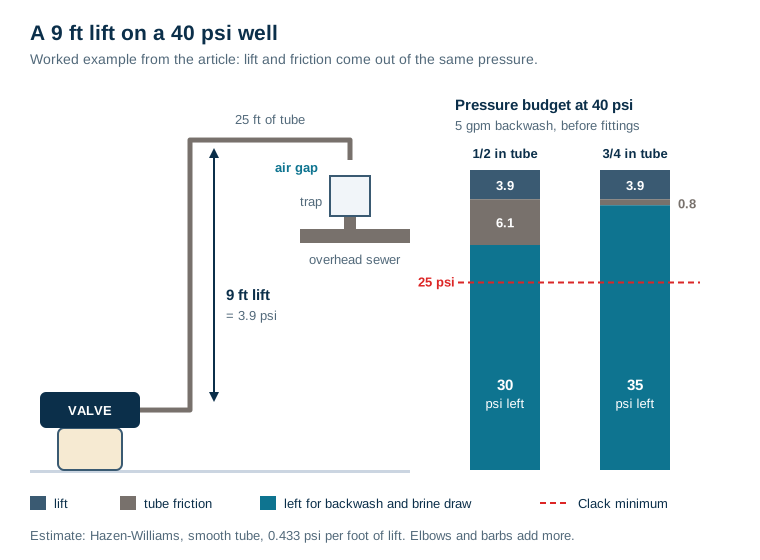
Worked example. A basement softener on a well with a 40/60 switch drains to an overhead sewer 9 feet up, through 25 feet of tube.
| 1/2 in ID tube | 3/4 in ID tube | |
|---|---|---|
| Working pressure | 40 psi | 40 psi |
| Lift, 9 ft × 0.433 | 3.9 psi | 3.9 psi |
| Friction, 25 ft at 5 gpm | 6.1 psi | 0.8 psi |
| Left before fittings | about 30 psi | about 35 psi |
| Margin over Clack's 25 psi | about 5 psi | about 10 psi |
The 1/2-inch line leaves almost nothing for elbows, barbs and pressure dips. The 3/4-inch line leaves a workable margin. The lift costs the same either way.
Then confirm it with a bucket. During backwash, time how long the line takes to fill a 5-gallon bucket at its discharge end and compare the flow with the gpm stamped on the drain line flow control. The full method, and what a low reading does to the resin bed, is in water softener drain line requirements.
Why a Longer Vertical Run Is Not the Fix
When a line does not work, the instinct is to reroute it higher or further to reach a better drain. That usually makes it worse:
- Every extra foot up is another 0.43 psi gone.
- Every extra foot along adds friction.
- Going up and then down does not give the lift back to the valve, and the long downhill leg can siphon. Water-Right's answer for a line that rises and then empties into a drain below the valve is a 7-inch loop at the discharge end, with the bottom of the loop level with the valve's drain connection.
If the arithmetic fails at the nearest acceptable receptor, the fix is a pump or more pressure, not more pipe.
Choosing a Drain Pump
With a pump, the softener drains down by gravity into a basin at floor level, through an air gap. The valve sees almost no back pressure, and the pump does the lifting. This is also the standard answer when there is no drain nearby at all; the other options for that case are in installing a softener with no drain or outlet nearby.
What to check before buying:
| Requirement | Why it matters |
|---|---|
| Flow above the backwash rate at your total head | The pump curve must show more gpm than the drain line flow control at the lift plus friction, or the basin fills faster than it empties |
| Basin volume | A small basin at 5 gpm fills in about a minute; a larger basin gives the pump time to start and the float room to work |
| Salt-tolerant materials | Discharge carries brine during rinse; corrosion-resistant pump bodies and fittings last longer |
| Check valve on the discharge | Stops the lifted water falling back into the basin every cycle |
| Air gap into the basin | The softener tube still ends above the basin inlet, never sealed into it |
| Discharge to the sanitary sewer | Not the sump, not the yard; see where a water softener can drain |
| Independent high-water alarm | The only warning you get if the pump float fails |
Condensate pumps are the common mistake. They are sized for the trickle from a furnace or air conditioner, not a softener backwash, and they overflow their small reservoirs when asked to do the larger job.
The Float Switch Failure That Floods a Basement
A drain pump adds one failure mode the softener cannot see: the pump does not start.
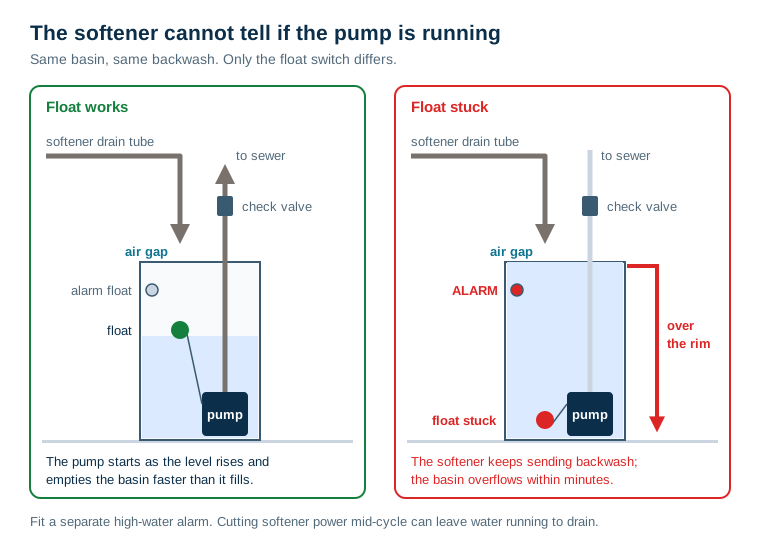
The softener has no idea whether the pump is working. It regenerates on schedule, usually in the small hours, and sends its backwash at full rate for the programmed time. If the float is stuck, tangled on its own cord, crusted with scale or salt, or jammed by debris, or if the pump has failed or its outlet has tripped, the basin fills in minutes and overflows onto the floor. Nobody is awake to hear it.
How to design that risk out:
- Fit a separate high-water alarm with its own float, not one that shares the pump switch.
- Choose a vertical or enclosed float switch that cannot tangle on the basin wall or its cord.
- Keep the basin clean and check the float by lifting it every few months.
- Run a manual regeneration during the day after installation and after any service, and watch a full backwash cycle go through the pump.
- Do not rely on cutting the softener's power to stop the flow. If power is removed mid-regeneration, the valve can stay in a regeneration position with water running to drain. Clack's troubleshooting table lists "power outage during regeneration" as the first cause of water running to drain.
What a Drain Pump Does Not Fix
- Low inlet pressure. A pump removes the back pressure from the drain side. It cannot add pressure to the inlet, and backwash still needs the valve's minimum.
- The air gap requirement. The tube still ends above the basin inlet with open air between them.
- The brine tank overflow. It is a gravity line and cannot run uphill at all. It needs its own route to a receptor below its fitting, or into the pump basin with its own air gap.
- Power cuts. The pump stops when the power does. So does an electric softener, but a regeneration interrupted halfway can still leave water running.
The short version: work out the lift and friction against your real pressure before running a single foot of tube. If the numbers leave a margin, go up. If they do not, go down into a pump basin and let the pump do the climbing.
Frequently Asked Questions
How high can a water softener drain line go?
It depends on the valve and your water pressure. WaterBoss allows the drain line to be elevated up to 8 feet from the appliance as long as water pressure is 40 psi or more. Clack lists a drain line that is too high as a cause of the valve failing to draw brine, and Fleck's 5600SXT manual gives size and length rules but no lift figure. Every foot of lift costs about 0.43 psi, so lower pressure means less lift.
Can a water softener drain uphill?
Yes. The control valve discharges under house pressure during backwash and rinse, so it can push water up to a receptor above it. The limit is pressure: the lift, the friction in the tube and the fittings all subtract from what the valve has left for backwash and brine draw. Check your valve's manual and your pressure during regeneration before planning a high run.
What happens if a water softener drain line is too high?
The valve works against more back pressure than it was designed for. Backwash flow can fall below its rated rate, so the resin bed is not lifted and cleaned properly, and the injector can fail to draw brine. Clack's troubleshooting table lists drain line too long or too high under failure to draw regenerant, with the fix: shorten the length and or the height.
Do I need a pump for my water softener drain?
You need one when your pressure cannot support the lift and friction to the nearest acceptable receptor, or when there is no receptor above or at the softener's level at all. The softener then drains by gravity, through an air gap, into a pump basin, and the pump lifts the water to the sanitary sewer. The pump must move more than the softener's backwash rate at the total lift.
Can a condensate pump handle water softener discharge?
Usually not. Condensate pumps are built for the slow trickle from a furnace or air conditioner, while a softener backwash can run at several gallons a minute for several minutes. A pump that cannot keep up will overflow its reservoir. Choose a pump rated above the backwash rate at your lift height, with a basin large enough for the flow.
Does a bigger drain line let a softener lift higher?
Only a little. A bigger line cuts friction, which matters on long runs, but it does nothing for the pressure needed to lift water, which is about 0.43 psi per foot no matter how wide the pipe is. Raising lift capacity takes more pressure at the valve or a drain pump.
