
Water Softener Drain Line Requirements
The core water softener drain line requirements are a minimum 1/2-inch inside diameter, an upsize to 3/4 inch for long runs or high backwash flows, a vertical lift within what your house pressure can support, and an air gap where the line ends. Size, length and lift draw on one shared pressure budget, so exceeding any one of them starves backwash.
That last point is what the usual advice misses. The rules below come straight from four valve manuals, but the useful part is seeing how they combine.
Water Softener Drain Line Requirements at a Glance
These are the figures the manufacturers actually print. They are not identical, which is the first reason to read the manual for your own valve before buying tubing.
| Requirement | Fleck 5600SXT | Clack WS1 | Water-Right Impression | WaterBoss |
|---|---|---|---|---|
| Minimum line size | 1/2 in | Fitting takes 5/8 in polytube or 3/4 in NPT | 1/2 in inside diameter, or 3/4 in rigid pipe (recommended) | 1/2 to 5/8 in inside diameter |
| Upsize trigger | 3/4 in above 7 gpm backwash or over 20 ft | Not stated as a length | 3/4 in above 7 gpm backwash | 5/8 in at 25 ft or longer |
| Lift | Not stated | "Drain line too long or too high" is a listed fault | Loop required if the line rises then falls to the drain | Up to 8 ft at 40 psi or more |
| Air gap at the end | 2 × line diameter, 1 in minimum | Not stated | 1-1/2 in or 2 × diameter, whichever is greater | Air gap or siphon break |
| Water pressure | 20 psi minimum, 125 psi maximum | 25 psi minimum during regeneration (troubleshooting table) | 30 to 100 psi | 20 psi minimum |
Sources: Fleck 5600SXT service manual, the Clack WS1 drawings and service manual, Water-Right's Impression owner's manual, and the WaterBoss installation manual.
Code sits on top of this. U.S. model plumbing codes generally treat softener discharge as indirect waste that ends through an air gap or air break into a trapped, vented receptor. The edition and local amendments your jurisdiction adopted decide the details, and whether the work needs a permit is a question for your local building department.
Why Size, Length and Lift Are One Budget
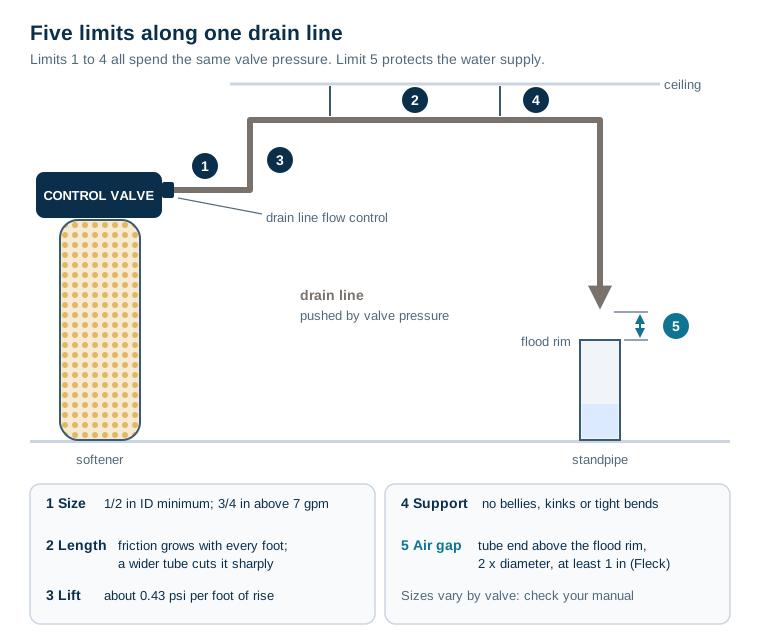
A softener drain line is not a gravity drain. During backwash and rinse, the control valve pushes water out through a small restrictor called the drain line flow control, and that water arrives under pressure. The valve's pressure is spent in three places on its way out:
- Lift. Raising water costs about 0.433 psi per foot of height. It does not matter how wide the pipe is; 8 feet of rise always costs about 3.5 psi.
- Friction. Moving water along a tube costs pressure in proportion to length, and it rises steeply as the tube narrows or the flow increases.
- Fittings and exit. Every elbow, barb and kink adds a little more.
Whatever those three consume is pressure the valve can no longer use to drive backwash flow through the bed or to pull brine through the injector. Clack's troubleshooting table says it plainly: under "control valve fails to draw in regenerant" it lists "drain line restriction or debris cause excess back pressure" and "drain line too long or too high," with the fix "shorten length and or height."
The interaction that matters: upsizing the tube cuts friction dramatically but does nothing for lift. Raising house pressure helps both. So a long, flat run is a size problem, and a tall run is a pressure problem.
The Constraint Table: Estimated Back Pressure by Run, Lift and Size
This table puts numbers on the budget. It is an estimate for straight, smooth tubing at a 5 gpm backwash, typical of a mid-size residential tank, using the Hazen-Williams friction formula (C = 150) plus 0.433 psi per foot of lift. Elbows and barbs add more, so treat the figures as a floor, not a ceiling.
| Run length | Lift | 1/2 in ID tube | 3/4 in ID tube | What it tells you |
|---|---|---|---|---|
| 10 ft | 0 ft | about 2.4 psi | about 0.3 psi | Short and flat: either size works |
| 20 ft | 4 ft | about 6.6 psi | about 2.4 psi | Friction now dominates in 1/2 in |
| 30 ft | 8 ft | about 10.8 psi | about 4.5 psi | 1/2 in has spent a quarter of a 40 psi supply |
| 50 ft | 8 ft | about 15.7 psi | about 5.2 psi | Long runs are a size problem |
| 30 ft | 12 ft | about 12.5 psi | about 6.2 psi | Tall runs stay costly even in 3/4 in |
Read it against your house pressure while water is flowing, not the static figure. A rule of thumb (ours, not a manufacturer formula): keep your running pressure minus the estimated back pressure comfortably above the minimum your manual gives. A home at 45 psi running 30 feet of 1/2-inch tube up 8 feet has roughly 34 psi left before fittings. A home at 30 psi with the same line has about 19 psi left, below both Fleck's 20 psi floor and Clack's 25 psi regeneration minimum.
Two things change the numbers:
- Smaller backwash, smaller problem. At 2 gpm, friction in 1/2-inch tube falls to about 0.9 psi per 20 feet. Small tanks with small flow controls tolerate longer runs.
- Tubing labelled by outside diameter. A tube sold as "1/2 inch OD" is much narrower inside than 1/2 inch, and friction rises steeply as the bore shrinks. Manuals give inside diameter.
On a well, use the pressure-switch cut-in pressure, the low number, because backwash often runs while the pump is recovering. If the well pump cannot keep up with backwash at all, no drain line fixes that.
If the lift column is the problem, the full arithmetic, by valve and with drain pump options, is in how high a softener can push its drain water.
The Symptom Nobody Traces Back to the Drain
An inadequate drain line rarely leaks or makes noise. It changes how regeneration works, and the symptoms turn up in the water, the brine tank and the salt bill.
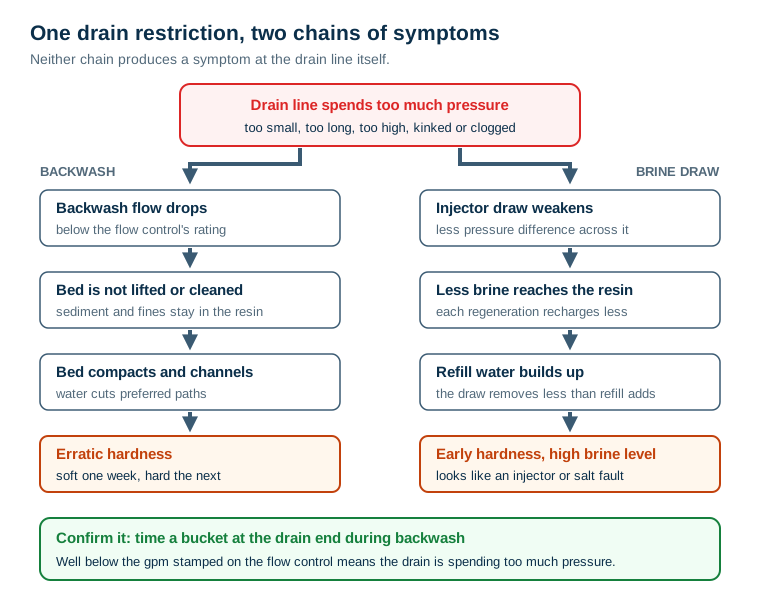
Chain one: backwash. Backwash is supposed to lift and loosen the resin bed so the beads resettle evenly and trapped sediment leaves. With too little flow the bed stays packed. Water then cuts preferred paths through it, which is resin channeling. The signature is erratic hardness: soft one week, hard the next, with resin that looks healthy.
Chain two: brine draw. The injector works on the pressure difference across it. Raise the back pressure and the draw weakens. Less brine reaches the resin, so each regeneration recharges less capacity, and the refill keeps adding water the draw did not remove. The brine tank fills higher than it should.
Put together, a softener with a starved drain can look like it has three unrelated faults. It is one.
The confirming test takes five minutes:
- Find the number stamped on the drain line flow control inside the valve's drain elbow. Clack's flow controls, for example, carry their gpm rating on the part.
- Start a manual regeneration and let it reach backwash.
- At the end of the line, keeping the air gap, catch the flow in a 5-gallon bucket and time it.
- Divide gallons by minutes. A bucket filling in 60 seconds is 5 gpm.
If the measured flow is well below the rated number, something between the valve and the bucket is spending too much pressure. Check for kinks, a clogged flow control, too small a tube, too much lift, or low house pressure, in that order.
How to Route a Line That Meets the Requirements
Once the budget is right, the route has to keep it right for years.
- Keep it as short as the layout allows. Water-Right's manual opens its installation list with it: the distance between drain and unit "should be as short as possible."
- Use rigid pipe for long or overhead runs. Water-Right recommends 3/4-inch rigid pipe on the NPT fitting. Rigid pipe does not sag, kink or chafe. Fleck warns to keep solder joints at least 6 inches from the flow control fitting and to finish soldering before fitting it.
- Make the first bend gentle. A kink at the valve outlet behaves exactly like a blockage.
- Support flexible tubing so it cannot belly. Water left in a low point adds weight and stress every cycle.
- Handle a rise-then-fall correctly. If the line climbs and then drops to a drain below the valve, Water-Right calls for a 7-inch loop at the discharge end, with the bottom of the loop level with the valve's drain connection. That stops the long downhill leg from siphoning the valve.
- Keep it above freezing. Water-Right says not to put the unit or its drain and overflow lines anywhere they will drop below 33°F.
- Secure the end. Backwash starts abruptly. An unsecured tube can whip out of the receptor.
How to make the physical connection to the valve's drain elbow is covered in how to connect water softener drain tubing.
Termination: The Air Gap and the Receptor
Where the line ends is a requirement of its own, not an afterthought. The tube end must sit above the receptor's flood rim with open air between them. Fleck asks for twice the drain line diameter and at least 1 inch; Water-Right asks for 1-1/2 inches or twice the diameter, whichever is greater. The International Plumbing Code (802.3.1) sets an air gap of at least twice the effective opening of the indirect waste pipe (IPC 2024, Chapter 8, via UpCodes).
The receptor has to take the flow. A standpipe that overflows during backwash is too small or partly blocked; the answer is a bigger or clearer receptor, never pushing the tube deeper. The backflow reasoning, the gap by line size and the fittings that make it easy are in why a water softener drain needs an air gap. Which receptors are acceptable at all is compared in where a water softener can drain.
The brine tank overflow is a separate gravity line with different rules. WaterBoss and Water-Right both say not to connect it to the valve's drain line; the reason is in brine tank overflow line requirements.
What the Drain Line Cannot Fix
- Low house pressure. A perfect drain line still needs the valve's minimum pressure at the inlet. If you are below it, fix pressure first.
- Wrong backwash rate for the tank. The drain line flow control sets the rate. A drain line can only fail to deliver it, not correct a wrong one.
- Resin that is already fouled or broken down. Restoring backwash flow often clears channeling, but it will not revive resin that is coated with iron or has fractured.
- A receptor that is blocked downstream. If the standpipe or floor drain itself backs up, the house drain needs attention.
A good drain line does not improve a softener. It lets the valve do what it was designed to do. Measure the backwash flow once after installation, write the number down, and you will have a baseline for the day softening starts to wander.
Frequently Asked Questions
What size should a water softener drain line be?
Most residential manuals set a minimum of 1/2 inch inside diameter. Fleck's 5600SXT manual and Water-Right's Impression manual both move you up to 3/4 inch when the backwash rate is above 7 gallons per minute, and Fleck also requires 3/4 inch when the run is longer than 20 feet. WaterBoss specifies 1/2 to 5/8 inch and moves to 5/8 inch at 25 feet. Always size from the inside diameter, never from the outside diameter printed on some tubing.
How far can a water softener drain line run?
There is no single figure. Length is limited by friction, and friction depends on the backwash flow and the tube's inside diameter. At a 5 gallon per minute backwash, 20 feet of true 1/2 inch tubing costs roughly 5 psi, while the same run in 3/4 inch costs well under 1 psi. That is why manuals set a length at which you must upsize rather than an absolute maximum. Follow your valve's manual first.
Can a water softener drain line go up?
Yes, within limits. The valve pushes drain water under pressure, so it can lift it some distance. WaterBoss allows up to 8 feet of lift at 40 psi or more. Clack lists a drain line that is too long or too high as a cause of the valve failing to draw brine, and the Minnesota Department of Health warns against drain lines more elevated than the manufacturer recommends. Each foot of lift costs about 0.43 psi that the valve cannot get back.
Does a water softener drain line need a trap?
The softener drain line itself is not normally trapped. It discharges through an air gap into a receptor such as a standpipe, laundry tub or floor drain, and that receptor carries the trap and vent. Water-Right's manual adds a sink-type trap with an air gap where the drain empties into an overhead sewer line. Never glue the softener line straight into a trapped pipe: that removes the air gap.
Can I use a garden hose for a water softener drain line?
It is not a good idea for a permanent install. A garden hose is often narrower inside than the 1/2 inch minimum, kinks easily at the first bend, and is not made to sit loose on a floor for years. Use tubing or rigid pipe of the size your manual specifies, with a proper connection at the valve's drain fitting.
What happens if a water softener drain line is too small or too long?
The valve sees more back pressure than it was designed for. Backwash flow can fall below the rate needed to lift and clean the resin bed, which leaves it compacted and channeled, and the injector can struggle to draw brine. The symptoms are erratic hardness, a brine tank that fills with water, and a softener that seems to need more salt than it should. None of them points at the drain line on its own, which is why it gets missed.
