
Installing a Softener Without a Drain or Outlet Nearby
Water softener, no drain nearby? You have five workarounds. In rough order of cost and reliability, they are a longer drain line within the manufacturer's length and height limits, a shared laundry standpipe or sink, a drain pump big enough for backwash flow, a non-electric valve if the missing piece is power, and portable exchange tanks if you have neither drain nor power. Each has one limit that decides whether it works, and those limits are what this page covers.
Two facts drive everything below. A regenerating softener sends water to a drain every regeneration: backwash, brine draw and rinse. And most control valves need a live outlet around the clock to keep time and start that regeneration. Take away either one, and the standard installation no longer works.
Water Softener With No Drain Nearby: Name the Real Problem First
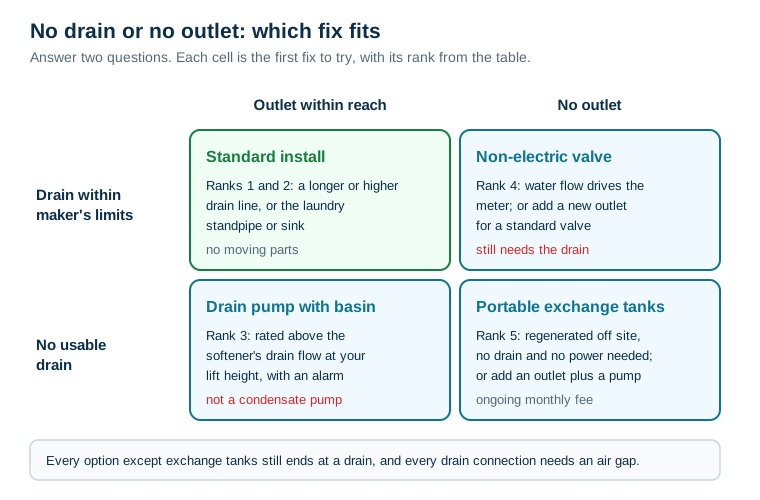
"No drain" and "no outlet" are different problems with different fixes, and people often mix them up.
- No drain, outlet available. The fix is a longer drain run or a pump.
- Drain available, no outlet. The fix is a new outlet or a non-electric valve.
- Neither. The fix is a new outlet plus a pump, or exchange tanks that need neither.
Before you decide you have "no drain," check what counts as one. A floor drain, a laundry standpipe, a laundry sink, and in some cases a trapped connection on an overhead sewer line can all take softener discharge through an air gap. Where each is allowed is covered in where a water softener can drain.
The Five Workarounds, Ranked by Cost and Reliability
| Rank | Workaround | Solves | Relative cost | Reliability | The limit that decides it |
|---|---|---|---|---|---|
| 1 | Longer or higher drain line | Distant drain | $ | High, with no moving parts | Manufacturer's length and height limits, and water pressure |
| 2 | Laundry standpipe or sink | No floor drain | $ | High | Air gap; regeneration timed away from the washer |
| 3 | Drain pump with a basin | No drain within reach | $$ | Medium, because the pump can fail | Must pump faster than the softener discharges; needs an outlet |
| 4 | Non-electric control valve | No outlet | $$ to $$$ | High | Still needs a drain, and a new softener |
| 5 | Portable exchange tanks | No drain and no outlet | Ongoing monthly fee | High, if deliveries keep up | Capacity per swap; service area |
The ranking favors fixes with no moving parts. A drain line that is 10 feet longer never fails. A pump will fail one day, and when it does, it floods.
1. Run the Drain Line Farther or Higher
The softener's drain line is not a gravity drain. The control valve pushes backwash and rinse water out under line pressure, so the line can run a fair distance and even go uphill. There are limits, and they vary by maker.
- The Whirlpool installation guide says the drain "should not be more than 30 feet away from the softener" and the drain line "should not be elevated more than 8 feet above the floor."
- The Fleck 5600SXT service manual calls for a minimum 1/2-inch drain line and says runs "in excess of 20' (6 m)" need a 3/4-inch line.
- The Water-Right Impression Plus manual lists "drain line too long or too high" as a cause of faults, and its fix is to shorten the length or height.
What goes wrong past the limit. Backpressure in the drain line works against the injector that draws brine out of the salt tank. The softener regenerates, but with weak brine or none, so hardness returns early or salty water reaches the taps. A long drain line can also slow backwash enough that the resin bed never fully lifts and loosens. The softener keeps working, just badly, which is harder to spot than a leak.
Running the line overhead. If the nearest drain is a pipe near the ceiling, the drain line can often rise to it. Water-Right says that where the drain empties into an overhead sewer line, "a sink-type trap must be used with appropriate air gap." It also says that where the line is raised but empties into a drain below the valve, you should form a loop at the discharge end so the line cannot siphon. How high each type of valve can push is covered in detail in how high a softener can pump its drain water.
Cost: tubing or pipe, fittings and an air gap. This is the cheapest fix and the most reliable one if you stay inside the limits.
2. Share the Laundry Standpipe or Sink
The laundry standpipe is the most common softener drain in houses without a floor drain. It is already trapped, vented and sized for a washer's pump-out, which is far faster than any softener discharges.
Three details make it work.
- An air gap, not a sealed connection. Fleck requires an air gap of twice the drain line's diameter, with a minimum of 1 inch. Water-Right asks for 1-1/2 inches or twice the pipe diameter, whichever is greater. Never push the drain tube down into the standpipe.
- A secured line. A loose tube can whip out of the standpipe the first time backwash starts. Clamp it to the pipe or use a standpipe clip.
- Separate timing. Regeneration usually runs in the early morning. If the washer runs at the same time, the two flows can overflow the standpipe. Set the regeneration time to one when no laundry is going.
A laundry sink works the same way, with the tube clipped to the rim above the flood level. The brine tank overflow line, which only flows by gravity, also needs to reach the standpipe or sink lower than the overflow fitting. If it cannot, the brine tank must go higher.
3. Pump the Discharge to a Drain
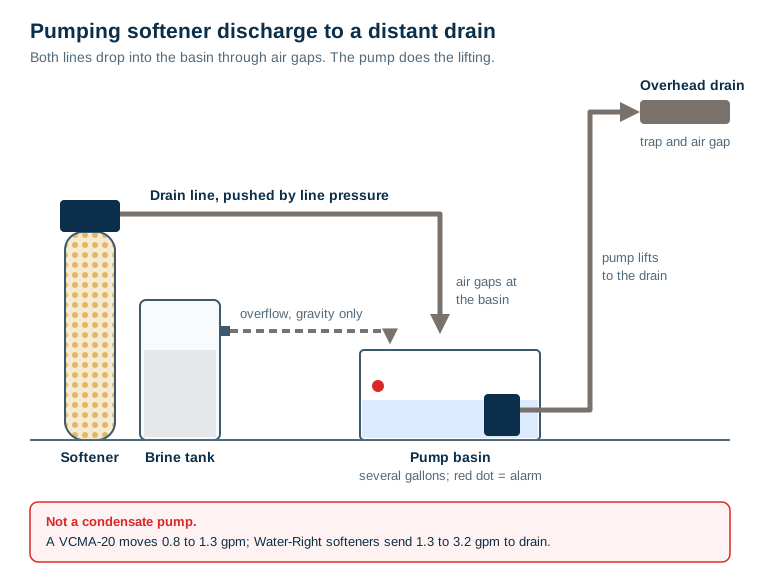
When there is no drain within reach, a pump carries the water there. This is where the most common mistake happens: using a condensate pump.
Why a condensate pump falls behind. Compare the flows:
| Flow | Gallons per minute |
|---|---|
| Softener drain flow during regeneration, Water-Right models | 1.3 to 3.2 |
| Little Giant VCMA-20 condensate pump at 1 ft of lift (80 gph) | about 1.3 |
| Same pump at 5 ft of lift (70 gph) | about 1.2 |
| Same pump at 10 ft of lift (48 gph) | 0.8 |
The condensate pump's tank holds half a gallon. At 10 feet of lift, it moves water at about a quarter to two-thirds of the softener's drain flow. The reservoir fills within a minute of backwash starting and then overflows onto the floor. Condensate pumps are built for the slow trickle from a furnace or air conditioner, not for a softener's backwash.
What to use instead. Use a drain pump with a basin, often sold as a laundry tray or sink drain pump system. It should have:
- a basin of several gallons, so it can hold the surge while the pump cycles
- a flow rating well above your softener's drain flow, checked at your actual lift height. Your softener's manual lists its backwash and drain flow
- materials rated for brine. Ask the pump maker whether it allows softener discharge. Brine corrodes some metal parts
- a high-water alarm or overflow switch that cuts power to the softener, or at least warns you, if the pump fails
- a separate air gap where the softener's drain line enters the basin, so basin water cannot siphon back
The overflow line. The brine tank overflow flows by gravity only, so it has to discharge into the basin at a point lower than the overflow fitting. If the basin sits higher than that, the overflow has nowhere to go.
The limit on this fix: it needs power, and it adds a part that will fail. Test the pump and alarm every time you add salt.
4. No Outlet: Add One, or Use a Non-Electric Valve
Most softener valves draw very little power. Water-Right lists 0.5 amps. But they need that power all the time. Water-Right specifies an "uninterrupted outlet," and Fleck warns against plugging into a switched outlet and says outages over 8 hours may cost the valve its time setting. An extension cord from across the room works until someone unplugs it for the vacuum.
You have two real options.
- Add a receptacle near the softener. A licensed electrician can usually add one, and it is the right answer if you also need a drain pump.
- Choose a non-electric softener. These valves use water flow to turn a meter and drive regeneration, so they need no outlet. Most are twin-tank designs. The catch is that a non-electric valve still needs a drain and enough water pressure, and it means buying a different softener, not modifying yours. The trade-offs are covered in electric vs non-electric water softeners.
A battery-powered or battery-backup valve does not solve a missing outlet. The battery usually keeps only the time setting during an outage and does not run regeneration.
5. No Drain and No Outlet: Portable Exchange Tanks
A portable exchange service installs softener tanks with no brine tank, no control valve and no drain line. When the resin is used up, the company swaps the tank for a freshly regenerated one and regenerates the old tank at its own plant. Nothing on site needs a drain or power, and there is no salt to carry.
That makes exchange tanks the only option that removes both blockers at once. The costs are an ongoing fee instead of a one-time purchase, soft water only as long as the tank lasts between swaps, and dependence on a provider serving your area. Heavy water use or very hard water means frequent swaps. The full comparison is in portable exchange tank vs installed softener.
What About Draining Outside?
Some owners want to run the drain line out through the wall onto the ground. Rules on this vary widely. Some health departments allow ground discharge with a set distance from any well, and many places restrict or ban it. Brine on the ground can also harm plants and soil near the outlet, and an outdoor line freezes in winter. Treat outdoor discharge as a question for your local health or building department, not a default. It is not one of the five ranked workarounds for that reason.
What These Workarounds Cannot Do
None of these fixes changes what a softener does. A softener removes hardness, and a small amount of dissolved iron. It does not remove bacteria, sediment or most contaminants. A no-drain workaround is worth it only if hardness is your actual problem, so test first.
A pump or a long drain line also does not remove the need for an air gap, and a non-electric valve does not remove the need for a drain. If you are still choosing a location, the best fix is often to move the softener to where the drain and outlet already are, as long as it still sits before the water heater and after any outdoor tap branch. Check the space there as well as the plumbing: overhead room above the valve matters as much as floor area. In a flat or condo, where the drain, the space and the lease all limit the choice, compact softeners scored for apartments compares the units that fit.
Frequently Asked Questions
Can a water softener be installed without a drain?
A standard regenerating softener cannot. Every regeneration sends backwash and brine rinse water to a drain. If there is no drain nearby, you can run a longer drain line within the manufacturer's limits, use a laundry standpipe or sink, pump the water to a drain, or use portable exchange tanks, which regenerate off site and need no drain at all.
How far can a water softener drain line run?
It depends on the model. Whirlpool says the drain should not be more than 30 feet from the softener and the drain line should not be raised more than 8 feet above the floor. Fleck calls for a 3/4-inch drain line once the run is longer than 20 feet. A line that is too long or too high can reduce brine draw and leave salty water or poor softening.
Can I use a condensate pump for a water softener drain?
Usually not. A typical condensate pump such as the Little Giant VCMA-20 is rated at 80 gallons per hour at 1 foot of lift, about 1.3 gallons a minute, and 48 gallons per hour at 10 feet, with a half-gallon tank. One maker's softeners send 1.3 to 3.2 gallons a minute to the drain during regeneration. The pump falls behind and the reservoir overflows.
Can a water softener drain into a washing machine standpipe?
Yes, and it is one of the most common arrangements. Secure the softener's drain line above the standpipe opening with an air gap, never sealed into the pipe. Schedule regeneration for a time when the washer is not running, because both discharging at once can overflow the standpipe.
Do water softeners need electricity?
Most do. Their control valves need an uninterrupted 115/120 V outlet. Non-electric softeners use water flow to drive the meter and start regeneration, so they need no outlet. They still need a drain, though, so a non-electric valve solves only the power problem.
Can water softener discharge go outside onto the ground?
Only where local rules allow it. Some health departments permit ground discharge if it stays a set distance from any well, and many places restrict or ban it. An outdoor line also freezes. Check with your local health or building department before running a drain line outside.
