
Fleck 9100SXT Review: Twin-Tank Capacity, Reserve and Cost Against a 5600SXT
The Fleck 9100SXT is a twin-tank softener valve that keeps one resin tank in service while the other regenerates or waits. That gives soft water around the clock and lets each tank run to exhaustion, with no day of reserve held back. It does not double flow, because only one tank is in service at a time. On a typical family's water, a single Fleck 5600SXT of the same resin volume costs less up front and less over ten years. The 9100SXT pays for itself only when the daily hardness load is heavy, as in a large household on very hard water, or when water is used around the clock.
This Fleck 9100SXT review works from Pentair's technical sheet and SXT manual, the sellers' Amazon listings and the AFWFilters store. The capacity and cost figures are worked examples. Nothing here comes from physical testing.
Disclosure: Hard Water Solved may earn a commission if you buy through links on this page, at no extra cost to you. It does not change which products we include or how we rank them. Read our disclaimer.
How this review was put together. Valve data from Pentair's Fleck 9100 technical sheet; controller behaviour from Pentair's Fleck 5600SXT service manual, which covers the SXT controller's two-tank setting. System contents from the Amazon listings. Capacity is stated at 6 lb of salt per cubic foot of resin; salt at $7 per 40 lb bag. Prices are not listed here because they change often. Use the buttons to see the current price on Amazon.
How the 9100SXT Alternates Its Tanks
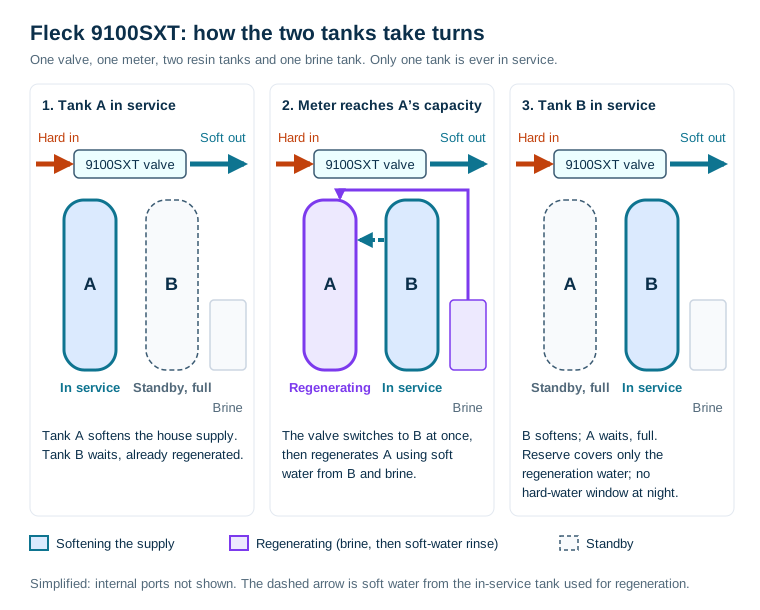
Pentair describes the 9100 as providing "continuous soft water provision with only one tank in use, other being in regeneration or stand-by," with "regeneration with softened water." In practice:
- Tank A softens the supply. The turbine meter counts gallons.
- When A's programmed capacity is used, the valve switches to B immediately, at any time of day, and regenerates A. The backwash and rinse water for A comes from B, so A is regenerated with soft water.
- B softens; A waits, fully regenerated. The cycle repeats.
Two consequences follow. There is no 2 a.m. regeneration window, because regeneration happens whenever a tank is exhausted. And because the switch is immediate, the system does not need to keep a day of capacity in reserve. The full logic of reserve on single-tank units is set out in water softener reserve capacity.
Fleck 9100SXT Review of the Capacity Math
This is where most 9100SXT owners go wrong, in two different ways.
Mistake 1: entering both tanks' capacity
Listings often advertise the combined figure. One CAI Technologies listing describes "Twin tank 96,000 grain total system capacity" for two 1.5 cubic foot tanks. But the valve regenerates one tank at a time. The unit capacity you enter in the controller is the capacity of one tank.
Mistake 2: entering the box rating
The 48,000 grains per tank is the maximum-salt figure. At an efficient 6 lb of salt per cubic foot, each 1.5 cubic foot tank delivers about 31,500 grains. That figure is explained, with the full table, in advertised vs usable softener capacity.
| Resin per tank | Sold as | Capacity per tank at 6 lb/cu ft | Salt per regeneration | Total sold as |
|---|---|---|---|---|
| 1.0 cu ft | 32,000 per tank | about 21,000 | 6 lb | 64,000 |
| 1.5 cu ft | 48,000 per tank | about 31,500 | 9 lb | 96,000 |
| 2.0 cu ft | 64,000 per tank | about 42,000 | 12 lb | 128,000 |
The reserve: small, not zero
Twin-tank marketing often says "no reserve needed." Pentair's 5600SXT service manual, which covers the SXT controller's two-tank setting, is more precise: "in twin tank systems with soft-water regeneration, the reserve capacity should be set to the volume of water used during regeneration to prevent hard water break-through." Regenerating tank A uses soft water from tank B, and that water counts against B's capacity.
Most residential softeners use roughly 40 to 100 gallons per regeneration, as covered in how much water regeneration uses. Measure or estimate your system's figure, then set the reserve to it.
Worked example
A family of four uses about 300 gallons a day on 15 gpg water: 4,500 grains of hardness a day. On a 1.5 cubic foot per tank 9100SXT:
| Setting | Value | Working |
|---|---|---|
| Unit capacity | 31,500 grains | One tank at 6 lb/cu ft |
| Hardness | 15 gpg | Add about 4 gpg per ppm of iron if present |
| Gallons per tank | 2,100 | 31,500 ÷ 15 |
| Reserve | 50 gallons | About one regeneration's water (assumed) |
| Gallons before switching | 2,050 | 2,100 − 50 |
| Days per tank | about 6.8 | 2,050 ÷ 300 |
A single 5600SXT with the same 1.5 cubic feet of resin has to hold back a day of reserve, 300 gallons, so it delivers about 1,800 gallons per cycle, around 6 days. The twin gets about 14% more softening out of each regeneration. The step-by-step method for both valve types is in how to set softener capacity and reserve.
Flow and Pressure Drop
A twin-tank softener does not double your flow. Only one tank is in service, so the house sees one resin bed's resistance plus the valve's.
| Source | What it says |
|---|---|
| Pentair 9100 technical sheet, valve alone, 1 inch | About 4.5 m³/h (roughly 20 gpm) at a 1 bar drop; about 5.9 m³/h (roughly 26 gpm) at 1.8 bar |
| Pentair 9100 technical sheet, valve alone, 3/4 inch | About 4 m³/h (roughly 18 gpm) at a 1 bar drop |
| AFWFilters 9100SXT, 1.5 cu ft per tank | 6.5 gpm service, 9.8 gpm peak |
The AFWFilters figure is much lower than the valve alone and lower than many single-tank 48,000-grain listings claim. It most likely reflects the 1.5 cubic foot bed in a 10-inch tank, which limits flow far more than the valve does. The figure is conservative, and the same bed limit applies to a single tank with the same resin. If your home regularly runs several showers at once, size each tank for the flow, not just the hardness. The relationship is explained in water softener pressure drop.
To check your own installation, fit pressure gauges before and after the softener and open several taps. A drop well above 15 psi at your normal peak is a sign the bed is undersized for your flow.
What Four Amazon Listings Ship
| Twin 48k per tank, CAI | Twin 48k per tank | Twin 32k per tank, CAI | Twin 64k | |
|---|---|---|---|---|
| Amazon listing | Check price on Amazon | Check price on Amazon | Check price on Amazon | Check price on Amazon |
| Valve | 1 in 9100SXT metered | 9100SXT metered | 3/4 in 9100SXT metered | 9100SXT digital metered |
| Resin per tank | 1.5 cu ft "premium grade" | 1.5 cu ft high capacity | 1.0 cu ft "premium grade" | Not stated |
| Mineral tanks | Not stated in bullets | 10 x 54 in | Not stated in bullets | "USA mineral tanks" |
| Distributors | High-flow 1.05 in | Not stated | High-flow 1.05 in | Not stated |
| Brine tank | 18 x 33 in, grid and float | 14 x 36 in, safety float | 18 x 33 in, grid and float | Included |
| Bypass | Not stated in bullets | 1 in plastic | 3/4 in | 1 in plastic, included |
Notes on the table:
- The CAI listings carry a seller warning: "Unless 'Ships from and sold by' shows CAI Technologies, this is not a genuine CAI product." Check the seller line before ordering.
- Resin grade is rarely stated. "Premium grade" and "high capacity" do not tell you the crosslink. On chlorinated city water, consider AFWFilters' 10% crosslink version of the 1.5 cubic foot twin, which costs a little more.
- An 18 x 33 brine tank matters more on a twin. Two tanks regenerating draw from one brine tank, so a larger tank means fewer refills.
Cost Against a Single 5600SXT of Equal Capacity
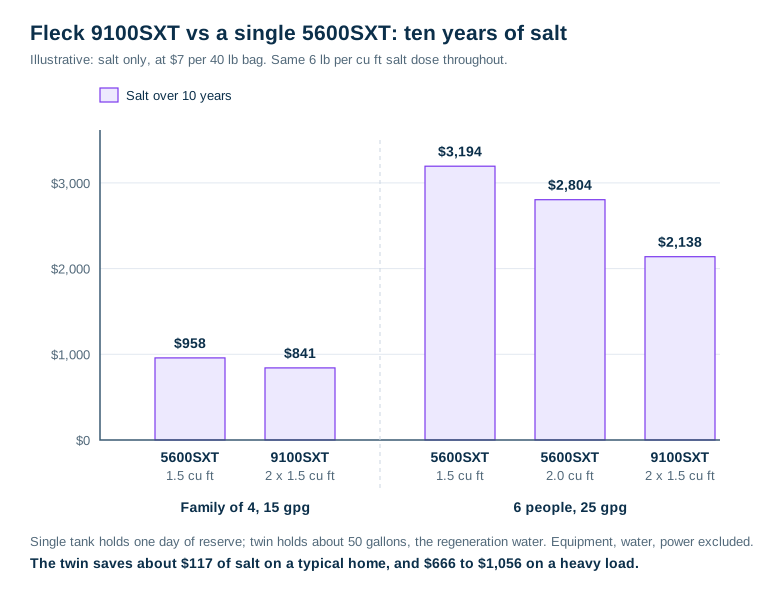
The comparison that matters: the same resin per regeneration, single tank vs twin. The 9100SXT costs noticeably more up front than a single 5600SXT with the same 1.5 cubic feet of resin. Its saving is salt, because it never regenerates a bed with a day's reserve still unused.
| Ten-year salt cost, illustrative | Salt per year | Salt, 10 years |
|---|---|---|
| Family of 4, 15 gpg (4,500 grains a day) | ||
| Single 5600SXT, 1.5 cu ft | about 548 lb, $96 | $958 |
| Twin 9100SXT, 2 x 1.5 cu ft | about 481 lb, $84 | $841 |
| 6 people, 25 gpg (11,250 grains a day) | ||
| Single 5600SXT, 1.5 cu ft | about 1,825 lb, $319 | $3,194 |
| Single 5600SXT, 2.0 cu ft | about 1,602 lb, $280 | $2,804 |
| Twin 9100SXT, 2 x 1.5 cu ft | about 1,222 lb, $214 | $2,138 |
Assumptions: 6 lb of salt per cubic foot; single-tank reserve of one day's hardness load; twin reserve of 50 gallons of regeneration water; salt at $7 per 40 lb bag; water, electricity and resin replacement not included. Add the current price of each system to compare total cost.
What the numbers say:
- On a typical family's water, the twin does not pay back. It saves about $12 a year in salt, roughly $117 over ten years, far less than the twin's higher purchase price.
- On a heavy load, it does. For six people on 25 gpg water, a single 1.5 cubic foot tank holds back over a third of its capacity as reserve every cycle. The twin uses its whole bed and saves about $1,056 in salt over ten years against that tank, and about $666 against a larger 2.0 cubic foot single tank. When this review was written, both savings were larger than the twin's extra purchase price, so the twin came out cheaper over ten years. Check today's prices against those savings.
- The real reason to buy a twin is usually not salt. It is round-the-clock soft water: homes with night shifts, small businesses, or any use pattern where a 2 a.m. regeneration window is a problem. When a single tank does run out of soft water, the cause is usually undersizing or a bad reserve setting rather than the single-tank design, as covered in single-tank vs twin-tank water softeners.
Who Should Not Buy a Fleck 9100SXT
- A typical family on moderately hard water. A correctly programmed single 5600SXT does the same job for less.
- Anyone hoping to double their flow rate. One tank serves the house at a time.
- Homes short on floor space. Two mineral tanks plus a brine tank need more room than a single unit.
- Anyone who will enter the box rating or the combined total as the capacity. The system will run past exhaustion or regenerate wastefully. Use the per-tank usable figure.
- Buyers who mainly want lower salt bills on light use. The saving is real only when the daily load is large relative to one tank.
- Anyone unsure whether they need salt-based softening at all. That decision comes first, and is covered in salt-based vs salt-free water treatment.
The verdict of this Fleck 9100SXT review: it is a well-proven twin-tank valve with the same serviceable Fleck parts and SXT controls as the 5600SXT. Buy it for a heavy daily load, very hard water or round-the-clock use, and program it with one tank's usable capacity and a reserve equal to the regeneration water. For an ordinary household, the single-tank 5600SXT is the better value.
Frequently Asked Questions
Is a Fleck 9100SXT better than a 5600SXT?
It is better at one thing: supplying soft water around the clock without holding back a day of reserve. Its two tanks alternate, so one is always in service, and each bed is run to exhaustion before it regenerates. For a typical family on moderately hard water, a single 5600SXT of the same resin volume costs less up front and less over ten years. The 9100SXT earns its price on heavy daily loads, very hard water or round-the-clock use.
Does a twin-tank softener need a reserve setting?
Only a small one. A twin-tank valve switches to the standby tank the moment the in-service tank's capacity is used, so it does not need to hold back a day's supply. But it regenerates the exhausted tank with soft water from the tank now in service. Pentair's SXT controller manual says that in twin-tank systems with soft-water regeneration, the reserve should be set to the volume of water used during regeneration, to prevent hard water break-through.
Does a twin-tank softener double the flow rate?
No. Only one tank is in service at a time, so the flow the house sees is limited by one tank's resin bed and the valve. A twin system with two 1.5 cubic foot tanks flows like a single 1.5 cubic foot softener, not a 3 cubic foot one. AFWFilters lists its 48,000-grain-per-tank 9100SXT at 6.5 gpm service and 9.8 gpm peak.
How do I set the capacity on a Fleck 9100SXT?
Enter the capacity of one tank, not both, at the salt dose you will use. For a 1.5 cubic foot tank at an efficient 6 lb of salt per cubic foot, that is about 31,500 grains, not the 48,000-grain box rating and not the 96,000-grain total. Enter your compensated hardness, then set the reserve to about the volume of water one regeneration uses.
How much does a Fleck 9100SXT system cost?
The price rises with resin per tank and resin grade: a twin with 1.0 cubic foot per tank costs least, 1.5 cubic feet per tank more, and 10% crosslink resin at 1.5 cubic feet per tank more again. Any 9100SXT twin costs more up front than a single 5600SXT with the same resin per regeneration. Prices change often, so check the current price on Amazon or the seller's store before buying.
Can a 9100SXT run on a timer instead of a meter?
The point of a twin-tank valve is metered alternation, switching tanks when one is used up. Run on a timer, it loses that advantage. Every 9100SXT system reviewed here ships with the metered SXT control.
