
Waterdrop G3P600 Review: Filter Costs, the TDS Faucet and Hard Water
This Waterdrop G3P600 review comes down to one condition. The G3P600 is a well-built tankless RO system with a fast 600 GPD rating, a 2:1 pure-to-drain ratio and a TDS readout on the faucet. Most households replace its filters on the time schedule, not the gallon limits. But its warranty only holds on municipal water under 7 grains per gallon of hardness and under 750 ppm TDS. On soft or softened city water it is easy to recommend. On hard, unsoftened water, its 24-month RO filter rating and its warranty both stop applying.
Disclosure: Hard Water Solved may earn a commission if you buy through links on this page, at no extra cost to you. It does not change which products we include or how we rank them. Read our disclaimer.
Waterdrop G3P600 Specs, Checked Against the Paperwork
Listings repeat the headline numbers. This table puts each one next to what Waterdrop's own documents actually say.
| Claim | What the document says | Source |
|---|---|---|
| 600 GPD | "Max daily production rate" 600 GPD | User manual, specifications |
| 2:1 pure to drain | 2 cups of filtered water for every 1 cup to drain | Waterdrop product page |
| 8 stages | Three cartridges: CF (pre-sediment and carbon block), RO membrane, CB (activated carbon) | User manual |
| NSF certified | Certified by IAPMO R&T to NSF/ANSI 42 and 58 for listed claims, and 372 for lead-free materials | Performance data sheet |
| TDS reduction | 93.59% at a 750 mg/L challenge under NSF/ANSI 58 | Performance data sheet |
| Fluoride | 88.23% reduction from 8.0 mg/L | Performance data sheet |
| Operating range | 14.5 to 87 psi, 41 to 100°F, municipal tap water | User manual |
| Power | 110 to 240 V AC. It needs an outlet under the sink | User manual |
| Size | 18.12" x 5.67" x 17.72", no storage tank | User manual |
| Warranty | 1 year, plus a 30-day money-back guarantee | User manual, warranty section |
Two corrections to common listing copy. First, some listings and roundups give the G3P600 NSF/ANSI 53 certification. Its own performance data sheet shows VOC results under Standard 53, but the certification statement names only 42, 58 and 372. The step-up G3P800 is the model listed with 53. Second, "8 stages" counts layers inside three cartridges. You buy and change three filters, not eight.
Where to buy: the G3P600 is sold on Amazon and on Waterdrop's own store.
How This Review Was Put Together
Method. No unit was physically tested for this review. Every figure comes from Waterdrop's G3P600 user manual, its performance data sheet, its product page, plus EPA's WaterSense figures for RO waste water. Filter schedules assume each cartridge is changed at its time or gallon limit, whichever comes first. The Amazon listing was opened to confirm it is live.
Prices are not listed here because they change often. Use the buttons to see the current price on Amazon.
What 600 GPD and 2:1 Mean at the Faucet
Flow. Without a storage tank, the G3P600 makes water as you draw it, using an internal booster pump. Waterdrop says it fills an 8 oz cup in about 8 seconds. That is slower than an ordinary kitchen tap. Filling a large pot or a 5-gallon jug takes patience, a point some owner reviews make.
Waste. A 2:1 ratio means half a gallon goes to the drain for every gallon you drink. EPA's WaterSense page on point-of-use RO says a typical system sends five gallons or more to the drain per gallon made. WaterSense-labeled units must stay at 2.3 gallons or less. The G3P600's rated ratio is well inside that, though we found no WaterSense label for it.
| Daily RO use | RO water per year | Sent to drain at 2:1 | At a typical 5:1 system |
|---|---|---|---|
| 1.5 gal | ~550 gal | ~275 gal | ~2,740 gal |
| 3 gal | ~1,100 gal | ~550 gal | ~5,480 gal |
| 6 gal | ~2,190 gal | ~1,095 gal | ~10,950 gal |
Flushing. The manual says the system flushes itself for 20 seconds after every two hours of cumulative running time. It also requires a 5-minute flush for a new CF filter, 15 minutes for a new CB filter and 30 minutes for a new RO filter. That water goes down the drain too, but it adds little over a year.
Filter Changes Per Year at Three Household Sizes
The G3P600 uses three cartridges, each with a time limit and a gallon limit. The faucet's filter-life light changes at whichever comes first.
| Filter | Life (manual) |
|---|---|
| CF prefilter (G3-N1CF) | 6 months or 550 gallons |
| CB activated carbon (G3-N3CB) | 12 months or 1,100 gallons |
| RO filter (G3P600-RO) | 24 months or 2,200 gallons |
Run those limits against three realistic usage levels:
- 1.5 gallons a day (one or two people, drinking only): about 550 gallons a year. Every filter expires on time before it reaches its gallon limit. That is two CF filters, one CB and half an RO filter each year.
- 3 gallons a day (family of four, drinking and some cooking): about 1,100 gallons a year. The filters still run out on time, and only just. The CF reaches its 550-gallon limit in about six months anyway. The filter bill is the same as at 1.5 gallons a day, but spread over twice the water, so the cost per gallon halves.
- 6 gallons a day (large family, cooking, coffee, pets): about 2,190 gallons a year. Now the gallon limits win. That is four CF filters, two CB and one RO filter a year, twice the light-use bill, at about the same cost per gallon as 3 gallons a day.
Waterdrop's own comparison table quotes an average annual filter cost that matches the time-limit schedule above, so the brand's figure is honest for most homes. It does not cover heavy use.
Two things move these numbers. Subscription pricing on Waterdrop's store takes about 5% off. The bigger risk is the RO filter wearing out early. It is the dearest of the three cartridges, so every year it falls short of 24 months adds noticeably to the bill. Hard water is the usual reason.
Reading the TDS Faucet: What a Rising Number Means
The faucet's display shows the TDS (total dissolved solids) of the water coming out, in ppm. It does not show your tap water's TDS, so the number means little on its own. The manual gives the rule for reading it.
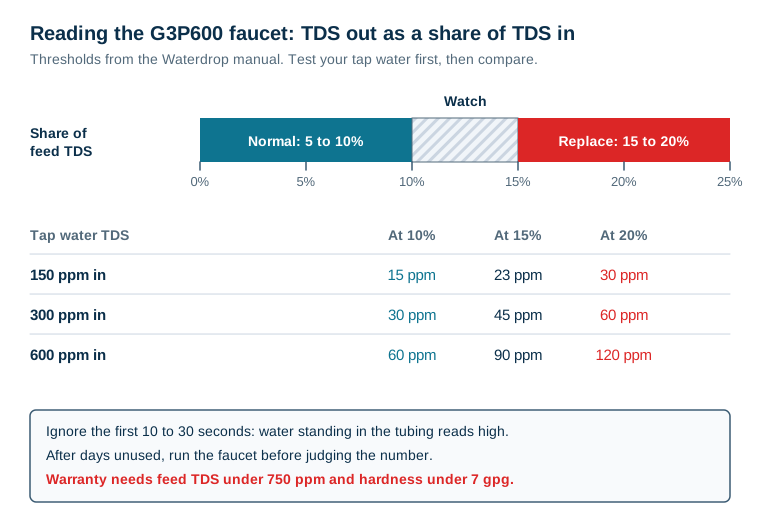
- Normal: filtered TDS about 5 to 10 percent of the tap water's TDS. The manual describes this as a 90 percent or better rejection rate.
- Replace: when filtered TDS "creeps up to 15%-20%" of the tap water's TDS, the manual says to do a routine filter replacement.
- Ignore the first 10 to 30 seconds. The manual explains that water left in the tubing makes the early reading higher than the true value.
- After the system sits unused, a high reading is expected. Run the faucet for a while and it should come back down.
- A sudden jump with a working filter light can mean a crimped or blocked drain line, which the manual lists as a cause of high TDS.
You need one more number to use this: your tap water's TDS. A handheld TDS pen gives it in seconds. Write it down on the day you install the system, and check it again every few months, because city water changes with the season.
On softened water, expect a slightly higher reading. A softener swaps calcium and magnesium for sodium. It does not lower TDS, and it can raise it a little. RO membranes generally hold back single-charge ions like sodium less completely than calcium, so the same membrane can show a few ppm more on softened water. That is normal. Watch the trend, not one reading. Why a TDS number and a hardness number are different measurements is explained in hard water vs TDS and alkalinity.
The 24-Month RO Filter on Unsoftened Hard Water
This is where the G3P600 matters most for hard-water homes. The manual's limited warranty is valid only if:
- feed pressure is 14.5 to 87 psi,
- feed temperature is 41 to 100°F,
- pH is between 6.5 and 8.5,
- turbidity is under 1.0 NTU,
- the feed is municipal tap water,
- TDS is under 750 ppm, and
- hardness is under 7 grains per gallon.
The 24-month RO rating sits inside those conditions. RO membranes concentrate calcium and magnesium on the reject side. Once that water passes calcium carbonate's limit, scale forms on the membrane surface. The membrane then makes less water and lets more dissolved solids through, which you see as a rising faucet number. Waterdrop does not publish how much shorter the RO filter lasts on 12 or 20 gpg water, and nobody else does either. The membrane-life evidence that does exist is collected in reverse osmosis and water softener together.
What this means in practice:
| Your water | Warranty | What to expect from the RO filter |
|---|---|---|
| City water under 7 gpg | Covered | The 24-month rating applies |
| City water over 7 gpg, softened | Covered, because feed hardness is now near zero | The 24-month rating applies. Feed from a softened cold line |
| City water over 7 gpg, not softened | Not covered | Shorter life by an unpublished amount. Track the TDS percentage |
| Well water, any hardness | Not covered (municipal water only) | The manual says to prefilter well water, or particles will clog the filters |
If the faucet reading reaches 15 percent of tap TDS after one year on hard water instead of two, you buy an RO filter every year instead of every other year, doubling the most expensive part of the filter bill. Track it and you will know within the first year.
For a hard-water home, the fix is usually not a different RO system. It is softening first. A whole-house softener removes the hardness the membrane objects to and treats every other tap and appliance, which an under-sink RO cannot do. How the two compare as tools, and why one rarely replaces the other, is set out in water softener vs reverse osmosis.
Installation and Under-Sink Fit
- Power: the booster pump needs an outlet in the cabinet. This is the most common surprise for buyers coming from tank systems.
- Space: about 18 x 5.7 x 17.7 inches, with no tank. That is the G3P600's biggest advantage in a crowded sink cabinet.
- Faucet hole: the manual calls for a 1-inch hole for the faucet and a 1/4-inch hole in the drain pipe for the drain saddle.
- Feed line: 3/8-inch inlet tubing, with an adapter for 3/8- and 1/2-inch cold lines. Use cold water only.
- Noise: the manual says it stays under 65 dB under lab conditions, and that rattling usually comes from the unit touching the cabinet wall or from unstable pressure.
Changing filters is quick. The cartridges twist out without shutting off the water or power, according to the manual.
G3P600 or the G3P800?
Waterdrop's step-up is the G3P800: 800 GPD, a 3:1 pure-to-drain ratio, 10 stages and NSF/ANSI 53 listed alongside 42, 58 and 372. It costs more to buy, and Waterdrop puts its average yearly filter cost slightly above the G3P600's.
For drinking and cooking water, 600 GPD is already more than a household needs. The G3P800 makes sense if the 53 certification matters for your water report, or if you want the better waste ratio. Speed alone is not a reason to pay the difference.
Pros and Cons
Pros
- Tankless, slim cabinet footprint
- 2:1 waste ratio, far better than EPA's typical 5:1
- TDS readout and filter-life lights on the faucet
- Certified to NSF/ANSI 42, 58 and 372 by IAPMO R&T
- Predictable, time-based filter schedule for most households, with honest brand cost figures
Cons
- Warranty void on well water, on feed over 7 gpg and on feed over 750 ppm TDS
- Needs an electrical outlet under the sink
- Not certified to NSF/ANSI 53, despite some listings
- Flow is slow for filling big containers
- Only a 1-year warranty
Who Should Skip the Waterdrop G3P600
- Well owners. The warranty covers municipal water only, and well water needs prefiltration first.
- Unsoftened water over 7 gpg. Soften first, or accept an uncovered membrane and a shorter filter life.
- Feed water over 750 ppm TDS. That is outside the warranty, and high-TDS water needs a system designed for it.
- Cabinets with no outlet, unless you are willing to add one.
- Anyone who mainly wants softer water for the house. RO treats one tap. Start with salt-based vs salt-free water treatment for the whole-house decision.
Waterdrop G3P600 Review: The Bottom Line
On municipal water that is soft, or softened before it reaches the sink, the G3P600 is one of the easier RO systems to live with. It is compact, it wastes little water, it has a predictable filter schedule with an honest brand cost figure, and its faucet tells you when the membrane is slipping, as long as you know your tap water's TDS. On hard, unsoftened water, its best feature, the 24-month RO filter, is no longer covered or predictable. Put a softener in front of it, or budget for an RO filter every year.
Frequently Asked Questions
How often do you change the filters on a Waterdrop G3P600?
Waterdrop's manual gives the CF prefilter 6 months or 550 gallons, the CB carbon block 12 months or 1,100 gallons, and the RO filter 24 months or 2,200 gallons, whichever comes first. Most households reach the time limit before the gallon limit, so they buy two CF filters, one CB filter and half an RO filter a year. A household using about 6 gallons a day hits the gallon limits first and buys about twice as many.
What should the TDS reading on the Waterdrop faucet be?
There is no single right number. Waterdrop's manual says the filtered water's TDS should be about 5 to 10 percent of your tap water's TDS. On 300 ppm tap water, 15 to 30 ppm is normal. When the reading climbs to 15 to 20 percent of the tap water figure, the manual says to replace the filters. Ignore the first 10 to 30 seconds of flow, which reads high.
Does the Waterdrop G3P600 work on well water?
It can filter it, but the warranty does not cover it. The G3P600 manual makes the limited warranty valid only if the feed is municipal tap water, under 750 ppm TDS and under 7 grains per gallon of hardness. Its troubleshooting section also says well water must go through a prefiltration system first, or large particles will clog the filters.
Is the Waterdrop G3P600 NSF certified?
Its performance data sheet says it is certified by IAPMO R&T against NSF/ANSI 42 and 58 for the listed claims and NSF/ANSI 372 for lead-free materials. The same sheet shows test results for VOCs under NSF/ANSI 53 and emerging compounds under NSF/ANSI 401, but the certification statement names only 42, 58 and 372.
Do I need a water softener before a Waterdrop G3P600?
If your water is over 7 grains per gallon, a softener protects both the membrane and your warranty, because Waterdrop's warranty requires feed hardness under 7 gpg. Under that, the G3P600 can run on unsoftened water. A softener also treats the rest of the house, which an under-sink RO cannot do.
