
Watts OneFlow Plus Review: Salt-Free Claims and Cartridge Costs Checked
This Watts OneFlow Plus review comes down to three checks, and the system passes only the first on independent evidence. The OneFlow+ (model OFPSYS) is a compact, salt-free unit that combines a 20-micron carbon block with a scale-prevention cartridge. Its third-party certification is real but narrow: NSF/ANSI 372, which covers the lead content of the parts that touch your water. Its scale prevention and chlorine reduction are Watts' own claims. The bigger surprise is the running cost. The carbon block is rated for 50,000 gallons, so a family of four replaces it about every five and a half months. Over a few years, the cartridges cost more than the system itself.
Disclosure: Hard Water Solved may earn a commission if you buy through links on this page, at no extra cost to you. It does not change which products we include or how we rank them. Read our disclaimer.
Watts OneFlow Plus at a Glance
| Spec | What Watts' catalog says |
|---|---|
| Model | OFPSYS, OneFlow+ Salt-Free Scale Prevention and Water Filtration |
| Connections | 1 inch |
| Flow range | 0.5 to 10 gpm |
| Stage 1 | 20-micron radial-flow carbon block, holds up to 2.2 lb of dirt |
| Carbon block rating | Chlorine taste and odour reduction for up to 50,000 gallons, at 3 gpm |
| Stage 2 | OneFlow scale-prevention cartridge, Media Assisted Crystallization (MAC) |
| Scale cartridge rating | 250,000 gallons or 3 years, whichever comes first |
| Replacement parts | OFPRFC carbon block (annually), OFPSP OneFlow cartridge (3 years), OFPCOM combo pack |
| Needs | No salt, no electricity, no backwash, no drain |
| Amazon | Check price on Amazon |
The source is Watts' current residential water quality catalog, which gives the OneFlow+ its own page. The system ships with a mounting bracket and a multi-function tool for cartridge changes.
How This Review Was Put Together
Method. No unit was physically tested. Specifications and cartridge ratings come from Watts' residential catalog. Certification was checked by model number in the WQA certified-product database and NSF's listings database. Cartridge counts are modelled from Watts' ratings and stated household water use.
- Not reviewed: the scale-only Watts OneFlow OFTWH, a single-cartridge unit for tankless heaters.
- Prices are not listed here because they change often. Use the buttons to see the current price on Amazon.
Claim 1: Certification Covers Lead-Free Parts, Nothing Else
Watts' certification badge is the claim buyers most often misread. On 2 October 2026 we searched WQA's certified-product database by model number. The OneFlow+ system, OFPSYS, appears. So do both cartridges, OFPSP and OFPRFC. All three are listed under one standard: NSF/ANSI/CAN 372, Drinking Water System Components, Lead Content. No reduction claims are attached. A search of NSF's own listings for OFPSYS returned "No Matching Products Found".
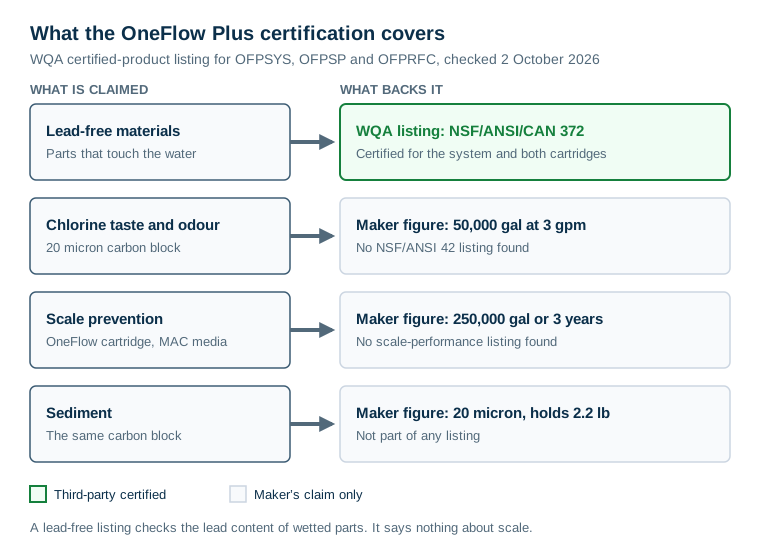
NSF/ANSI 372 checks that the wetted parts meet the lead-content limit. It is the same standard a faucet or valve carries. It says nothing about whether the system prevents scale, and nothing about chlorine.
The database does record performance claims when a product has them. Watts' own Premier UF3 drinking-water unit, for example, is listed under NSF/ANSI 42 for chlorine, taste and odour and NSF/ANSI 53 for cyst, lead and VOC reduction. The OneFlow+ carbon block has no such entry. Its 50,000-gallon chlorine figure is Watts' own rating. How to run this kind of check on any badge, in a couple of minutes, is shown in how to verify a softener certification.
None of this means the product does not work. It means the evidence for scale and chlorine performance is Watts' word, plus whatever the category research says.
Claim 2: The Scale Cartridge Prevents Scale Without Softening
Watts describes the OneFlow cartridge as Media Assisted Crystallization. The media "attract[s] hardness minerals and convert[s] them into harmless, inactive microscopic crystal particles", which "stay suspended in the water and are passed to drain". The catalog then says, in bold terms, "The OneFlow+ system is not a water softener."
That is accurate, and it is the right way to judge the product:
- A hardness test will read the same before and after installation. That is normal and does not mean the cartridge has failed.
- Scale in heated equipment is the target. Water heaters, tankless units, kettles and pipework are where crystallization media can make a difference.
- Spotting continues. Water drying on glass, taps and shower screens still leaves its minerals behind, especially at higher hardness.
Watts says the system has "proven third party laboratory test data". The catalog does not publish it, and we did not find it in the certification listings. The best independent evidence for this type of media is category-level. A WateReuse study funded partly by the Bureau of Reclamation found template-assisted crystallization media cut scale by more than 88% under a heated lab protocol. That result covers the technology class, not this cartridge. Where salt-free media fits, and where it does not, is set out in salt-based vs salt-free water treatment.
The water it needs
Crystallization media is far fussier about the water than a softener. Watts' OneFlow engineering specification sets these limits for its OneFlow media, with the lower hardness figure applying to cartridge models. The OneFlow+ catalog page does not print a separate table, so treat these as the working limits:
- Hardness: 30 gpg maximum for cartridge models
- Iron: under 0.3 mg/L. Manganese: under 0.05 mg/L. Copper: under 1.3 mg/L
- Free chlorine: under 2 ppm
- Phosphates: under 3.0 ppm, and no other antiscalant before or after the media
- Silica: 20 ppm. Watts notes that OneFlow does not reduce silica scaling
- pH: 6.5 to 8.5. Water temperature: 40 to 100°F
City water usually meets these. Many wells do not without an iron filter in front. What happens near the 30-grain line, and why the two published hardness figures differ, is explained in hardness limits for salt-free conditioners.
Claim 3: The Carbon Stage Improves Taste and Odour
The first stage is a 20-micron radial-flow carbon block. Watts rates it for chlorine taste and odour reduction for up to 50,000 gallons, at a flow rate of 3 gpm, and lists it as an annual change. It also holds up to 2.2 lb of dirt, so it doubles as the sediment prefilter for the scale cartridge.
Two details in that rating matter:
- The 50,000-gallon figure is quoted at 3 gpm. The system is rated to 10 gpm. Carbon reduces chlorine through contact time, and Watts does not give a capacity at the higher flow. Two showers and a dishwasher at once will push water through faster than the rating assumes.
- It is not optional. The scale media needs free chlorine under 2 ppm and sediment kept off it. A spent or skipped carbon block stops protecting the scale cartridge, the dearer of the two.
For many households, the carbon block is useful in its own right. City water with a chlorine taste will taste better while the block is fresh. Just budget for it as a running cost, not a once-a-year extra.
How Many Cartridges Five Years Takes
This is where the OneFlow+ differs most from a whole-house tank system. Both cartridges run out on gallons or time, whichever comes first. For most homes, gallons come first.
Assumptions: 75 gallons per person per day; carbon block replaced every 50,000 gallons or every 12 months; scale cartridge every 250,000 gallons or 3 years.
| 2 people, 150 gal/day | 4 people, 300 gal/day | |
|---|---|---|
| Water used per year | about 54,750 gal | about 109,500 gal |
| Carbon block lasts | about 11 months | about 5.5 months |
| Carbon blocks in 5 years | 5 | 10 |
| Scale cartridge lasts | 3 years (calendar limit first) | about 27 months (gallons first) |
| Scale cartridges in 5 years | 1 | 2 |
Illustrative. Your water use will move these counts. Multiply them by the current cartridge prices you find; the OFPCOM combo pack may lower the cost of a combined change.
Three things follow:
- The family of four never sees the three-year scale cartridge life. At 300 gallons a day it reaches 250,000 gallons in about 27 months.
- The carbon block is the bigger cost. Both households buy five carbon blocks for every scale cartridge.
- Combine the changes. For the four-person home, every fifth carbon change falls about when the scale cartridge is due. That is when a combo pack makes sense.
For comparison, the site's worked example in salt-free water conditioner maintenance puts a whole-house salt-free tank at about $210 to $290 a year, and a softener's salt and upkeep at about $113 to $238 a year at 10 to 25 gpg. The OneFlow+ costs more to run than either for a family. The cartridge format and the small carbon block are why.
Installation Notes
- Cold line, before the water heater. Watts says the system goes on the cold water service line, "just prior to the service line feeding the residential home".
- 1-inch connections. Fit shutoff valves on both sides, and a bypass loop if you can, so the system can be isolated for cartridge changes and during any shock chlorination.
- Mounting. The bracket and multi-function tool come in the box. Leave room below the housings for the cartridges to come out.
- Safe water first. Watts warns not to use the system "with water that is microbiologically unsafe or of unknown quality without adequate disinfection".
- Not in heat or frost. Keep the inlet water within 40 to 100°F, and keep the unit out of unheated spaces.
- Write the install date and gallons on each housing. Both cartridges are counted in gallons, and the system has no meter.
Pros and Cons
Pros
- No salt, power, drain or wastewater, so it fits where a softener cannot
- Compact cartridge format with 1-inch connections and a mounting bracket included
- Carbon stage improves chlorine taste and protects the scale media from sediment
- Lead-free materials certified by WQA under NSF/ANSI/CAN 372 for the system and both cartridges
- Watts is clear that it is not a softener, and publishes its feed-water limits
Cons
- No third-party listing for scale performance or chlorine reduction
- 50,000-gallon carbon block means changes every 5 to 11 months for most homes
- Cartridges are a large running cost: one to two carbon blocks a year on our assumptions
- No meter, so cartridge life must be tracked by hand
- No help with iron, manganese, spotting or soap use
Watts OneFlow Plus Review: The Verdict
The OneFlow+ is an honest product with a misleadingly simple pitch. It does what Watts says it does, on Watts' word: crystallization media for scale in heated equipment, and a carbon block for taste. It is the right size for a small household on clean city water, below about 30 gpg, that cannot fit a softener and mainly wants to protect a water heater.
Read the certification for what it is. The lead-free listing is worth having on any part that touches drinking water. It is not evidence of scale or chlorine performance. Then budget for the carbon block on gallons, not on the calendar. For two people, that is five carbon blocks and one scale cartridge in five years. For four, it is ten carbon blocks and two scale cartridges.
Who the Watts OneFlow Plus Is Wrong For
- Anyone who wants soft water. No change to hardness, soap use, feel or spots. A softener does that.
- Families of four or more on a budget. Ten carbon blocks and two scale cartridges in five years cost more than a softener's salt at most hardness levels.
- Homes above about 30 gpg. That is the cartridge models' limit, and spotting gets worse well before it.
- Well water with iron, manganese or bacteria. The media needs iron under 0.3 mg/L and manganese under 0.05 mg/L, and safe water. Treat those first.
- Homes with a phosphate feeder or another antiscalant. Watts says not to use one before or after the media. Choose one treatment.
- Buyers who want third-party proof of scale reduction. The OneFlow+ has none listed. If that matters, compare products whose scale or reduction claims appear in the certification databases.
Frequently Asked Questions
Is the Watts OneFlow Plus certified?
Yes, but only for lead-free materials. On 2 October 2026, WQA's certified-product database listed the OneFlow+ system (OFPSYS) and both replacement cartridges (OFPSP and OFPRFC) under NSF/ANSI/CAN 372, the lead-content standard. We found no listing for chlorine taste and odour reduction or for scale performance, and NSF's own database returned no match for OFPSYS.
How often do you change the Watts OneFlow Plus cartridges?
Watts rates the carbon block for 50,000 gallons and lists it as an annual change, and the OneFlow scale cartridge for 250,000 gallons or 3 years, whichever comes first. A two-person home using 150 gallons a day reaches 50,000 gallons in about 11 months. A four-person home at 300 gallons a day reaches it in about 5.5 months, and uses up the scale cartridge in about 27 months.
Does the Watts OneFlow Plus soften water?
No. Watts says plainly that the OneFlow+ system is not a water softener. Its media converts hardness minerals into microscopic crystals that stay suspended in the water, so a hardness test reads the same before and after. It aims to reduce scale in water heaters, pipes and fixtures. It does not give soap lather, a slippery feel or spot-free glass.
How much do OneFlow Plus replacement cartridges cost?
The bill depends mostly on how fast you use up the 50,000-gallon OFPRFC carbon block. On our assumptions, a two-person home buys five carbon blocks and one OFPSP scale cartridge in five years, and a four-person home ten carbon blocks and two scale cartridges. Prices vary by seller and change often, so check the current price on Amazon and at plumbing suppliers before buying.
Can the Watts OneFlow Plus be used on well water?
Only after pretreatment. Watts' OneFlow specifications require iron below 0.3 mg/L and manganese below 0.05 mg/L, and they warn against microbiologically unsafe water without disinfection. Many wells need an iron filter, and sometimes disinfection, ahead of it. A carbon block is not an iron filter.
