
AFWFilters Iron Pro 2 Review: Sizing It for Real Well Water
This AFWFilters Iron Pro 2 review comes down to one point: it is a good buy for one specific well, with dissolved, clear-water iron up to about 5 ppm, a pH above 6.7 and moderate hardness. It is a Fleck 5600SXT metered softener with fine-mesh resin, so it removes iron the same way it removes hardness, by ion exchange. It cannot remove iron that has already rusted, and it is no answer to iron bacteria. Size it on compensated hardness, not on the grain number in its name. On iron water, the right model is usually smaller than the one you would pick by instinct.
Disclosure: Hard Water Solved may earn a commission if you buy through links on this page, at no extra cost to you. It does not change which products we include or how we rank them. Read our disclaimer.
AFWFilters Iron Pro 2 at a Glance
The Iron Pro 2 is sold in four resin volumes, all on the same Fleck 5600SXT digital metered valve. The figures below come from AFWFilters' own product pages.
| Model | Resin | Service / peak flow | Brine tank | Amazon |
|---|---|---|---|---|
| 32k | 1.0 cu ft | 5 / 7.5 gpm | 14" square | not confirmed |
| 48k | 1.5 cu ft | 6.5 / 9.8 gpm | 14" x 14" x 36" | Check price on Amazon |
| 64k | 2.0 cu ft | 10 / 15 gpm | 18" x 33" round | Check price on Amazon |
| 80k | 2.5 cu ft | 11 / 16 gpm | 18" x 33" round | Check price on Amazon |
What every size shares:
- Valve: Fleck 5600SXT, metered (on-demand) regeneration with a regeneration day override.
- Resin: sold as fine mesh, rated by AFWFilters for ferrous iron "up to 6 ppm".
- Connections: 3/4" or 1" MNPT plastic, or stainless steel FNPT as an upgrade. A bypass is included.
- Warranty: 5 years on the control head and 10 years on the mineral tank, per AFW's listing.
- Operating limits: 20 to 125 psi and water no hotter than 110°F, from the Fleck 5600SXT manual.
The 64k model is the one most listings and reviews describe, and the one that sells as "Iron Pro 2" on Amazon. It is not the right size for most of the wells it is sold to, as the sizing section shows.
How This Review Was Put Together
Method. No unit was physically tested for this review. It is built from AFWFilters' product pages, the Pentair Fleck 5600SXT service manual, Penn State Extension's guidance on iron in private wells, and sizing arithmetic using a fixed salt dose of 6 lb per cubic foot of resin (about 21,000 grains per cubic foot). Each Amazon listing was opened to confirm the product page exists.
Prices are not listed here because they change often. Use the buttons to see the current price on Amazon.
The Iron Pro 2 Removes One Kind of Iron
Most iron in a private well arrives dissolved, as ferrous iron. It is invisible at the tap and turns orange only after the water meets air. A softener resin can swap ferrous iron for sodium just as it swaps calcium. Once iron has oxidized into ferric iron, it is a solid particle. Resin cannot exchange a particle. It traps it, and the bed slowly clogs.
AFWFilters says this plainly on its 80k listing: the system removes "up to 6 ppm of ferrous iron", and "if ferric iron or higher levels of iron are present a separate iron filter is recommended". Penn State Extension's guide to iron and manganese is stricter. It recommends a softener for iron only when the pH is above 6.7, hardness is between 3 and 20 grains per gallon and dissolved iron is below 5 mg/L. It also warns that raw water must not meet air or chlorine before the softener, and that using a resin bed as a filter for oxidized iron "is generally not recommended".
So the first check is not grain capacity. It is the form your iron is in. The free glass test in dissolved vs oxidized iron in well water answers that in half an hour.
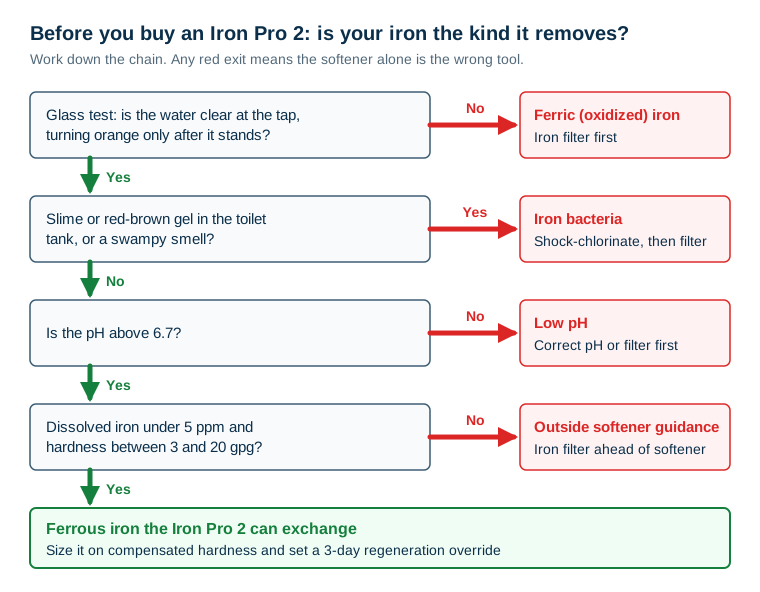
Three results rule the Iron Pro 2 out on its own:
- Water that is already orange or cloudy at the tap. That is ferric iron, and it needs a filter first.
- Slime, red-brown gel in the toilet tank, or a swampy smell. That points to iron bacteria. They coat resin and valve ports, and shock chlorination plus filtration come before any softener.
- Low pH. Below about 6.7, Penn State's conditions for softening iron are not met.
If all three are clear and the lab result sits under 5 ppm, the Iron Pro 2 is a reasonable single-tank answer.
Compensated Hardness: The Number You Program
A metered Fleck valve divides the bed's capacity by the hardness you enter, then counts gallons. If you enter raw hardness on a well with iron, the valve thinks the bed lasts longer than it does. Iron uses up exchange sites, so it has to be counted as extra hardness.
Compensated hardness = hardness (gpg) + 4 × (iron ppm + manganese ppm)
Manuals differ on the multiplier, from 3 to 5 grains per ppm. This review uses 4, the middle figure. The reasons for that, and what each multiplier does to the result, are worked through in how iron changes water softener sizing.
That page makes one more point that matters for this product. Iron that stays on the bed lowers the next cycle's capacity. Manufacturers recommend a regeneration day override when iron is present, and about three days is a sensible upper limit. The Fleck 5600SXT manual describes the same setting: the valve regenerates once the set number of days passes, even if the meter has not run out.
That rule changes which Iron Pro 2 you should buy.
Sizing the AFWFilters Iron Pro 2 for Three Real Wells
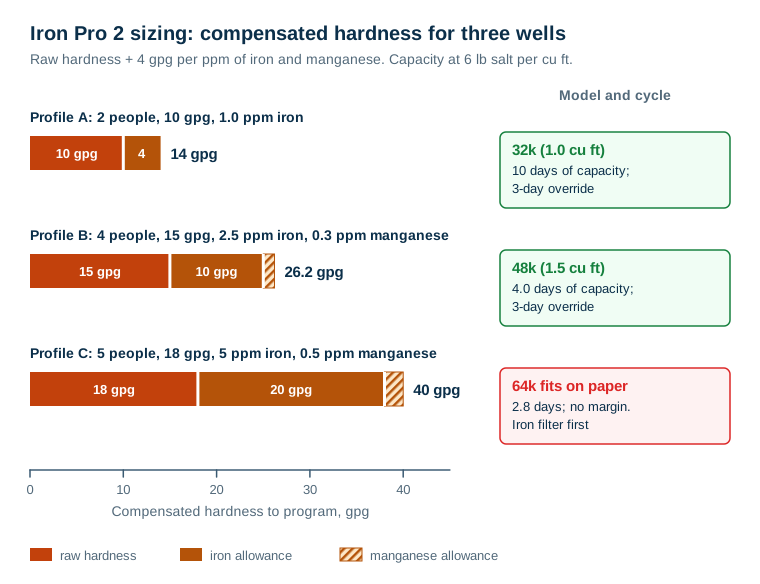
Each profile below assumes 75 gallons per person per day and a salt dose of 6 lb per cubic foot of resin. At that dose, 1.0 cu ft gives about 21,000 grains, 1.5 cu ft about 31,500, 2.0 cu ft about 42,000 and 2.5 cu ft about 52,500. Those are well below the names on the boxes. The gap is explained in advertised vs usable softener capacity.
Profile A: Two people, 10 gpg, 1.0 ppm iron
- Compensated hardness: 10 + (4 × 1.0) = 14 gpg
- Daily load: 14 × 150 gallons = 2,100 grains
- 32k (1.0 cu ft): 21,000 ÷ 2,100 = 10 days of capacity
- 48k (1.5 cu ft): 31,500 ÷ 2,100 = 15 days
Both beds last far longer than three days, so the day override does the work. Either model regenerates about 122 times a year. The 32k uses 6 lb of salt each time, about 730 lb a year. The 48k uses 9 lb, about 1,100 lb a year. That is the same soft water for roughly nine more 40 lb bags. A 5 gpm service flow covers a two-person house with one bathroom in use at a time.
Pick: the 32k. We could only confirm it on AFWFilters' own store, not as a current Amazon listing.
Profile B: Family of four, 15 gpg, 2.5 ppm iron, 0.3 ppm manganese
- Compensated hardness: 15 + (4 × 2.8) = 26.2 gpg
- Daily load: 26.2 × 300 gallons = 7,860 grains
- 32k: 2.7 days. 48k: 4.0 days. 64k: 5.3 days
On capacity alone, the 32k lasts almost exactly the three days iron calls for. Its 5 gpm service flow is the problem. Two showers and a washing machine at once can ask for more than that, and pressure drops. The 48k's 6.5 gpm service and 9.8 gpm peak flow are a better match for a four-person house. With the three-day override it regenerates about 122 times a year at 9 lb, roughly 1,100 lb of salt. The 64k would also regenerate every three days, but at 12 lb each time, or about 1,460 lb.
Pick: the 48k. Choose the 64k only if you have three or more bathrooms that often run together.
Profile C: Five people, 18 gpg, 5 ppm iron, 0.5 ppm manganese
- Compensated hardness: 18 + (4 × 5.5) = 40 gpg
- Daily load: 40 × 375 gallons = 15,000 grains
- 64k (2.0 cu ft): 42,000 ÷ 15,000 = 2.8 days
- 80k (2.5 cu ft): 3.5 days, so the three-day override still applies
The arithmetic finds an answer. The 64k regenerates about every 2.8 days, around 130 times a year at 12 lb, which is about 1,560 lb of salt, or 39 bags. But 5 ppm is right at Penn State's limit and only 1 ppm under AFW's rating. If the iron rises, or any of it oxidizes in the pressure tank, the resin becomes the filter for it.
Put a dedicated iron filter ahead of the softener and the softener is sized on 18 gpg alone. That is 6,750 grains a day, so the same 64k lasts about 6.2 days and uses roughly 700 lb of salt a year. The iron filter has its own cost to run, but the softener stops carrying iron at its limit.
Pick: the 64k only with an iron filter in front of it. As a single tank, this well is outside the conditions the Iron Pro 2 is designed for.
The three wells side by side
| Profile | Compensated hardness | Grains per day | Model | Days of capacity | Salt per year |
|---|---|---|---|---|---|
| A: 2 people, 1.0 ppm Fe | 14 gpg | 2,100 | 32k | 10 (3-day override) | ~730 lb |
| B: 4 people, 2.5 ppm Fe | 26.2 gpg | 7,860 | 48k | 4.0 (3-day override) | ~1,100 lb |
| C: 5 people, 5 ppm Fe | 40 gpg | 15,000 | 64k | 2.8 | ~1,560 lb |
| C with iron filter first | 18 gpg | 6,750 | 64k | 6.2 | ~700 lb |
Days of capacity are before the valve's reserve. Salt figures assume 6 lb per cubic foot of resin per regeneration.
Why the Biggest Iron Pro 2 Is Often the Wrong One
With hardness only, a bigger bed regenerates less often and uses salt more efficiently. Iron reverses that. Once the three-day override is in charge, every regeneration happens on schedule whether the bed is spent or not. A larger bed then simply burns more salt per cycle.
That is why Profile A should not buy the 64k "to be safe". It would regenerate the same 122 times a year as the 32k, at twice the salt. For iron wells, choose the smallest bed that:
- lasts about three days on compensated hardness, and
- has a service flow rating that covers your household's busiest moment.
Flow, not capacity, is usually the reason to move up a size.
Fine-Mesh Resin: What It Changes, and a Listing Problem
Fine-mesh resin has smaller beads, so it has more surface area for the same volume. Iron moves into and out of the beads faster, which helps them regenerate cleanly. What fine mesh does not do is raise the amount of iron a softener can handle. Resin manufacturers' data sheets give no iron limit by bead size. The trade-offs, including the gentler backwash fine mesh needs and its extra pressure drop, are covered in standard vs fine-mesh softener resin.
One thing to check before you order: AFWFilters' Iron Pro pages call the resin fine mesh in the title and bullet points. Further down, the same pages carry a paragraph saying "inside every unit is upgraded 10% crosslink resin". Those are two different products. Fine mesh is about bead size. 10% crosslink is about chlorine resistance. A resin can be both, but the listing does not say so. Ask AFWFilters which resin is in the tank, in writing, before you buy. This matters most if your well is chlorinated for bacteria.
Installation and Setup Notes From the Fleck Manual
The Iron Pro 2 ships as a DIY system, with AFW's illustrated instructions and video. Some owner reviews call the written programming steps vague, so keep the Fleck manual to hand as well.
- Pressure and temperature. The valve needs at least 20 psi to regenerate, and no more than 125 psi or 110°F.
- Clean pipes first. The manual notes that piping clogged with iron should be replaced, and that a separate iron filter belongs ahead of the softener in that case.
- Enter compensated hardness in the hardness setting, not your raw test result.
- Set the day override to 3 days for iron.
- Backwash flow matters. AFW lists 2.2 gpm of backwash flow for the 32k and 4.5 gpm for the 80k. Check that your well pump can deliver that while the house is quiet. Fine mesh is more easily lost to the drain than standard resin if the drain flow is wrong.
- Space. The 64k and 80k come with an 18-inch round brine tank. The floor space the two tanks need is a common complaint in published reviews.
The Iron Pro 2 sits after the pressure tank and before the water heater. If any line is chlorinated before it, the iron will oxidize on the way in, which undoes the reason for buying it.
Running Cost and Warranty
The price step from one size to the next is not the real difference. The salt is. In Profile A, the bigger bed costs about 370 lb more salt every year, and that is a running cost you will pay long after the purchase price is forgotten.
The warranty listed by AFWFilters is 5 years on the Fleck control head and 10 years on the mineral tank. We found no separate warranty on the resin. Resin fouled by ferric iron or bacteria is a water-chemistry problem, not a defect, so treat the decision chart above as the real warranty.
Pros and Cons
Pros
- Fleck 5600SXT is a common valve, so parts and service knowledge are easy to find
- Metered regeneration plus a day override, which is exactly the control iron water needs
- Four resin volumes, so you can size small for iron instead of buying the biggest bed
- Rated for ferrous iron up to 6 ppm, and AFW states its ferric iron limit honestly
- 5-year valve and 10-year tank warranty, per the listing
Cons
- Removes ferrous iron only, so no help with rust that is already visible, or with iron bacteria
- The listing contradicts itself on resin type
- The 5600SXT is a 3/4-inch valve, so large homes outgrow its flow before its capacity
- Two tanks and an 18-inch brine tank on the larger models take real floor space
- The 32k, the right size for many small iron wells, was not confirmed as a current Amazon listing
Who Should Not Buy the AFWFilters Iron Pro 2
- Anyone whose water is orange at the tap. That is oxidized iron. Filter it first.
- Wells with iron bacteria, sulfur smell or tannins. A softener treats none of them.
- Wells over 5 ppm of iron, or close to it. Use an iron filter ahead of a plain softener. The Iron Pro 2 then becomes an expensive way to buy fine mesh you no longer need.
- City water with chlorine and no iron. Fine mesh adds nothing there, and chlorine oxidizes any iron before the bed.
- Homes over about 10 gpm of real demand. The 5600SXT runs out of flow before it runs out of capacity. A larger valve is the better fit.
- Anyone deciding whether to soften at all. Start with salt-based vs salt-free water treatment. The Iron Pro 2 is a salt-based softener, and salt-free conditioners do nothing for iron.
AFWFilters Iron Pro 2 Review: The Verdict
The AFWFilters Iron Pro 2 does what it says, within limits it states honestly: hardness plus ferrous iron up to 6 ppm, on a reliable Fleck valve, at a fair price for a complete system. Most bad experiences come from the water, not the hardware. People buy it for iron that has already oxidized, or size it from the grain number on the box.
Run the glass test. Confirm the iron level with a lab. Add 4 gpg per ppm of iron and manganese. Then buy the smallest model that lasts about three days and keeps up with your peak flow. For most two-person wells that is the 32k, and for a typical family it is the 48k. The 64k only earns its place on a well big enough to need its flow, or behind an iron filter.
Frequently Asked Questions
Does the AFWFilters Iron Pro 2 remove iron bacteria?
No. The Iron Pro 2 removes dissolved ferrous iron by ion exchange, the same way it removes calcium and magnesium. Iron bacteria form slime and red-brown gel that coat the resin and the valve. If you see slime in the toilet tank or smell a swampy odour, the well needs shock chlorination and a filter ahead of any softener.
How much iron can the Iron Pro 2 handle?
AFWFilters rates it for up to 6 ppm of ferrous iron. Penn State Extension's guidance for softeners is lower: dissolved iron under 5 mg/L, pH above 6.7 and hardness between 3 and 20 grains per gallon. If your well is close to either limit, an iron filter ahead of the softener is the safer design.
Which size Iron Pro 2 do I need?
Add 4 grains per gallon for every ppm of iron and manganese to your hardness, multiply by daily water use, and choose the bed that lasts about three days. Two people on 10 gpg water with 1 ppm iron need only the 1 cubic foot model. A family of four on 15 gpg with 2.5 ppm iron fits the 48,000-grain model. Flow rate can push you one size up.
Is the Iron Pro 2 fine-mesh resin or 10% crosslink resin?
AFWFilters sells it as a fine-mesh resin system, and the product titles say so. Some of the same store pages also contain a paragraph saying every unit has upgraded 10% crosslink resin. The two are different resin grades, so ask AFWFilters which one is in the tank before you order, especially if your water is chlorinated.
What warranty does the Iron Pro 2 come with?
AFWFilters' product pages list a 5-year warranty on the Fleck 5600SXT control head and a 10-year warranty on the mineral tank. Read the warranty terms on the listing you buy from, because the warranty is provided by the seller and the valve maker, not by Amazon.
