
Dissolved vs Oxidized Iron in Well Water

The difference between dissolved vs oxidized iron shows up in a glass of cold water within 30 minutes. Water that comes out clear and turns orange as it stands carries dissolved (ferrous) iron. Water that is already tinted or specked at the tap carries oxidized (ferric) iron. A softener can only treat the first kind. The second needs filtration.
That test costs nothing and it decides which equipment is worth considering. A lab confirms it, but the lab result has a trap of its own: iron can oxidize inside the sample bottle before anyone measures it. Both are covered below.
Dissolved vs Oxidized Iron: What Actually Differs
It is the same element in two chemical states. They behave so differently that they need different treatment.
| Dissolved (ferrous, Fe²⁺) | Oxidized (ferric, Fe³⁺) | |
|---|---|---|
| Common names | Clear-water iron, reduced iron | Red-water iron, particulate iron |
| At the tap | Clear and colorless | Orange, red or yellow tint, or visible specks |
| In a standing glass | Turns cloudy, then orange, then settles | Already colored; particles settle over time |
| Physical state | Dissolved ion | Solid particles of ferric hydroxide |
| Where it comes from | Low-oxygen groundwater | Ferrous iron that met air or chlorine, or rust from pipe, casing or tank |
| What removes it | Ion exchange within limits, or an oxidizing filter | Filtration that catches particles |
| What it does to a softener | Exchanges like hardness and uses up capacity | Fouls the resin bed |
Penn State Extension uses the terms "reduced" and "oxidized" and gives the visual rule. Water that is clear when collected but forms orange-brown or black particles over time holds dissolved metals. Water with particles visible straight away holds metals that are already oxidized.
The two forms are not a fixed property of the aquifer. Ferrous iron becomes ferric the moment it gets enough oxygen. Where that happens, whether in the well, the pressure tank, the plumbing or your glass, decides what reaches the softener.
The 30-Minute Glass Test, Step by Step
You need two clear drinking glasses, a sheet of white paper, a phone camera and a timer.
- Pick the right tap. Use the one closest to the well, ahead of any softener or filter. A hose bibb or the drain valve by the pressure tank is often the best choice. If the only taps are downstream of treatment, put the treatment in bypass first.
- Run the cold water until it is cold and steady. NDSU Extension advises running water for 15 minutes before a lab sample so that it comes from the aquifer and not the pipes. A few minutes is enough for the glass test, but the longer run is worth doing if the house has been empty.
- Fill one glass gently, without splashing, so you do not add air.
- Fill the reference glass with bottled or distilled water. Set both side by side on the white paper in steady light. The reference glass lets you see a faint tint that you would miss when looking at one glass on its own.
- Photograph both glasses from the same spot at 0, 5, 15 and 30 minutes. Keep the phone still.
- Leave the glass for an hour and take a final look. Some color changes are slow.
The photographs matter more than they seem to. A slow change is easy to misremember. A set of four time-stamped pictures is also more useful than a description when you show it to an installer, or when you compare it with a lab report weeks later.
Reading the Glass at 0, 5, 15 and 30 Minutes
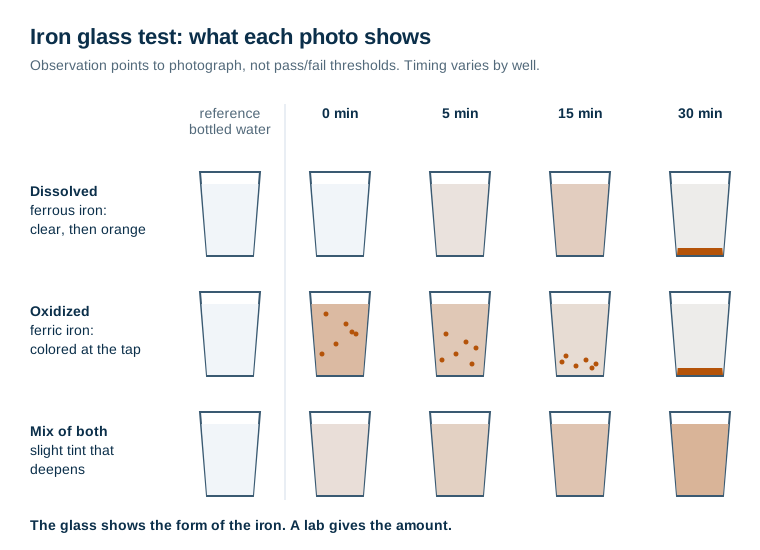
Compare your photographs against this table:
| What the photos show | What it means | Equipment path |
|---|---|---|
| Clear at every time stamp, no fixture staining | No meaningful iron in either form | Iron is not your problem. Confirm with a lab if fixtures stain anyway |
| Clear at 0, a faint haze by 5 to 15 minutes, orange particles settling by 30 | Dissolved ferrous iron | A softener is possible within its rating, and an oxidizing filter is the alternative |
| Tinted or specked at 0, particles settle, clearer water above them | Oxidized ferric iron | Filtration ahead of any softener |
| Slight tint at 0 that deepens as the glass stands | A mix of both | Treat it as oxidized for equipment purposes |
| Dark brown to black specks or haze | Manganese, alone or with iron | Measure manganese; it fouls resin as well |
| Yellow or tea color that does not settle, even after an hour | Tannins or organically bound iron | Neither form above. See why softened water looks yellow |
Things the glass test cannot tell you:
- It does not give you a concentration. A faint change might be 0.5 ppm or 2 ppm. The glass tells you the form of the iron and the lab tells you the amount.
- It does not set a timetable. How fast the change happens varies from one well to another. The time stamps are a record for comparison, not a pass or fail.
- Low iron is easy to miss. A very faint tint can escape the eye, which is what the reference glass and the photographs are for.
Where You Draw the Glass Changes the Answer
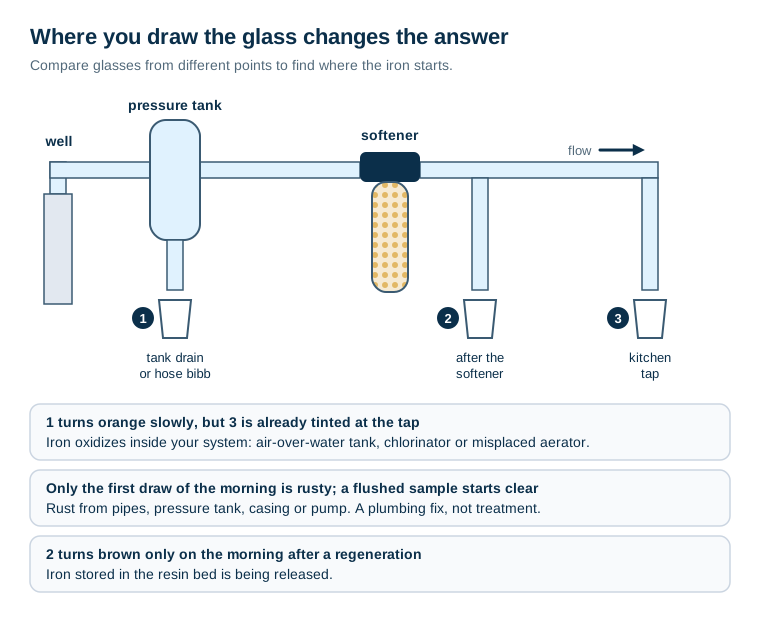
One glass from the kitchen tap tells you what arrives at the kitchen. It does not tell you what leaves the well. Pouring glasses from three places will usually show where the problem starts.
At the wellhead or pressure tank compared with a downstream tap. Suppose the wellhead glass starts clear and turns orange, but the kitchen glass is already tinted when it comes out. The iron is oxidizing inside your system, before it reaches the treatment. An older tank where air and water share the same space, a chlorinator, or an aerator installed in the wrong position can each cause this. It matters because a softener needs the water to arrive un-oxidized. Hellenbrand's softener manual says outright that air "must be kept from coming in contact with water" until it has been softened.
First draw of the morning compared with water that has been flushed. NDSU Extension lists rusted galvanized pipes and connections, a rusted pressure tank, and rust from the well casing or pump as sources of particulate iron. If only the first draw after the water has sat overnight comes out rusty, and a flushed sample starts clear, the iron is coming from the plumbing and not the aquifer. That is fixed in the plumbing, not with treatment equipment.
Before and after an existing softener. If treated water turns brown only on the morning after a regeneration, the source is iron stored in the resin bed. That is covered in brown water after softener regeneration.
The Sampling Trap: Iron That Oxidizes in the Bottle
The chemistry that makes the glass test work also spoils lab samples. Dissolved iron does not stop oxidizing because the water is in a sample bottle.
The EPA's guidance on groundwater sampling for metals states the problem directly. Filtering oxygen-poor groundwater "is very difficult without iron oxidation and colloid formation", which removes iron that was dissolved when the sample was drawn. A household sample carried in a half-full bottle is exposed to the same process for hours.
The trap can push the result in either direction:
- The dissolved figure reads low, and the iron looks more oxidized than it was. Suppose the lab filters the sample when it arrives. Iron that was dissolved at the tap but precipitated in transit is caught by the filter and counted as particulate. The gap between total and dissolved iron grows, so a well that is really ferrous looks ferric on paper. You could end up buying a filter you did not need.
- The total figure reads low. Iron that settles or sticks to the bottle wall is missed if only the water above it is analyzed. Equipment sized on that number will be too small.
Neither mistake shows on the report. It will print a figure to two decimal places either way.
The Preservation Method That Prevents It
The laboratory approach is to stop the chemistry at the tap, and it is different for each measurement.
For total iron, the bottle is acidified. EPA Method 200.8 requires total metals samples to be left unfiltered and acidified with nitric acid to pH below 2. The requirement is quoted in an EPA drinking water memo on acidified metals samples. At that pH, iron is held in solution, which is why a preserved bottle gives a far more reliable total than one left untreated. The same memo says acidification may be done at the laboratory instead of at the tap, provided the method's shipping-time instructions are followed. It also says an acidified sample must then stand for 16 hours before analysis.
For dissolved iron, the sample is filtered in the field before air reaches it. The EPA sampling guidance says filtration for dissolved species "should be performed in the field with no air contact and immediate preservation." Filtering at the bench a day later measures what survived the trip, not what came out of the well.
What that means when you order a test:
- Ask for a metals bottle pre-charged with preservative for total iron. Do not rinse it before filling, because that washes out the acid. Other bottle-handling errors are covered in water hardness sampling mistakes.
- Ask whether the lab can report dissolved iron from a field-filtered sample, and how the filtering is done. If they filter at the bench, treat any "dissolved" result with caution.
- Fill to the top, cap it straight away, keep it cool and deliver it the same day. Less air and less time mean less oxidation, whatever the bottle.
- If field filtering is not available, pair the lab's total iron with your glass photographs. The glass shows the form and the preserved bottle gives the amount. Together they answer the equipment question.
The full test panel, including manganese, pH and hardness, is set out in test iron and manganese before sizing a softener.
Two Results That Fit Neither Box
Iron bacteria. NDSU Extension describes their signature as a brown slimy material, or black-brown where manganese is involved. A glass from such a well can look like an ordinary ferrous result, so the slime in tanks, toilets and fixtures is what gives it away. Neither a softener nor a standard iron filter treats the bacteria themselves.
Organic or tannin-bound iron. Iron attached to dissolved organic matter stays yellow or brown, does not settle and does not clear with standing. It behaves like neither form in the table and needs its own treatment approach.
If your glass does either of these things, go no further with the ferrous and ferric decision until the cause is identified.
What Your Result Means for Equipment
- Dissolved only, at a low concentration, pH above 6.7. A softener may be able to carry it. The conditions and published limits are in can a water softener remove iron, and one fine-mesh unit built for this case is weighed in our review of the AFWFilters Iron Pro 2 for clear-water iron up to about 5 ppm.
- Any oxidized iron, or a mix. Filtration comes first. The order of stages and the backwash conflicts are in should an iron filter go before a water softener, and choosing an iron filter for your iron level and pH sorts the media by test result.
- Choosing between them, or deciding you need both. The decision matrix and costs are in water softener vs iron filter.
Photograph the glass before you phone anyone for a quote. It is the cheapest test in water treatment, and it narrows the choice of equipment more than any other single test.
Frequently Asked Questions
How do I know if I have ferrous or ferric iron?
Fill a clear glass with cold water from a tap near the well, before any treatment, and watch it for 30 minutes against a white background. If it comes out clear and slowly goes cloudy, then orange, with rust-colored particles settling, the iron is dissolved ferrous iron. If it is tinted or specked the moment it leaves the tap, at least some of it is already oxidized ferric iron. A lab report showing dissolved and total iron separately confirms the split.
Why does my well water come out clear and turn orange after sitting?
Because the iron in it is dissolved. Groundwater is usually low in oxygen, so iron stays in its dissolved ferrous form underground and in the pipes. Once the water sits open to air, oxygen converts it to ferric iron, which forms the orange-brown particles you see. Penn State Extension describes exactly this: water that is clear when collected but forms orange-brown particles over time has its iron in the dissolved, reduced form.
What is the difference between total iron and dissolved iron on a water test?
Total iron is everything in the sample, dissolved and particulate, measured without filtering. Dissolved iron is what passes through a fine filter, usually 0.45 micron. The gap between the two is the portion that was already particles. That gap is the number that tells you whether a softener can handle your iron, but only if the dissolved sample was filtered before air reached it.
Can a water softener remove oxidized iron?
No. A softener removes ions by exchange, and oxidized iron is a particle, not an ion. The resin bed strains some of it out and the rest coats the beads, which is why Penn State Extension warns that oxidized iron and manganese foul softener resin. Oxidized iron needs filtration ahead of the softener.
Why did my lab test show less iron than I expected?
Usually because the iron left the water before it was measured. In a partly filled or unpreserved bottle, dissolved iron oxidizes, precipitates and sticks to the bottle wall or settles. If the lab then analyzes only the water above it, the result reads low. Ask for a bottle pre-charged with acid preservative for total iron, fill it to the top, and deliver it the same day.
Can I have both ferrous and ferric iron in my well?
Yes, and it is common. Some iron oxidizes on the way through the pressure tank or plumbing, and old galvanized pipe or a rusting casing adds particles of its own. The glass test shows a mix as water that is slightly tinted at the tap and then darkens further as it stands. Treat a mix as oxidized iron when choosing equipment, because the particulate part is what damages a softener.
