
Aquasana Water Softener Review: A Filter Brand's Scale Claims
An honest Aquasana water softener review starts by saying Aquasana does not sell a water softener. It sells the Rhino whole-house filter and a salt-free scale conditioner that can be added to it. The filtration half is well documented: Aquasana publishes NSF/ANSI 42 test data showing more than 97 percent chlorine reduction across the filter's full 1,000,000-gallon rating. The scale half rests on a different kind of evidence: a statement that the conditioner is "independently tested", with no named standard, laboratory or data sheet. It also works only within tight limits, below 15 gpg of hardness and pH 8.3. Buy the Rhino for chlorine. Treat the conditioner as a separate decision.
Disclosure: Hard Water Solved may earn a commission if you buy through links on this page, at no extra cost to you. It does not change which products we include or how we rank them. Read our disclaimer.
What Aquasana Actually Sells
| System | What it contains | Amazon |
|---|---|---|
| Rhino filter + salt-free conditioner | Carbon and KDF filter tank, pre-filter, salt-free conditioner | Currently unavailable (1 Oct 2026); buy from Aquasana |
| Rhino well water with UV + salt-free conditioner | Filter tank, salt-free conditioner, UV stage | Check price on Amazon |
| Rhino filter only | Carbon and KDF filter tank, pre-filter | Check price on Amazon |
| Salt-free conditioner on its own | Scale Control Media tank | not checked |
Aquasana's store runs promotions, and its sale prices can sit far below list. The Amazon listing for the Rhino plus salt-free conditioner package showed "Currently unavailable" when checked on 1 October 2026, so for that combination buy from Aquasana's own store. The other two Amazon listings use Aquasana's older EQ-1000 model names, so check that what ships is the current Rhino.
Do not confuse generations. Aquasana's older SimplySoft unit, the EQ-SS20, was described as phosphate-based scale control, not crystal-forming media. Reviews and Q&A written about it do not apply to the current conditioner.
How this review was put together. No Aquasana system was physically tested. The review uses Aquasana's product pages, its performance data sheets, its certified products list, and the household water-use figure used across this site (70 gallons per person per day). The running-cost comparison uses this site's published salt-cost figures.
Prices are not listed here because they change often. Use the buttons to see the current price on Amazon.
Aquasana Water Softener Review: Which Certification Covers Which Stage
The confusion around Aquasana comes from treating the system as one product with one set of credentials. It is two or three stages, and each has its own evidence.
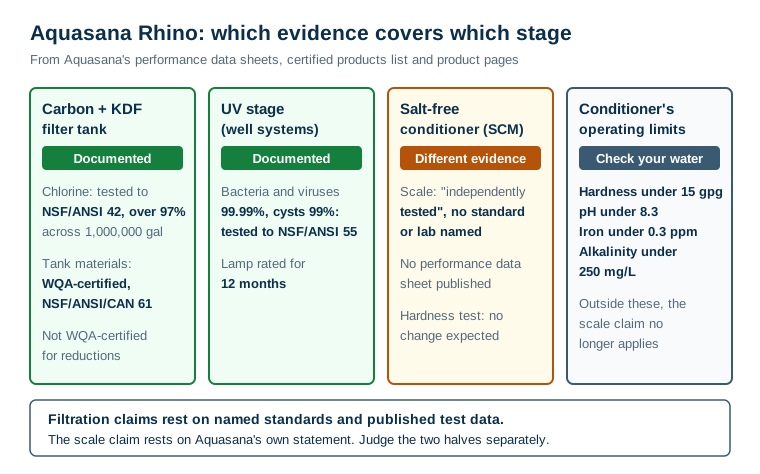
The Rhino filter tank: documented. The Rhino performance data sheet says the system was independently tested according to NSF/ANSI 42 for free chlorine, with a challenge of about 2 mg/L. It passed with an overall reduction above 97.4 percent, and the data table runs from start-up to the full 1,000,000 gallons. That is the strongest evidence anywhere in the system. Read the small print carefully, though. The tank is "tested and certified by WQA under NSF/ANSI/CAN 61 for Materials Safety Requirements Only", and the sheet adds that it is "Not certified for contaminant reductions by WQA". So the chlorine figure is tested to the standard; the WQA certification covers what the tank is made of.
The UV stage on well systems: documented. The Rhino well water UV data sheet says it was independently tested to NSF/ANSI 55 to inactivate 99.99 percent of bacteria and viruses and 99 percent of cysts. The lamp is rated for 12 months.
The salt-free conditioner: a different evidence base. Aquasana describes Scale Control Media that alters the charge of hardness ions so they form "inactive microscopic crystal particles". Its product page says it is "independently tested to naturally and safely reduce scale buildup". It names no standard, no laboratory and no percentage. Aquasana's performance data sheet page has no sheet for the conditioner, and its certified products list shows certifications for the filters and UV but none for the conditioner.
None of this proves the conditioner does not work. Crystal-forming media have a body of independent testing behind them in general, as covered in how a salt-free water conditioner works. It does mean the chlorine claim and the scale claim are not the same quality of claim. For contrast, a salt-based softener's hardness reduction can be certified to NSF/ANSI 44, explained in what NSF/ANSI 44 means. No equivalent certification appears for this conditioner.
The Conditioner's Operating Limits
Aquasana's product page gives four limits for the conditioner. Each one rules out a lot of homes:
| Limit | Aquasana's figure | Who it rules out |
|---|---|---|
| Hardness | below 15 gpg | Many private wells and very hard city supplies |
| pH | below 8.3 | Some alkaline supplies, including some municipal water raised for corrosion control |
| Iron | under 0.3 ppm | Most wells with any noticeable iron |
| Alkalinity | under 250 mg/L | Some high-carbonate groundwater |
The 15 gpg ceiling is the one most buyers miss. The reasons hardness limits exist at all are explained in hardness limits for salt-free conditioners. On a well, the iron limit matters as much: the well water package carries a UV stage for bacteria, but nothing in it is an iron filter.
What the Filter Does That a Softener Does Not
This is where Aquasana is strong, and where buyers sometimes expect too much from a softener instead. Carbon and KDF media reduce chlorine, which affects taste and smell throughout the house. A softener does not do that. A softener removes hardness, which a carbon filter does not. The two jobs, and when you need both, are set out in water softener vs whole house water filter.
So the real question for most buyers is not "Aquasana or a softener?" It is whether they need chlorine reduction, scale control, or both, and how much evidence they want behind each.
10-Year Running Cost Compared
For a family of four using 70 gallons each per day, about 102,000 gallons a year. Both Aquasana tanks are rated for 1,000,000 gallons or 10 years, so this household reaches the end of their rated life at about year 10.
| Setup | Running cost over 10 years | What you get |
|---|---|---|
| Rhino filter only | pre-filters only | Chlorine reduction, no scale control |
| Rhino + salt-free conditioner | pre-filters only | Chlorine reduction plus scale control, under 15 gpg only |
| Rhino + a basic cabinet softener | pre-filters plus salt, about $470 to $700 | Chlorine reduction plus soft water, at any normal hardness |
Salt from this site's illustrative $7 per 40 lb bag at an efficient dose, for 10 to 15 gpg. Equipment, installation, pre-filter cartridges and the softener's drain connection are not included.
Three points stand out:
- The conditioner has no salt bill. Against a filter plus a basic softener, that is what its extra cost buys: no salt and no drain line.
- The softener does more for the money. It removes hardness, so soap lathers and laundry benefits, and its performance can be certified.
- Compare equipment prices on the day you buy. Aquasana's prices move a long way between sale and list, so set the conditioner's current price against a basic softener's plus ten years of salt.
The full comparison between salt-based and salt-free approaches is in salt-based vs salt-free water treatment.
Warranty and Guarantee
Aquasana gives the Rhino and the salt-free conditioner a 10-year limited warranty and a 90-day satisfaction guarantee, according to their product pages. The warranty length matches the media's rated life, which is a reasonable sign of confidence in the tanks.
Who Should Not Buy the Aquasana Salt-Free System
- Homes with water over 15 gpg, pH over 8.3, iron over 0.3 ppm or alkalinity over 250 mg/L. The scale claim does not apply.
- Anyone who wants soft water, for lather, laundry or appliances with a hardness requirement. The water stays hard.
- Buyers who want certified scale performance. None is published for this conditioner.
- Wells with iron, manganese or sulfur. Nothing in the well package removes them.
- Anyone buying it mainly for scale on a tight budget. A filter plus a basic softener does more, and at sale prices it costs only a little more.
Buy the Rhino if chlorine is your problem; its evidence is solid. Add the conditioner only if your water sits comfortably inside its limits and you accept that its scale claim is Aquasana's word rather than a published test.
Frequently Asked Questions
Is the Aquasana salt-free system a water softener?
No. Aquasana's salt-free water conditioner uses what it calls Scale Control Media to turn hardness minerals into inactive microscopic crystals. The calcium and magnesium stay in the water, so a hardness test reads the same afterwards. It is a scale conditioner, which is a different job from softening.
Is the Aquasana salt-free conditioner NSF certified?
Not for scale, as far as Aquasana's own documents show. Its certified products list covers the Rhino filter under NSF/ANSI 42 and NSF/ANSI/CAN 61 and the UV stage under NSF/ANSI 55, but lists no certification for the conditioner. Its product page says only that it is independently tested to reduce scale, without naming a standard or laboratory, and no performance data sheet is published for it.
What are the limits of the Aquasana salt-free conditioner?
Aquasana's product page gives four: hardness below 15 grains per gallon, pH below 8.3, iron under 0.3 ppm and alkalinity under 250 mg/L. Outside those, its scale claim does not apply. Water harder than 15 gpg is common, especially on private wells, so check a recent test before buying.
How much chlorine does the Aquasana Rhino remove?
Aquasana's performance data sheet says the Rhino was independently tested to NSF/ANSI 42 and reduced free chlorine by more than 97.4 percent overall across its 1,000,000-gallon rated capacity. The tank is certified by WQA under NSF/ANSI/CAN 61 for materials safety, and the sheet notes that it is not certified by WQA for contaminant reductions.
How long does the Aquasana Rhino last?
The Rhino filter and the salt-free conditioner are each rated for up to 1,000,000 gallons or 10 years. A family of four using 70 gallons each a day passes about 102,000 gallons a year, so it reaches the gallon limit at about the same time as the 10-year limit. Pre-filters and, on well systems, the UV lamp are replaced more often.
Is the Aquasana well water system good for iron?
No. Aquasana's own limit for the salt-free conditioner is iron under 0.3 ppm, and the well system's filter and UV stages are not iron filters. A well with more iron than that needs iron treatment ahead of the system, or a different system altogether.
