
How Does a Salt-Free Water Conditioner Work?

A salt-free water conditioner works by template-assisted crystallization (TAC). Hard water flows through a bed of polymer beads whose surfaces carry tiny nucleation sites. Dissolved calcium and carbonate gather at those sites, grow into microscopic crystals, break free and travel on in the water. Because the mineral is now in crystal form, less of it bonds to pipes and heater elements as scale. Nothing is removed, so the water is still hard.
That last sentence is where most explanations go wrong in one direction or the other. Sellers blur it into "softening". Softener sellers treat it as proof the device does nothing. Neither is accurate, and the difference matters when you decide whether one suits your house.
What Is Inside the Tank
A whole-house TAC conditioner looks like a smaller version of a softener tank, minus the brine tank and, usually, minus the control valve.
- The media. Small polymer beads with a surface engineered to act as a template for crystal growth. Different brands use their own formulations; the principle is the same.
- An up-flow design. Water enters at the bottom and rises through the bed fast enough to lift and tumble the beads. This "fluidized" bed keeps the whole bead surface in contact with the water and knocks crystals free as they form.
- A simple head. Most units have an inlet, an outlet and nothing to program. There is no timer, no meter and no piston, because nothing needs to happen on a schedule.
Point-of-use versions use the same media in a cartridge housing for a single appliance, such as a coffee machine, an ice maker or a tankless water heater.
How a Salt-Free Water Conditioner Works, Step by Step
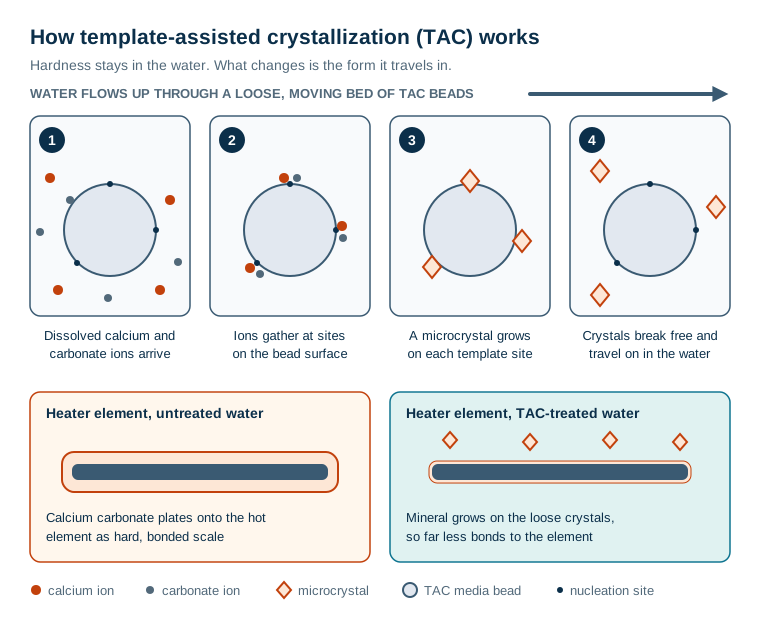
- Hardness arrives dissolved. Calcium and bicarbonate or carbonate ions are spread through the water. In this state they are what a hardness test measures and what forms scale when water is heated.
- Ions gather at nucleation sites. The media surface is designed so that these ions cluster at particular points rather than staying spread out.
- A microcrystal grows. The cluster organises into a tiny, stable crystal of calcium carbonate, anchored to the bead.
- The crystal breaks free. The tumbling bed and the water flow detach it. It travels onward as a particle far too small to see or feel.
What happens next is the part that matters in your home. When the water is heated, calcium carbonate comes out of solution. In untreated water, the easiest place for it to grow is on a surface: the heater element, the tank wall, the inside of a tankless heat exchanger. In TAC-treated water, the suspended crystals offer a ready-made surface. The manufacturers' explanation is that mineral preferentially grows on those crystals and is carried away with the water rather than bonding to metal.
What Independent Testing Has Measured
The most useful independent evidence comes from WateReuse Research Foundation project 08-06, carried out by Arizona State University with funding partners including the Bureau of Reclamation. It compared several no-salt technologies with ion exchange using the German DVGW W 512 protocol, which heats treated and untreated water under controlled conditions and compares the scale that forms.
TAC reduced scale formation by more than 88 percent. Electromagnetic and electrically induced devices managed about 50 percent. Ion exchange, which removes the hardness altogether, also cut scale efficiently. We compare those device types more fully in water softeners vs electronic and magnetic descalers.
Two honest caveats:
- That is a lab heating test, not years in your specific water heater. Real results depend on hardness, temperature, flow and whether your water stays inside the media's limits.
- It measures scale, not softness. An 88 percent reduction in scale is a strong result for protecting equipment. It says nothing about spots, lather or feel, because those depend on the dissolved hardness that TAC leaves in place.
Why It Needs No Drain, No Electricity and No Backwash
This is the practical advantage that often decides the purchase, and it follows directly from the mechanism.
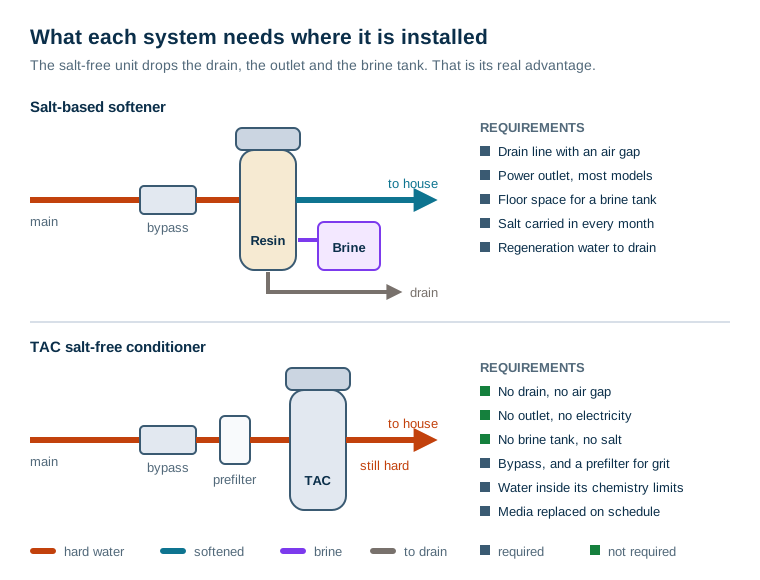
A softener captures hardness on its resin, so the resin fills up. Regenerating it means pushing brine through, rinsing, and sending the captured calcium, magnesium and spent brine to a drain, all controlled by a powered valve on a schedule. The EPA's description of cation exchange softeners makes the point that this regeneration is where softeners use their salt and water.
TAC media captures nothing. The crystals leave with the water. So:
- No regeneration, therefore no brine tank, no salt and no wastewater.
- No backwash, because the up-flow bed is continuously self-agitating and has no trapped hardness to flush.
- No control valve to power, because there is no cycle to start or stop.
- No drain line and no air gap, because nothing ever goes to drain.
What That Means for Installation Feasibility
Removing the drain and the outlet opens up locations that rule out a softener, or make one expensive.
| Location | Salt-based softener | TAC conditioner |
|---|---|---|
| Condo or apartment utility closet with no floor drain | Often impossible without a drain pump | Usually straightforward |
| Slab-on-grade home, main line in a garage wall | Drain may need a long run or a pump | Needs only the space and a bypass |
| Crawl space | Hard to service, brine tank access poor | Possible if it stays above freezing |
| Area that restricts brine discharge | May be prohibited | Allowed, no discharge |
| Small footprint, no room for a brine tank | Difficult | Single slim tank |
If your house has no drain near the main line, compare this route with the softener workarounds in installing a softener with no drain or outlet nearby before deciding. Sometimes a softener is still possible, and sometimes the salt-free unit is the only sensible fit.
A few practical requirements remain:
- A bypass valve, so the unit can be isolated for media changes.
- A sediment prefilter where the water carries sand or grit, which would otherwise coat the media.
- Protection from freezing and heat. The Watts OneFlow OF110-1 manual, for example, specifies water between 40 and 100 °F and pressure between 15 and 90 psi.
- No other scale inhibitor on the line. Watts states that its media "will not be effective" alongside polyphosphate or other scale inhibitors.
- Sizing by flow rate, not by grains. A TAC tank is chosen for the peak gallons per minute it must pass while keeping the bed fluidized, because there is no capacity to exhaust.
The Operating Limits That Decide Whether It Will Work
TAC media is sensitive to water chemistry in ways a softener is not. The Watts OneFlow OF110-1 installation manual lists its feed-water requirements explicitly, and they are a good picture of the category:
| Parameter | Limit in the Watts OneFlow manual |
|---|---|
| Hardness | 30 gpg recommended maximum (effective up to 75 gpg, with possible visible residue) |
| pH | 6.5–8.5 |
| Free chlorine | Under 2 ppm |
| Iron | Under 0.3 mg/L |
| Manganese | Under 0.05 mg/L |
| Copper | Up to 1.3 ppm; new copper lines passivated for 4 weeks first |
| Silica | 20 ppm maximum, for appearance; media does not reduce silica scaling |
| Total phosphates | Under 3.0 ppm |
| Oil and hydrogen sulfide | Must be removed before the unit |
| TDS | 1,500 mg/L |
Other brands publish their own figures, and they are usually similar. The pattern is consistent: metals such as iron, manganese and copper coat the active surface, oxidizers damage it, and very hard water can overwhelm it. On a private well, a full water test before buying is not optional.
What TAC Does Not Do
Stating the limits plainly is what keeps expectations right, and they are not small.
- It does not soften water. Hardness is unchanged, and Watts describes its cartridge as having no grain removal capacity. Our follow-up on whether a salt-free system actually softens water explains why a hardness test should still read high afterwards.
- It does not stop water spots. When water evaporates on glass or a faucet, whatever minerals it carried stay behind, crystal or not.
- It does not change soap behaviour. Lather, soap scum and detergent dosing respond to dissolved hardness, which is still present.
- It does not remove existing scale reliably. Some manufacturers suggest gradual reduction over time; plan on descaling heavily scaled equipment separately.
- It is not a filter. It does not reduce chlorine, lead, PFAS, bacteria or nitrate, and it does not treat iron. Anything like that needs its own treatment step.
Where TAC Sits Among "Salt-Free" Options
The label "salt-free water softener" is used for several unrelated technologies, which is part of why buyers get confused.
- TAC and similar nucleation media. What this article describes. The best-documented salt-free route to scale reduction.
- Polyphosphate feeders. A cartridge dissolves a small amount of phosphate into the water to keep hardness in solution. Useful on specific appliances; not interchangeable with TAC and, per Watts, not to be combined with it.
- Citric acid conditioners. A cartridge doses a little citric acid, which binds calcium so it does not form scale and lowers pH slightly. The Nuvo H2O review covers where that approach suits and where it does not, and if you are choosing between the two routes, weighing TAC media against citric acid on scale control and cartridge cost sets one of each side by side.
- Electronic and magnetic descalers. Coils or magnets on the outside of a pipe. Independent results are weaker and more variable.
- Potassium chloride softeners. Sometimes marketed as "salt-free" because they use no sodium chloride. They are ordinary ion-exchange softeners with a different regenerant.
For the broader decision between the two families, the comparison of salt-based and salt-free water treatment sets out which problems each one actually solves.
What to Do Next
- Test your water for hardness, pH, iron, manganese and, on city water, chlorine. Compare every figure with the limits of the unit you are considering. The SpringWell FutureSoft review sets one TAC unit's published limits against its scale claim, which is the check to repeat on any model.
- Decide what result you need. Heater and pipe protection points toward TAC. Spot-free glass and better lather point toward a softener.
- Check your installation site. If a drain or outlet is the obstacle, TAC may be the only practical whole-house option.
- Size by flow rate and add a sediment prefilter if your water carries grit.
- After installation, judge it by your equipment, not by a hardness test. Inspect the water heater or flush it after six to twelve months and compare with what came out before.
Frequently Asked Questions
Does a salt-free water conditioner remove hardness?
No. A template-assisted crystallization (TAC) conditioner leaves the calcium and magnesium in the water and changes their form into microscopic crystals. A hardness test reads about the same before and after, and Watts states plainly that its OneFlow cartridge has no grain removal capacity. What it aims to reduce is scale forming on surfaces, particularly in heated equipment.
How long does TAC media last?
It depends on the product and your water. The small Watts OneFlow OF110-1 cartridge is rated for replacement at least once a year. Whole-house tanks usually run for several years between media changes, but iron, manganese, copper, chlorine and phosphates all coat or damage the media and shorten that. Follow the interval in your unit's manual rather than a general figure.
Do salt-free water conditioners need electricity or a drain?
Genuine TAC units need neither. The media is not regenerated, so there is no backwash, no brine and no wastewater, and there is no control valve to power. That is why they can go in places a salt-based softener cannot, such as a condo closet, a slab-floored garage or a spot far from any drain.
Is a salt-free conditioner as good as a water softener?
They do different jobs. A softener removes hardness, which gives you spot-free glass, better lather and the slippery feel. A TAC conditioner leaves hardness in place and aims only to cut scale on surfaces. In the independent WateReuse study it reduced scale by more than 88 percent in a heated test, which is a strong result for that one job, but it will not change soap use or spotting.
What water is not suitable for a salt-free conditioner?
Water outside the media's limits. The Watts OneFlow manual, for example, calls for pH 6.5 to 8.5, free chlorine under 2 ppm, iron under 0.3 mg/L, manganese under 0.05 mg/L, silica under 20 ppm and a recommended hardness maximum of 30 grains per gallon. Well water with iron or manganese usually needs treatment first, and very hard water may leave visible residue.
Can you install a salt-free water conditioner yourself?
The plumbing is simpler than a softener's because there is no drain line or outlet to arrange: a bypass, the tank and usually a sediment prefilter. You still need to cut into the main line and follow any local permit rules. Check whether an existing polyphosphate or scale-inhibitor cartridge is on the line, because Watts warns that its media will not work alongside one.
