
Best 80,000 Grain Water Softener, and When a Twin Tank Is the Better Buy

The best 80,000 grain water softener for most large households is the AFWFilters Iron Pro 2 80k. It has 2.5 cubic feet of fine-mesh resin in a 13×54 tank on a Fleck 5600SXT valve, and it was the lowest-cost per usable grain of the units we compared. An 80k makes sense for a daily hardness load of about 5,600 to 12,500 grains, but it needs a well that can hold about 4.6 gpm of backwash. If yours cannot, or the load is higher, a Fleck 9100SXT twin with two 10-inch tanks is the better buy. It costs considerably more per usable grain, needs only about 2.7 gpm, and never sends hard water to the taps.
Disclosure: Hard Water Solved may earn a commission if you buy through links on this page, at no extra cost to you. It does not change which products we include or how we rank them. Read our disclaimer.
How we chose. Each single-tank pick is a complete metered system rated at 80,000 grains, sold on Amazon.com, with a published tank size. We compared them on usable capacity at the same efficient salt dose, the backwash flow they ask of a well, service flow and warranty, then set them against a 9100SXT twin. We dropped three plan candidates whose Amazon listings showed as currently unavailable on 1 October 2026: two Fleck 7000SXT 80k systems and the SoftPro Elite Ultimate 80k. Evidence comes from listings, AFWFilters' published specifications and design guidance. Nothing was physically tested.
Prices are not listed here because they change often. Use the buttons to see the current price on Amazon.
Who should buy none of these: households with a daily hardness load under about 5,600 grains (a 64k or smaller fits), wells that cannot hold even 2.7 gpm for 20 minutes, and water with visible rust or iron above about 6 ppm.
What You Are Buying With 80,000 Grains
The rating describes about 2.5 cubic feet of resin at a heavy salt dose. At an efficient 6 lb of salt per cubic foot, it delivers about 50,000 grains per cycle, using about 15 lb of salt. Why the box number overstates real capacity is covered in can a water softener be too large, which shows the same gap for every common size.
AFWFilters publishes unusually complete figures for its 2.5 cubic foot single:
| Spec | AFW 80k single (13×54) | AFW 9100SXT twin (1.5 cu ft per tank) |
|---|---|---|
| Tanks | One 13×54, about 62 inches tall with valve | Two 10×54 |
| Service flow | 11 gpm | 6.5 gpm |
| Peak flow | 16.5 gpm | 9.8 gpm |
| Backwash flow required | 4.6 gpm | 2.7 gpm |
| Brine tank | Round, about 18×33 | 14-inch square, 18×33 or 18×40 options |
Two numbers in that table drive everything else. The single passes far more water, which matters in a big house. It also asks the well for 4.6 gpm during backwash, which matters on a weak well.
Who an 80k Single Fits
Daily hardness load is people × 75 gallons × gpg. Add about 4 gpg per 1 ppm of dissolved iron, as set out in how iron changes softener sizing. A single 80k delivering 50,000 grains, with one day held back as reserve, regenerates every 3 to 8 days when the load is between about 5,600 and 12,500 grains a day.
| Household | Daily load | Days between regenerations | Verdict |
|---|---|---|---|
| 4 people, 15 gpg | 4,500 | 10.1 | Oversized. A 64k fits |
| 6 people, 15 gpg | 6,750 | 6.4 | Good fit |
| 5 people, 20 gpg | 7,500 | 5.7 | Good fit |
| 6 people, 20 gpg | 9,000 | 4.6 | Good fit |
| 5 people, 25 gpg | 9,375 | 4.3 | Good fit |
| 6 people, 30 gpg | 13,500 | 2.7 | Too small for a single. Twin |
| 8 people, 25 gpg | 15,000 | 2.3 | Too small for a single. Twin |
Usable Grains per Cycle: 80k Singles vs a 9100SXT Twin
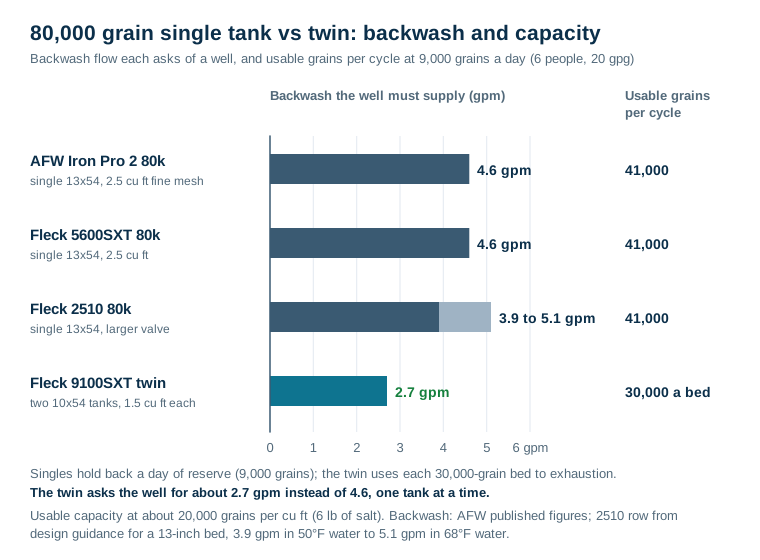
Comparing on the box number flatters the twin. AFW's 1.5 cubic foot per tank twin is sold as 48,000 grains per tank, 96,000 in total. Comparing on what you can actually use per cycle, for a household using 9,000 grains a day, gives a different picture.
- A single holds back a day of reserve, so of its 50,000 grains, about 41,000 are usable each cycle.
- The twin switches to the standby tank the moment one bed is exhausted, so it needs no reserve. Each 1.5 cubic foot bed gives its full 30,000 grains.
| Option | Usable per cycle at 9,000 a day | Days per cycle | Salt per year at 6 lb/cu ft | Backwash |
|---|---|---|---|---|
| AFW Iron Pro 2 80k | 41,000 | 4.6 | about 1,200 lb | 4.6 gpm (AFW 13×54 figure) |
| Fleck 5600SXT 80k (AFW system) | 41,000 | 4.6 | about 1,200 lb | 4.6 gpm |
| Fleck 2510 80k (AFW system) | 41,000 | 4.6 | about 1,200 lb | about 3.9 to 5.1 gpm by design guidance |
| Fleck 9100SXT twin, 2 × 1.5 cu ft | 30,000 per bed, no reserve | 3.3 per bed | about 990 lb | 2.7 gpm, one tank at a time |
Usable capacity uses about 20,000 grains per cubic foot at 6 lb of salt. Salt figures are a model for a 9,000 grain-a-day household.
What the table shows:
- Singles cost much less per usable grain. A single delivers more softening per cycle and usually costs less than a twin. That is the main reason to buy one.
- The twin saves salt. It never regenerates a bed with reserve still in it, so for this household it uses roughly 215 lb less salt a year. That saving takes years to repay the twin's premium over a 5600SXT single, so salt alone does not justify it. The case for twins in general is set out in single tank vs twin tank water softeners.
- The twin regenerates more often, about 110 times a year against about 80, so it sends more regenerations' worth of water to the drain even though it uses less salt.
- The twin's real advantage is the well. It asks for 2.7 gpm instead of 4.6 gpm.
AFW also sells twins with 2.5 cubic feet per tank. They need the same 13-inch backwash as a single, so they solve the capacity problem but not the well problem.
The Backwash Your Well Must Deliver
Backwash flow rises with the area of the resin bed, not the grain rating. The WC&P softener design guide asks for enough flow to expand the bed by at least 50 percent, at about 4.2 gpm per square foot in 50°F water rising to 5.5 in 68°F water. A 13-inch bed has about 0.92 square feet, so it needs roughly 3.9 to 5.1 gpm. AFW's published 4.6 gpm sits in the middle of that range. A 10-inch bed needs about 2.3 to 3.0 gpm, and AFW publishes 2.7 for its twin.
On city water none of this matters. On a well, the flow has to be held for the whole backwash and rinse, not just a minute. Penn State Extension's fact sheet on low-yielding wells explains why a quick bucket test flatters a weak well: the first few minutes come from water stored in the casing, and the well's own yield may be far lower. The two-test method, a pump-rate bucket test and then a sustained run at the backwash rate, is set out in well pump flow and backwashing.
If the sustained test fails at 4.6 gpm but holds at 2.7, the twin is the answer. If it fails at 2.7 too, no backwashing softener of this size suits the well as it stands. The options are covered in sizing a softener for a low-yield well.
The Best 80,000 Grain Water Softener Picks
1. AFWFilters Iron Pro 2 80k: Best Overall
AFW's store lists this as 2.5 cubic feet of fine-mesh resin in a 13×54 tank on a Fleck 5600SXT metered valve, rated for iron up to 6 ppm, with a 5-year warranty on the control head and 10 years on the tank. The Amazon listing goes further, claiming hardness up to 85 gpg, iron of 6 to 8 ppm, manganese up to 6 ppm and 18 gpm. Treat the store's 6 ppm iron figure as the safer planning number. Fine mesh costs little extra here and covers the iron that many very hard wells also carry. That is why it tops a list aimed at big rural homes.
- Good: lowest cost per usable grain of our picks, handles clear-water iron, common valve.
- Watch: 4.6 gpm of backwash, plus more if an iron filter regenerates the same night. Program it from about 50,000 grains, less any iron allowance.
2. DuraWater Fleck 5600SXT 80k: Best Standard-Resin Single
A plain 80k for water without iron. The listing gives 2.5 cubic feet of resin in a 13×54 tank, the Fleck 5600SXT with a paddle-wheel meter, an 18×40 brine tank with safety float, a bypass with a threaded yoke and an iron and hardness test kit. It is about 62 inches tall overall. The valve carries 5 years of warranty and the tanks 10.
- Good: standard Fleck platform, larger brine tank, test kit included.
- Watch: DuraWater does not publish prices off Amazon, so compare with AFW's own 80k 5600SXT systems before buying.
3. Abundant Flow (AFWFilters) 80k Fleck 2510: Best for High Peak Flow
The Fleck 2510 is a larger valve body than the 5600SXT. That matters where peak flow, not capacity, is the constraint, such as a big house with several bathrooms in use at once. The Amazon listing describes a complete 13×54 system with the 2510SXT meter valve. AFW's own store now sells the 80k with the 2510AiQ, which it describes as formerly the 2510SXT, so ask which valve ships.
- Good: more valve for very high-demand homes, same 13-inch bed.
- Watch: costs noticeably more than a 5600SXT single for the same capacity and the same backwash demand.
4. Fleck 9100SXT Twin, 1.5 cu ft per Tank: The Twin Alternative
Not an 80k single, but the realistic alternative to one. The listing gives 1.5 cubic feet of resin per tank, 96,000 grains of total rated capacity, the 9100SXT metered alternating valve and an 18×33 brine tank with grid. AFW's version of the same configuration uses two 10×54 tanks, with 6.5 gpm service flow, 9.8 gpm peak and 2.7 gpm backwash. The Amazon listing names CAI Technologies as the maker and warns that units not sold by CAI are not genuine, so confirm the seller and the warranty before ordering.
- Good: soft water around the clock, lower backwash demand, no reserve wasted.
- Watch: lower service flow than a single 80k, a higher cost per usable grain, and two tanks to house.
Single or Twin: The Rule
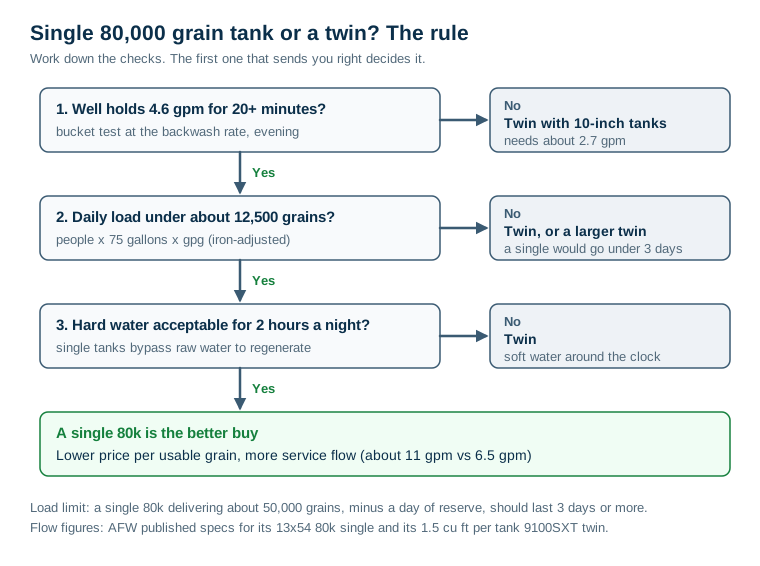
Choose a single 80k when all three of these hold:
- The well can sustain about 4.6 gpm for 20 minutes or more, or you are on city water.
- Your daily load is between about 5,600 and 12,500 grains, iron-adjusted.
- Two hours of untreated water overnight is acceptable, which it is for most households that are asleep at 2 am.
Choose a twin if any one of them fails. Choose nothing at this size if your load is under about 5,600 grains a day. A 64k, or the size worked out in how to size a water softener, will serve you better.
Who Should Skip an 80k Altogether
- Households under about 5,600 grains a day. An 80k would sit more than 8 days between regenerations, wasting salt held in reserve and leaving the resin idle.
- Wells that fail a sustained 2.7 gpm test. No backwashing softener of this capacity suits them without storage or a smaller design.
- Water with visible rust, iron bacteria or iron above about 6 ppm. Put an iron filter first, and remember it adds its own backwash demand.
The Bottom Line
An 80,000 grain single is the cheapest way to buy a lot of softening. The best 80,000 grain water softener for most homes, the AFWFilters Iron Pro 2 80k, gives the lowest cost per usable grain and handles clear-water iron. Buy it, or the DuraWater standard-resin equivalent, when your load is 5,600 to 12,500 grains a day and your well can hold about 4.6 gpm of backwash. Choose the Fleck 2510 version for very high peak flow. When the well falls short, the load runs higher, or you want soft water at 2 am, the 9100SXT twin costs more per grain and is the right buy anyway.
Frequently Asked Questions
How many people is an 80,000 grain water softener good for?
At an efficient salt setting an 80,000 grain unit delivers about 50,000 grains per cycle. It is well sized for a daily hardness load of about 5,600 to 12,500 grains, which is roughly six to eight people on 15 gpg water, four to six on 20 gpg, or three to five on 25 gpg. Smaller loads leave it sitting too long between regenerations. Larger loads make it regenerate more often than every three days, where a twin tank works better.
What tank size is an 80,000 grain softener?
Usually a 13 x 54 inch tank holding about 2.5 cubic feet of resin. AFWFilters lists its 80k singles at about 13 x 54 inches and about 62 inches tall with the control head, plus a round brine tank of about 18 x 33 inches. Leave headroom above the valve for service.
How much backwash flow does an 80,000 grain softener need?
AFWFilters publishes 4.6 gpm for its 13 x 54 inch 80k single. Design guidance for a 13-inch bed gives about 3.9 to 5.1 gpm depending on water temperature. On a well, the pump and the well must hold that flow for the whole backwash and rinse, often 20 minutes or more. A 9100SXT twin with 10-inch tanks needs about 2.7 gpm, and only one tank backwashes at a time.
Is a twin tank better than a single 80,000 grain softener?
Not for most homes. A single 80k costs less per usable grain and passes more water, about 11 gpm of service flow against 6.5 gpm for AFW's 1.5 cubic foot per tank twin. The twin wins when the well cannot hold about 4.6 gpm of backwash, when the daily hardness load is above about 12,500 grains, or when hard water during a two-hour overnight regeneration is not acceptable.
How much salt does an 80,000 grain softener use?
At an efficient 6 lb per cubic foot, a 2.5 cubic foot bed uses about 15 lb of salt per regeneration. A household using 9,000 grains of hardness a day would use roughly 1,200 lb a year at that setting. A twin with two 1.5 cubic foot beds would use about 990 lb for the same water, because it runs each bed to exhaustion instead of holding back a reserve.
Can an 80,000 grain softener handle iron?
A fine-mesh model can handle some dissolved iron. AFWFilters lists its Iron Pro 2 80k for iron up to 6 ppm on its own store, with a 2.5 cubic foot fine-mesh bed. Iron counts against capacity, roughly 4 gpg of extra hardness per 1 ppm, so iron can push a household from a 64k into 80k territory. Rust you can see, or iron above the rating, needs an iron filter first.
