
Sizing a Softener for a Low-Yield Well
Sizing a water softener for a low-yield well runs backwards: the well's flow sets the tank diameter before your hardness does. Backwash flow rises with tank width, so the sizing order flips. Start from the flow the well can hold for a full backwash. Pick the widest tank that fits, then the tallest version of it, then work out how often it regenerates. If that interval is too short, the answer is two tanks or a storage tank, not a bigger softener.
Whether your well can support backwashing equipment at all, and the two bucket tests that measure it, are covered in how well pump flow limits backwashing. This page starts where that one ends, with the number you measured.
Why Normal Water Softener Sizing Breaks on a Low-Yield Well
The standard method, set out in most manufacturer manuals, runs from demand to hardware:
- Daily grains: people × gallons per person × hardness in grains per gallon (gpg). Hellenbrand's softener manual uses 75 gallons per person per day as the household average.
- Capacity: daily grains × the number of days you want between regenerations.
- Resin volume: capacity ÷ grains per cubic foot at your salt setting.
- Tank: whatever tank holds that much resin.
- Backwash: the valve is fitted with the flow control that tank needs.
Step 5 is where a weak well fails, and nobody looks at it. A family of four on 20 gpg water uses 4 × 75 × 20 = 6,000 grains a day. A week between regenerations calls for about 42,000 grains, so the method lands on something like Pentair's 2-cubic-foot, 12×48 unit, rated at 50,400 grains on 18.75 lb of salt. Pentair's specification sheet lists its backwash at 3.5 gpm. If your well can only sustain 2.6 gpm, that softener will under-backwash every time it regenerates.
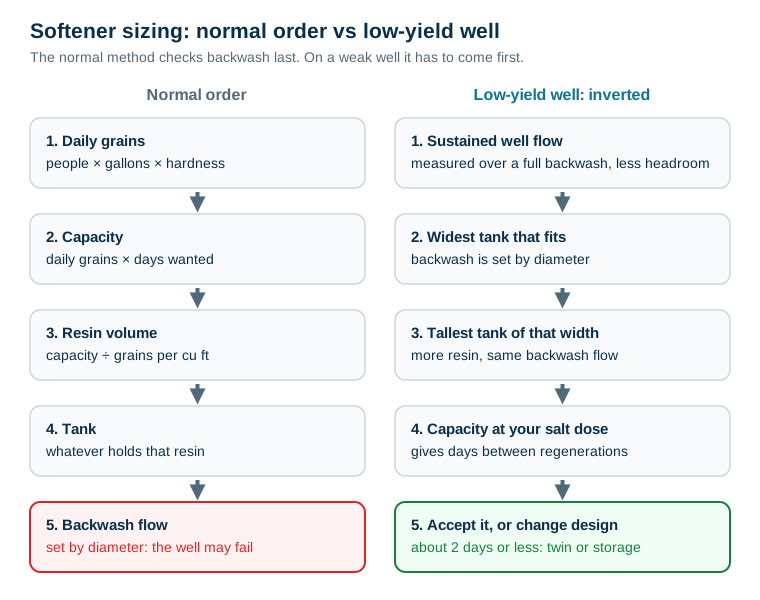
The fix is to run the same method in the opposite direction.
Step 1: Start From the Flow the Well Can Sustain
Use the flow your well held steady through a full backwash-length run, measured at the worst time of day and ideally in a dry month. The procedure is in how well pump flow limits backwashing. Do not use the quick bucket figure at the pressure tank. That measures the pump, and a low-yield well can beat it for a few minutes from casing storage.
Then take something off for headroom. Other things draw water during a 2 a.m. regeneration: a toilet refilling, an ice maker, a second treatment unit. A reserve of around 20 percent is a sensible margin. That is a judgement rather than a published rule, so size it to your own household. A well that holds 3.1 gpm steady gives you about 2.5 gpm to spend on backwash.
Subtract any other backwashing unit that regenerates at the same hour, or better, stagger them. An iron filter can need several times a softener's backwash flow.
Step 2: Find the Widest Tank That Fits
The backwash rate is set by tank diameter. These are published figures for residential softeners with standard resin:
| Tank | Resin | Backwash | Source |
|---|---|---|---|
| 9 × 48 | 1.0 cu ft | 2 gpm | ECI Fleck softener catalog |
| 10 × 44 | 1.0 cu ft | 2.5 gpm | Pentair spec sheet |
| 10 × 54 | 1.5 cu ft | 2.5 gpm | Pentair spec sheet |
| 12 × 48 | 2.0 cu ft | 3.5 gpm | Pentair spec sheet |
| 12 × 52 | 2.0 cu ft | 3 gpm | ECI Fleck softener catalog |
Pick the widest diameter whose backwash fits inside the number from Step 1. With 2.5 gpm to spend, that is a 10-inch tank. With 2 gpm, it is a 9-inch. With less than 2 gpm, skip to the storage-buffered design further down, because very few residential softeners are built narrower than that.
Check the actual flow control, not the family. Two softeners with the same tank can ship with different drain line flow controls. The one in the valve you buy is what your well has to supply. Its rating is printed on the spec sheet and usually stamped on the part.
Step 3: Get Capacity From Height, Not Width
This is the step that makes the inverted method workable. Backwash depends on the bed's area, not its depth. A taller tank of the same diameter holds more resin and needs the same backwash flow.
Pentair's own sheet shows it. The 10×44 and 10×54 units both backwash at 2.5 gpm. The taller tank holds 1.5 cubic feet of resin instead of 1.0, which is 50 percent more capacity for no extra demand on the well:
| Salt per regeneration | 10 × 44 (1.0 cu ft) | 10 × 54 (1.5 cu ft) |
|---|---|---|
| Low | 17,500 grains @ 3.9 lb | 24,300 grains @ 5.2 lb |
| Medium | 25,200 grains @ 9.8 lb | 37,000 grains @ 14.3 lb |
| High | 33,500 grains @ 15.6 lb | 48,600 grains @ 23.4 lb |
How far can height go? The bed needs room to expand. The WC&P softener design guide asks for at least 50 percent bed expansion during backwash, and a tank tall enough to allow it. It also sets a minimum resin depth of 24 inches in smaller tanks. So a tall, narrow tank is fine, as long as the manufacturer has left the freeboard above the resin. Do not overfill a tank with extra resin to squeeze out more capacity. The bed then has nowhere to expand, and you are back to a backwash that does not work.
Step 4: Work Out the Regeneration Interval and Accept It
Now run the normal arithmetic forwards from the tank you chose. These three worked examples use Hellenbrand's 75 gallons per person per day and published tank ratings. The households and water are illustrative, so put in your own metered use and lab results.
Example A: four people, 20 gpg, well holds 3.1 gpm.
- Backwash budget after headroom: about 2.5 gpm, so a 10-inch tank.
- Daily load: 4 × 75 × 20 = 6,000 grains.
- 10×54 at 24,300 grains: about 4 days between regenerations, on only 5.2 lb of salt each time.
- 10×54 at 37,000 grains: about 6 days, on 14.3 lb.
That is a perfectly good softener. It regenerates more often than the 12-inch the normal method picked, but it backwashes properly every time.
Example B: four people, 20 gpg, well holds 2.4 gpm.
- Budget: about 2 gpm, so a 9-inch tank.
- ECI's catalog rates a 1-cubic-foot 9×48 at 20,000 grains on 5 lb of salt, 25,000 on 10 lb and 30,000 on 15 lb.
- At 25,000 grains: about 4 days. At 30,000: 5 days.
Still workable, with a bit more salt per year.
Example C: six people, 25 gpg plus 1 ppm dissolved iron, well holds 2.4 gpm.
- Budget: about 2 gpm, so a 9-inch tank again.
- Compensated hardness, using Hellenbrand's 3 grains per ppm of iron: 25 + 3 = 28 gpg.
- Daily load: 6 × 75 × 28 = 12,600 grains.
- 9×48 at 30,000 grains: about 2.4 days between regenerations, on 15 lb of salt each time.
Example C is where a single tank runs out of room. How iron changes the capacity you need is set out in how iron changes water softener sizing.
What "accept it" means in practice:
- For the resin, frequent regeneration is fine. More backwashes, done properly, keep the bed cleaner than fewer weak ones. Weak backwashes are what cause resin channeling.
- For salt, it costs more. Example C uses 15 lb about every 2.4 days, which comes to roughly 2,300 lb a year.
- For water, it is volume, not rate. Each regeneration sends a set amount to drain. Penn State Extension points out that even a 1 gpm well produces 1,440 gallons a day. The daily total is rarely the problem on a low-yield well. The rate during the cycle is.
- For margin, it gets thin. A single-tank valve regenerates overnight and holds back a reserve for the next day. When the whole bed only lasts two days, one day of laundry and guests can use it up before the regeneration comes round.
When a Twin-Tank Softener Becomes the Answer
Move to twin tanks once a single tank's interval drops to about two days, or when the household uses water at every hour and cannot tolerate hard water during a regeneration.
What twin tanks fix:
- Each tank is smaller, so each backwash asks the well for a lower flow.
- One tank is always in service. When one is exhausted, the other takes over, and there is no hard-water gap waiting for 2 a.m.
- Capacity is split, not reduced. Two 9-inch tanks give you the resin of a much larger single tank without a single large backwash.
What they do not fix:
- The well still supplies each backwash. Two tanks of a diameter your well cannot backwash are no better than one.
- Timing can work against you. Many twin units regenerate as soon as a tank is exhausted. On a weak well, that can land in the evening peak, when the casing is already drawn down. Ask whether the valve can hold the regeneration until a set hour.
- Cost and space. A twin unit costs more and takes more floor space than a single tank of the same total capacity.
When Only a Storage-Buffered Design Works
If the flow you measured is below even a 9-inch tank's backwash rate, no choice of softener tank fixes it. The flow has to come from somewhere else.
Penn State Extension describes the standard layout for low-yielding wells. The well pump fills a non-pressurized storage tank at a rate "slightly less than the yield of the well." A second pump draws from that tank and repressurizes the water for the house. A low-water cutoff in the well protects the well pump.
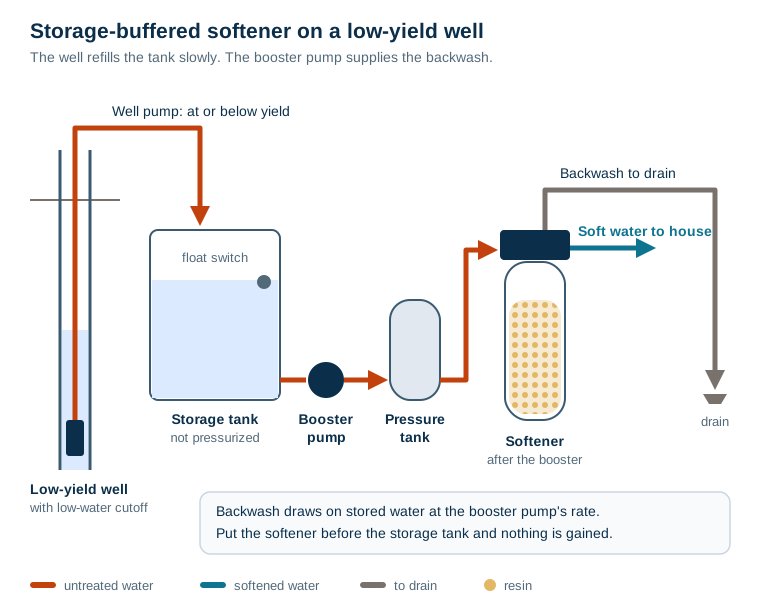
Where the softener goes matters. It has to sit after the booster pump and pressure tank. There it backwashes at the booster's rate from stored water. Placed between the well and the storage tank, it is still limited by the well.
Sizing changes back to normal. Once the booster pump can supply the backwash, tank diameter is no longer limited by the well. Size on grains in the usual way, and check two things instead:
- The booster pump's rate covers the softener's backwash, plus whatever the house might draw during regeneration.
- The storage volume covers a day's use plus a regeneration. Penn State's rule of thumb for households is 100 gallons of storage per person.
The tradeoffs are a second pump, the power to run it, a tank that needs a heated space or burial below the frost line, and periodic cleaning of an open tank. Penn State's 2005 fact sheet put a household system at under $1,500 without chlorination, a figure that is now well out of date. The general layout and placement rules for treatment on a well are in where to install a softener on a well system.
What Sizing Cannot Fix
- A softener does not add water. If the house runs short at peak times, sizing the softener differently will not help. That is a yield or storage problem.
- The bed still has to be backwashed. Resin makers such as Purolite specify a backwash that expands the bed by 50 to 70 percent. Shortening the backwash or fitting a smaller flow control to suit the well just brings back the under-expanded bed this method is trying to avoid.
- Smaller tanks pass less peak flow. On a weak well the well usually limits peak flow first. Still, check the rated service flow of the tank you pick against your fixtures.
- Iron, manganese and bacteria change the answer. Sizing assumes clean, dissolved hardness. Test for iron and manganese before sizing, because a bed that is also carrying iron needs more capacity and more frequent cleaning.
Sizing a water softener for a low-yield well comes down to choosing which limit to respect first. Respect the backwash flow, and a narrower, taller tank that regenerates every few days will outlast a bigger one that never gets properly cleaned.
Frequently Asked Questions
What size water softener do I need for a low-yield well?
Start with the flow your well can sustain through a full backwash, not with the grain capacity. Choose the widest tank whose backwash rate fits inside that flow with some headroom, then choose the tallest version of that tank to recover capacity. On published figures that usually means a 9-inch tank at about 2 gpm or a 10-inch tank at about 2.5 gpm. Then check how often it will regenerate, and accept a shorter interval than a city-water system would run.
Is it bad if my water softener regenerates every two or three days?
Not for the resin. Frequent regeneration is normal on a small tank, and it keeps the bed well cleaned. The cost is salt and water, which add up over a year, and a thinner margin if one heavy day uses more than the bed can hold before the next overnight regeneration. Once a single tank can only last about two days, a twin-tank unit or a storage-buffered system is usually the better design.
Can I put a bigger softener on a low-yield well if I regenerate less often?
Not safely. A bigger tank does regenerate less often, but each regeneration asks for a higher backwash flow, because backwash is set by tank diameter. If the well cannot hold that flow for the whole backwash, the bed never fully lifts and slowly channels. Fewer regenerations do not help if each one is a weak backwash.
Are twin-tank water softeners good for low-yield wells?
They can be. A twin-tank unit uses two smaller tanks, so each one backwashes at a lower rate, and one tank is always in service, so you are not left with hard water if the bed runs out before night. Check when it regenerates. A twin unit that regenerates the moment a tank is exhausted can do it during the evening peak, when a weak well is already drawn down.
Should a water softener go before or after a storage tank?
After the booster pump that draws from the storage tank. In that position the softener backwashes from stored water at the booster pump's rate, while the well refills the storage tank at its own pace. If the softener sits between the well and the storage tank, it is still limited by the well's flow and nothing has been gained.
