
Best Iron Filters for Well Water, Matched to Iron Type
The best iron filters for well water are picked by technology first and brand second. For most wells with up to about 10 ppm of iron and little manganese or sulfur, the AFWFilters Air Injection Silver 10 is the simplest choice. Heavy iron with a rotten-egg smell needs a bigger air injection tank such as Oceanic's 12x52. High manganese points to greensand, acidic water below pH 6.8 points to Katalox Light, and iron bacteria rule out every filter until the well is disinfected.
Four lab results decide which of those you are: iron plus manganese, pH, hydrogen sulfide and any sign of iron bacteria. The chart below runs them in order, and each pick lists its oxidant, the backwash flow your well must supply and the lowest pH its maker states.
Disclosure: Hard Water Solved may earn a commission if you buy through links on this page, at no extra cost to you. It does not change which products we include or how we rank them. Read our disclaimer.
Best Iron Filters for Well Water at a Glance
| Pick | Technology | Oxidant | Seller's rating (Fe / Mn / H2S) | Backwash flow | Lowest pH stated | Amazon |
|---|---|---|---|---|---|---|
| AFWFilters Air Injection Silver 10 | Air injection, filter media | Air pocket in the tank | 10 / 2 / 4 ppm | 5 gpm | Not stated | Check price on Amazon |
| Oceanic AIO 12x52 | Air injection, catalytic carbon | Air pocket in the tank | 27 / 11 / 17 ppm | 10 gpm | Not stated | Check price on Amazon |
| AFWFilters Filox 10 | Manganese dioxide media | The media surface | 15 / 3 / 7 ppm | 5.3 gpm | Not stated | Check price on Amazon |
| AFWFilters Greensand Plus 15 | GreensandPlus media | Media coating; chlorine feed advised for high iron | 15 / 15 / 5 ppm | 5.5 gpm | 6.8 (NDSU, for greensand) | Check price on Amazon |
| WECO KL-1054 Katalox Light | Katalox Light media | The media surface | Not published as ppm | 5.6 gpm | 5.8 | Check price on Amazon |
How We Chose
Methodology. Nothing on this page was physically tested. Each pick is judged from its seller's product page, the media maker's data sheet where one exists, and extension-service guidance from Penn State and NDSU. Ratings are quoted as the sellers state them.
- Included: whole-house, automatically backwashing iron filters sold new on Amazon, with a published backwash flow figure. One pick per technology, so you compare methods rather than five near-identical tanks.
- Excluded: Birm-only filters (Penn State does not recommend Birm for hydrogen sulfide, and it needs pH of at least 6.8 for iron and 7.5 for manganese), cartridge "iron filters" (consumables, not systems), fine-mesh softeners sold as iron removers (they take dissolved iron only and belong in a softener roundup), and the WECO KDF85-1054, which needs 16 gpm of backwash flow on WECO's own table.
- Prices are not listed here because they change often. Use the buttons to see the current price on Amazon.
How iron behaves on a well in general, including the full test panel, is covered in water softener for well water. This page assumes you have a lab result and have decided on a filter rather than a softener.
Match the Technology to Four Test Results
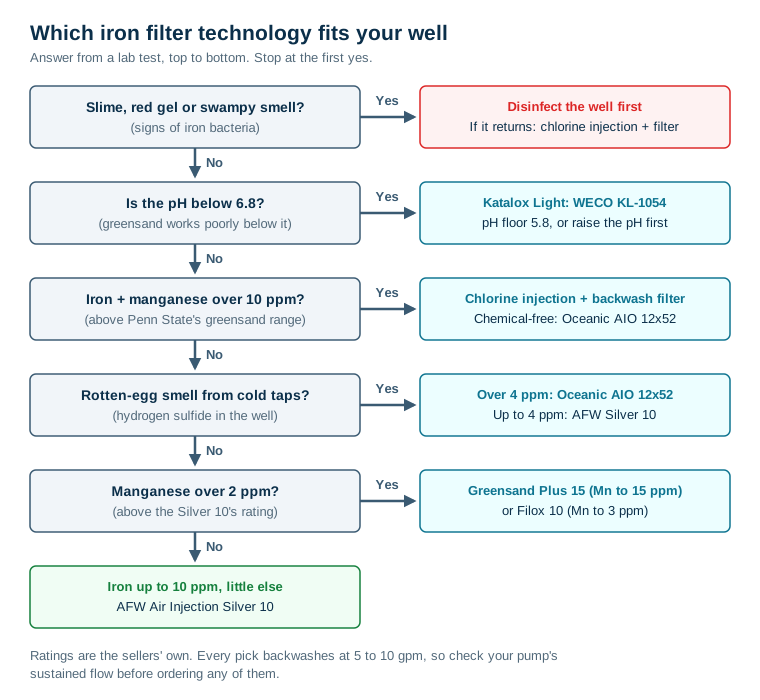
Read the chart from the top and stop at the first yes. The order matters, because the early checks make some technologies useless however much iron they are rated for.
- Iron bacteria. Slime, red-brown gel in the toilet tank or a swampy smell means the well needs disinfecting before any filter goes in. Bacteria coat media and valve ports, and a new filter fouls in months.
- pH. NDSU Extension says greensand "will probably not filter out the iron and manganese adequately" below pH 6.8. Katalox Light lists an inlet range of 5.8 to 10.5, so it is the low-pH choice. The other option is to raise the pH first.
- Iron plus manganese. Penn State Extension recommends oxidizing filters such as greensand for combined iron and manganese of about 3 to 10 mg/L. Above 10 mg/L it recommends chlorine (or another oxidant) followed by filtration.
- Hydrogen sulfide. A rotten-egg smell from the cold taps means sulfide in the well. It uses up the oxidizing capacity that would otherwise go to iron.
- Manganese. It needs more oxidizing push than iron and is the first thing a light-duty air injection unit lets through.
Iron form matters less here than it does for a softener. All five picks oxidize and then filter, so they take both dissolved and already-rusted iron. The form still tells you something. Water that is orange at the tap has met air or chlorine somewhere, and dissolved vs oxidized iron in well water shows how to find out where. If the iron is dissolved, under a few ppm and the water is hard, a softener alone may do. That trade-off is laid out in water softener vs iron filter.
The Best Iron Filters for Well Water, One per Technology
AFWFilters Air Injection Silver 10: best for most wells
- Technology and oxidant: air injection. The Fleck 2510 AiQ air injection head (formerly sold as the AIS10-25SXT) keeps a pocket of air in the top of the tank. Water passes through it, the iron oxidizes, and 1 cubic foot of Filter Ag Plus traps the particles.
- Seller's rating: iron up to 10 ppm, hydrogen sulfide up to 4 ppm, manganese up to 2 ppm. 10 gpm recommended peak flow.
- Backwash flow: 5 gpm, from AFW's air injection comparison table, which also says the 1 cu ft systems need a backwash at least every 3 days.
- Lowest pH: not stated by AFW.
- Tank and warranty: 10x54 tank, 62 inches tall overall. AFW lists 1 year on the control head and 10 years on the tank for its air injection systems.
This is the default because it uses nothing but air and a backwash. There is no chemical tank and no regenerant. The media is plain filter media, and AFW sells a replacement 1 cu ft Filter Ag Plus kit. Its ratings fit the commonest well problem: a few ppm of clear-water iron with a trace of manganese.
Watch for: manganese. At 2 ppm it has the lowest manganese rating of the five picks. If your manganese result is above that, or black specks appear after installation, move down the chart.
Wrong for: wells with a strong sulfur smell. Sulfide above about 4 ppm takes this unit past its rating.
Oceanic AIO 12x52: best for heavy iron with sulfur
- Technology and oxidant: air injection, with 1.5 cu ft of catalytic carbon as the filter bed in the version whose flows Oceanic publishes. A daily backwash removes the iron and refreshes the air pocket, per Oceanic.
- Seller's rating: iron up to 27 ppm, sulfur up to 17 ppm, manganese up to 11 ppm. 9 gpm service flow, 15 gpm peak for under 10 minutes.
- Backwash flow: 10 gpm minimum, on Oceanic's 12x52 product page.
- Lowest pH: not stated by Oceanic.
- Versions: the catalytic carbon version runs on a Fleck 5600SXT. Oceanic also sells a 12x52 on a Fleck 2510SXT.
Nothing else here is rated for this much iron and sulfide together. A 12-inch tank holds more media and gives water longer contact, which is why the ratings are higher than the 10-inch picks.
Watch for: the backwash. 10 gpm is double what the Silver 10 asks for, and many domestic pumps cannot hold it for a full cycle. Measure your pump's sustained flow first. Check which media and valve the Amazon listing ships with, because Oceanic sells several 12x52 versions.
Wrong for: combined iron and manganese far above 10 ppm where you want margin. Penn State's guidance at that level is chlorine injection, and a seller's 27 ppm figure is a ceiling, not a comfortable operating point.
AFWFilters Filox 10: best chemical-free choice for moderate manganese
- Technology and oxidant: a manganese dioxide filter media (Filox, also sold as Mang-Ox) on a standard backwashing Fleck 2510 AiQ valve. AFW sells it as chemical free. The media surface does the oxidizing, and there is no air pocket on this version.
- Seller's rating: iron up to 15 ppm, hydrogen sulfide up to 7 ppm, manganese up to 3 ppm. AFW adds that "actual removal capabilities may vary".
- Backwash flow: 5.3 gpm.
- Lowest pH: not stated by AFW.
- Tank: about 9x48 inches, 1 cu ft of media.
Filox suits a well that has outgrown the Silver 10's manganese and sulfide ratings but does not justify greensand. It is heavier media than Filter Ag, which is why its backwash figure is slightly higher despite the narrower tank.
Watch for: cost. It usually costs more than the Silver 10 for a modest step up in ratings. Buy it for the manganese and sulfide headroom, not for iron alone.
Wrong for: manganese above 3 ppm. Greensand is rated for far more.
AFWFilters Greensand Plus 15: best for high manganese
- Technology and oxidant: 1.5 cu ft of GreensandPlus media in a 10x54 tank on a Fleck 2510SXT. AFW says its version "does not require potassium permanganate to regenerate", because the media's coating does the oxidizing. Its head cannot connect to a permanganate feeder, and AFW recommends chlorine injection ahead of the system for high iron. An air injection head is an option.
- Seller's rating: iron and manganese each up to 15 ppm, hydrogen sulfide up to 5 ppm. AFW says it treats both dissolved and oxidized iron.
- Backwash flow: 5.5 gpm minimum.
- Lowest pH: 6.8. AFW does not state one, but NDSU Extension says greensand works poorly below it.
- Size: AFW designs the 15 for 1 to 2 bathrooms and up to 4 people.
- Amazon listing: the listing did not load for our check, so confirm it is the 1.5 cu ft model before ordering.
Greensand is the long-standing answer for manganese, and AFW's 15 ppm manganese rating is the highest on this page. Penn State notes that classic greensand needs regular permanganate regeneration and careful chemical handling. AFW's setup removes that step and swaps in optional chlorine feed instead, so read its manual for the regime it expects.
Watch for: the smaller Greensand Plus 10. Its lower price looks like a saving, but AFW designs it for 1 to 2 people with a 2.2 to 4.4 gpm service flow. It suits a cabin, not a family.
Wrong for: acidic water. Below pH 6.8, correct the pH first or choose Katalox Light.
WECO KL-1054 Katalox Light: best for acidic well water
- Technology and oxidant: 1.5 cu ft of Katalox Light, a manganese dioxide coating on a lightweight zeolite base. The data sheet says no permanganate, chlorine or chlorine dioxide dosing is mandatory, though an oxidant can be added to boost removal.
- Seller's rating: WECO does not give ppm limits on the listing. Its table gives an 8 gpm service flow for this size.
- Backwash flow: 5.6 gpm minimum, from WECO's sizing table.
- Lowest pH: 5.8. The Katalox Light data sheet gives an inlet pH range of 5.8 to 10.5.
This is the only pick whose media maker states that it works on mildly acidic water. That can save you a separate neutralizer tank on a well that sits between pH 6 and 6.8. WECO's Amazon listing describes the unit as made in the USA.
Watch for: the price, which is usually the highest here, and the missing ppm ratings. Ask WECO to confirm your iron, manganese and sulfide figures are within range before you order.
Wrong for: anyone whose only problem is moderate iron at neutral pH. The Silver 10 does that job for considerably less.
When Chlorine Injection Is the Right Answer
None of the five picks is the best tool for every well. Penn State's guidance for combined iron and manganese above 10 mg/L is oxidation followed by filtration, usually a small chlorine feed pump, a mixing tank or pipe coil for contact time, and a backwashing filter after it. NDSU adds that chlorine oxidizes iron fastest at about pH 8.0 and manganese at about 8.5, and it also controls iron bacteria. A carbon filter afterwards removes the chlorine taste.
It is more work: the solution tank needs refilling, and the filter and carbon still need servicing. But it has no ceiling in the way a rated media does. AFWFilters sells chlorine injection packages on its own store. We could not match one to an Amazon listing on the day we checked, so none is ranked here.
Backwash Flow: The Spec That Rules Out More Wells Than Iron Does
Every pick on this page needs between 5 and 10 gpm of backwash flow, held for the whole cycle. That is roughly twice the 2.5 gpm Pentair lists for a softener in a 10-inch tank, because an iron filter bed has to be lifted and scrubbed hard enough to release the iron it has trapped.
Before you order, measure what your pump delivers with a bucket and a watch while nothing else in the house is running. Then compare it with the figure in the table at the top:
- Under 5 gpm: none of these picks is a safe fit as listed. Ask the seller about a smaller tank or a storage-tank setup.
- 5 to 7 gpm: the 10-inch and 9-inch picks fit once your figure clears theirs, which runs from 5 gpm (Silver 10) to 5.6 gpm (KL-1054). There is little to spare.
- 10 gpm or more: the Oceanic 12x52 becomes an option.
If you also own a softener, set the two units to regenerate at different hours. Both drawing from the pump at once is the commonest reason an iron filter is under-washed. The full equipment order is set out in iron filter before water softener.
What Running an Iron Filter Costs
The purchase price is most of the bill, because none of the air injection or catalytic picks uses a chemical. Running costs come from three things:
- Backwash water. Every cycle sends water to drain. Air injection units backwash often: daily for the Oceanic, at least every 3 days for AFW's Silver.
- Media replacement. AFW sells a replacement Filter Ag Plus kit for the Silver 10. Oceanic says its filter media lasts about 5 years on average.
- Chlorine, if you use it. It applies only to a chlorine feed ahead of greensand or to a full chlorine injection system. It is a monthly supply, not a one-off.
Iron filters also save money downstream. With the iron removed, a softener after it no longer needs iron cleaner or extra salt to cope with iron, as can a water softener remove iron explains.
Who Should Buy None of These
- Wells with iron bacteria. Disinfect first. The Minnesota Department of Health's iron bacteria guidance lists shock chlorination as the most common treatment and warns that it may need repeating.
- Iron under 0.3 ppm. Penn State's recommended limit for drinking water is 0.3 mg/L. Below it, iron rarely stains, and a filter adds cost for little visible gain.
- Hard water with low, dissolved iron. If the iron is clear-water iron within a fine-mesh softener's rating and the pH is above 6.7, one softener can handle both. In that case, look at well-water softeners with fine-mesh resin rather than a separate iron filter.
- Wells that cannot hold 5 gpm. Every pick here needs at least that for backwashing.
- Yellow or tea-coloured water that is not iron. Tannins need a different media, and an iron filter will not clear them.
The best iron filter for well water is the one whose technology matches your four results, with a backwash your pump can hold. For most wells that is a plain air injection unit. The chart moves you to something else only when the water gives a reason.
Frequently Asked Questions
What is the best iron filter for well water?
It depends on your test. For most wells with up to about 10 ppm of iron, little manganese and no strong sulfur smell, an air injection filter such as the AFWFilters Air Injection Silver 10 is the simplest choice. Heavy iron with sulfur points to a larger 12-inch air injection tank. High manganese suits greensand. Acidic water below pH 6.8 suits Katalox Light media. Iron bacteria need disinfection first.
Is air injection or greensand better for iron?
Air injection is easier to live with because it uses only air and a nightly or every-few-days backwash. Greensand handles more manganese: AFW rates its Greensand Plus systems for up to 15 ppm of manganese against 2 ppm for its basic air injection unit. NDSU Extension warns greensand will probably not work well below pH 6.8, so check pH before choosing it.
How much iron can a whole-house iron filter remove?
Seller ratings for the picks on this page run from 10 ppm (AFWFilters Air Injection Silver 10) to 27 ppm (Oceanic's 12x52 air injection tank). Penn State Extension recommends oxidizing filters such as greensand for combined iron and manganese of about 3 to 10 mg/L, and chlorine injection followed by filtration above 10 mg/L. Treat a seller's top figure as a best case, not a design target.
Do I still need a water softener with an iron filter?
Only if your water is also hard. An iron filter removes iron, manganese and some sulfur, but not calcium and magnesium. If hardness is above about 3 to 4 grains per gallon, a softener goes after the iron filter. With the iron removed first, the softener can be sized on hardness alone.
Will an iron filter remove iron bacteria?
No. Iron bacteria form slime that coats filter media and valves. The Minnesota Department of Health lists shock chlorination as the most common treatment, often repeated. If the bacteria keep coming back, continuous chlorine injection ahead of a backwashing filter is the usual long-term answer.
What pH does an iron filter need?
It varies by media. NDSU Extension says greensand will probably not remove iron and manganese adequately below pH 6.8. The Katalox Light data sheet gives an inlet pH range of 5.8 to 10.5. AFWFilters does not publish a minimum pH for its air injection or Filox systems. On acidic water, either choose a low-pH media or raise the pH first.
