
Can a Water Softener Remove Iron From Well Water?
Can a water softener remove iron? Yes, but only dissolved (ferrous) iron, and only when the conditions fit. The pH should be above 6.7, and no air or chlorine can reach the water before the softener. The concentration also has to sit inside the unit's own rating. Published ceilings run from about 2 to 10 ppm. Iron that has already oxidized fouls the resin instead of being removed.
This page is about the numbers and the conditions attached to them. How to tell which form of iron you have is covered in dissolved vs oxidized iron in well water. How iron changes the capacity you need is in how iron changes water softener sizing.
The Published Iron Limits, Side by Side
The most common answer online is that a softener handles "some iron" or "a few ppm". The primary sources are more specific than that, but they do not agree with each other:
| Source | Iron figure | Conditions attached |
|---|---|---|
| Penn State Extension | Dissolved iron under 5 mg/L | pH above 6.7, hardness 3 to 20 gpg, and raw water must not contact air or chlorine before the softener |
| NDSU Extension, iron and manganese removal | Up to 5 mg/L for some softeners, 2 mg/L for others | Check the manufacturer's rating for your unit |
| NDSU Extension, water softening | "Up to 10 ppm of iron and manganese" for some softeners | Above 10 ppm, a dedicated iron removal system may be needed |
| Nebraska Extension (G1491) | "As much as 5-10 ppm" of iron and manganese | Excess iron above 5 ppm "can reduce the effectiveness" of the softener |
| Hellenbrand residential softener manual | 2 ppm of ferrous bicarbonate iron | Air must be kept away from the water until after it has been softened |
| Same manual, salt settings | Iron under 0.5 ppm | Only for the high-efficiency (lowest salt) setting |
| Chandler Systems softener manual | Filtration "most generally" required above 5 ppm | The same applies to iron coloration, iron bacteria or sediment |
Why the figures run from 0.5 to 10 ppm. They answer different questions.
- The extension figures describe what ion exchange can do when conditions are good.
- The manufacturer figure describes what one specific unit is designed and warranted for.
- The 0.5 ppm figure is not a removal limit. It is the most iron allowed if you want to run the salt-saving setting.
Your working ceiling is the lowest figure that applies to your setup. Take a softener rated at 2 ppm on a well with 3.5 ppm of dissolved iron. Extension guidance says 3.5 ppm is possible, but that does not make the softener suitable. The manufacturer's limit is the one the equipment was built around, and the warranty is written against it.
Why a Softener Can Take Any Iron at All
A softener works by cation exchange. The resin holds sodium loosely and swaps it for positively charged ions with a stronger pull. Calcium and magnesium are the targets. Dissolved ferrous iron (Fe²⁺) carries the same double positive charge, so the resin takes it up the same way and releases it during regeneration.
Oxidized ferric iron is a different thing. Once ferrous iron meets oxygen, it turns into insoluble particles of ferric hydroxide, the orange floc you see in a glass left standing. There is no dissolved ion left to exchange. The resin bed can only strain out the particles, and it does that badly. Backwash lifts some of them out, and the rest coat the beads. The progression is described in what is water softener resin fouling.
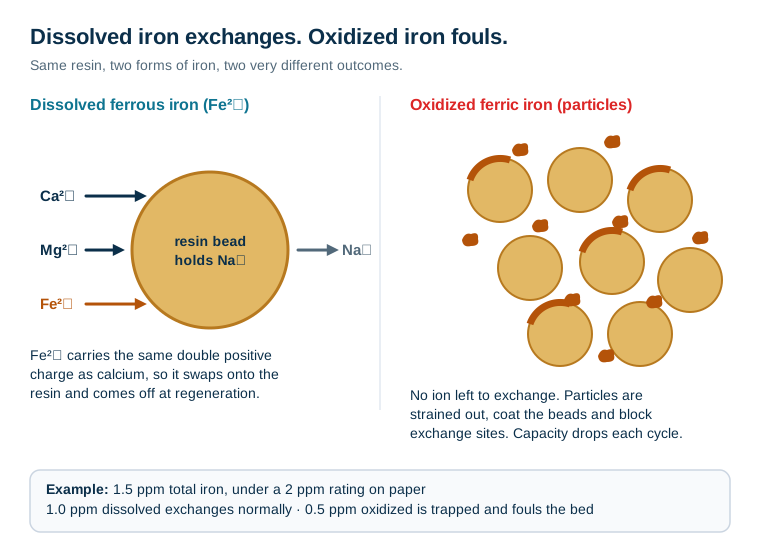
This is why form matters more than concentration. A softener can handle 2 ppm of dissolved iron. The same softener handles 0.5 ppm of oxidized iron badly.
When a Water Softener Can Remove Iron: The Six Conditions
Every number in the table above assumes these conditions. If any one of them fails, the number stops applying.
- The iron is still dissolved when it reaches the softener. Clear water that turns orange in a glass over several minutes is the field sign. Water that is orange as it leaves the tap already carries oxidized iron. The glass test and the lab confirmation are in the dissolved vs oxidized iron guide.
- Nothing upstream oxidizes it. Penn State calls it "critical" that raw water not contact air or chlorine before the softener. That rules out an air-injection system or chlorinator ahead of the softener. It also means bypassing the softener during shock chlorination, until the chlorine has flushed out. Hellenbrand's manual says the same thing about air.
- The pH is above 6.7. This is Penn State's threshold. Low-pH water also raises a corrosion question that a softener does nothing for, which is covered in interpreting pH and hardness together.
- Hardness is in the range a softener is meant for. Penn State gives 3 to 20 gpg. A softener installed only to catch iron on nearly soft water is using the wrong tool for the job.
- The concentration is within the unit's own rating. This is the lowest applicable number from the table, not the most generous one.
- There are no iron bacteria, and manganese has been measured. NDSU describes iron bacteria as producing a brown slimy material, and a softener does not treat bacteria. Manganese uses up the same resin capacity and stains black rather than orange. Penn State recommends keeping it under 0.05 mg/L in drinking water.
A well that meets all six conditions is a genuine candidate for a softener alone. A well that fails even one of them is not, however low the iron number is.
Why the Limit Collapses Once Any Iron Has Oxidized
This is the point most "softeners remove iron" pages skip. For oxidized iron, the practical ceiling is not a lower number. It is zero.
Take a well with 1.5 ppm of total iron, where 1.0 ppm is still dissolved and 0.5 ppm has oxidized somewhere on the way through the system. On the total figure, it sits comfortably under a 2 ppm rating. In practice:
- The 1.0 ppm of dissolved iron exchanges normally and is removed at regeneration.
- The 0.5 ppm of oxidized iron is trapped in the bed as particles. Some of it backwashes out and some stays behind.
- The iron left behind coats the beads and blocks exchange sites. Capacity drops, hardness and iron come through earlier, and the next regeneration recovers a little less.
Penn State states it directly: "oxidized forms of iron and manganese will foul the softener resin." Hellenbrand's manual lists "ferric hydroxide iron" as a condition that needs additional equipment, alongside iron bacteria and low pH.
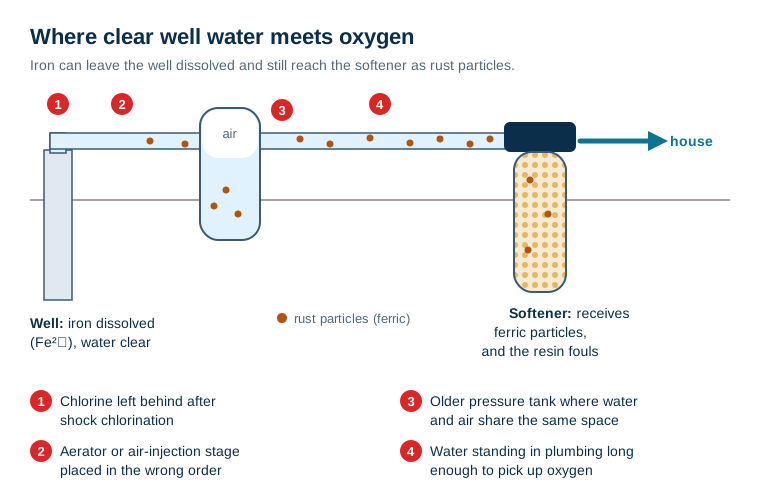
Where does the oxidation come from on a well that tests clear? Usually from something between the well and the softener:
- chlorine left behind after shock chlorination
- an aerator or air-injection stage placed in the wrong order
- an older pressure tank where water and air share the same space
- water standing long enough in plumbing to pick up oxygen
The source water can be entirely ferrous, and the softener still sees ferric iron.
That is why the telltale symptom is often brown water after softener regeneration. Iron that built up in the bed is released during backwash and some of it ends up in the house.
Does the Resin Type Raise the Ceiling?
Specialty resins are often sold as the fix for iron, so the claims deserve a careful reading.
- Shallow-shell resin. Purolite's SST60 engineering bulletin lists "better iron removal" and "less susceptible to fouling" among its advantages. The explanation it gives is that the core of standard resin beads stays unregenerated, and calcium, magnesium and iron build up there. A shell-only bead has no deep core for iron to become stuck in.
- Fine mesh resin. Purolite describes fine mesh resin as giving higher operating capacity and faster kinetics. Retailers often label it as the resin for clear-water iron.
What those documents do not say is how many ppm of iron each resin can handle. Neither gives an iron ceiling by resin type. The improvements are real, but they are about how completely iron comes off at regeneration. They do not allow the system to run above its rating, and no resin changes the outcome for oxidized iron. If a seller quotes an iron figure for a resin, ask for the datasheet it came from.
How to Check a Manufacturer's Iron-Removal Claim
An iron rating means something only if you know the test conditions behind it. Before you rely on a number from a product page, get answers to these questions:
| Ask | Why it matters | A trustworthy answer looks like |
|---|---|---|
| Which form of iron was the figure based on? | A ferrous-only rating says nothing about ferric iron | "Dissolved ferrous iron, clear when drawn" |
| At what pH and with what oxygen exposure? | Penn State's conditions are pH above 6.7 and no air contact | A stated pH floor and a warning about air or chlorine upstream |
| At what salt dose? | Hellenbrand limits its high-efficiency setting to water with under 0.5 ppm iron | A named salt setting, not the lowest one |
| At what regeneration interval? | Chandler's manual recommends a regeneration day override "when iron is being treated" | A maximum number of days between regenerations |
| Iron alone, or iron and manganese combined? | Both use up the same resin capacity | A combined figure, or separate limits for each |
| Is it in the manual or only in marketing copy? | The manual is what the warranty is written against | A printed operating-conditions section |
Watch for certification wording that does not cover iron. Hellenbrand's manual carries an NSF/ANSI 44 statement, but it covers salt efficiency. The same manual says operating efficiency in real installations is "typically less than the tested efficiency" because of contaminants that reduce capacity. Iron is one of those contaminants. A claim tested on laboratory water tells you what the unit can do on laboratory water, not on your well. Ask what the iron figure was actually tested against. If the seller cannot say, treat it as marketing copy.
Where This Answer Stops, and What to Do Next
Even a softener that removes iron correctly pays for it in capacity. Manufacturers ask you to add 3 to 4 grains per gallon to the hardness setting for every ppm of iron. Hellenbrand uses 3 and Chandler uses 4. That changes resin volume, salt use and regeneration frequency, all of which are worked through in how iron changes water softener sizing.
Work through it in this order:
- Get dissolved and total iron measured separately, along with manganese, pH and hardness. What to order is in test iron and manganese before sizing a softener.
- Check all six conditions above. Any failure means the softener cannot be the iron treatment.
- Compare your dissolved iron with the lowest applicable rating, not the highest one you found. If you are shopping, choosing a well-water softener by iron band sets each model's stated iron rating beside the conditions it leaves out.
- If you fall outside the range, the choice between a filter, a softener or both is covered in water softener vs iron filter. Once a filter is the answer, choosing an iron filter by iron level, pH and form sorts the options by your test result.
The honest summary is that a softener can remove iron, but only within narrow conditions. If you rely on it outside those conditions, you will be replacing resin before the rest of the unit wears out.
Frequently Asked Questions
How much iron can a water softener remove?
It depends on whose number you read, and the conditions matter more than the number. Penn State Extension recommends a softener for iron only when dissolved iron is under 5 mg/L, pH is above 6.7 and hardness is between 3 and 20 grains per gallon. NDSU Extension notes some softeners handle up to 5 mg/L while others are limited to 2 mg/L. One residential manufacturer's manual rates its unit for 2 ppm of dissolved ferrous iron. Use the lowest figure that applies to your equipment.
Will a water softener remove iron from well water?
It will remove dissolved, clear-water iron in the low single-digit ppm range if the water reaches the resin before it meets air or chlorine. It will not remove iron that has already oxidized into rust particles, iron bound up with organic matter, or iron bacteria. Those foul the resin instead of exchanging on it. A glass of cold water left to stand for 30 minutes tells you which kind you have before you spend anything.
Do I need an iron filter if I already have a water softener?
You need one if your iron is above your softener's rated limit, if any of it arrives already oxidized, or if iron bacteria are present. You probably do not need one if the iron is dissolved, stays within the manufacturer's rating, and the pH is above 6.7. The deciding test is a lab report showing dissolved and total iron separately, plus pH and manganese.
Why is there still iron in my water after the softener?
The usual reasons are iron above the unit's rating, iron that oxidized before it reached the resin, a resin bed already coated with iron and losing capacity, or a hardness setting that does not include an allowance for iron, so the softener regenerates too late. Iron coming through only right after regeneration usually means the backwash is not clearing the bed properly.
Will iron ruin a water softener?
Dissolved iron within the rating does not ruin one if the softener regenerates often enough and the resin is cleaned periodically. Oxidized iron and iron above the rating coat the resin beads, reduce capacity cycle after cycle, and can end with a resin replacement. Penn State Extension states plainly that oxidized forms of iron and manganese will foul softener resin.
