
Water Softener vs Iron Filter: Which One Do You Need?
Water softener vs iron filter is usually not an either-or choice. A softener removes hardness and can deal with a little dissolved iron. An iron filter removes iron in either form but leaves the water hard. Three test results decide which you need: the iron level, the form of the iron, and the hardness. The answer is a softener alone, a filter alone, both in sequence, or a different technology.
This page is the decision and its cost. How to identify the form of your iron is covered in dissolved vs oxidized iron, and the limits of a softener on iron are in can a water softener remove iron.
Water Softener vs Iron Filter: What Each One Does
| Water softener | Iron filter (oxidizing type) | |
|---|---|---|
| How it works | Ion exchange: resin swaps sodium for calcium, magnesium and dissolved iron | Oxidizes dissolved iron into particles, then traps them in a media bed |
| Treats hardness | Yes, which is its job | No |
| Dissolved (ferrous) iron | Within a narrow rating, and only if no air reaches it first | Yes |
| Oxidized (ferric) iron | No, it fouls the resin | Yes, particles are filtered out |
| Typical iron range | Penn State: under 5 mg/L with pH above 6.7. One manufacturer rates its unit at 2 ppm | Penn State: oxidizing filters for combined iron and manganese of 3 to 10 mg/L. NDSU Extension: greensand up to 10 mg/L |
| pH sensitivity | Recommended only above pH 6.7 | NDSU: greensand performs poorly below pH 6.8 |
| Consumables | Softener salt; resin cleaner if it carries iron | Depends on the design. Greensand is regenerated with potassium permanganate |
| Backwash | Yes, at each regeneration | Yes, often a large flow |
| What it cannot do | Remove oxidized iron, iron bacteria or high iron | Soften water |
The row that decides most cases is the one for oxidized iron. A softener has no way of dealing with particles. It can only strain them out, and they foul the resin. Penn State Extension is explicit that oxidized iron and manganese will foul softener resin, and that raw water must not contact air or chlorine before it reaches the softener.
"Iron filter" covers several designs: greensand and other manganese-oxide media, air-oxidation units, and chlorine-fed systems. They differ in cost and upkeep, but for this decision they all do the same job. They take iron out and leave the hardness behind. Which design fits a given iron level, form and pH is covered in choosing an iron filter type from your test result.
The Decision Matrix: Four Possible Answers
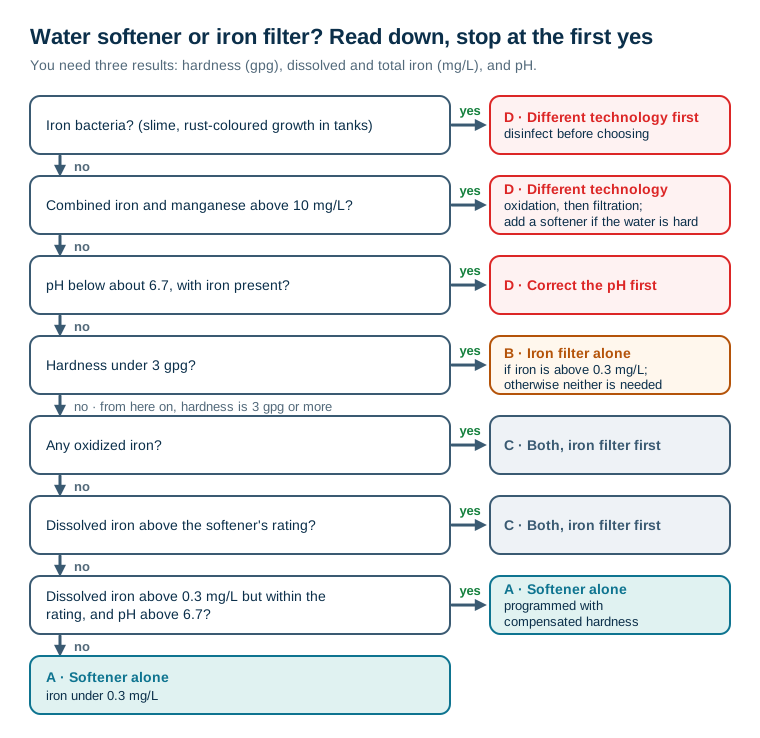
You need three results, from a lab report or from a glass test plus a lab report. They are hardness (gpg), dissolved and total iron (ppm, which gives you the form), and pH. Manganese and a bacteria check help too. Read down the table and stop at the first row that matches.
| # | If your water has... | Answer |
|---|---|---|
| 1 | Iron bacteria (slime, rust-colored growth in tanks) | D. Different technology first. Disinfect before choosing any filter or softener |
| 2 | Combined iron and manganese above 10 mg/L | D. Different technology. Penn State: oxidation (such as chlorination) followed by filtration. Add a softener after it if the water is hard |
| 3 | pH below about 6.7 with iron present | D. Correct the pH first. Softener and greensand guidance both assume near-neutral water |
| 4 | Hardness under 3 gpg, iron above 0.3 mg/L (either form) | B. Iron filter alone. Water this soft is below the hardness range Penn State gives for softeners |
| 5 | Hardness 3 gpg or more, any oxidized iron | C. Both, iron filter first |
| 6 | Hardness 3 gpg or more, dissolved iron above the softener's rating | C. Both, iron filter first |
| 7 | Hardness 3 gpg or more, dissolved iron above 0.3 but within the rating, pH above 6.7 | A. Softener alone, programmed with compensated hardness |
| 8 | Hardness 3 gpg or more, iron under 0.3 mg/L | A. Softener alone |
| 9 | Hardness under 3 gpg, iron 0.3 mg/L or less | Neither. Below Penn State's softener range, and below the level where iron stains |
Notes on the thresholds:
- 0.3 mg/L is the iron level Penn State recommends for drinking water, and it matches EPA's secondary standard. Below it, iron rarely stains.
- 3 to 20 gpg is the hardness range where Penn State recommends a softener in the first place.
- The softener's rating is the figure in its own manual. Hellenbrand's residential unit is rated for 2 ppm of dissolved ferrous iron. Extension sources give ceilings from 2 to 10 ppm, and the lowest figure that applies to your equipment is the one to use.
- Polyphosphate. Penn State lists it as an option for dissolved iron under 2 mg/L. It controls staining rather than removing the iron, and does nothing for hardness. It is worth knowing about for soft water with light iron. It is not a substitute for either unit on hard water.
Five example wells run through the matrix
| Well | Test results | Row | Answer |
|---|---|---|---|
| Suburban drilled well | 14 gpg, 0.2 ppm iron, pH 7.4 | 8 | Softener alone |
| Clear-water iron well | 12 gpg, 1.5 ppm dissolved iron, pH 7.2, softener rated at 2 ppm | 7 | Softener alone, programmed at 12 + (4 × 1.5) = 18 gpg |
| Mixed-iron well | 16 gpg, 4 ppm total iron, part of it already oxidized | 5 | Iron filter, then softener |
| Soft iron well | 2 gpg, 3 ppm dissolved iron, pH 7.0 | 4 | Iron filter alone |
| Heavy iron well | 18 gpg, 11 ppm combined iron and manganese | 2 | Oxidation and filtration, then softener |
The arithmetic behind the second well's setting, and why 4 ppm is too much iron to leave to the softener, is set out in how iron changes water softener sizing.
The Honest Cost Comparison
These installed price ranges come from HomeGuide's well water filtration cost guide. They are national ranges, and your local quotes may differ.
| Path | Installed cost | Running costs | Costs people miss |
|---|---|---|---|
| A. Softener alone | $1,000 to $3,500 | Salt, $5 to $15 a month | Salt use rises with iron. At 2 ppm, the worked example uses 53% more salt than the same well without iron. Add resin cleaner, and resin replaced early if iron is under-estimated |
| B. Iron filter alone | $1,000 to $3,500 | Media and any regenerant. HomeGuide puts annual maintenance for well systems at $100 to $500 | Backwash water. Hard water is left untouched, so scale continues |
| C. Both, filter first | About $2,000 to $7,000 (the two ranges added) | Filter upkeep plus salt at the hardness-only rate | Two backwashing units on one well. Space, drain capacity and pump output all need checking |
| D. Different technology | Designed for the specific water. HomeGuide puts multi-stage well systems at $3,000 to $10,000 | Chlorine or other chemical feed, plus filter upkeep | Contact tanks, feed pumps and a second round of testing after installation |
Path C is not simply twice the cost of path A. Once an iron filter sits in front of the softener, the softener is sized on hardness alone. In the worked example in how iron changes water softener sizing, a 15 gpg well with 4 ppm of iron would push a 1 cu ft softener to about 888 lb of salt a year. With the iron removed first, the same softener needs about 430 lb. The salt saved each year offsets part of the filter's running costs.
Path A is cheapest only while the iron stays within its limits. A softener carrying iron above its rating fails gradually and expensively. Capacity falls, iron comes through after regeneration, and the resin wears out long before the valve does. When that happens, the savings from skipping the filter go on resin, cleaner and service calls.
HomeGuide also gives a range for a typical multi-stage well setup: $3,000 to $7,000 installed for a sediment filter, iron removal, a softener and an under-sink RO unit. That is a useful ceiling check if an installer's quote for path C comes in far above it.
The Mistakes That Make Either Choice Expensive
- Choosing on total iron alone. 1.5 ppm of dissolved iron and 1.5 ppm of oxidized iron lead to different rows of the matrix. Do the glass test or get the dissolved and total iron figures before you buy.
- Buying a softener sold as an "iron removal" softener for oxidized iron. No resin changes what happens to particles.
- Installing them in the wrong order. The filter protects the softener, so it has to be upstream. The full reasoning, and the thresholds for adding a sediment stage, are in should an iron filter go before a water softener.
- Scheduling two backwashes at the same time on one well. Both units backwash, and some iron filters need a high flow rate to do it. If both are set for 2 a.m., the pump may not keep up with either. Stagger the times and check the well's output first. Placement relative to the pressure tank is covered in where to install a softener on a well system.
- Skipping the retest. A new filter changes what the softener sees. Test after the filter once it is running, and set the softener's hardness from that result, not from the raw-water report.
What to Do Next
- Get the test done properly: hardness, dissolved and total iron, manganese, pH, and a bacteria check. What to order and how to sample are in test iron and manganese before sizing a softener.
- Run your numbers through the matrix and note the row you land on. Rows 1 to 3 mean you should stop and deal with that problem first.
- Ask each installer which row they think you are in. A quote for path A on a well in rows 5 or 6, or path C on a well in row 8, deserves an explanation.
Most well owners who end up buying equipment twice made the purchase before the test. The matrix only works if the three numbers going into it are right.
Frequently Asked Questions
Do I need a water softener or an iron filter for well water?
It depends on three test results: the iron level, whether the iron is dissolved or already oxidized, and hardness. Hard water with little or no iron needs a softener. Iron with soft water needs an iron filter. Hard water with iron above the softener's rating, or with any oxidized iron, needs both, with the iron filter first. Iron bacteria, very high iron or low pH point to other treatment entirely.
Can I use a water softener instead of an iron filter?
Only when the iron is dissolved, stays within the softener's rated limit, the pH is above 6.7, and no air or chlorine reaches the water first. Published softener limits range from 2 to 10 ppm depending on the source, and one residential manufacturer rates its unit at 2 ppm. Outside those conditions, a softener used as an iron filter fouls its resin.
Does an iron filter also soften water?
No. An iron filter oxidizes and traps iron, and manganese in many designs, but calcium and magnesium pass straight through. If your water is hard, a filter alone leaves you with iron-free hard water that still scales fixtures and water heaters.
Which goes first, the iron filter or the water softener?
The iron filter goes first. The softener's resin needs to receive water with the iron already removed. If the order is reversed, the softener takes the full iron load and fouls, while the filter downstream has almost nothing left to do.
Is an iron filter cheaper than a water softener?
Their installed prices overlap. HomeGuide puts iron and manganese filters at about $1,000 to $3,500 installed and well-water softeners in the same $1,000 to $3,500 range. The running costs differ more than the purchase price. Softeners use salt, typically $5 to $15 a month by HomeGuide's estimate, and more when they also carry iron. Filters mostly cost media and occasional regenerant.
What if I have both iron and hard water?
Then the question is whether the iron is low enough, and dissolved enough, for the softener to handle it alone. If dissolved iron is within the softener's rating and pH is above 6.7, a softener sized with compensated hardness can do both jobs. If not, install an iron filter ahead of the softener and size the softener on hardness alone.
