
Best Salt-Free Water Conditioners: 3 Picks Graded on Evidence and Limits
The best salt-free water conditioners are the Watts OneFlow+ for most city homes, the NuvoH2O Manor for moderately hard water above pH 7.3, and the Aquasana Rhino with its salt-free conditioner if you also want chlorine filtered and your water is under 15 gpg. They earn their places on two things buyers rarely get: evidence you can trace and water limits you can check. None of them publishes a full test report for its own unit, and that is true of every salt-free conditioner we looked at. The picks below are the ones whose makers come closest, and whose manuals tell you plainly which water will defeat them.
Disclosure: Hard Water Solved may earn a commission if you buy through links on this page, at no extra cost to you. It does not change which products we include or how we rank them. Read our disclaimer.
The Best Salt-Free Water Conditioners at a Glance
| Pick | Media | Best evidence published | Hardness limit | Media life | Amazon |
|---|---|---|---|---|---|
| Watts OneFlow+ OFPSYS: best for most city homes | Crystal-forming media plus carbon block | Watts cites DVGW W 512-based testing of the media type | 30 gpg | Scale cartridge 250,000 gal or 3 years | Check price on Amazon |
| NuvoH2O Manor: best documented single product | Citric acid cartridge | Maker-funded heater study run with Battelle | 25 gpg | About 6 months or 50,000 gal | Check price on Amazon |
| Aquasana Rhino + salt-free conditioner: best with chlorine filtration | Scale control media plus carbon and KDF filter | "Independently tested", nothing named | Under 15 gpg | 1,000,000 gal or 10 years | Check price on Amazon |
How We Chose
Methodology. Nothing on this page was physically tested. Every limit and claim is quoted from the maker's specification sheet, manual, product page or warranty, and the evidence grade is based on what those documents name.
- Entry gate: published scale-reduction evidence that goes beyond the maker's own say-so, ideally a third-party test to the German DVGW W 512 protocol or an equivalent heated test. Where no product met that fully, we ranked by how close each maker's evidence gets and said so.
- Also required: a published table of hardness, pH, iron, manganese and chlorine limits, so you can rule the unit out against your own water test, and a listing on Amazon.
- Excluded: SpringWell FutureSoft (its "up to 95%" claim names no test, and its Amazon listings showed no offer when this site checked on 1 October); Pentair Pelican NaturSoft (every Amazon listing unavailable on 1 October); Aquasure Serene (no test and no water limits on its product page); the A. O. Smith whole-house descaler (its owner's manual gives no hardness, iron or pH limits and restricts it to municipal water); and electronic coil descalers, a different technology covered on a separate page.
- Prices are not listed here because they change often. Use the buttons to see the current price on Amazon.
The Evidence Behind Each Scale Claim
A salt-free conditioner cannot be judged with a hardness test, because the calcium and magnesium are still in the water afterwards. Why that is, and why a test strip reads the same before and after, is explained in does a salt-free system actually soften water. The only fair test is to heat treated and untreated water and weigh the scale. The German DVGW W 512 protocol does exactly that, which is why independent researchers use it.
The best independent benchmark is WateReuse Research Foundation project 08-06, led by Arizona State University. Under DVGW W 512 it found that template-assisted crystallization (TAC) "reduced scale formation by greater than 88 percent". It names technologies, not brands. So it tells you crystal-forming media can work, not that any product on a shelf does.
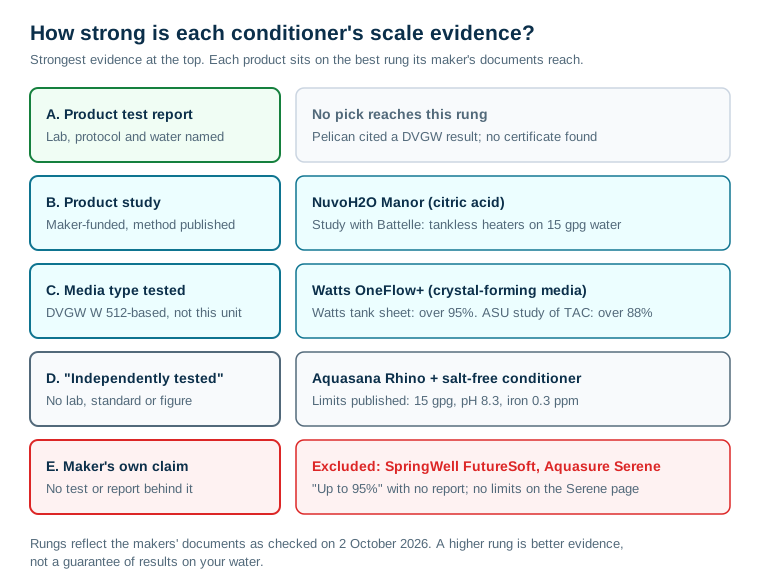
Here is where each maker's documents land:
- NuvoH2O: a product study, paid for by the maker. Its scale claim rests on a 2011 to 2012 study run "in conjunction with, but not endorsed by" the Battelle Memorial Institute. Five treated electric tankless heaters on about 15 gpg water averaged 0.87 g of scale against 45.6 g for five untreated ones. That is the only test we found on a specific product. It is also maker-funded and on one appliance type.
- Watts: the media type, tested. Watts' engineering sheet for its OneFlow tank systems says independent testing under a protocol based on DVGW W 512 confirmed scale reduction of over 95 percent for TAC. It does not name the lab. The current sheet for the OneFlow+ cartridge system makes no performance figure at all, and states that "contaminant reductions" are "not tested or certified by WQA". Its WQA certification is to NSF/ANSI/CAN 372, which covers lead-free materials, not scale.
- Aquasana: a sentence. The product page says the conditioner is "independently tested to naturally and safely reduce scale buildup". No standard, lab or percentage is given, and Aquasana's certified-products list shows nothing for the conditioner stage.
- SpringWell: a number with nothing under it. "Prevents up to 95% of scale buildup" appears without a protocol, lab or report, which is why FutureSoft failed the gate.
How to read any of these claims, including the difference between "tested to" and "certified to", is set out in evaluating salt-free and maintenance-free claims.
Every Pick's Water Limits in One Table
This is the table to hold against your water test. A conditioner outside its limits does not just work less well. The media fouls, and most warranties treat out-of-spec water as grounds to refuse a claim.
| Limit | Watts OneFlow+ OFPSYS | NuvoH2O Manor | Aquasana salt-free conditioner |
|---|---|---|---|
| Hardness, maximum | 30 gpg (513 ppm) | 25 gpg | Below 15 gpg |
| pH | 6.5 to 8.5 | 7.3 to 8.5 | Below 8.3 |
| Iron | 0.3 ppm maximum | Not given; "exclusively for scale" | Under 0.3 ppm |
| Manganese | 0.05 ppm maximum | Not given | Not given |
| Free chlorine | Under 2 ppm | Not given | Not given (the Rhino filter removes it upstream) |
| Copper | 1.3 ppm; new copper passivated 4 weeks | Watch for corrosion; pH falls | Not given |
| Oil and hydrogen sulfide | Must be removed first | Treat separately | Not given |
| Other | Phosphates under 3.0 ppm, silica 20 ppm, TDS under 1,500 mg/L | — | Alkalinity under 250 mg/L |
| Temperature and pressure | 40 to 100°F; 10 to 90 psi | Not captured | Not captured |
Sources: the Watts OFPSYS engineering specification, NuvoH2O's product pages and FAQ, and Aquasana's product page, as checked by this site. "Not given" means the maker publishes no figure, not that there is no limit.
Three things to take from it:
- Hardness rules out Aquasana first. Water between 15 and 30 gpg is common, and only the Watts covers that whole band. Above 30 gpg, none of the three is a good buy.
- pH rules out NuvoH2O on many wells. It works by adding citric acid and nudging pH down, so it is not recommended below 7.3.
- "Not given" is not "no limit". Iron and manganese coat every kind of scale media. If your test shows any, treat it first, whichever unit you choose. Why those metals fail before hardness does is covered in hardness limits for salt-free conditioners.
The Best Salt-Free Water Conditioners, Pick by Pick
Watts OneFlow+ OFPSYS: best for most city homes
- What it is: two cartridges in one housing: a 20-micron carbon block for sediment, chlorine taste and odour, then a OneFlow+ scale cartridge
- Flow: nominal up to 10 gpm, 1-inch MNPT connections
- Cartridge life: scale cartridge 250,000 gallons or 3 years, whichever comes first; carbon block about once a year (rated for 50,000 gallons of chlorine taste reduction at 3 gpm)
- Size: about 18.75 inches tall, 16 lb dry, wall-mounted
- Certification: WQA to NSF/ANSI/CAN 372, lead-free materials only
Watts publishes the fullest limits table of any conditioner we checked, and it is unusually frank about what the product will not do. The sheet says it "is not a water softener", that "soft scale spotting may occur", and that a point-of-use softener should be used where spot-free results are mandatory, such as glass stemware. It also explains its own hardness number: the media controls scale inside the plumbing up to 30 gpg, and that figure is a recommended maximum because of residue outside the plumbing.
It is a cartridge system, so it is compact and needs no soaking or flushing of a media tank. The trade-off is that 10 gpm is a nominal figure for a single housing. Watts warns that exceeding the maximum flow "can reduce effectiveness and void warranty". For a large house with several bathrooms running at once, ask Watts or a dealer about the larger OneFlow tank systems.
Watch for: the stacking rules. OneFlow must be the last stage before the equipment it protects, and Watts says not to apply "any other antiscalants before or after". If you already have a polyphosphate cartridge on the line or in front of a tankless heater, remove it.
NuvoH2O Manor: best documented single product
- What it is: a citric acid cartridge that binds calcium as calcium citrate and lowers pH toward neutral
- Range: up to 25 gpg; pH 7.3 to 8.5; for homes over 1,500 sq ft
- Cartridge life: about 6 months or 50,000 gallons
- Evidence: a maker-funded study run with Battelle on tankless water heaters
- Guarantee: 90-day money-back, 5-year limited warranty (a 20 percent restocking fee applies to installs by its partner)
NuvoH2O is not TAC, and it is the only pick that adds something to the water. That is both its weakness and why it has better evidence: a dosed chemical can be tested on a specific product more easily than a generic media. The heater study is a strong result on one water and one appliance, under a protocol NuvoH2O approved. Treat it as real evidence with a sponsor, not as independent proof.
Watch for: two costs the box price hides. The cartridge runs out every six months or so, which adds up to about twenty cartridges over ten years for a family of four. And the pH drop matters in a copper-plumbed house near the bottom of the range. Test pH before buying and again a month after installation.
Aquasana Rhino with salt-free conditioner: best with chlorine filtration
- What it is: Aquasana's Rhino carbon and KDF whole-house filter followed by a salt-free scale conditioner
- Range: hardness below 15 gpg, pH below 8.3, iron under 0.3 ppm, alkalinity under 250 mg/L
- Media life: 1,000,000 gallons or 10 years for each tank
- Evidence: the filter has published NSF/ANSI 42 test data for chlorine; the conditioner is described only as "independently tested"
- Guarantee: 10-year limited warranty and 90-day satisfaction guarantee, per the product pages
Buy this one for the filter, and treat the conditioner as a bonus that works only on fairly moderate water. The Rhino's chlorine claim is the best-documented figure anywhere on this page: Aquasana's data sheet shows more than 97.4 percent free chlorine reduction across its full 1,000,000-gallon rating. The conditioner's evidence is the weakest of the three picks, and its 15 gpg ceiling is the lowest.
Watch for: availability. This site found the Rhino-plus-conditioner package unavailable on Amazon on 1 October, so confirm the listing is in stock before planning around it.
Which Pick for Your Water Test
Start with three numbers from an independent lab test: hardness, pH and iron. Then:
- Iron above 0.3 ppm, any manganese, or a sulfur smell: none of these yet. Filter first, then add a conditioner.
- Hardness above 30 gpg: none of these. Spotting will be heavy and scale control is outside every pick's rating.
- Hardness 15 to 30 gpg, pH 6.5 to 8.5: the Watts OneFlow+.
- Hardness up to 25 gpg, pH comfortably above 7.3, city water: the Watts or the NuvoH2O; the NuvoH2O if you want the only product-specific study.
- Hardness under 15 gpg and you also want chlorine taste and odour gone: the Aquasana pair.
How these media actually turn dissolved hardness into crystals, and why heat is where the benefit shows, is in how a salt-free water conditioner works.
What the Running Costs Look Like
None of the three needs salt, electricity or a drain. All three have a part that wears out:
| Pick | Replaced part | Interval | What we could confirm |
|---|---|---|---|
| Watts OneFlow+ | Scale cartridge; carbon block | 3 years or 250,000 gal; about yearly | Intervals from the spec sheet |
| NuvoH2O Manor | Citric acid cartridge | About 6 months or 50,000 gal | Interval from NuvoH2O's product pages |
| Aquasana | Pre-filters; both tanks at end of life | Pre-filters more often; tanks at 10 years | Tank life from the product page |
For a family of four using about 102,000 gallons a year, the Watts scale cartridge reaches its three-year limit before its gallon limit, and the NuvoH2O Manor needs about two cartridges a year. Price the replacements on the day you buy. A cheap housing with dear cartridges is the most common way a salt-free system ends up costing more than a softener.
Who Should Buy None of These
- Anyone who wants soft water. If the goal is spot-free glass, better lather, less soap scum or softer laundry, a conditioner cannot deliver it. Only ion exchange removes the hardness. The full trade-off is set out in salt-based vs salt-free water treatment.
- Wells with iron, manganese or hydrogen sulfide that are not already treated. Every pick either sets a near-zero limit or says it handles scale only.
- Water harder than 30 gpg. Choose a softener, sized properly for the load.
- Homes already dosing polyphosphate for a tankless heater or boiler, unless you remove it. Watts says not to combine antiscalants with its media.
- Very soft water. Below about 3 gpg there is little scale to prevent.
- Buyers who need certified performance. No salt-free conditioner here holds a scale certification you can look up. A salt-based softener can be certified to NSF/ANSI 44.
The University of Nebraska–Lincoln's extension guide to salt-free water "softener" alternatives puts it simply: standardised test procedures for these devices have not been developed, so investigate product claims before buying. That is what the evidence ladder above does for you. For most city homes within its limits, the Watts OneFlow+ is the pick to start from. Check your test against its table first.
Frequently Asked Questions
Do salt-free water conditioners really work?
For scale in heated equipment, the technology has independent support. A WateReuse Research Foundation study led by Arizona State University found template-assisted crystallization cut scale formation by more than 88 percent under the German DVGW W 512 heated test. That result is for the media type, not for any one product. No salt-free conditioner removes hardness, so spotting, soap lather and laundry feel do not change the way they do with a softener.
Which salt-free water conditioner has the best test evidence?
None of the units we checked publishes a product-specific report naming the lab, protocol and test water. NuvoH2O comes closest, with a study it funded and ran with Battelle on tankless water heaters. Watts cites independent DVGW W 512-based testing of its crystal-forming media type. Aquasana says only that its conditioner was independently tested. SpringWell's 95 percent figure has no published test behind it.
What hardness can a salt-free water conditioner handle?
It depends on the model, and the limits differ a lot. Aquasana's conditioner is rated below 15 grains per gallon, NuvoH2O to 25 gpg and the Watts OneFlow+ cartridge system to 30 gpg. Watts explains that 30 gpg is a recommended maximum because spotting outside the plumbing gets worse above it. Above 30 gpg, a salt-based softener is the safer choice.
Can you use a salt-free water conditioner on well water?
Only if the well water is clean of iron, manganese and hydrogen sulfide, or treated for them first. Watts lists iron at 0.3 ppm and manganese at 0.05 ppm as maximums, Aquasana lists iron under 0.3 ppm, and NuvoH2O says its systems are for scale only. Many wells also run below pH 7.3, which is outside NuvoH2O's range. Get a full lab test before buying for a well.
How long does a salt-free water conditioner last?
The scale media or cartridge is the part that wears. Watts rates its OneFlow+ scale cartridge for 250,000 gallons or three years, and its carbon cartridge for about a year. NuvoH2O's Manor cartridge lasts about six months or 50,000 gallons. Aquasana rates its conditioner for 1,000,000 gallons or 10 years. Budget for those replacements, not just the system price.
Is a salt-free conditioner better than a water softener?
Not better, different. A conditioner needs no salt, drain or power and adds no sodium, which suits homes that cannot run a drain line or where softener discharge is restricted. A softener removes hardness, so it also stops soap scum, spotting and stiff laundry, and its performance can be certified to NSF/ANSI 44. Choose by the result you need.
