
Does a Salt-Free System Actually Soften Water?
Does a salt-free system soften water? No. A salt-free system leaves the calcium and magnesium in your water, so a hardness test reads about the same afterwards, soap lathers the same, and glasses still spot. What a good one can change is whether those minerals bond to surfaces as scale, and that shows up mainly in water heaters and other heated equipment.
That makes the category easy to be disappointed by, and just as easy to dismiss unfairly. Knowing exactly what to expect, and what not to, is what makes it a sensible purchase or a clear pass.
What a Hardness Test Should Show After Salt-Free Treatment
This is the single most useful thing to understand before buying, and the most common reason for complaints afterwards.
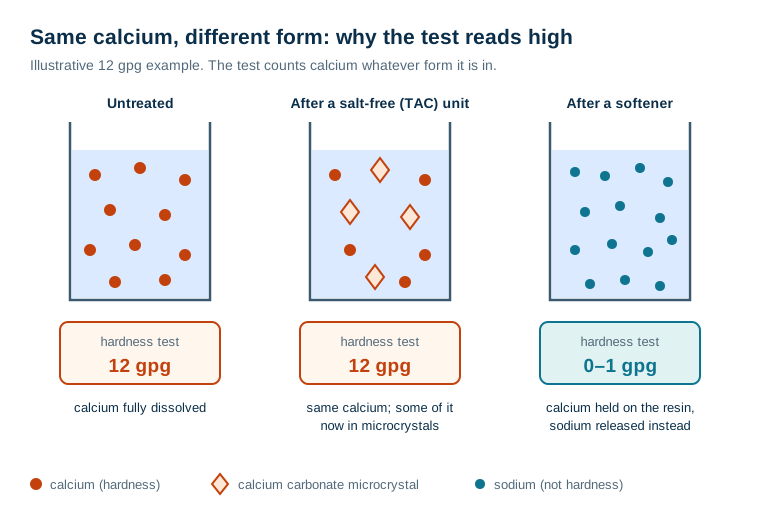
A hardness test, whether a colour strip or a drop-count titration, measures the calcium and magnesium in a sample. A salt-free conditioner using template-assisted crystallization (TAC) converts part of the dissolved calcium into microscopic calcium carbonate crystals. Those crystals are still calcium, still in the water, and still counted by the test.
So:
- A reading close to your untreated hardness is correct. If your water tested 12 grains per gallon before, expect roughly 12 afterwards.
- It is not a sign the media has failed. The manufacturers say this themselves. The Watts OneFlow OF110-1 manual states that the cartridge "does not have a grain removal capacity".
- A sharply lower reading is suspicious, not reassuring. It usually means a sampling difference: a hot-tap sample, where scale has already dropped calcium out in the heater, or a sample taken from a different tap or day.
If you have a salt-free unit and a softener installer tells you the high test result proves it "isn't working", they are testing the wrong thing. If you are the one testing it, put the strips away and use the checks later in this article.
Does a Salt-Free System Soften Water? An Expectation Scorecard
Here is what changes and what does not, set out plainly.
| What you might expect | Salt-free TAC system | Ion-exchange softener |
|---|---|---|
| Hardness test result | Unchanged | 0–1 gpg |
| Slippery feel in the shower | No | Yes |
| Less soap, shampoo and detergent needed | No | Yes |
| Fewer spots on glasses, faucets and shower glass | No | Yes |
| Softer laundry | No | Yes |
| Less scale in the water heater | Likely, often substantially | Yes |
| Less scale in a tankless unit or kettle | Likely | Yes |
| Existing scale removed | Not reliably | Slowly, as soft water redissolves some |
| Sodium added to the water | No | Yes, in proportion to hardness |
| Salt, drain, electricity | None | Salt and drain; usually power |
The rows marked "No" for the salt-free column are not flaws in a particular brand. They follow from the fact that the hardness is still dissolved in, or suspended in, the water that reaches your skin, soap and glassware.
Why Soap, Skin and Spots Stay the Same
Each of these depends on the hardness itself, not on scale.
Soap and lather. Soap molecules react with dissolved calcium and magnesium to form insoluble curd, the grey ring in a bath and the film on shower walls. That reaction happens in cold and warm water at the tap, and it uses up soap before any lather forms. Hardness that has not been removed keeps doing that.
The slippery feel. Softened water feels slippery because soap rinses off completely once the calcium and magnesium have been exchanged for sodium or potassium. We explain the chemistry in why soft water feels slippery. With the hardness still present, rinsing feels exactly as it did.
Spots. A water spot is what is left after a droplet evaporates. Whatever minerals the droplet carried stay on the surface, and a microcrystal dries onto glass just as surely as a dissolved ion does. Watts also notes that its media does not reduce silica, which acts as a binder and makes spots harder to wipe away.
Where Salt-Free Treatment Can Make a Real Difference
The benefit is concentrated where water is heated, because heat is what drives calcium carbonate out of solution and onto surfaces.
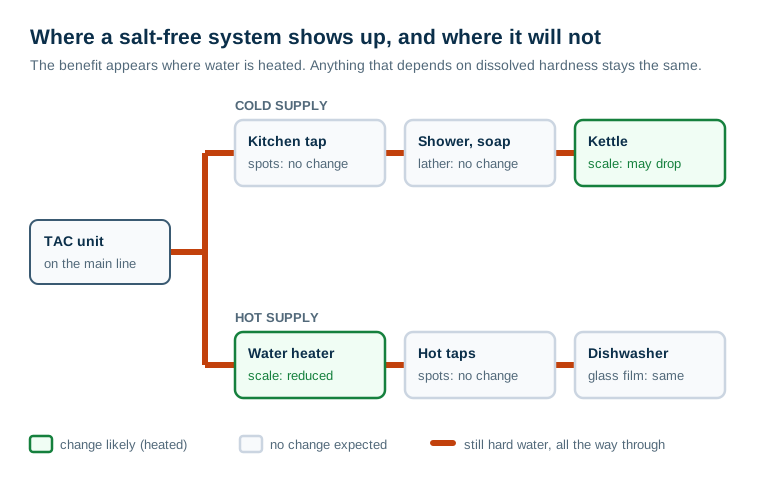
In untreated water, heating makes calcium carbonate precipitate onto the hottest surface available: a heater element, a tank bottom, a tankless heat exchanger. TAC-treated water already carries microscopic crystals, and the idea is that new mineral grows on those instead of on metal. The step-by-step mechanism is covered in how a salt-free water conditioner works.
The independent evidence is encouraging for this one job. In WateReuse Research Foundation project 08-06, run by Arizona State University under the German DVGW W 512 heated-scale protocol, TAC reduced scale formation by more than 88 percent. That was a controlled lab test, not years in a real heater, but it is a strong and specific result.
Where you are most likely to notice it:
- Tank water heaters. Less hard scale on elements and less crusty sediment in the tank.
- Tankless water heaters. Longer intervals between descaling flushes.
- Kettles and coffee makers. Slower crust build-up, though some visible residue can still form on very hard water.
Where you will not:
- Anything cold and evaporating: faucets, shower glass, fixtures, car washing.
- Anything that depends on soap chemistry: bathing, laundry, dish detergent performance.
That split is the core difference between preventing scale and removing hardness, which we look at from the other direction in scale prevention vs hardness removal.
How to Judge Whether Your Salt-Free System Is Working
Because the hardness test is the wrong instrument, you need a different method. These checks are slower, but they measure the thing the system is designed to change.
- Set a baseline before installing, if you still can. Flush a few gallons from the water heater drain valve into a bucket and note how much sediment comes out and what it looks like. Photograph the inside of a kettle.
- Flush again after six to twelve months. Less sediment, or a finer, looser sediment instead of hard chips, is the change you are looking for.
- Track descaling intervals on a tankless heater or coffee machine. If the interval stretches, the system is doing its job.
- Keep the water inside the unit's limits. Media fouled by iron, manganese or copper, or damaged by chlorine, stops working without any visible sign. The Watts manual, for example, specifies iron under 0.3 mg/L, manganese under 0.05 mg/L, free chlorine under 2 ppm, pH between 6.5 and 8.5, and a recommended hardness maximum of 30 grains per gallon.
- Replace media on schedule. A worn-out bed shows up as scale returning in the heater, not as any change you can see at a tap.
Five Questions to Ask a Seller Before You Buy
The fastest way to tell a careful seller from a careless one is to ask questions whose honest answers are known.
- "What will a hardness test show after installation?" The right answer is "about the same as now". A seller who promises a lower reading is either confused about the product or relying on a sampling trick.
- "Will my glasses and shower door spot less?" The right answer is no. Anyone who says yes is selling softening that the unit cannot deliver.
- "What are the media's limits for iron, manganese, chlorine and pH, and how do my test results compare?" You want a printed specification, like the table in the manufacturer's manual, checked against your own water test, not a verbal "it handles anything".
- "How long does the media last on my water, and what does a replacement cost?" Media replacement is the running cost of the category. Get the interval and price in writing so you can compare it with a softener's salt bill.
- "How long is the satisfaction guarantee?" Scale reduction takes months to show in a water heater. A 30-day window ends long before you could know. Look for at least a year.
A seller who answers the first two honestly is usually worth hearing out on the rest.
When a Salt-Free System Is the Wrong Choice
It is the wrong tool whenever the problem you want solved depends on dissolved hardness.
- You want spot-free glass and fixtures. Only removing hardness does that.
- You want softer laundry, softer skin or less soap. Same reason.
- Your water has iron, manganese or hydrogen sulfide. These foul TAC media and need their own treatment first.
- Your hardness is very high. Above the manufacturer's recommended maximum, visible residue becomes more likely even where scale reduction still works.
- You expect a test result to prove it works. It will not, and that expectation leads to the unit being ripped out for doing exactly what it was designed to do.
The full list, including water chemistry and household situations, is in when a salt-free conditioner is the wrong choice.
What to Do Next
- Decide which result you are paying for. Protecting heaters and pipes points to salt-free. Soft water at the tap points to a softener.
- Test your water fully for hardness, pH, iron, manganese and chlorine, and compare it with the limits of any salt-free unit you are considering.
- If you already have one, stop judging it with test strips. Flush the water heater, check the kettle, and compare with how things looked before.
- If your complaint is spots, lather or dry skin, the salt-free system is not the problem to fix. The hardness is, and only removing it will change those.
Frequently Asked Questions
Why is my water still hard after installing a salt-free system?
Because a salt-free conditioner is not designed to remove hardness. Template-assisted crystallization changes some of the calcium into microscopic crystals, but the calcium is still in the water, so a hardness test counts it. A reading close to your untreated number is the expected result, not a sign that the unit has failed.
Will a salt-free water softener stop spots on glasses and shower doors?
No. Spots form when water evaporates and leaves its minerals behind, and a salt-free system leaves those minerals in the water. Crystal or dissolved, the calcium dries onto the glass. Only removing the hardness, with an ion-exchange softener or reverse osmosis at the tap, reduces spotting.
Does salt-free water feel slippery like softened water?
No. The slippery feel of softened water comes from soap rinsing off more completely when calcium and magnesium have been replaced with sodium or potassium. A salt-free system leaves the hardness in place, so soap, skin and hair feel the same as they did on untreated water.
Will I use less soap and detergent with a salt-free system?
You should not expect to. Soap and detergent react with dissolved hardness, which a salt-free system does not remove, so lather and dosing stay about the same. Detergent savings are a benefit of hardness removal, not of scale conditioning.
How do I know if my salt-free conditioner is working?
Judge it by scale in heated equipment, not by a hardness test. Flush or inspect the water heater before installation and again after six to twelve months, and compare the amount and texture of the sediment. Kettle scaling and tankless heater descaling intervals are useful second checks. Also confirm your water stays inside the unit's limits for iron, manganese, chlorine and pH.
Is a salt-free water conditioner a waste of money?
Not if you bought it for the right job. In an independent WateReuse study, TAC media cut scale formation by more than 88 percent in a heated test, which is a real benefit for water heaters and tankless units. It is a poor purchase if you wanted spot-free glass, softer laundry or less soap, because it does none of those things.
