
How a Whole-House Carbon Filter and Softener Work Together

To run a carbon filter and water softener together, the carbon goes first, so chlorine never reaches the resin. That part is simple. The two problems come after installation. Both units backwash, so their regenerations must be scheduled apart or they compete for water and drain capacity. And their pressure drops add up, which can leave an upstairs shower weak.
Whether you need the carbon at all is a separate question, worked through with payback figures in when city chlorine requires carbon pretreatment. This page assumes the answer was yes and covers running the pair.
Carbon Filter and Water Softener Together: Layout and Unit Types
The order is sediment (if needed), then carbon, then softener, then the house. Each unit gets its own bypass so it can be serviced without shutting off the water. If the supply is chloramine, the carbon has to be catalytic and larger. The reason is set out in how chloramine affects a water softener.
The operating problems depend on the kind of carbon unit you have:
| Carbon unit type | Backwashes? | Needs drain and power? | Scheduling conflict with the softener? | Main tradeoff |
|---|---|---|---|---|
| Backwashing tank with control valve | Yes, on a timer | Yes | Yes | Needs enough backwash flow for its tank diameter |
| Upflow or non-backwashing tank | No | No | No | The bed cannot be regraded, so media is replaced on a schedule |
| Large cartridge housings | No | No | No | Short media life, less contact time, pressure drop rises as they load |
If you have a non-backwashing carbon unit, skip to the pressure-drop worksheet. The scheduling sections apply to two backwashing tanks on one supply.
Why Two Backwashing Units Clash
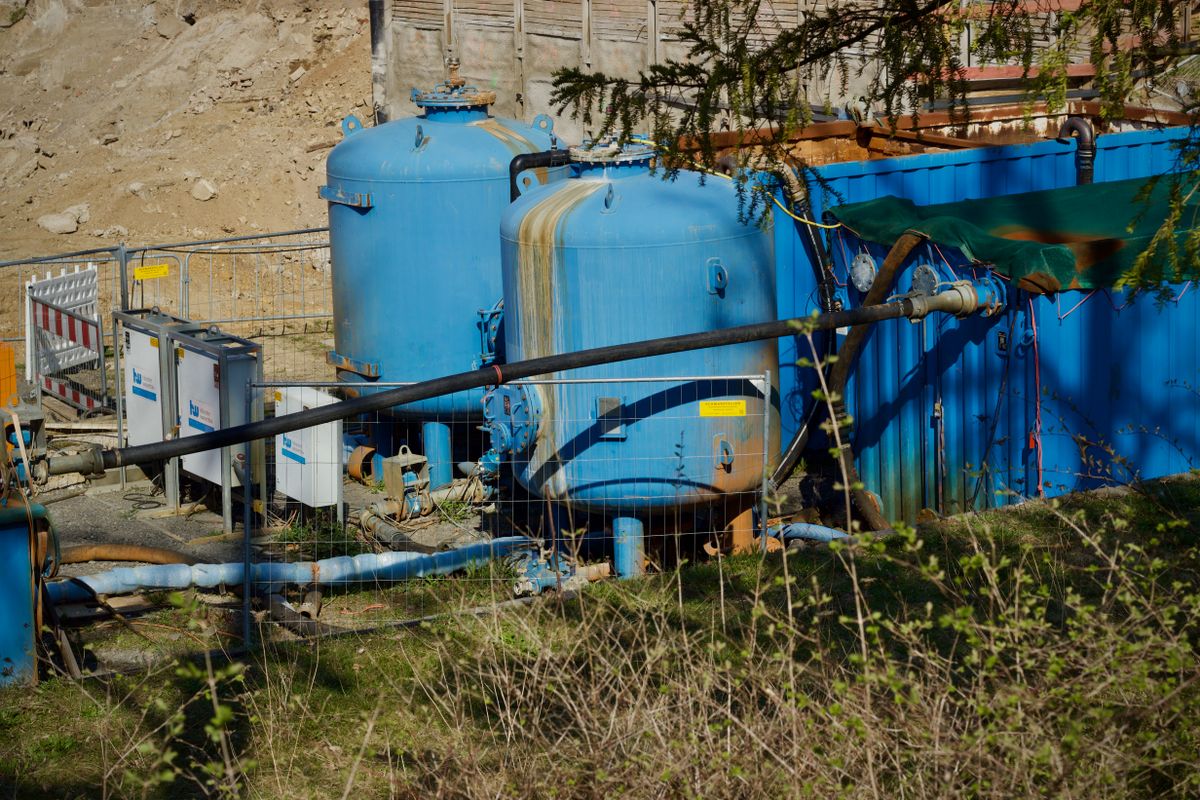
A backwash sends water up through the bed fast enough to lift and loosen it, then out to the drain. Each unit needs a minimum backwash flow for its tank diameter. Run two at once and several things go wrong together.
1. They split the supply between them. For standard granular carbon, Pure Water Products' backwash and flow rate chart lists backwash rates of 5 gpm for a 10-inch tank, 7 gpm for a 12-inch tank and 8.3 gpm for a 13-inch tank. Add the softener's own backwash and the demand can exceed what the service line or meter delivers at night. Neither bed then lifts fully, and a bed that never lifts compacts and channels.
2. The valve may not be able to backwash the tank you bought. Pentair's Fleck 5600SXT specification sheet gives a maximum backwash of 7 gpm and says the valve accommodates "softener tanks up to 12" and filter up to 10" in diameter." A 3 cubic foot chloramine tank on a small valve can be under-backwashed every single cycle, whatever the schedule. Check the valve's filter rating against the tank diameter before buying. If you are buying both at once, comparing softener and carbon combos that keep each stage in its own tank shows the valve and tank pairings on offer.
3. Untreated water reaches the softener. Most single-tank control valves pass untreated water to their outlet while they regenerate, so the house keeps its water. When the carbon regenerates, its outlet carries chlorinated water, and that goes straight into the softener. If the softener is backwashing or rinsing at the same moment, it runs part of its own cycle on chlorinated water.
4. Two drain flows at once. Both drain lines often end at the same standpipe or floor drain. A drain that copes with one unit can overflow with two. The drain-line limits are covered in why a water softener drain line leaks.
5. The house gets hard, chlorinated water during the overlap. Anyone showering at 2:00 a.m., or an irrigation zone running on the house supply, gets neither treatment.
Scheduling the Pair So They Never Overlap
Most controls leave the factory with a default regeneration time, often 2:00 a.m., so a new carbon tank and a new softener installed on the same day start out on the same hour. The fix costs nothing.
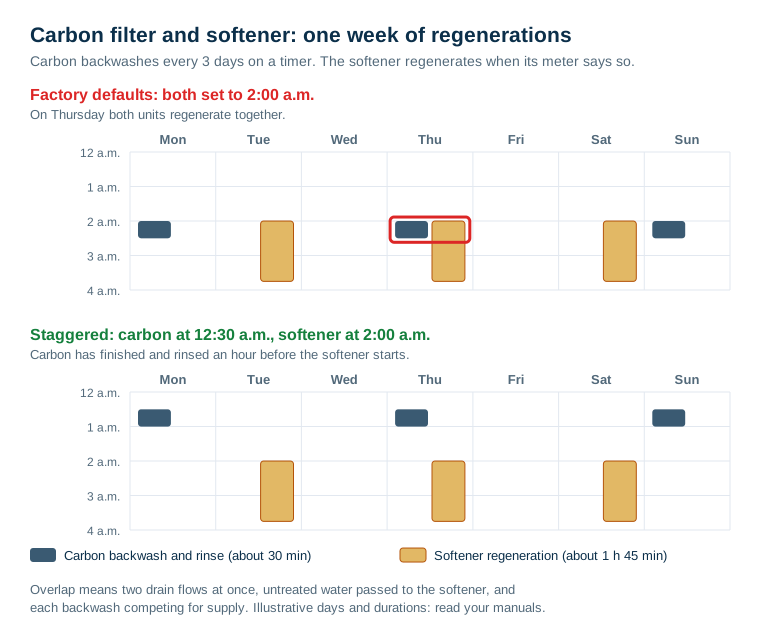
Why it clashes on some nights and not others. A backwashing carbon filter usually runs on a timer: its valve backwashes every set number of days. Pentair's Fleck 5600SXT service manual calls this the day override, and for a timer-type control "the day override setting determines how often the system will regenerate." A metered softener regenerates only when its capacity runs out. The two patterns line up on some nights and not others, so a clash can happen a few times a month and go unnoticed for years.
The rules:
- Carbon first, softener second. The softener should regenerate on freshly backwashed, dechlorinated water.
- Leave a gap longer than the carbon's whole cycle. Read the carbon valve's total cycle time from its display or manual, then add a margin. An hour is usually plenty.
- Keep both inside the hours nobody uses water. Check for automatic irrigation, a night-time dishwasher or a shift worker's shower.
- Set the carbon's day override on purpose. Use the installer's or media maker's recommendation, not whatever the valve shipped with. Backwashing with chlorinated feed water helps keep the bed from growing bacteria, so do not stretch the interval just to save water.
- Recheck both clocks after every power cut. A control that reverts to its default puts both units back on the same hour.
The keypad steps for changing a regeneration time are in how to start a manual regeneration safely. The same clash happens with an iron filter and a softener on a well, and it is covered from that side in pretreatment order: sediment and iron filters before a softener.
The Combined Pressure-Drop Worksheet
Every stage costs pressure while water is flowing. One stage rarely matters. Three stages in series, plus the pipes and a second floor, can.
Two rules make the worksheet work:
- Pressure drop rises with the square of flow. A unit rated at 15 psi at 10 gpm costs about 15 × (8 ÷ 10)² = 9.6 psi at 8 gpm, and about 2.4 psi at 4 gpm. Spec sheets normally give a drop at a rated flow, so scale it to your own peak.
- Height costs 0.433 psi per foot. A shower 20 feet above the entry point starts 8.7 psi down before any friction.
The worksheet. Fill in the "Your value" column from your own readings and spec sheets:
| Line | Item | How to get it | Example (illustrative) | Your value |
|---|---|---|---|---|
| A | Flowing pressure at the entry, at peak flow | Gauge at the first hose bib with several fixtures running | 55 psi | |
| B | Your peak flow | Sum of the fixtures that realistically run together | 8 gpm | |
| C | Sediment filter drop at B | Gauge pair, or spec sheet scaled. Use the loaded figure | 10 psi (2 when new) | |
| D | Carbon tank drop at B | Rated drop × (B ÷ rated flow)² | 15 psi at 10 gpm → 9.6 psi | |
| E | Softener drop at B | Rated drop × (B ÷ rated flow)² | 15 psi at 12 gpm → 6.7 psi | |
| F | Pipe and fitting friction to the worst fixture | Estimate, or measure with the softener in bypass | 5 psi | |
| G | Height of the worst fixture above the entry × 0.433 | Measure in feet | 20 ft → 8.7 psi | |
| H | Left at the worst fixture = A − (C + D + E + F + G) | 15 psi |
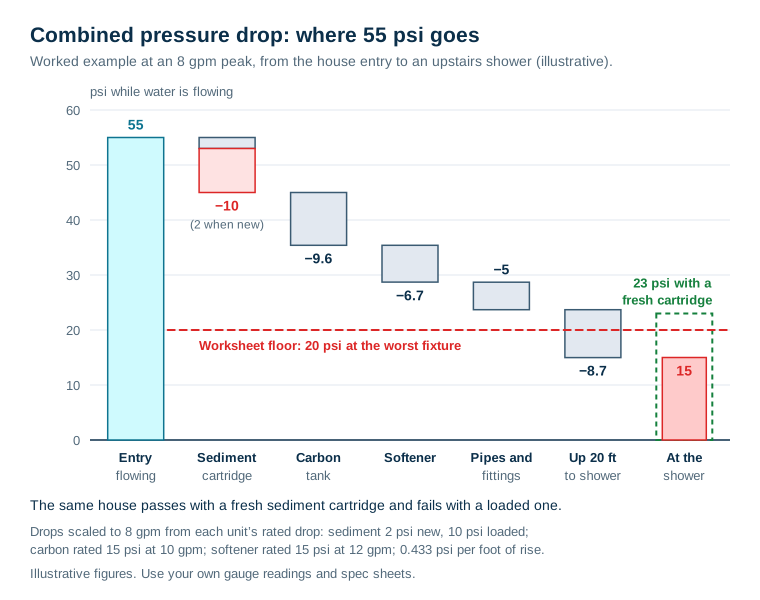
Reading line H. This worksheet uses 20 psi at the worst fixture as its planning floor. Below that, showers feel weak and some appliances misbehave. Check the minimum inlet pressure in the manuals for your tankless heater, washer and refrigerator, because some need more. In the example, the house has 23 psi with a fresh sediment cartridge and 15 psi with a loaded one. The softener and carbon are not the problem. Letting the prefilter load up is.
A separate floor for the control valves. The Fleck 5600SXT manual states that "a minimum of 20 psi (1.4 bar) of water pressure is required for the regeneration valve to operate effectively." That is measured at the valve during regeneration. On city water it is rarely a problem at 2:00 a.m., but a loaded sediment cartridge upstream can pull it down.
Check the worksheet against gauges. A two-gauge reading across each unit at a known flow replaces the estimates with real numbers. The method is in why water pressure drops after a softener, and the change point for the sediment stage is in when to replace a sediment prefilter before a softener.
When the Worksheet Comes Up Short
Work down this list in order. The cheap fixes come first.
- Change the sediment cartridge at a lower differential, or use a coarser grade on clean city water. In the example, that alone recovers 8 psi.
- Check every isolation and bypass valve is fully open. A valve left a turn short behaves like another filter.
- Check the pressure-reducing valve. If the house has one set low, a plumber can raise it within your local code limit.
- Choose units with larger valve ports. A 1-inch or 1.25-inch valve loses less at the same flow than a 3/4-inch one. Larger tanks also lower the drop, but they need more backwash flow, so check the valve's backwash rating as well.
- Consider a non-backwashing carbon unit, which removes the scheduling conflict. Compare its published pressure drop at your peak flow, not a single headline figure.
- A booster pump is the last resort, not the first. It adds noise, power use and another part that can fail.
Starting the Pair Up: Flush the Carbon Before the Softener Sees It
New carbon media carries fine dust from manufacture and shipping. On the first day that dust leaves the tank with the water. If the softener is in service, the fines go into the softener valve and settle on the resin bed. If it is not, they go straight to your aerators and appliance screens as black specks. Commissioning in the right order avoids both.
- Put the softener in bypass before the carbon tank is filled. Leave it there until step 4.
- Follow the carbon valve's start-up procedure. Most have you fill the tank slowly with the valve in its backwash position so trapped air escapes to the drain, rather than blowing through the bed.
- Run manual backwash and rinse cycles on the carbon until the drain water runs clear. It can take more than one cycle with new media.
- Bring the softener into service, then open a cold tap after it and run it until the water is clear.
- Take a baseline reading. Test total chlorine between the carbon and the softener. It should be at or near zero. Write the number, the date and the media type on a label on the carbon tank, so later readings have something to compare against.
- Set both regeneration times and the carbon's day override before anyone forgets, and write those on the labels too.
The same order applies after a carbon media change. New media always sheds fines, and the softener should be bypassed until the carbon has run clear.
If the house is not using water for a while after installation, run the carbon through a manual backwash before the first real use. A new bed that has sat still for days is exactly the situation the bacteria warning in when city chlorine requires carbon pretreatment describes.
Keeping the Pair Working
| Task | How often | What it catches |
|---|---|---|
| Check softener salt | Monthly | Bridging and running out |
| Test total chlorine after the carbon | Every few months | Carbon breakthrough, or a utility switch to chloramine |
| Read the sediment gauges | Monthly at first, then as the log suggests | Loading before it costs pressure |
| Replace carbon media | When chlorine appears after the filter | Exhausted media |
| Check both regeneration clocks | After every power cut | Units drifting back to the same hour |
| Log gallons between softener regenerations | Every few months | Resin damage showing up as falling capacity |
What the pair still cannot do. Carbon and a softener together do not disinfect, and they do not reliably remove nitrate, fluoride, arsenic or bacteria. Lead and PFAS reduction depend entirely on a specific product being certified for that claim. Where each of those actually gets treated is set out in what a water softener does not remove. For drinking water, many households add reverse osmosis at the kitchen sink, as described in how reverse osmosis and a water softener work together.
The Short Version
Running a carbon filter and water softener together works well once three things are right. Put the carbon first. Schedule its backwash to finish well before the softener starts. And do the pressure arithmetic, sediment cartridge included, before the plumber arrives. The order is what everyone mentions. The schedule and the pressure budget are what decide whether the system still works well two years later.
Frequently Asked Questions
Can you have a carbon filter and a water softener together?
Yes, and on chlorinated city water it is a common pairing. The carbon filter goes first so the resin never sees chlorine, with a sediment filter ahead of both if the water carries silt. Give each unit its own bypass. Schedule their regenerations at different times, and check that the two pressure drops together still leave enough pressure at your highest fixture.
Which comes first, the carbon filter or the water softener?
The carbon filter. Its job, besides fixing taste, is to strip chlorine or chloramine out before the water reaches the resin. If the softener comes first, the resin is oxidised the whole time and the carbon only fixes the taste. The only thing that normally goes ahead of carbon is a sediment prefilter.
Can a carbon filter and water softener regenerate at the same time?
They can, but they should not. Many control valves leave the factory set to 2:00 a.m., so a new pair often clashes. Together the two backwashes ask more of the supply and the drain, and most single-tank valves pass untreated water to the outlet while they regenerate. That means the softener can end up running its own cycle on chlorinated water. Set the carbon to regenerate first and the softener after it has finished.
Will a carbon filter and water softener reduce water pressure?
Each costs some pressure, and the losses add up. A sediment cartridge, a carbon tank and a softener in series can easily take 15 to 25 psi at a busy household flow, more when the cartridge is loaded. On strong city pressure nobody notices. On a house that was already marginal, or with bathrooms on an upper floor, the combined drop can be enough to weaken showers. The worksheet in this article adds it up before you buy.
How often should a whole-house carbon filter backwash?
On a schedule, not never. Backwashing tank filters are normally set to run every set number of days using the valve's day-override setting. Follow the installer's or media maker's recommendation. Regular backwashing also helps keep bacteria from building up in the bed, so do not stretch it out just to save water.
Do I need a drain for a whole-house carbon filter?
A backwashing carbon tank needs a drain and, usually, power for its control valve, the same as a softener. Upflow or non-backwashing carbon tanks and large cartridge housings need neither. They avoid the scheduling problem entirely, but they bring their own tradeoffs in media life, channelling and pressure drop.
