
EcoPure Water Softener Review: EP31, EP42 and the EPHS Hybrid Against Their Whirlpool Twins
This EcoPure water softener review answers what the price tag cannot: an EcoPure and a Whirlpool cabinet softener come from the same factory. Water Channel Partners of Minnesota makes and warrants both, and the current manuals show the EcoPure EP31 and the Whirlpool WHES30 with the same resin volume, the same capacity within 2 percent and the same iron rating. So what the difference in badge buys is not hardware. It is where you can buy it, and on the larger and hybrid models a few real differences in capacity and warranty. Of the three EcoPure models reviewed, the EP42 is the best value for most households, the EP31 suits one to four people, and the EPHS hybrid makes sense only if you understand that its "never replace" carbon has a rated life.
Disclosure: Hard Water Solved may earn a commission if you buy through links on this page, at no extra cost to you. It does not change which products we include or how we rank them. Read our disclaimer.
How this review was built. Nothing here was physically tested. The sources are the current EP31 and EP42 owner's manual (revision F, January 2025), the EPHS manual (revisions C and F), EcoPure's extended-warranty page, NSF's EcoPure softener listing, the Amazon listings and published Whirlpool specifications. Prices are not listed here because they change often. Use the buttons to see the current price on Amazon.
The Three EcoPure Models at a Glance
All three are single-tank cabinet softeners: the resin tank stands inside the salt bin. All use EcoPure's demand-learning control, which it calls AutoSense, and all have 1-inch connections.
| EP31 | EP42 | EPHS hybrid | |
|---|---|---|---|
| Resin | 0.81 cu ft | 1.09 cu ft | 0.98 cu ft, plus carbon |
| Capacity at minimum / middle / maximum salt | 12,300 @ 2.4 lb / 26,200 @ 7.7 lb / 31,300 @ 12.9 lb | 16,600 @ 3.3 lb / 35,300 @ 10.3 lb / 42,200 @ 17.4 lb | 14,000 @ 2.9 lb / 29,800 @ 9.3 lb / 35,600 @ 15.6 lb |
| Efficiency at minimum dose | 5,090 grains per lb | 5,090 grains per lb | 4,230 grains per lb |
| Service flow | 7.2 gpm | 8.2 gpm | 8.0 gpm |
| Pressure drop at that flow | 14.9 psi | 14.9 psi | 8.4 psi |
| Max hardness | 110 gpg | 110 gpg | 100 gpg |
| Max clear-water iron | 8 ppm | 11 ppm | 3 ppm |
| Amazon | Check price on Amazon | Check price on Amazon | Check price on Amazon |
Specifications from the current owner's manuals. All three are listed by NSF as efficiency-rated softeners under NSF/ANSI 44.
Who Makes EcoPure Water Softeners
The EP31 and EP42 manual's warranty page is direct: "Warrantor: Water Channel Partners, 2805 Dodd Road, Suite 300, Eagan, MN 55121", and "This water softener is manufactured by Water Channel Partners". The October 2023 EPHS manual gives the same company at a Woodbury, Minnesota address. NSF's listing files every certified EcoPure softener under Water Channel Partners, and the Amazon listings name it as the manufacturer.
You will still see EcoPure described as Ecodyne's retail brand. That was true of earlier documents, which named Ecodyne Water Systems of Woodbury, Minnesota. The current paperwork does not. It matters for one practical reason: Water Channel Partners also makes and warrants Whirlpool softeners under licence, which is why the two lines can be compared model for model.
EcoPure vs Whirlpool: What the Badge Difference Buys
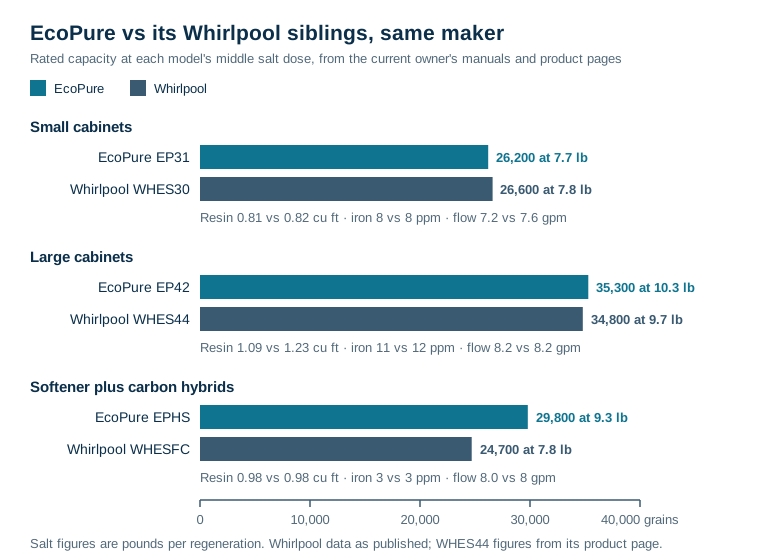
| Pair | Resin | Middle-dose capacity | Iron | Hardness | Full warranty and extension |
|---|---|---|---|---|---|
| EcoPure EP31 / Whirlpool WHES30 | 0.81 / 0.82 cu ft | 26,200 / 26,600 | 8 / 8 ppm | 110 / 95 gpg | 1 yr to 5 / 1 yr to 5 |
| EcoPure EP42 / Whirlpool WHES44 | 1.09 / 1.23 cu ft | 35,300 / 34,800 | 11 / 12 ppm | 110 / 140 gpg | 1 yr to 5 / 1 yr to 5 |
| EcoPure EPHS / Whirlpool WHESFC | 0.98 / 0.98 cu ft | 29,800 / 24,700 | 3 / 3 ppm | 100 / 120 gpg | 1 yr to 5 / 2 yrs to 10 |
Whirlpool figures from its WHES30/33 owner's manual and product pages. Both makers' extensions depend on registering and using their own cleaner.
Three conclusions follow.
The small cabinets are the same softener. The EP31 and WHES30 differ by 0.01 cubic feet of resin and 400 grains. The EcoPure is rated for harder water, 110 against 95 gpg, and the Whirlpool for slightly more flow. Buy whichever is cheaper and in stock.
The large cabinets trade resin for nothing obvious. The WHES44 holds about 13 percent more resin, but at the middle salt dose the two are within 500 grains, and the EP42 is rated at 5,090 grains per pound at its minimum dose, the same figure Whirlpool quotes for its larger models. On paper the WHES44's extra resin shows up only at the heaviest salt setting.
The hybrids differ most. With the same 0.98 cubic feet of resin and the same 3 ppm iron limit, the EPHS is rated at 29,800 grains at 9.3 lb of salt, against the WHESFC's 24,700 at 7.8 lb. But the Whirlpool is a PRO model, with a two-year full warranty extendable to ten. The EPHS offers one year, extendable to five.
What neither badge changes: the cabinet, the proprietary valve and its parts, the support line run by the same company, and the rule in both manuals that aftermarket parts void the warranty. On 1 October 2026 Whirlpool's Amazon softener listings showed no active offer, so on availability the EcoPure currently wins by default.

EP31: The Small-Household Cabinet
The EP31 is sized for one to four people. At the middle dose of 7.7 lb of salt it delivers 26,200 grains. For a household of three using about 225 gallons a day on 15 gpg water, that is roughly 3,400 grains a day and a regeneration about every eight days at that setting. Run it at the minimum dose and it regenerates every three or four days but uses salt very efficiently: 5,090 grains per pound, well above the 3,350 that NSF's efficiency rating requires. The trade-off between dose and salt bill is set out in water softener salt efficiency.
Its limits are flow and size. At 7.2 gpm with a 14.9 psi pressure drop, two showers and a washing machine running together will feel it. Amazon's listing gives the cabinet as 48 inches high, 15 wide and 20.5 deep.
EP42: The Best Value of the Three
The EP42 adds about a third more resin for a modest step up in price. It is rated at 35,300 grains at 10.3 lb of salt and up to 11 ppm of clear-water iron, the highest of the three, and its 8.2 gpm flow suits a larger household. Amazon describes it as sized for one to five or more people.
The iron rating needs reading carefully. The manual's figure is for ferrous, clear-water iron only, "substantiated by laboratory test data", and it adds that Wisconsin requires additional treatment above 5 ppm. You also have to program for it: the manual says to add 5 grains per gallon to the hardness setting for every 1 ppm of ferrous iron, so 20 gpg water with 2 ppm of iron is set as 30. On 11 ppm water that is a 55-grain addition, which means frequent regenerations. How iron changes the sizing is worked through in how iron changes water softener sizing.
Retail listings disagree on the EP42's cabinet size, so measure your space against the spec label before you order.
EPHS Hybrid: The Carbon Stage, With a Lifespan
The EPHS combines softening resin with a carbon media for chlorine taste and odor. It is certified to NSF/ANSI 42 for that, and NSF's softener listing also shows it with barium and radium reduction claims. EcoPure's selling point is that the carbon "never needs changing": there is no cartridge to replace.
The manual gives the carbon a rated capacity, though, and that capacity falls as chlorine rises:
| Chlorine in your water | Rated capacity | Years at 300 gal/day |
|---|---|---|
| 0.5 ppm | 2,280,000 gal | ~20.8 |
| 0.75 ppm | 1,520,000 gal | ~13.9 |
| 1.0 ppm | 1,140,000 gal | ~10.4 |
| 1.5 ppm | 760,000 gal | ~6.9 |
| 2.0 ppm | 570,000 gal | ~5.2 |
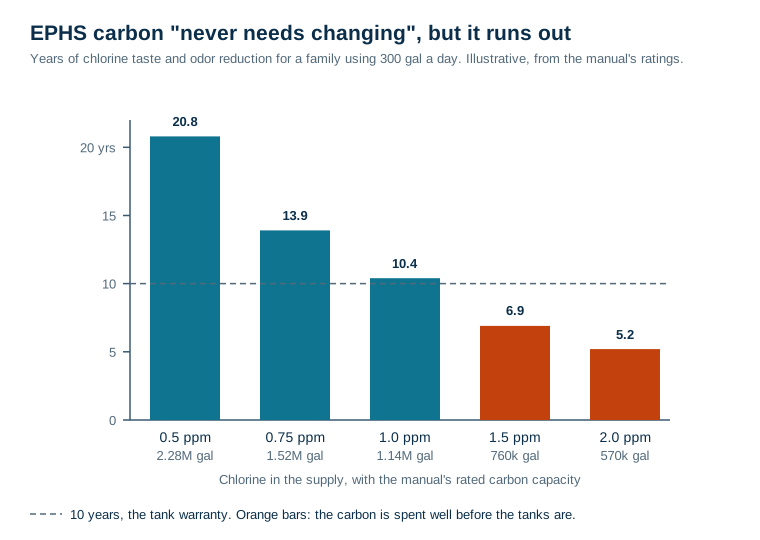
The manual notes that typical residential chlorine is 0.5 to 1.0 ppm. At those levels the carbon outlasts the one-year full warranty several times over. On water nearer 2 ppm, the "never replace" carbon becomes "can't replace" carbon after about five years. The softener keeps working, but the taste benefit you paid for fades.
Three more EPHS details differ from the EP31 and EP42:
- Lower efficiency. 4,230 grains per pound at its minimum dose, against 5,090, and it uses more water per regeneration: up to 58.6 gallons at the maximum dose.
- Lower iron limit. 3 ppm, so it is a city-water product more than a well-water one.
- A cooler temperature limit in the warranty. The EPHS warranty applies at water temperatures "not exceeding 100°F", against 120°F for the EP31 and EP42.
Availability is the last problem. When this site checked earlier, Amazon showed the EPHS as currently unavailable, and on 2 October 2026 we could not confirm a current US offer. EcoPure's website now features the EPH130, a 2-in-1 softener and filtration cabinet for up to five people. It was listed on Amazon on 1 October 2026, but EcoPure publishes no grain rating or carbon capacity for it, so it cannot yet be compared on the numbers above.
The Warranty and the Cleaner Arithmetic
The EP31 and EP42 manual sets out the terms:
- One year full warranty on all parts, and on labor to repair or replace a defective part.
- Ten years on the salt storage tank and fiberglass resin tank.
- Three years on the electronic control board.
- After the first year, the warrantor "will ship a replacement part, directly to your home, without charge", but "labor necessary to maintain this product is not covered".
- "If a repair or replacement part is unavailable, Warrantor may refund the original purchase price."
- "Use of aftermarket, used, or non-manufacturer provided parts will void all warranties." The product must also be bought from an authorised dealer.
The extension is the condition most buyers miss. The one-year full warranty "can be extended to five (5) years" if you "use one bottle of EcoPure EPCL Water Softener Cleaner, as directed, every four months from the date the water softener is delivered" and keep proof of purchase. "Purchase of no more than three (3) bottles" in any 12 months counts, and "use of any water softener additive other than EcoPure EPCL will not provide extended warranty coverage". EcoPure's extended-warranty page adds that you must register the product and keep the original receipt, and lists the EP31, EP42 and EPHS among the eligible models.
The EPCL cleaner comes in 16 oz bottles. Three bottles a year for five years is 15 bottles, and against the price of an EP42 that adds up to a noticeable share of what you paid for the softener, spent to keep four extra years of full cover on a unit whose board is already covered for three. On iron-bearing well water, the cleaner earns its keep anyway by keeping the resin clean. On clean city water, it is mainly an insurance premium. Our guide to reading a water softener warranty explains how to judge conditional extensions like this.
How Long an EcoPure Lasts
EcoPure publishes no service life. The warranty is the best clue to how the maker expects the parts to age: tanks for ten years, the control board for three, everything else for one unless you keep buying cleaner. That matches the general pattern in how long a water softener lasts: tanks outlast valves, and electronics are usually the first expensive failure. One EP31 owner review on Amazon describes the display going blank a month after the base warranty ended, which is exactly the gap the cleaner extension is designed to close.
Things that shorten an EcoPure's life:
- The wrong salt. The manual recommends nugget, pellet or coarse solar salt with less than 1 percent impurities and rules out rock, block, granulated and table salt.
- Iron near the rating, which fouls the resin and the valve faster.
- Pressure above 125 psi or freezing, both of which void the warranty.
On Amazon, the EP31 averaged 4.1 out of 5 from 100 ratings and the EPHS 4.0 from 131 on 2 October 2026.
Who an EcoPure Softener Is Wrong For
- Households that regularly draw more than about 8 gpm. All three are cabinet units with flow to match. Our comparison of single-tank and twin-tank softeners covers the alternatives.
- Wells with iron above the model's rating, or with any red-water or bacterial iron. Treat the iron first.
- EPHS buyers on high-chlorine water who expect the carbon to last as long as the tanks.
- Owners who will not keep a cleaner schedule but expect five years of full cover.
- Anyone wanting a ten-year full warranty. Neither EcoPure model reviewed here offers the extended terms of Whirlpool's PRO tier.
- Homes that do not need softening. If you are still deciding, start with salt-based vs salt-free water treatment.
For a small-to-medium household on city or low-iron well water, the EP42 is the pick: the most capacity and iron headroom of the three for a modest step up from the EP31, from the same maker as a Whirlpool and on the same terms. Buy the EP31 if your space or budget is tight, and pass on the EPHS unless you can find it in stock and your chlorine is near 1 ppm or below.
Frequently Asked Questions
Who makes EcoPure water softeners?
Water Channel Partners of Minnesota. The current EP31 and EP42 owner's manual names it as both manufacturer and warrantor, at an Eagan, Minnesota address, and NSF lists every certified EcoPure softener under its name. The same company makes and warrants Whirlpool softeners under licence. Older documents for these product lines named Ecodyne Water Systems.
Is EcoPure the same as Whirlpool?
Not the same brand, but the same maker and a very similar design. The EcoPure EP31 has 0.81 cubic feet of resin and is rated at 26,200 grains at 7.7 lb of salt; the Whirlpool WHES30 has 0.82 cubic feet and 26,600 grains at 7.8 lb. Both are rated for up to 8 ppm of clear-water iron. The warranty terms follow the same pattern: one year full, three years on the electronics, ten on the tanks, extendable with the maker's cleaner.
How do I extend the EcoPure water softener warranty to 5 years?
Register the softener and use one bottle of EcoPure EPCL Water Softener Cleaner every four months from the day it is delivered, keeping proof of purchase. The manual says no more than three bottles in any 12 months count toward the extension, and that any other additive does not count. That extends the one-year full parts and labor warranty to five years.
Does the EcoPure EPHS carbon filter need replacing?
EcoPure says the built-in carbon never needs replacing, and there is no cartridge to change. But the manual rates it for a fixed number of gallons: 1,140,000 gallons at 1.0 ppm chlorine and 570,000 at 2.0 ppm. For a family using 300 gallons a day that is about ten years at 1.0 ppm and five years at 2.0 ppm. After that, chlorine reduction fades while the softener keeps working.
How much iron can an EcoPure softener handle?
The current manuals rate the EP42 for up to 11 ppm of clear-water (ferrous) iron, the EP31 for 8 ppm and the EPHS hybrid for 3 ppm. They are not rated for red-water or bacterial iron. Add 5 grains per gallon to the hardness setting for each 1 ppm of ferrous iron, and note that Wisconsin requires extra treatment above 5 ppm.
