
Why a Humidifier Leaves White Dust
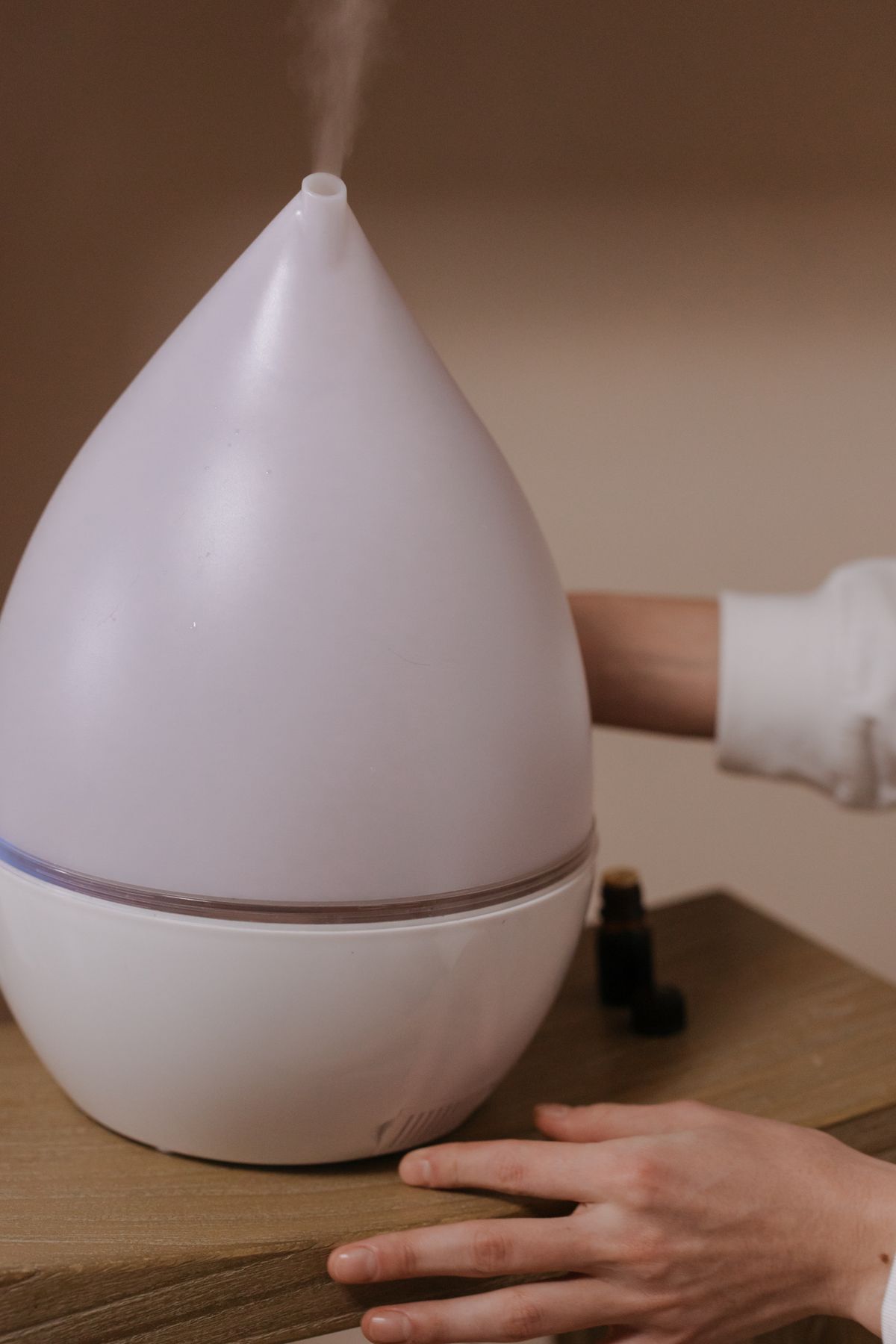
Humidifier white dust is the mineral content of your tap water, sprayed into the room and left behind when the mist evaporates. It comes from ultrasonic and impeller humidifiers specifically, because those two types atomise liquid water mechanically and carry everything dissolved in it into the air. Evaporative and warm-mist humidifiers do not do this.
The correction almost every article on this topic gets wrong: a water softener will not stop it. Understanding why explains both this problem and what a softener actually does.
What the White Dust Is — and What It Is Not
The powder settling on your furniture, monitor and windowsill is dried tap water. Calcium and magnesium mostly, along with sodium, silica, bicarbonate and whatever else your supply carries in solution.
It is worth ruling out what it is not, because two other white deposits get confused with it:
- It is not mould. Mould in a humidifier is a genuine and more serious problem, but it presents as slime in the tank, a musty smell, and dark or coloured growth — not as a dry white powder distributed evenly around the room.
- It is not drywall or plaster dust. That is coarser, appears near a specific source, and does not correlate with the humidifier running.
- It is not soap or cleaning residue. Unlike the soap-and-scale mix that leaves spots on faucets, humidifier dust lands on horizontal surfaces nowhere near a water outlet, and it stops when the humidifier does.
The single best confirmation costs nothing: run the humidifier for two days, then turn it off for two days, wiping surfaces clean at the start of each period. If dust appears in the first window and not the second, it is the humidifier.
The EPA is direct about the mechanism in its guidance on home humidifiers: "Researchers have documented that ultrasonic or impeller humidifiers are very efficient at dispersing minerals in tap water into the air." The same EPA page on use and care of home humidifiers notes those minerals also build up as scale inside the unit, which is a separate problem with a separate reason to care.
Which Humidifiers Do It, and Which Do Not
This table decides whether you have a water problem or a machine problem.
| Type | How it works | Produces white dust? | Where the minerals end up |
|---|---|---|---|
| Ultrasonic | Piezoelectric plate vibrates water into a cool fog | Yes — worst offender | Airborne, then on your furniture |
| Impeller / cool mist | Spinning disc flings water at a diffuser | Yes | Airborne |
| Evaporative | Fan draws air through a wet wick | No | Trapped in the wick filter |
| Warm mist / steam | Boils water, releases vapour | No | Scaled onto the heating element |
| Whole-house bypass | Flows water over a media pad into the ducts | No | On the pad, and down the drain |
If you own an ultrasonic unit and the dust is intolerable, swapping to an evaporative model solves it outright — the minerals stay in a replaceable wick instead of in your air. That is a real option and it is often cheaper than a year of distilled water.
Why a Water Softener Will Not Stop Humidifier White Dust
This is the section this article exists for.
A water softener works by ion exchange. Water passes through a bed of resin beads that hold sodium ions; calcium and magnesium ions stick to the resin, and sodium ions are released into the water in their place. The EPA's description of cation exchange water softeners sets out the process.
Notice what did not happen: nothing was removed. Two ions went in, two ions came out. Total dissolved solids after softening are approximately unchanged — often very slightly higher, because it takes two sodium ions to replace one calcium ion.
An ultrasonic humidifier does not care which ions are dissolved. It shatters water into droplets, the droplets evaporate, and whatever was dissolved is deposited as dust. Feed it softened water and you get sodium-based dust instead of calcium-based dust. Some owners report it looks slightly different — finer, and less visible on pale surfaces — but the quantity does not fall.
There is a piece of evidence that makes this concrete. A 2020 study in Water Research X by Yao, Gallagher and Dietrich measured what an ultrasonic humidifier actually puts into a room, and their tap water was soft — 42 mg/L hardness as calcium carbonate, about 2.5 grains per gallon, with 75 mg/L total dissolved solids. Running eight hours, it produced average indoor particle concentrations of 211 µg/m³, with a median particle diameter of 146 nanometres and 85 percent of particles under half a micron. The same unit filled with distilled water measured around 25 µg/m³.
Read that again: water that would pass any hardness test as soft still produced substantial dust. Hardness was never the variable. Total dissolved solids is the variable, and a softener does not reduce it.
That distinction is the most useful thing hard water testing teaches you, and it is the reason knowing your actual water numbers beats guessing at treatment. Hardness and TDS are different measurements answering different questions.
The same misunderstanding produces the widespread belief that softened water makes clearer ice in a refrigerator ice maker. It does not, for a closely related reason: what clouds a cube is dissolved gas rather than dissolved minerals, and ion exchange removes neither.
The Dark-Surface Test: Tap vs Softened vs RO
If you want to see the difference for yourself rather than take anyone's word for it, this takes three days and a piece of black card.
Setup. Cut three squares of matte black card. Place one about 18 inches from the humidifier outlet, angled slightly, with the humidifier on a hard surface in a room whose door stays shut. Photograph the card under the same lamp each time, at the same angle.
Run one — untreated tap water. Fill, run eight hours overnight, photograph the card in the morning. Label and set aside. Clean the tank.
Run two — softened water. If you have a softener, draw from a softened cold tap; if you do not, this is the run to borrow from someone who does. Same duration, same position, same photograph.
Run three — distilled or RO water. Same again.
What you will see, in every home I have seen it done in: runs one and two look broadly alike, and run three looks almost clean. The softened sample is often a slightly finer, more even deposit rather than a lighter one. That result is the whole argument in one photograph, and it is more persuasive than any amount of explanation about ion exchange.
Two notes to keep the test honest. Use the same humidifier and the same fill level each time, since output rate affects deposit. And descale the ultrasonic plate between runs — a scaled plate atomises less water and will bias whichever run comes last.

What Actually Works, Ranked
| Approach | Effect on white dust | Cost | Worth it? |
|---|---|---|---|
| Switch to an evaporative or warm-mist unit | Eliminates it | One-off, price of a humidifier | Best value for most households |
| Distilled water | Near-elimination | Ongoing, per gallon | Effective; tedious for a large unit run nightly |
| Reverse osmosis water | Near-elimination | Higher up front, low per gallon | Best if you already have or want RO for drinking |
| Demineralisation cartridge | Partial — reduces, does not stop | Consumable, replaced every 4–6 weeks | Useful stopgap; declines as it exhausts |
| Water softener | None | High | Buy it for scale, never for this |
| Running it lower / smaller room | Proportional reduction | Free | Reduces dust and humidity equally, which may not be what you want |
| An air purifier in the room | Captures some airborne fraction | Moderate | Helps with what is in the air; not with what has landed |
The CPSC reaches the same practical conclusion in its consumer guidance on humidifiers, recommending distilled or demineralised water in room humidifiers to reduce both scale buildup and the release of dust.
One caveat on demineralisation cartridges, since they are the option most people try first: they are ion-exchange or mixed-bed media in a small housing, and they exhaust. A cartridge that worked beautifully in week one and appears to have stopped working in week six has not failed — it is used up. If you rely on them, replace on schedule rather than on symptoms.
The Health Question, Answered Honestly
You will find confident claims in both directions online. Here is what the sources actually support.
The CPSC states that minerals released in the mist can settle as fine white dust, that some particles are small enough to be inhaled into the lungs, and that the health effects of inhaling this dust are not clear and depend on the types and amounts of minerals in the water used. That is a careful, deliberately unresolved position, and it is the accurate one.
The particle measurements give the concern its mechanical basis: at a median 146 nanometres, this material is in the size range that reaches deep lung tissue rather than being caught in the upper airway. What has not been established is what that exposure does over time at household concentrations.
So the reasonable position is proportionate rather than alarmed. If the room is a nursery, or someone using it has asthma or another respiratory condition, use distilled water or an evaporative unit — the cost of caution is low and the uncertainty is real. If it is a spare bedroom used a few weeks a year, the dust is a housekeeping annoyance and treating it as one is defensible.
Separately and more definitely: keep the tank clean. Standing water plus mineral scale is a growth surface, and a dirty humidifier is a documented health problem in a way that white dust is not.
What to Do Next
- Identify your humidifier type. If it is evaporative or warm-mist, whatever is dusting your furniture is not coming from it and you are chasing the wrong source.
- Run the on/off confirmation — two days running, two days off, wiping clean at each changeover. Do this before spending anything.
- Do not buy a softener for this. It will not help. If you are considering one, decide on whether your hardness level justifies it for scale and appliances, which is a genuine case, and treat the humidifier as a separate problem.
- Try distilled for one week. It is the cheapest way to confirm the diagnosis before committing to RO or a new humidifier.
- Descale the tank and plate fortnightly with white vinegar regardless of which water you settle on. That part is not optional, and it matters more than the dust does.
Frequently Asked Questions
Is humidifier white dust harmful?
The honest answer is that it is not established either way, and the agencies are careful about it. The CPSC's guidance says minerals released in the mist can settle as fine white dust and that some particles are small enough to reach the lungs, while noting the health effects are not clear and depend on what is in the water. The measured particle sizes support the concern mechanically — one peer-reviewed study found a median diameter of 146 nanometres, with roughly 90 percent of the deposited fraction under a micron. If someone in the room has asthma or another respiratory condition, that uncertainty is worth avoiding rather than debating.
Does a water softener stop humidifier white dust?
No, and this is the most common wrong answer on the subject. A softener does not remove minerals — it exchanges calcium and magnesium ions for sodium ions. Total dissolved solids stay roughly the same or rise slightly. An ultrasonic humidifier aerosolises whatever is dissolved, so the dust continues; it simply becomes sodium-based rather than calcium-based, which is finer and can be harder to see on light surfaces. Softening solves scale in your plumbing. It does not solve this.
Will distilled water completely stop the white dust?
Very nearly. Distillation leaves almost nothing dissolved, and the EPA's humidifier guidance recommends bottled water labelled distilled for exactly this reason, while noting it still contains some mineral content. In practice most people see the dust stop entirely. Reverse osmosis is the other route and it removes the large majority of dissolved solids, so it is close but not identical — an under-sink RO system costs more up front and far less per gallon than buying distilled by the jug.
Why does my humidifier leave white dust but my neighbour's does not?
Almost always the humidifier type rather than the water. Ultrasonic and impeller humidifiers atomise liquid water mechanically and carry every dissolved solid into the room with it. Evaporative humidifiers pull air through a wet wick, and warm-mist units boil the water — both leave the minerals behind in the machine, which is why they scale up internally instead of dusting your furniture. Same tap, different physics.
How do I clean up humidifier white dust?
Wipe with a damp microfibre cloth rather than dry-dusting, because dry dusting re-suspends particles you were trying to remove. On electronics, use a slightly damp cloth on the case and compressed air on vents. For the humidifier itself, descale the tank and the ultrasonic plate with white vinegar every one to two weeks — a scaled plate atomises less efficiently and the buildup gives microorganisms somewhere to live, which is a bigger problem than the dust.