
Point-of-Entry vs Point-of-Use Water Softening
The point of entry vs point of use decision comes down to one rule: treat water where it enters the house when the goal is protecting plumbing, the water heater and appliances, and treat it at one tap when the goal is what you drink. Scale protection only works whole-house. Drinking water quality is usually better and cheaper handled at the kitchen sink.
Most of the confusion comes from sales pitches that blur the two: a whole-house system sold as making water "safe to drink," or a countertop filter sold as "softening" your home. This guide applies the rule to the common goals, then covers the partial-house designs that are legitimate and the plumbing you need to plan for them.
Point of Entry vs Point of Use: The Definitions
The CDC's guide to home water treatment systems gives the standard definitions. Point-of-use systems "deliver it to a single tap, such as your kitchen sink," while whole-home or point-of-entry systems "treat most or all of the water that enters your home."
| Point of entry (POE) | Point of use (POU) | |
|---|---|---|
| Where it goes | Main line, after the meter or well pressure tank | Under a sink, on a countertop, inline to one appliance |
| What it serves | Every outlet downstream, hot and cold | One tap or one appliance |
| Share of household water treated | Nearly all of it | Typically a few gallons a day |
| Typical examples | Water softener, iron filter, acid neutralizer, whole-house carbon, UV | Reverse osmosis, pitcher and faucet filters, appliance cartridges |
| Protects the water heater? | Yes, if it is upstream of it | No |
| Improves drinking water? | Only for what it removes, and some add sodium | Yes, for whatever the unit is certified to reduce |
The Rule: Protect the House at Entry, Treat What You Drink at the Tap
Hard water's real cost is not in the glass. It is in the water heater, the tankless heat exchanger, the dishwasher and washer, shower valves, fixtures, and the scale that forms wherever water is heated or evaporates. Every one of those sits downstream of the main line, so the only way to protect them all is to treat the water before it branches out.
Drinking water works the other way. A family drinks and cooks with a few gallons a day out of a few hundred used. Treating only those few gallons, with a system chosen for the specific thing you want out of your water, costs far less than treating all of it and usually does a more thorough job.
| Goal | Where to treat | Why |
|---|---|---|
| Stop scale in the water heater, pipes and appliances | Point of entry | Every heated or wetted surface is downstream of the main |
| Better lather, softer laundry, less soap scum | Point of entry | Showers, sinks and the washer are spread through the house |
| Remove iron staining, sulfur odor, sediment | Point of entry | Staining and odor show up at every fixture |
| Correct acidic, corrosive water | Point of entry | Corrosion happens in the pipes, before any tap. Penn State Extension notes corrosion treatment has to be point of entry to protect the plumbing |
| Better-tasting drinking water, less sodium from the softener | Point of use | Only the kitchen tap needs it |
| Reduce a drinking-water contaminant such as lead, arsenic or nitrate | Point of use, usually, with a unit certified for that contaminant | Exposure is mainly through drinking. Ask your health department whether whole-house treatment is advised |
| Protect one appliance only (espresso machine, ice maker) | Point of use at that appliance | Only worth doing when that appliance is the only concern |
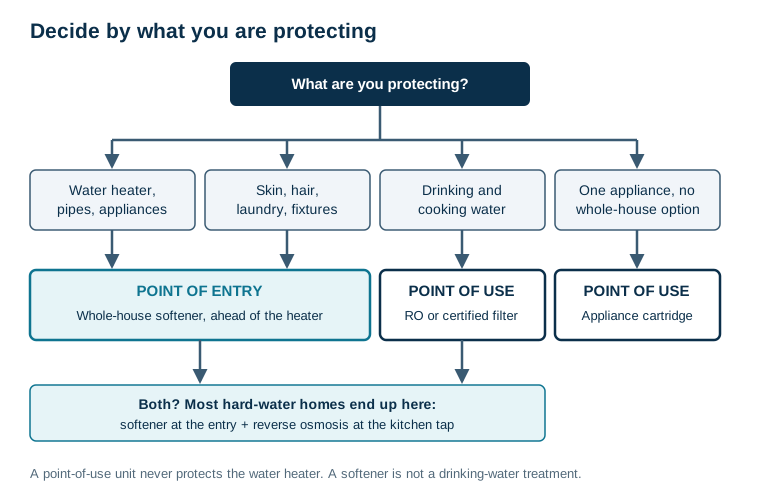
Both directions have a failure mode. A POU filter does nothing for scale in the heater. A POE softener does not make water safer to drink, and it adds sodium to every tap, which is why a drinking-water tap is often treated separately.
What a Typical Well-Planned House Looks Like
Most homes on hard water end up with both. Treatment at the entry protects the house, a separate unit at the kitchen handles drinking water, and a few outlets stay deliberately on hard water.
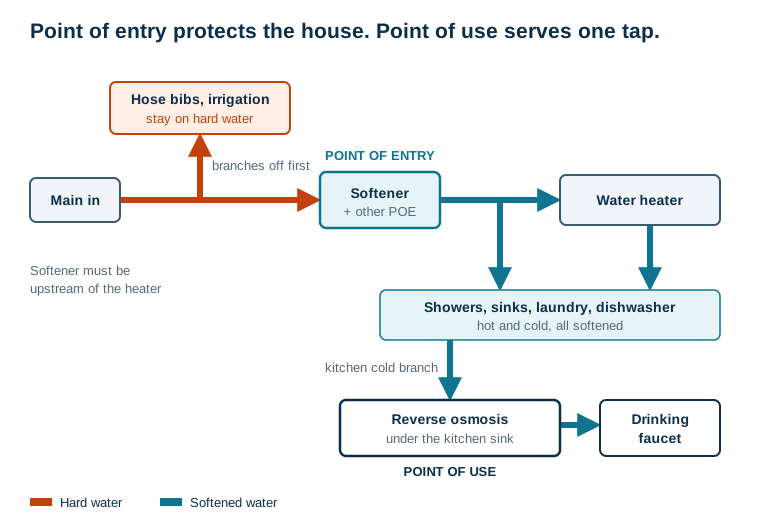
Reading the map left to right:
- The main enters after the meter, or after the pressure tank on a well.
- Outdoor branches split off first, so irrigation and hose water skip the softener.
- The softener and any other POE treatment sit next, ahead of the water heater.
- The water heater and every indoor branch receive softened water.
- The kitchen sink gets a POU unit, usually reverse osmosis, on its cold side. It feeds a separate drinking faucet.
If the heater is plumbed ahead of the softener, the whole point of POE is lost for hot water. Where the softener goes relative to the heater, drain and electrical supply is covered in where to install a water softener. Running an RO unit on softened water is covered in reverse osmosis and a water softener together.
When a Partial-House Design Is Legitimate
"Soften only what you need" is sound advice. Minnesota's Department of Health puts it directly: "People often choose to soften showers, sinks, and laundry hookups. Toilets, hose bibs, basement sinks, and other cold water taps typically do not need to be connected to a softener." Penn State Extension's water softening guidance gives the same list.
Five partial designs make sense:
| Design | Why it's legitimate | What it costs you |
|---|---|---|
| Outdoor faucets and irrigation on hard water | Softened water wastes salt and adds sodium to soil and plants | Hard water spots on cars and windows washed with the hose |
| A hard or RO cold tap at the kitchen | Drinking water without added sodium | A second faucet or a branch line. See whether a kitchen tap should bypass the softener |
| Toilets on hard water | Toilets use a large share of water, and hardness does little harm there | Rings and tank-part scale on very hard water. Usually only practical in new construction |
| Basement utility sink, cold only | Rarely used, no heating | Minor spotting |
| Softening one appliance only, where a POE softener is not possible | Rentals, condos and some apartments can't take a whole-house unit | The heater, showers and pipes stay unprotected |
What is not a legitimate partial design is softening only the hot water, or only one bathroom, to save money. Cold hard water still spots every fixture, leaves soap curd in every shower, and scales the dishwasher and washer. In most houses the saving is small because hot water and bathrooms account for most of the softener's load anyway.
Planning the Plumbing for a Partial Design
The plumbing decides whether a partial design works. Get the tie-in point right on day one, because moving it later means opening walls.
- Find where each branch leaves the main. Hose bibs and irrigation must branch off upstream of the softener. If one branches off downstream, it gets softened water unless you add a dedicated hard line.
- In new construction, ask for a softener loop with the outdoor lines and any toilet or kitchen hard lines taken off before the loop. It costs little during rough-in and a lot afterwards.
- In an existing house, look for the cheap wins. Outdoor faucets are often on one or two runs near the main, which are easy to tie in ahead of the softener. Toilets are usually not worth re-piping.
- Keep the drinking tap simple. An under-sink RO with its own faucet serves most families better than running a separate hard line up to the kitchen.
- Label the hard lines at the manifold or main so a future plumber doesn't tie a new bathroom into the wrong side.
- Size the softener to the softened fixtures only. Taking irrigation off the softened side can drop the daily water use you size for a lot.
When a Whole-House Unit Is Not an Option
Condos, apartments, rentals and some manufactured homes can't take a point-of-entry softener. There may be no access to the main, no drain, no space, or no permission. The rule still applies. You just have fewer tools to apply it with, so aim them at the most expensive damage first.
| What you can protect | Point-of-use option | What it will not do |
|---|---|---|
| Dishwasher | Use the built-in softener and salt reservoir if the machine has one, and set it to your hardness | Protects only the dishwasher |
| Coffee or espresso machine, ice maker | An inline softening cartridge rated for scale, replaced on the maker's schedule | Stops working without warning when exhausted |
| Drinking and cooking water | Under-sink or countertop reverse osmosis | Nothing downstream of the kitchen sink |
| Kettle, iron, humidifier | Distilled or RO water, and descaling on a schedule | Treats the appliance, not the water supply |
| Water heater | Nothing at the point of use. Flush it more often and ask the owner about POE treatment | The heater will scale at the full hardness |
Two things to be wary of. Shower filters sold as "softening" usually contain carbon or KDF media that target chlorine, not calcium, so check whether hardness reduction is listed with a capacity. And a portable softener that has to be regenerated by hand only helps if someone actually does the regeneration.
Four Scope Mistakes That Cost Money
- Buying a point-of-use product to fix a whole-house symptom. A pitcher, faucet filter or shower filter will not change the scale in the water heater or the spots on the shower glass. If the problem shows up at more than one outlet, it is a point-of-entry problem.
- Putting the tie-in downstream of the heater, or leaving the heater on a hard branch. Hot water is where hardness does most of its damage, so a softener that misses the heater protects the cheapest part of the house.
- Sizing the softener for the whole flow when irrigation is bypassed, or leaving irrigation on the softened side. Either way, salt and capacity go to the lawn.
- Feeding a reverse osmosis unit hard water to "keep the minerals" on the drinking side. RO removes most of the minerals anyway, and hardness shortens membrane life. Feed it softened water and let the membrane deal with the sodium.
What Each Approach Cannot Do
- A point-of-entry softener cannot make water safe to drink. It removes hardness and small amounts of iron and manganese. The CDC notes that "water softeners do not remove parasites, bacteria, or viruses."
- A POE softener adds sodium to every softened tap, in proportion to the hardness removed.
- A point-of-use filter cannot protect anything downstream of the main except its own faucet. No countertop, pitcher or under-sink unit prevents scale in a water heater.
- POU devices only reduce what they are certified for. A carbon pitcher is not a softener, and an RO unit does not disinfect a contaminated well.
For a closer look at the two most common units side by side, see water softener vs reverse osmosis.
What to Do Next
- Write down what you are trying to fix, one line per goal.
- Put each goal in the POE or POU column using the table above.
- Map your main line from where it enters to the water heater, and note where the outdoor branches leave it.
- Plan the hard branches before you buy, then size the softener for the softened side only.
- Choose the POU unit on the certification for the contaminants on your water test, not on the box claims.
Frequently Asked Questions
What is the difference between point of entry and point of use?
A point-of-entry (POE) system treats all or most of the water where it enters the house, so every tap, shower and appliance downstream gets treated water. A point-of-use (POU) system treats water at one outlet, usually the kitchen sink, and nothing else in the house benefits. A whole-house water softener is point of entry. An under-sink reverse osmosis unit or a pitcher filter is point of use.
Is a whole-house water softener point of entry?
Yes. It is installed on the main line after the meter or pressure tank so that the water heater, showers, fixtures and appliances all get softened water. Most installations leave outdoor faucets, and sometimes a kitchen cold tap, on a hard branch taken off before the softener. That is still a point-of-entry system, just with deliberate exceptions.
Can I soften water just for one faucet or appliance?
You can, but it only protects that outlet. Small inline softener cartridges exist for espresso machines and ice makers, and many dishwashers have a built-in softener. These make sense when one appliance is the only problem. They do nothing for the water heater, the shower or the pipes, which is where most of the cost of hard water lands.
Should drinking water be point of use or point of entry?
Usually point of use. Drinking and cooking account for a small share of household water, so treating only that share with reverse osmosis or a certified filter at the kitchen sink is cheaper and often more thorough than treating every gallon. The exception is a contaminant that is a problem to breathe or touch as well as drink, where whole-house treatment may be needed. Check with your state health department or a certified lab for that.
Do I need both a softener and reverse osmosis?
Many homes on hard water end up with both, and they do different jobs. The softener protects plumbing and appliances throughout the house. The reverse osmosis unit at the kitchen tap reduces the sodium the softener adds, along with other dissolved solids, in the water you drink. A softener upstream also helps the RO membrane last longer.
Which fixtures can be left on hard water?
Outdoor hose bibs and irrigation are the usual ones, because softened water wastes salt and the sodium is not good for plants. Minnesota's health department and Penn State Extension both suggest toilets, basement utility sinks and other cold-only taps typically do not need softening. The hot water system, showers, bathroom and kitchen sinks, and laundry should be on softened water.
