
Proportional Brining vs Fixed Salt Dosing Explained

A proportional brining water softener dissolves salt in proportion to the capacity actually used since the last regeneration. A fixed-dose softener dissolves the full charge every time, whether the resin was nearly exhausted or barely touched. The saving is small in a household that uses water evenly. It is large where regenerations happen with most of the capacity still unused.
Seasonal homes are the clearest case. So are homes with heavy weekends, or softeners with a generous reserve setting.
What a Proportional Brining Water Softener Actually Does
Every softener regeneration draws a measured amount of brine through the resin. The brine is made by refilling the brine tank with water, which dissolves salt until the next regeneration pulls it back out. At roughly 3 pounds of salt per gallon of refill water, the refill volume is the salt dose. The valve controls that volume by timing the refill through a small flow restrictor.
Fixed dosing refills the same amount every time. You set the salt dose once, often 6 to 12 lb for a typical household unit, and the valve repeats it every cycle.
Proportional brining changes the refill to match what was used. Clack's Water Specialist control valve manual describes the calculation plainly. The "actual salt level fill will be calculated by dividing the actual volume treated by the calculated volumetric capacity, then multiply the salt level fill selected by this percentage." Softened 60 percent of the capacity, get about 60 percent of the salt.
Why it usually comes with prefill. A conventional valve refills the brine tank at the end of a regeneration, ready for the next one. At that moment it cannot know how much water the household will use before the next cycle. A prefill valve does the refill shortly before regenerating, when the gallons used are known, and lets the salt dissolve for a set time first. That is why the same Clack manual lists proportional brining as an option only "if the system is set up as a prefill upflow softener." A valve that only post-fills cannot proportion in this way, whatever its brochure calls it.
Choosing the full salt dose in the first place is a separate job, covered in how to set the salt dose on a water softener. Proportional brining scales whatever dose you pick. It does not choose it for you.
Three Households, Three Very Different Answers
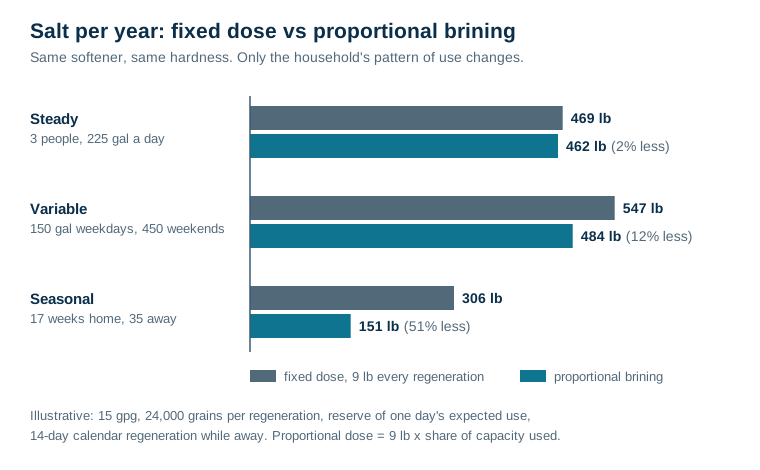
To see what the feature is worth, hold the softener constant and change only the household. The assumptions:
- Hardness of 15 grains per gallon.
- The valve is programmed for 24,000 grains per regeneration at 9 lb of salt.
- Demand-initiated regeneration with a reserve of one day's expected use, which many modern metered valves can calculate for themselves.
- A 14-day calendar override, a common setting that forces a regeneration if the meter has not called for one.
- With proportional brining, each dose is 9 lb multiplied by the share of capacity used.
These are illustrative numbers, not a lab test. The pattern is the useful part.
Steady household. Three people using 225 gallons a day, every day, is 3,375 grains a day. The softener regenerates every 7 days with 98 percent of its capacity used. There is almost nothing left over for proportional brining to save. 469 lb a year fixed, 462 lb proportional: about 2 percent.
Variable household. Two working adults using 150 gallons on weekdays, and 450 gallons a day at weekends with visitors. The valve now regenerates at uneven points in the week. Sometimes it goes at 75 percent used, because a heavy weekend day is coming and the reserve cannot cover it. Over a six-week cycle it averages 88 percent. 547 lb fixed, 484 lb proportional: about 12 percent.
Seasonal home. The steady household lives there 17 weeks a year. For the other 35 weeks the house sits empty and the calendar override regenerates the bed every 14 days with almost nothing used. A fixed dose puts 9 lb of salt down the drain 17 times for no softening at all. 306 lb fixed, 151 lb proportional: about 51 percent.
| Pattern | Regenerations a year | Average capacity used | Fixed dose | Proportional | Saving |
|---|---|---|---|---|---|
| Steady | 52 | 98% | 469 lb | 462 lb | 7 lb (2%) |
| Variable | 61 | 88% | 547 lb | 484 lb | 63 lb (12%) |
| Seasonal | 34 | 50% | 306 lb | 151 lb | 155 lb (51%) |
The takeaway: proportional brining earns its keep when regenerations happen with capacity still unused. In a well-set steady household that almost never happens, so there is little to recover.
The Reserve Setting Is the Hidden Variable
The steady household above only regenerates at 98 percent because its reserve is one day's use. Plenty of softeners run with a fixed reserve instead, often a quarter or a third of capacity, set once at installation and never revisited.
Run the same steady household with a fixed 30 percent reserve (7,200 grains):
- The valve now regenerates every 5 days, with only 70 percent of capacity used.
- Fixed dose: 73 regenerations × 9 lb = 657 lb a year.
- Proportional: 657 × 70 percent = 462 lb a year, the same figure as the well-set reserve.
That is a 30 percent saving in the household that gained only 2 percent a moment ago. Proportional brining makes salt use largely insensitive to a bad reserve setting. Fixing the reserve gets the same result for free. If your softener has neither variable reserve nor proportional brining, look at the reserve before paying for anything. Metered vs timer-based water softeners covers how each trigger decides when to regenerate.
Proportional Brining vs the Other "Salt-Saving" Features
The term is used loosely, often for features that save salt by a completely different route. Here is how they fit together.
| Feature | What it controls | Saves salt by |
|---|---|---|
| Demand-initiated (metered) regeneration | When to regenerate | Skipping regenerations the household did not need |
| Variable reserve | When, fine-tuned | Keeping a reserve sized to real daily use, not a fixed fraction |
| Proportional brining | How much salt per regeneration | Dosing only the capacity used |
| Low salt dose setting | How much, fixed | Running the resin where each pound softens most water |
| Upflow (counter-current) brining | Where fresh brine goes first | Letting a low dose work without hardness leaking through |
These stack. The EPA's WaterSense fact sheet on water-efficient softeners recommends demand-initiated regeneration and a salt efficiency above 3,350 grains per pound. The regeneration trigger is the foundation. Proportional brining is a refinement on top of it. It is not a substitute for a meter, and it cannot rescue a timer softener that regenerates on schedule regardless of use.
How counter-current brining fits in is covered in upflow vs downflow regeneration. How these features show up in a unit's certified efficiency rating is covered in what water softener salt efficiency means.
How to Check Whether a Valve Really Does It
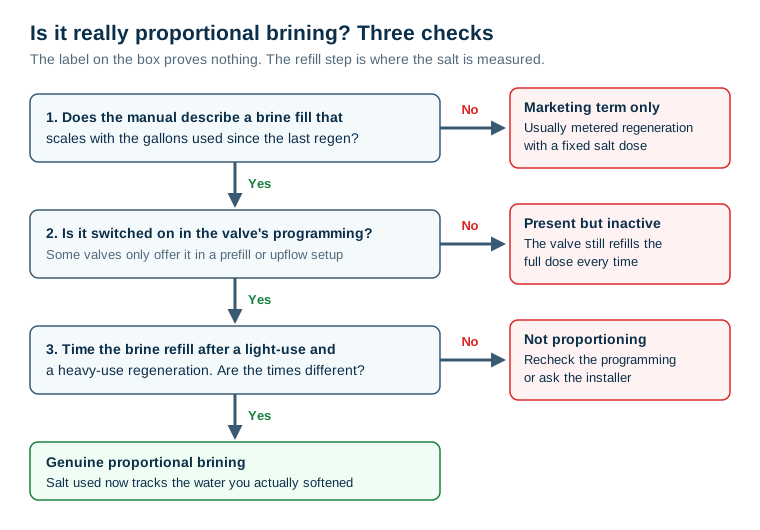
"Proportional" on a product page is not evidence. Three checks are.
1. Find the setting in the manual. Look for a brine or salt fill option that names the gallons treated, the capacity used, or "proportional" or "variable" fill. Clack's manual, for instance, offers two choices: a normal fill that always refills "with the salt level selected", and a proportional fill that scales it. If the manual has only a meter and a fixed salt setting, the unit is metered with a fixed dose. That is still useful, but it is not proportional brining.
2. Confirm it is switched on. On some valves the option only appears in the menu when the valve is configured a particular way, such as prefill and upflow. Check the installer's programming, not just the capability. A feature that exists but is set to "normal fill" does nothing.
3. Run the bench test. This takes two regeneration cycles and a stopwatch.
- Note the gallons remaining on the display just before a regeneration that follows a light-use period. A regeneration forced by the calendar override after a quiet week is ideal.
- During that regeneration, time the brine refill step. Many digital valves show the step and its countdown on screen. Otherwise watch the brine tank water level, or listen for refill flow at the brine line.
- Repeat for a regeneration that follows a heavy-use period, when the softener has run down to its reserve.
- Compare the two refill times. Proportional brining produces a clearly shorter refill after light use. Identical times mean a fixed dose.
Let the softener regenerate on its own schedule for the test where you can. Some valves treat a manually started regeneration differently from a metered one.
When It Is Not Worth Paying For
- Steady, predictable households with a variable reserve already in the valve. The worked example saves 7 lb of salt a year.
- Homes that could fix the reserve instead. If the saving comes from an oversized fixed reserve, reprogramming it is cheaper than a new valve.
- Seasonal homes that bypass the softener when empty. If you put the softener in bypass or vacation mode, or turn the calendar override off while away, the forced regenerations stop. Proportional brining then has little left to save. Check the manufacturer's guidance on idle periods first, because some recommend periodic regeneration to keep the bed fresh.
- Twin-tank softeners that switch tanks at full exhaustion. They regenerate each tank at close to 100 percent used, so the dose is already right.
Where it is clearly worth it: households whose use swings widely week to week, properties with long unoccupied periods that must stay in service, and rentals where the occupancy pattern is unknown.
What Proportional Brining Cannot Do
- It cannot make an inefficient salt dose efficient. It scales the dose you chose. Start from 15 lb per cubic foot and you get a smaller amount of an inefficient dose.
- It cannot correct a wrong hardness setting. The capacity it divides by is calculated from the hardness you entered. Enter the wrong hardness and the proportion is wrong too.
- It does not change what the softener removes. Hardness exchange is the same. Chlorine, sediment, oxidised iron and bacteria are outside what any brining feature addresses.
- It does not reduce the water used for backwash and rinse. Those steps run at full length. Only the brine refill scales.
The Short Version
If your water use is steady and your valve already sizes its reserve to daily use, proportional brining is worth a few pounds of salt a year. If use swings between weekdays and weekends, expect roughly a tenth off your salt bill. If the softener regenerates on a calendar through long empty periods, it can halve it. Verify it with the refill-time test rather than the box, and check the reserve setting before paying for the feature at all.
Frequently Asked Questions
What is proportional brining on a water softener?
It is a control setting that sizes the brine refill to the share of capacity actually used since the last regeneration, instead of refilling the full salt dose every time. Clack's Water Specialist manual describes it as dividing the volume treated by the calculated volumetric capacity and multiplying the selected salt setting by that percentage. If half the capacity was used, roughly half the salt is dissolved.
Is proportional brining worth it?
It depends on how evenly your household uses water. In a worked example on the same softener, it saved about 2 percent of the salt for a steady three-person household, about 12 percent for a household with heavy weekends, and about half for a seasonal home that sat empty most of the year while the valve forced regenerations on a calendar. Steady households with a sensible reserve setting gain little.
Is proportional brining the same as demand-initiated regeneration?
No. Demand-initiated (metered) regeneration decides when to regenerate, based on gallons used. Proportional brining decides how much salt to use when it does. A metered softener can still dissolve the full dose every time. Sellers often blur the two, so check the manual for a brine fill setting that scales with gallons used, not just a meter.
Why does proportional brining need a prefill softener?
Because the valve has to know how much capacity was used before it makes the brine. A conventional valve refills the brine tank at the end of each regeneration, ready for the next one, before it can know what the next cycle will need. A prefill valve makes the brine shortly before regenerating, when the gallons used are known. That is why Clack's manual offers proportional brining only when the valve is set up as a prefill upflow softener.
How do I tell if my softener is using proportional brining?
Time the brine refill step after two regenerations with very different water use since the one before, one after a light-use period and one after the softener has run down to its reserve. If the refill time is the same both times, the dose is fixed, whatever the box says. Where possible let the softener regenerate on its own schedule for the test, rather than forcing a manual regeneration.
Does proportional brining make the water less soft?
It should not, if it is working correctly. It restores the portion of the resin that was used, and the unused portion was still in sodium form anyway. Hardness breakthrough after switching it on usually points to a wrong capacity or hardness setting, since the dose is calculated from those numbers. Recheck the hardness setting against a fresh test before blaming the feature.
