
How to Read a Water Softener Warranty

A water softener warranty is really several warranties in one document. Each component has its own term. Tanks usually get the longest, commonly ten years, while valves and electronics get one to five and "everything else" as little as one. Most exclude labour, damage to your home, freeze damage, improper installation, untreated problem water, neglect and, often, moving the unit. Read it by component and by exclusion, not by the number on the box.
The comparison below uses five published warranty documents from owner manuals. Your model's document is the one that counts, so use this as a map of what to look for.
How a Water Softener Warranty Is Built
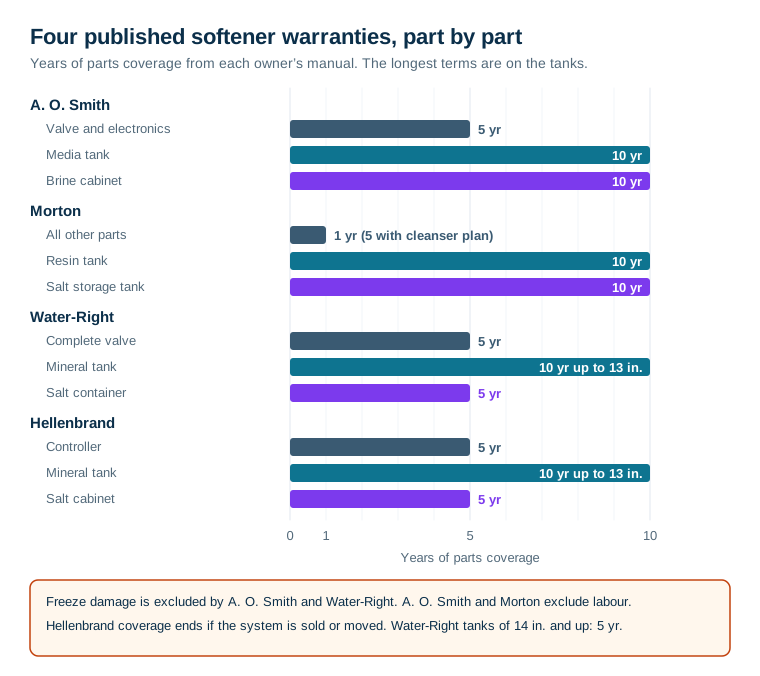
Every softener warranty we read has the same skeleton:
- Who is covered. Usually the original purchaser, sometimes only at the original address.
- What is covered, and for how long. A list of components, each with its own term.
- What the maker will do. Usually repair or replace the defective part. Not refund the unit, and not pay to fit the part.
- What is not covered. The exclusions. This is where claims are won or lost.
- How to claim. Serial number, proof of purchase, sometimes returning the part at your cost.
- The legal boilerplate. Limits on implied warranties and consequential damages, and the "some states do not allow…" sentence.
The marketing figure is usually the longest term in section 2, and that is almost always the tank. Tanks rarely fail. The part that does fail, the control valve, typically has a shorter term.
Five Published Warranties Side by Side
| Document | Valve / electronics | Mineral tank | Brine tank / cabinet | Other parts | Who and where |
|---|---|---|---|---|---|
| A. O. Smith softener owner's manual | 5 years | 10 years | 10 years | Media not warranted | Consumer purchaser |
| Morton installation and operation manual | 1 year; 5 with the maker's cleanser programme | 10 years | 10 years | 1 year | Original purchaser, bought from an authorised dealer |
| Water-Right Impression manual | 5 years, complete valve | 10 years up to 13 in. diameter; 5 years at 14 in. and up | 5 years | 1 year | Original owner, installed to Water-Right specifications |
| Hellenbrand H125 owner's manual | 5 years, controller | 10 years for 6–13 in.; 5 years at 14 in. and up | 5 years | Whole system 1 year | Original purchaser, original installation site only |
| WaterBoss limited warranty | 5 years, mechanical and electronic parts | Titled a "10 Year Limited Warranty"; read the tank clause in the document | — | — | Original owner at the original location; not transferable |
Sources: A. O. Smith's softener owner's manual, Morton manual 7387209, Water-Right's Impression manual, Hellenbrand's H125 manual (p/n 109122), and the WaterBoss water softener limited warranty.
Three things stand out:
- Tank size can change the term. Water-Right and Hellenbrand both give 10 years on tanks up to about 13 inches in diameter but only 5 on larger ones. A bigger softener can come with a shorter tank warranty.
- "Entire system: one year." Hellenbrand lists longer terms for named parts, but the system as a whole is covered for one year. Anything not named falls under that.
- Conditional extensions. Morton extends the one-year parts term to five years only if you use its own cleanser every four months and keep proof of purchase.
If you are still choosing a softener, comparing warranties across brands component by component applies the same reading to the wider market.
The Seven Exclusions That Decide Most Claims
| Exclusion | What the documents say | What it means for you |
|---|---|---|
| 1. Installation | A. O. Smith, Morton and WaterBoss exclude improper installation, and A. O. Smith and WaterBoss require installation to follow the instructions and local plumbing and electrical codes. Water-Right covers units installed "in accordance with Water-Right specifications" | Self-installation is not banned in these documents, but a mistake gives the maker grounds to refuse. Follow the manual exactly and photograph the finished job |
| 2. Problem water | A. O. Smith and WaterBoss say water containing sand, bacterial iron, algae, sulfur, tannins or organic matter must be treated first. A. O. Smith and Water-Right exclude non-potable supplies | Well owners should test before buying and install any pretreatment the test calls for. A fouled valve on untested well water is a likely denial |
| 3. Freezing | A. O. Smith, Water-Right and WaterBoss exclude freeze damage. Hellenbrand excludes unprotected outdoor installations | A garage or crawl-space unit that freezes is your cost, not the maker's |
| 4. Maintenance and neglect | Morton covers the unit only "when installed and maintained in accordance with the instructions." A. O. Smith excludes improper maintenance. WaterBoss excludes neglect | A dated maintenance log is your best evidence that neglect did not cause the failure |
| 5. Moving or selling | Hellenbrand ends coverage if the system is sold or moved. WaterBoss is not transferable to other sites or owners | Coverage usually stays with you at that address, not with the unit |
| 6. Pressure and temperature | Morton excludes over 125 psi or 120°F. Water-Right's tank term excludes 120 psi and up, 100°F and up, and vacuum | High house pressure with no pressure-reducing valve, or hot water back-feeding, can void the tank cover |
| 7. Consequential damage | A. O. Smith, Morton, Hellenbrand and WaterBoss exclude incidental and consequential damages | A leaking softener's warranty pays for the part, not your floor. That is an insurance question |
The last row catches people out most. If a failed tank floods a finished basement, the warranty may replace the tank, and nothing else. Whether your policy covers the rest is covered in does homeowners insurance cover a water softener leak.
Keep the maintenance record. Exclusion 4 is the one you control. The monthly and annual routine in the water softener maintenance schedule ends with a printable log. Keep it with the manual and the receipt, because it answers a neglect argument with dates.
"Limited" and "Lifetime": What the Words Mean
Limited. Under the federal Magnuson-Moss Warranty Act, a written warranty is either full or limited. The FTC's businessperson's guide to federal warranty law lists what a full warranty must do. It must serve anyone who owns the product during the term, provide service free of charge, and offer a replacement or refund if repair fails after a reasonable number of attempts. A warranty that falls short of any of those must be called limited. Every softener warranty we read was limited, which is why conditions like "original owner" and "labour excluded" are allowed.
Lifetime. When a softener is sold with a "lifetime" warranty, read which parts it applies to, whose lifetime (yours, the product's, or the time you own the house), and what conditions sit behind it, such as dealer servicing or registration. A lifetime term on a tank is worth less than it sounds, because tanks rarely fail. In-home dealer sales lean hardest on that word, and comparing Culligan and RainSoft on warranty and total cost shows what sits behind two such offers.
Implied warranties. The same FTC guide says a seller who offers a written warranty cannot disclaim implied warranties, though a limited warranty may limit how long they last. That is what the "some states do not allow limitations on how long an implied warranty lasts" sentence is about. Your rights can vary by state.
Brand-specific requirements. The FTC guide also explains that a warrantor generally cannot make coverage depend on using a particular brand of part or service unless it is provided free, or the FTC has granted a waiver. Two documents in our comparison touch on this: Morton's cleanser-based extension and A. O. Smith's clause about non-genuine parts. How a rule like that applies to a specific clause is a legal question, not something this article can answer. If it matters to a claim, ask the manufacturer in writing, or contact your state consumer protection office.
What a Softener Warranty Almost Never Pays For
- Labour and service calls. A. O. Smith, Morton and WaterBoss all exclude them. A free valve still has to be fitted.
- Shipping. WaterBoss requires defective parts to be returned prepaid, and ships the replacement freight collect. A. O. Smith sends a return label but has you pay shipping on the replacement.
- Damage to your home. Every document we could read in full excludes consequential damages.
- The resin, in some cases. A. O. Smith states that media is not warranted. Where resin is covered, it usually falls under a short "other parts" term, and chlorine damage or fouling is not a manufacturing defect.
- Performance on water it was not rated for. A. O. Smith does not warrant treatment "beyond those specifically represented."
This is where a dealer service contract sometimes fills the gap, at a price. Whether that adds up is weighed in is a water softener service contract worth it.
Questions That Expose a Weak Warranty Before You Buy

The FTC says sellers must make written warranties available to buyers before purchase, so ask for the document and read it. Then ask:
- What is the term on the control valve and electronics, not the tank?
- Does "system" or "all other parts" coverage run for just one year?
- Is labour included, and for how long? Who does warranty work, and is there a service-call fee?
- Is the resin covered at all?
- Does self-installation, or installation by my own plumber, affect coverage? Get the answer in writing.
- Does the warranty require a water test, pretreatment on well water, or documented maintenance?
- Does coverage end if I sell the house or move the unit?
- Is it the manufacturer's warranty or the dealer's? A dealer's promise depends on the dealer staying in business.
- Are valve parts sold openly, or only through one dealer network? That decides repair costs once the warranty ends.
Some of the answers are on the spec sheet rather than in the warranty, including the valve model, the tank size and the rated iron limit. How to compare water softener spec sheets shows where to find them. A warranty covers defects, not a unit that proves wrong for your house, so also check the return window and restocking fee before you order.
Making a Claim That Gets Paid
- Find the serial number before you call. Culligan's Gold Series manual places it on top of the media tank, Morton on a rating decal below the salt lid hinges, and WaterBoss on top of the valve.
- Gather proof of purchase and the installation date. Registering at purchase can stand in for a receipt with some makers.
- Describe the fault, not your diagnosis. "Water runs to drain continuously after regeneration" is more useful than "the valve is broken."
- Have your water test and maintenance log ready. These answer the problem-water and neglect exclusions before they are raised.
- Photograph the installation, including the bypass, drain line and air gap, pressure-reducing valve, and the room temperature if freezing could be suggested.
- Contact the maker within the term, and follow its return process exactly. Late or improperly returned parts are easy to refuse.
- Keep everything in writing.
What a warranty cannot do: it does not make a wrongly sized softener right, it does not treat water the unit is not designed for, and it does not pay for water damage. Read it as a promise about defects in specific parts for specific years, under specific conditions, and nothing more.
A water softener warranty is worth reading before you buy, not after something fails. Look past the headline to the valve term, the labour clause, the transfer rules and the seven exclusions. Then keep the paperwork that proves you met the conditions.
Frequently Asked Questions
What does a water softener warranty usually cover?
Defects in materials and workmanship, for terms that differ by component. In the published warranties we compared, mineral tanks carried 10 years, brine tanks or cabinets 5 to 10 years, valves and electronics 1 to 5 years, and everything else as little as one year. Labour, service calls, shipping and damage the failure causes to your home are usually excluded, and one maker excludes the resin outright.
Does installing a water softener yourself void the warranty?
Not automatically in the manufacturer warranties we read, but most exclude improper installation, and some require installation to follow the instructions and local plumbing and electrical codes. Dealer-sold systems may have their own terms that require dealer installation. If you install it yourself, follow the manual exactly, keep receipts and photos, and check your own document for installation conditions before you start.
Is a water softener warranty transferable?
Often not. Several published softener warranties cover only the original purchaser, and some also end if the unit is moved. Hellenbrand's warranty terminates if the system is sold, transferred or moved from its original installation site, and WaterBoss's is issued to the original owner at the original location and is not transferable. A buyer of a house with a softener should not assume any coverage remains.
What is not covered by a water softener warranty?
Typically labour and service calls, damage from freezing, fire, flood and other acts of nature, damage from improper installation or code violations, problems caused by untreated water such as sand, bacterial iron, sulfur or tannins, operation outside the pressure and temperature limits, neglect, and incidental or consequential damages such as water damage to floors. Some warranties also exclude the resin or media and any use of non-genuine parts.
What is the difference between a full and a limited warranty?
Under federal law, a full warranty must meet minimum standards, including free service for anyone who owns the product during the term and a refund or replacement if repair fails after reasonable attempts. Any warranty that falls short of those standards must be labelled limited. Almost every water softener warranty is a limited warranty, which is why the conditions and exclusions matter so much.
Do I need to register my water softener for the warranty?
It depends on the maker. A. O. Smith states that registration is not required for coverage, though registering means you will not need to produce proof of purchase later. WaterBoss says registration within 30 days qualifies as proof of original ownership but is not required. Either way, keep the receipt, the installation date and the serial number together with the manual.
