
Softened Water in Boilers and Hydronic Heating Systems

Softened water in boiler systems is good news on one side and conditional on the other. On the hot water side of a combi boiler, fresh water flows through the heat exchanger every time a tap opens, so softening stops scale where it starts. A sealed hydronic heating loop is filled once and then recirculates. There, softening removes no oxygen, and makers set fill-water rules of their own.
Mixing up those two circuits is a real and expensive error. The rest of this page separates them and shows what two manufacturers actually write.
Softened Water in a Boiler Depends on Which Circuit
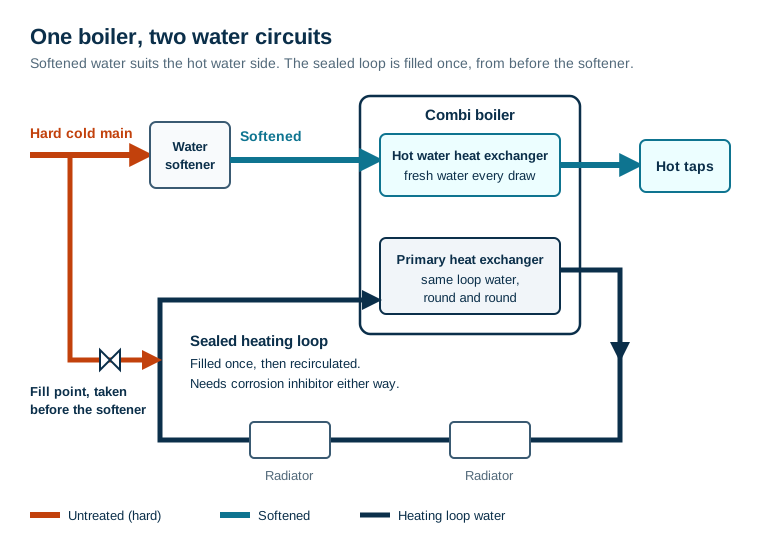
A combi boiler is two water systems sharing one burner.
- The domestic hot water circuit is open. Cold water comes in from the house supply, picks up heat in a plate heat exchanger, and leaves at a tap. It never comes back. Every gallon brings its own hardness.
- The heating circuit is sealed. It is filled once through a fill valve, pressurised, and pumped round the primary heat exchanger and the radiators or baseboard for years. The same water goes round and round.
A heating-only boiler has just the second circuit. A combi has both. Most confusion comes from treating them as one.
Heating-only boilers with an indirect tank
Many US homes with a heating-only boiler make hot water in a separate indirect tank. The boiler water runs through a coil inside that tank and never mixes with the water you drink. The same split applies, just in two boxes instead of one. The tank's domestic side takes fresh water all day and benefits from softening, exactly like a combi's hot water side. The coil and the rest of the boiler loop are sealed, so they follow the fill-water and inhibitor rules below. The tank's own manual sets its water limits. Where it sits relative to the softener is covered in whether a softener goes before or after the water heater.
If your house has a softener, the hot water side is almost certainly already getting softened water. The question is where the heating loop's fill valve connects, and it is rarely one anyone checks.
The Combi Hot Water Side: Where Softening Pays
A combi heats water on demand, in a compact heat exchanger with narrow passages. Hardness drops out of solution as water heats, so scale forms fastest exactly there. It is the same process that scales up a tankless water heater, in a smaller space.
Manufacturers set limits for this side. The Navien NCB-H installation and operation manual lists maximum levels for the domestic hot water supply:
| Parameter | Navien NCB-H maximum |
|---|---|
| Total hardness | 200 mg/L (12 grains per gallon) |
| Chloride | 250 mg/L |
| Iron | 0.3 mg/L |
| Manganese | 0.05 mg/L |
| pH | 6.5 to 8.5 |
| Total dissolved solids | 500 mg/L |
Navien adds that damage caused by poor water quality is not covered under warranty. If your raw water is above 12 grains, a softener on the supply is the most direct way to bring the hot water side inside that table.
Worcester Bosch takes a similar position in the UK. Its Greenstar 8000 Life combi manual says an ion exchange softener can be fitted to the property's cold water system. Where temporary hardness is above 200 ppm, it says a scale prevention device may be needed, and its commissioning checklist asks the installer to record one.
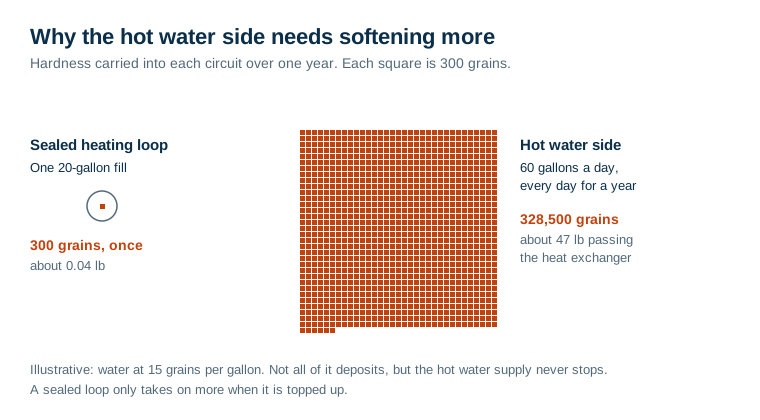
The scale of the difference between the two circuits is easiest to see with numbers. Take water at 15 grains per gallon, a heating loop holding 20 gallons, and a household drawing 60 gallons of hot water a day. These are illustrative figures, not measurements.
| Circuit | Water through it | Hardness carried in | Weight |
|---|---|---|---|
| Sealed loop, one fill | 20 gallons, once | 300 grains | About 0.04 lb |
| Hot water side, one year | 60 gallons a day | 328,500 grains | About 47 lb |
Not all of that hardness sticks to the exchanger, but the supply never stops. The loop's supply stops the day it is filled. That is why softening clearly benefits the hot water side of a combi and does little for scale in a healthy sealed loop.
The Sealed Heating Loop: Why Softening Alone Falls Short
A closed loop has a different enemy. After the first fill, the calcium in it has nowhere to come from. What does the damage over years is corrosion, and corrosion runs on oxygen.
Softening swaps calcium and magnesium for sodium. It does not remove dissolved oxygen, it does not add corrosion protection, and it does not set the pH to anything in particular. Navien's manual is direct about where the risk comes from. It warns that make-up water adds oxygen and minerals to the system that may lead to heat exchanger failure. It also says the continual introduction of fresh make-up water will reduce boiler life.
So three things protect a loop, and softening is not one of them:
- Fill water inside the maker's limits. Navien says to fill the heating system only after making sure the water chemistry meets its requirements. It applies the same 12-grain hardness cap, plus limits for chloride, pH, dissolved solids and chlorine.
- Inhibitor. Worcester Bosch says inhibitor must be added to the system. For freeze protection, Navien requires inhibited propylene glycol made for hydronic heating, recommends no more than 35 percent, and wants it tested at least yearly.
- No leaks. A sealed loop that never needs topping up never takes on fresh oxygen. One that needs weekly top-ups is feeding corrosion, whatever the fill water.
Softened fill water is not a substitute for any of the three. That is the conflation that costs money: a homeowner with a softener assumes the heating loop is protected because the water is soft, skips the inhibitor, and finds out when the heat exchanger fails.
What Boiler Manuals Actually Say About Softened Fill
The rules differ by manufacturer and by market, which is why a general answer online is not enough.
| Navien NCB-H (US combi) | Worcester Bosch Greenstar 8000 Life (UK combi) | |
|---|---|---|
| Softener on the hot water supply | Hot water table caps hardness at 12 grains | Ion exchange softener on the cold supply is permitted |
| Softened water to fill the heating loop | Not prohibited. Fill must meet the chemistry table | Must not be filled with ion exchange softened water |
| Fill point | External fill connection allowed where needed | Permanent untreated supply to the fill point, taken before the softener |
| If no untreated supply exists | — | Fill initially through the softener bypass. Occasional softened top-ups accepted |
| Inhibitor | Inhibited glycol only, if freeze protection is used | Inhibitor must be added |
| pH | 6.5 to 8.5 | 6.5 to 8.0 at commissioning. Checked yearly if topped up with softened water |
| Water quality and warranty | Damage from poor water quality not covered | Softened fill listed as a risk of damage to the appliance |
Worcester Bosch explains its position in pH terms. Its manual says salt-based softened water that adjusts the pH value must not be used to fill the system, and that treatment products that do not alter pH may not need an untreated bypass at all.
The two manuals do not contradict each other so much as show the range. One US maker writes limits and leaves the method to you. One UK maker names softened water directly. Your boiler's manual is the only one that counts for your warranty.
Filling or Refilling a Loop in a Softened House
If the manual for your boiler restricts softened fill water, or you simply want to follow the strictest reading, this is the sequence:
- Find the fill point. Trace the fill valve or auto-feeder back to where it tees off the cold supply. If that tee is after the softener, the loop has been filling with softened water.
- Fill through the bypass or an untreated branch. Put the softener in bypass for the fill, or have a plumber move the fill connection to a tee before the softener, as Worcester Bosch specifies.
- Test the fill water against the manual's table. Hardness, chloride, pH and dissolved solids at minimum. Reading pH and hardness together helps if your water is soft by nature and also low in pH.
- Dose inhibitor to the product's instructions, or inhibited glycol where the loop needs freeze protection.
- Record the pH and the date. If the loop can only be topped up from softened water, Worcester Bosch wants the pH checked and recorded yearly.
- Put the softener back in service once the loop is full and pressurised.
The Auto-Fill Trap
Many hydronic systems, including Navien's NCB-H, have an automatic feeder that tops the loop up whenever pressure drops. It usually takes its water from the nearest cold line, and in a softened house that line is usually softened.
That is rarely a problem in itself. Worcester Bosch accepts occasional topping up with softened water. The trap is that an auto-feeder hides a leak. Pressure falls, the feeder quietly refills, and the loop takes on a new charge of oxygen and fresh water. The inhibitor gets more dilute each time. Nobody notices until the exchanger fails.
Two cheap habits catch it:
- Log the boiler pressure gauge once a month when the system is cold. A stable reading means no top-ups are happening.
- Watch the softener's water use if your valve shows it. An unexplained rise can be a feeder running on a leaking loop.
What a Softener Cannot Do for a Boiler
A softener removes calcium and magnesium. It is worth being clear about what it leaves alone:
- It does not remove dissolved oxygen, the main driver of corrosion in a sealed loop.
- It does not act as an inhibitor. Soft water in a loop still needs inhibitor chemistry.
- It does not correct pH. Acidic well water stays acidic after softening. That matters for copper and for aluminium heat exchangers alike, and whether soft water harms pipes covers the plumbing side.
- It does not remove scale already in the exchanger. A combi that has been running on hard water needs descaling before softening can keep it clean.
- It does not replace the boiler's service schedule. Warranty claims are judged on records, not on the water.
If you are weighing a salt-free conditioner instead, the heating equipment case is covered in salt-free conditioning for tankless heaters and boilers. The combi-versus-loop split applies there too.
What to Do Next
- Find your boiler's manual and locate the water quality table and any statement on softened water. Those two items decide everything else.
- Trace the heating fill connection. Know whether it tees off before or after the softener.
- Soften the hot water feed if your raw water is above the manual's hardness limit. For a combi, that is where softening earns its keep.
- Confirm inhibitor is in the loop and its concentration was tested at the last service. If nobody can say, have it tested.
- Log the pressure gauge monthly. A loop that never needs topping up is the best protection you can give it.
Frequently Asked Questions
Can you use softened water in a combi boiler?
On the hot water side, yes, and it helps. Fresh cold water passes through the combi's hot water heat exchanger every time a tap opens, so hardness arrives continuously and softening stops it at the source. The sealed heating side is different. Some manufacturers set fill-water limits for it, and at least one major maker, Worcester Bosch, says the heating system must not be filled with salt-softened water at all. Check your own manual before filling the loop.
Why do some boiler makers say not to fill the heating system with softened water?
Worcester Bosch's reason, stated in its Greenstar 8000 Life manual, is pH. It says salt-based softened water that adjusts the pH must not be used to fill the system, requires inhibitor, and wants the pH between 6.5 and 8.0 at commissioning. A sealed loop is a closed chemistry experiment that runs for years, so makers want its starting water predictable. Softening also leaves the oxygen in the water, and oxygen is what corrodes a loop.
Does a closed hydronic heating system need a water softener?
Usually not. A sealed loop is filled once and then recirculates the same water, so it only ever receives the hardness in that one fill plus any top-ups. At 15 grains per gallon, a 20-gallon fill carries about 300 grains, which is roughly 0.04 lb of hardness. What a loop needs is fill water inside the manufacturer's limits, a correct dose of corrosion inhibitor, and no leaks.
Is softened water corrosive to boilers?
Softened water is not the main corrosion risk in a heating loop. Oxygen is. Navien's NCB-H manual warns that make-up water adds oxygen and minerals to the system and can lead to heat exchanger failure. That is true whether the make-up water is hard or softened. The protection is inhibitor chemistry and a leak-free system, not the choice between hard and soft fill water.
What water hardness do boiler manufacturers allow?
It varies by maker, which is why the manual matters. Navien's NCB-H combi boiler manual caps total hardness at 200 mg/L (12 grains per gallon) for both the hot water supply and the heating system fill, alongside limits for chloride, pH, iron and dissolved solids. Worcester Bosch's UK combi manual suggests considering scale prevention on the hot water side where temporary hardness is above 200 ppm.
Should my boiler's automatic fill valve come from softened water?
Ideally it comes from an untreated line, which is what Worcester Bosch specifies for its heating fill point. If your auto-fill is plumbed after the softener, occasional small top-ups are not a crisis. Worcester says occasional topping up with softened water is acceptable, with an annual pH check. The real warning is frequent top-ups, because they mean a leak, and every refill brings in fresh oxygen.
