
Should Softened Water Be Used for Baby Formula?
Should softened water be used for baby formula? No. The published guidance generally advises against making up baby formula with water from a salt-based softener, because the softener adds sodium. The UK's NHS guidance on making up formula says it plainly: "Do not use artificially softened water." Use an unsoftened cold tap, or water your pediatrician recommends.
That answer is conservative on purpose, and it is also the cheapest one to follow. The rest of this page explains the reasoning, works out how much sodium is involved, and shows how to make sure the house has a tap you can use.
Softened Water and Baby Formula: What the Guidance Actually Says
It helps to separate what the sources say from what the internet repeats.
- NHS (UK): explicit. "Do not use artificially softened water or water that has been boiled before." This is the clearest statement we found from a national health body.
- HealthyChildren.org, the American Academy of Pediatrics' site for parents: its page on preparing formula with water says the water "should also be low in certain minerals and contaminants that may be harmful." It also warns that adding the wrong amount of water "disturbs electrolyte and mineral balances such as calcium, sodium and potassium." It does not mention softeners by name.
- EPA: the sodium advisory explains why infants are the sensitive group. It says the kidneys of immature individuals "are not as effective in controlling sodium levels as the kidneys of adults."
- CDC: its formula preparation guidance says that if you are unsure whether your tap water is safe, contact your local health department. It does not address softened water.
So no US agency we could find publishes a line as direct as the NHS one. The reasoning points the same way, though, and nobody recommends softened water for formula. When the guidance is uneven and the alternative is simple, take the conservative option. Your pediatrician has the final say for your baby, especially for a premature baby or one with a kidney or heart condition.
Why the Same Water Matters More for a Baby
For adults, the sodium from softened water is a small addition to a large diet. For a formula-fed baby, the water is nearly the whole diet, and the body it goes into is about a fourteenth of an adult's size.
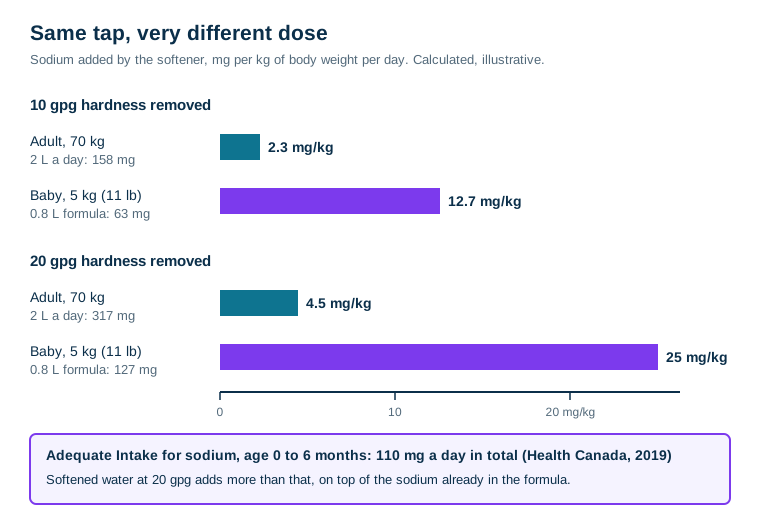
The numbers below are calculated, not measured. They use Penn State Extension's figure of 7.5 mg of sodium per quart for each grain per gallon (gpg) of hardness removed, which is about 7.9 mg per litre. For intake, they use HealthyChildren.org's feeding amounts: about 2½ ounces of formula per pound of body weight per day, up to about 32 ounces. An 11 lb baby takes roughly 27 ounces, about 0.8 litres.
| Hardness removed | Added sodium per 8 oz bottle | Added per day, 11 lb baby (0.8 L) | Per kg, baby | Per kg, adult drinking 2 L |
|---|---|---|---|---|
| 5 gpg | 9 mg | 32 mg | 6.3 mg | 1.1 mg |
| 10 gpg | 19 mg | 63 mg | 12.7 mg | 2.3 mg |
| 20 gpg | 38 mg | 127 mg | 25 mg | 4.5 mg |
| 30 gpg | 56 mg | 190 mg | 38 mg | 6.8 mg |
Calculated. Assumes the made-up formula is almost all water. Real intake varies with the baby's weight and appetite.
Now set that against what a baby needs. Health Canada's dietary reference intake tables, which use the 2019 values from the US National Academies, give an Adequate Intake for sodium of 110 mg a day from birth to six months and 370 mg a day from seven to twelve months. Infant formula already contains the sodium it is designed to supply. Softened water at 20 gpg would add more than a young baby's whole daily Adequate Intake on top of that.
Doubling the dose does not mean a baby will be harmed, and we are not claiming it does. What it does show is that formula makers balance the sodium in their product carefully, and softened water upsets that balance by a proportion that would never matter in an adult's glass. That is the reasoning behind the guidance. For the adult picture and the derivation of the per-grain figure, see how much sodium a water softener adds.
Which Tap to Use in a Softened House
Most softened houses have three kinds of cold and hot water at the kitchen. Only one of them suits formula.
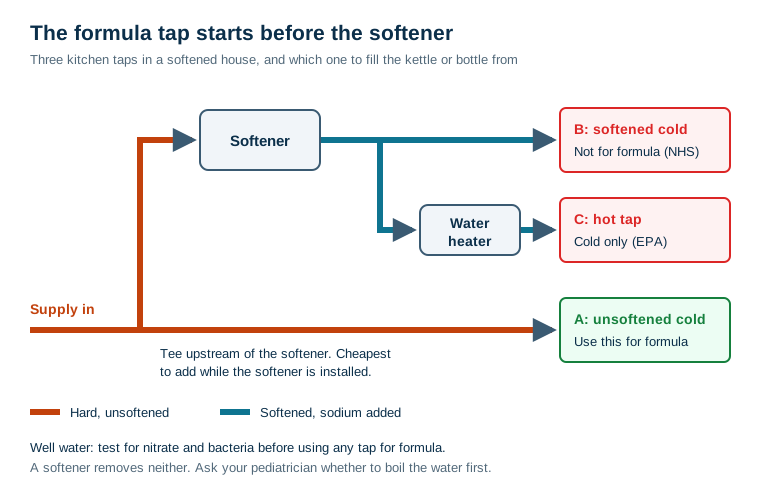
A: the unsoftened cold tap. This is fed from a tee on the supply line before the softener. It carries whatever your supply carries, with no added sodium. If your supply is safe, this is the tap to use.
B: the softened cold tap. This is the normal kitchen cold tap in most softened houses. Do not use it for formula.
C: the hot tap. Hot water in a softened house is softened too. EPA's lead guidance separately says to "use only cold water for drinking, cooking and making baby formula," because hot water dissolves more metal from pipes and fittings. Two reasons not to use it.
The fridge dispenser and the filter faucet. These catch people out. A refrigerator water dispenser is usually fed from a small line teed off the nearest cold pipe, which in a softened house is normally softened. Its carbon filter improves taste and may reduce chlorine, but it does not take out the sodium the softener added. The same goes for most single-stage filter faucets. Do not use either for formula unless you have confirmed that the line feeding it comes from before the softener.
How to tell which tap you have. Test it. A hardness test strip at a working unsoftened tap reads the same as your raw water. At a softened tap it reads at or near zero. Do this even if a previous owner or installer told you the kitchen was bypassed. Plumbing gets changed, and labels get lost. The hardness testing guide covers strips and drop kits.
Boiling, Bottled Water and Reverse Osmosis
Parents reach for these three fixes. Each one solves a different problem.
Boiling kills germs. It does not remove sodium. The CDC advises mixing powdered formula with water that has been boiled and then left for about five minutes for babies younger than 2 months, babies born before 37 weeks, and babies with a weakened immune system, to kill germs such as Cronobacter. Whether your baby needs that step is a question for your pediatrician. Boiling softened water does not make it suitable. Salt stays in the pot, and a long boil concentrates it slightly as water evaporates.
Bottled water varies. HealthyChildren.org advises mainly using safe tap water that is fluoridated, with occasional non-fluoridated bottled water. The NHS notes that some bottled water can contain too much sodium or sulphate. If you use bottled water, check the sodium on the label, and ask your pediatrician which brand suits your baby.
Reverse osmosis removes most sodium, so RO water from under the sink avoids the softener problem. RO also removes fluoride, which HealthyChildren.org discusses in the context of infant water, and none of the guidance we checked speaks to RO water for formula directly. Treat RO as a question to raise with your pediatrician, not a default. How RO and a softener work together is covered in reverse osmosis and a water softener together.
A fourth idea, switching the softener to potassium chloride, trades sodium for potassium. None of the infant guidance we found supports it for formula, so we would not rely on it.
Well Water Families: Two Tests Come First
If your house is on a private well, the softener is not the first question. EPA's page on well water contaminants warns that "infants below six months who drink water with high levels of nitrate can become seriously ill and die." A softener does not remove nitrate, and the CDC notes that softeners do not remove bacteria.
Before any well tap is used for formula, test for nitrate and coliform bacteria at a certified laboratory. Retest if anything changes, such as flooding, well work or nearby fertiliser use. If either result is a problem, the unsoftened tap is no better than the softened one, and your health department or pediatrician should guide the next step. The CDC's advice to contact your local health department applies here too.
Plan the Unsoftened Tap When the Softener Goes In
This is the part most households miss. If a baby is expected, or the house is likely to have young children while the softener is in service, put the unsoftened cold tap in at installation.
- At installation, it costs a tee and one pipe run. The installer already has the supply cut open at the softener. A branch from before the softener to the kitchen cold line, or to a separate small faucet, costs little extra in parts and time.
- Later, it may mean opening walls. The kitchen is often far from the softener, and retrofitting a dedicated line through finished ceilings costs more than most people expect.
- Put the tee upstream of the softener but downstream of any filter you want on it. A sediment filter or a well's treatment for bacteria should still feed the formula tap. What must not feed it is the softener.
- Label it. A small tag under the sink, "unsoftened, for drinking and formula," saves the next person, or the next owner, from guessing.
The trade-offs of a hard kitchen tap for the whole household, including scale in the kettle, are compared in should a kitchen tap bypass the softener.
What a Softener Cannot Do for Infant Feeding
- It cannot make an unsafe supply safe. It removes hardness. It does not remove bacteria, viruses, parasites or nitrate.
- It cannot lower sodium. A salt-based softener only adds sodium. It never removes it.
- Its bypass valve is not a feeding solution. Turning the whole softener to bypass each time you make a bottle works in an emergency, but it is easy to forget, and water already in the pipes stays softened until flushed. A dedicated tap is reliable.
- It cannot answer medical questions. Babies born early, babies with kidney or heart conditions, and babies on special formulas need their pediatrician's guidance on water, not a general rule.
What to Do Next
- Stop using the softened tap for formula today, and use unsoftened or pediatrician-approved water in the meantime.
- Find or test for an unsoftened cold tap. A hardness strip tells you in a minute.
- On a well, test for nitrate and bacteria before using any tap for formula.
- If there is no unsoftened tap, have one added, teed off before the softener, and label it.
- Bring the details to your pediatrician, including whether your supply is city or well and whether it has a softener, and follow their advice on boiling and water choice.
Frequently Asked Questions
Can I use softened water to make baby formula?
The published guidance says no. The UK's NHS tells parents not to use artificially softened water for formula, and EPA's sodium advisory notes that a baby's kidneys control sodium less well than an adult's. Use an unsoftened cold tap instead, and ask your pediatrician if you are unsure which water to use.
Does boiling softened water make it OK for formula?
No. Boiling kills germs, which is why the CDC advises boiled water for formula for babies under 2 months, premature babies and babies with weakened immune systems. Sodium is dissolved salt, though, and it does not boil off. Boiling water down actually concentrates it a little. Boil unsoftened water if your pediatrician recommends boiling. Do not boil softened water to make it suitable.
How much sodium does softened water add to a bottle?
About 19 mg in an 8 oz bottle at 10 grains per gallon of hardness removed, and about 38 mg at 20 gpg. That is calculated from Penn State Extension's figure of 7.5 mg per quart per gpg. For comparison, Health Canada's Adequate Intake for sodium from birth to six months is 110 mg a day in total.
Is bottled water better than softened water for formula?
It depends on the bottle, so read the label. HealthyChildren.org (from the American Academy of Pediatrics) advises using mainly safe, fluoridated tap water, with occasional non-fluoridated bottled water. The NHS says some bottled water is not recommended because it can contain too much sodium or sulphate. An unsoftened tap on a safe supply is usually the simpler choice. Ask your pediatrician which suits your baby.
Can reverse osmosis water be used for baby formula in a softened house?
Reverse osmosis removes most of the sodium a softener adds, so it avoids the main problem. None of the infant-feeding guidance we checked addresses RO water directly. HealthyChildren.org also raises fluoride, which RO removes. If RO is your only option, ask your pediatrician before relying on it.
Can I switch my softener to potassium chloride so the water is safe for formula?
That swaps the added sodium for added potassium. None of the infant-feeding guidance we checked says potassium-softened water is suitable for formula. An unsoftened cold tap avoids both. If you are considering it, ask your pediatrician first.
