
Softened Water in Small Appliances: Steam Ovens, Irons and Coolers
Softened water in small appliances is a maker-by-maker question, and the makers disagree. Thermador recommends softened water for its steam ovens on hard supplies. Miele's steam oven manual asks only for tap water and a correct hardness setting. Rowenta lists softened water as a type not to use in its steam generator irons, and Champion's evaporative cooler manual rules it out and excludes softener damage from the warranty. The reason is sodium: when water boils away, sodium stays behind.
Owners usually find these rules only after a denied warranty claim. This page puts them in one table.
Softened Water in Steam Ovens, Irons and Coolers: The Reference Table
Every entry below is taken from the manufacturer's own manual or support page. Rules change between models, so treat this as a map of how far apart the makers are, then check your exact model.
| Appliance and source | Water the maker asks for | Softened water | Distilled water |
|---|---|---|---|
| Thermador steam oven, PODS301/302 manual | Fresh tap water, or plain non-carbonated purchased water | Recommended if water is 10 grains per gallon or harder. Hardness setting "0 – softened" | Do not use |
| Miele steam oven, DG 4000 manual | "Only use tap water!" | Not mentioned. Program the hardness setting | Never use distilled or mineral water |
| Rowenta steam generator iron, Expert instructions | Untreated tap water. 50/50 with distilled if very hard | Do not use ("scented or softened water") | Only as a 50/50 mix |
| Philips steam irons and steamers, support page | Tap water. Distilled or demineralized to prolong life | Not named. "Chemically descaled water" not to be used | Recommended |
| Champion evaporative cooler, commercial owner's manual | Supply line to float valve, with a bleed-off kit | Do not use water from a softener. Warranty excludes softener damage | Not addressed |
Read across the last two columns and the problem is obvious. Philips recommends distilled water in irons. Miele and Thermador ban it in steam ovens. Thermador recommends softened water. Rowenta rules it out. There is no single "best water for steam appliances", only the right water for the appliance in front of you.
Why Sodium Matters in a Steam Generator
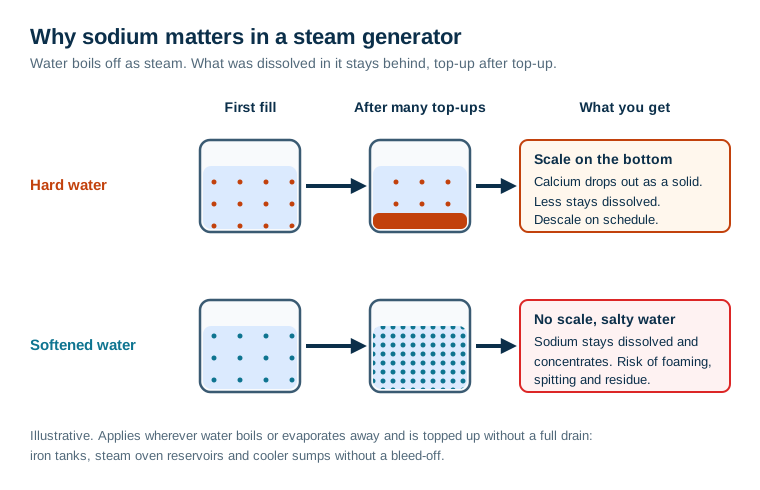
A water softener exchanges calcium and magnesium for sodium. That is the whole point on the pipes and fixtures, where calcium forms scale and sodium does not. Inside a small steam generator, the same swap changes where the minerals end up.
On hard water, much of the calcium leaves the water as it heats. It forms scale on the element or the bottom of the tank. That is a nuisance, but it is a solid, and it is why these appliances have descaling programs.
On softened water, there is little calcium to drop out. The sodium stays dissolved, however hot the water gets. Each time water boils off as steam and the tank is topped up, more sodium arrives and nothing takes it away. In an iron or a steam oven reservoir that is never fully drained, the water slowly becomes a stronger salt solution.
Manufacturers of larger steam equipment describe the effect directly:
- Aprilaire, discussing its electrode steam humidifier, says softened water ions "stay in solution to much higher concentrations than hard water ions". The unit has to drain and refill more often to keep that under control.
- Condair's RS steam humidifier manual tells operators to activate a soft start function and a demineralization mode when using softened water. It also asks them to contact Condair before running on softened or partly softened water. The same manual describes foam detection in the steam cylinder. See the Condair RS operation manual.
- Rowenta gives the same reasoning for irons: heat concentrates the elements in water during evaporation. The waters it excludes can cause spitting, brown staining or premature wear.
Large units can drain automatically. A steam iron cannot, and a countertop steam oven reservoir may be emptied only when you remember. That is the reason irons carry the strictest rules.
For how much sodium softening actually adds to drinking water, which is a separate question, see sodium in softened water.
Steam Ovens: Reset the Hardness Setting First
Steam ovens are the most forgiving group, and they share one instruction that almost every softened household misses.
Thermador says to use fresh tap water or plain non-carbonated purchased water. If your water is very hard, 10 grains per gallon or higher, it recommends softened water. Do not fill the tank with distilled water or any other liquid. Its hardness menu runs from level 1, 0 to 17 mg/L, labelled "0 – softened", up to "4 – very hard". The key line: if you move, or if your water source changes, you need to reset the water hardness level.
A new softener is a change of water source. Leave the oven on its old hard-water setting and it will call for descaling far more often than it needs to.
Miele's DG 4000 manual says to use only tap water and never distilled or mineral water. It ships set for 8 to 14 grains per gallon, and its lowest setting covers 1 to 7 grains. If you do not descale when told, the appliance locks after a set number of uses until the descaling program is run. Miele also specifies its own descaling tablets and says not to use vinegar.
On softened water, set the lowest level. The oven will ask for descaling less often. When it does ask, run the program with the specified descaler. A locked steam oven is not a warranty claim.
Steam Irons and Steam Generators: The Strictest Rules
Irons are where softened water is most often excluded, and where the rules contradict each other most.
- Rowenta says its steam generators are designed for untreated tap water. If yours is very hard, mix 50 percent untreated tap water with 50 percent distilled water. Among the waters not to use, it lists "scented or softened water", along with dryer water, rainwater, and boiled, filtered or bottled water. Its Focus iron instructions say to always use untreated water.
- Philips says tap water is fine. It recommends distilled or demineralized water, or a 50 percent mix with tap water, to prolong the iron's life. It does not name softened water, but lists perfumed water, dryer water, vinegar, starch, descaling agents and "chemically descaled water" as things not to use.
For a softened house, that leaves two practical routes. The first is an unsoftened tap: many installs leave a kitchen cold tap or an outdoor spigot on hard water, and that is untreated tap water in the manual's sense. The second, if the manual allows it, is a mix of untreated tap and distilled water. If the only water in the house is softened and your manual excludes it, buy distilled water to mix or use as the manual allows.
Garment steamers
Handheld and upright garment steamers boil water in a small reservoir, much like an iron, and they are covered by the same rules. Philips' guidance applies to its steamers and irons alike. The concentration problem is, if anything, worse. A steamer tank is often topped up many times between emptyings, and its output nozzle sits close to delicate fabric. If a steamer starts spitting or leaving pale marks on dark clothes, empty and rinse the tank before assuming it needs descaling. Then switch to the water its manual specifies.
For descaling intervals and why irons spit flakes in the first place, see scale in kettles, coffee makers and steam irons.
Evaporative Coolers: Softened Water Is the Wrong Fix
An evaporative cooler pumps water over pads while a fan pulls air through them. Water evaporates continuously, so dissolved minerals concentrate in the sump. A cooler has the same problem as a steam generator, running for hours a day.
Champion's owner's manual for its commercial coolers is unambiguous. It says: "Do not use water supplied from a water softener." Its warranty exclusions add that the company is not responsible for "any damage received from the use of water softeners, chemicals, descale material". The manual does not say why. The concentration effect above is the likely reason, since salts from softened water build up in the sump as water evaporates.
What Champion recommends instead is a bleed-off kit, which lets small amounts of circulating water drain away during operation to prevent scale build-up. It also says not to add any water treatment chemicals. The design answer to concentration is dilution, not softening.
Portable coolers follow the same logic by hand. Portacool's manual tells owners to shut down and drain the water tank once a week, which resets the concentration.
If a cooler is on a softened line now, move its supply to an unsoftened tee or a hose bib that bypasses the softener. Fit a bleed-off if the model supports one. Treat the sump like the humidifier tanks in should a humidifier use softened water: drain it, rinse it, and do not let it stand.
How Warranty Denials Actually Happen
The pattern is consistent across these appliances. The owner installs a whole-house softener and forgets that the steam appliances have their own water rules. Months later the iron spits brown water, the oven locks for descaling, or the cooler corrodes. The service technician asks what water was used, and the manual's exclusion ends the conversation.
Three habits prevent it:
- Read the water section of every steam appliance manual when the softener goes in, not when something fails. It is usually a single paragraph.
- Reset hardness settings on anything that has one, including steam ovens, dishwashers and coffee machines. The dishwasher version is covered in adjusting a dishwasher after installing a softener.
- Keep one untreated water source that is easy to reach, if the plumbing allows. It solves the iron and cooler problem without buying bottled water.
What a Softener Cannot Do for Small Appliances
- It does not reduce total dissolved solids. Anything that boils or evaporates water to dryness still leaves residue behind, sodium instead of calcium.
- It does not replace the descaling program. Steam ovens still count cycles and ask for descaling. Run it with the specified product.
- It does not make softened water acceptable where the manual excludes it. A softener's benefits to plumbing do not override an appliance warranty.
- It does not make water suitable for appliances that need distilled water. Softened water is not demineralized water.
What to Do Next
- List every appliance in the house that makes steam or evaporates water: iron, steam oven, garment steamer, coffee machine, humidifier and cooler.
- Find the water section in each manual and note which of the three answers it gives: softened water recommended, allowed, or excluded.
- Reset hardness settings on steam ovens and other appliances with a hardness menu to the softened level.
- Set up an untreated water source for irons and coolers that exclude softened water, or buy distilled water where the manual allows a mix.
- Keep the manuals. If a claim is ever made, being able to show you followed the water instructions is what decides it.
Frequently Asked Questions
Can I use softened water in a steam iron?
It depends on the brand, and some say no outright. Rowenta's instructions for its steam generator irons list scented or softened water among the types not to use, because heat concentrates what is dissolved in the water and can cause spitting, brown staining or premature wear. Philips does not name softened water, but lists chemically descaled water among the things not to use. If your manual is silent, use untreated tap water or the mix it recommends.
Can I use softened water in a steam oven?
Often yes, and one maker recommends it. Thermador's steam oven manual says to use fresh tap water and, if your water is 10 grains per gallon or harder, recommends softened water. It has a water hardness setting labelled 0 for softened. Miele's DG 4000 manual says to use only tap water and never distilled or mineral water, and has a hardness setting to program. In both cases, reset the hardness level after a softener is installed.
Why do steam appliance makers say not to use distilled water?
Different makers give different reasons, and some do recommend it. Miele and Thermador both prohibit distilled water in their steam ovens, which rely on sensors and controls designed around ordinary tap water. Rowenta recommends mixing distilled water 50/50 with untreated tap water when water is very hard, but not using it alone. Philips recommends distilled or demineralized water to prolong an iron's life. Follow the manual for your model, because these rules conflict.
Should I use softened water in an evaporative cooler?
Not if it is a Champion. Its commercial cooler manual says not to use water supplied from a water softener, and the warranty excludes damage from water softeners, chemicals and descaling material. Champion recommends a bleed-off kit instead, which drains a little circulating water during operation to stop minerals concentrating. Check your own model's manual before connecting a cooler to a softened line.
Does softened water void an appliance warranty?
It can, where the manual excludes it. Champion's cooler warranty explicitly excludes damage from water softeners, and Rowenta's instructions name softened water as a type not to use. Other makers are silent or positive about it. The safe approach is to read the water section of each manual and keep using whatever water it specifies, even when the rest of the house is softened.
