
SoftPro Elite Review: What Upflow Brining Saves in Three Real Households
This SoftPro Elite review comes down to one finding. The Elite is a solid upflow (counter-current) softener with a long warranty, and its salt savings are real, but they are far smaller than the "up to 75%" on its listing. In our model they range from about $9 a year for a couple on moderate water to about $58 a year for a large family on very hard water. That makes the Elite worth its premium mainly where low salt use matters for reasons beyond the bag price, such as a septic system or a chloride limit.
What follows is built from SoftPro's product page, warranty document and Amazon listings, a check of NSF's public listings, and a cost model for three households. It is not a hands-on test.
Disclosure: Hard Water Solved may earn a commission if you buy through links on this page, at no extra cost to you. It does not change which products we include or how we rank them. Read our disclaimer.
SoftPro Elite at a Glance
| Item | What we found |
|---|---|
| Type | Salt-based ion-exchange softener with upflow (counter-current) brining, metered, demand-initiated |
| Sizes | 32k, 40k, 48k and 64k (softener only, city water) |
| Amazon listings | 32,000 grain: Check price on Amazon · 48,000 grain: Check price on Amazon · 64,000 grain: Check price on Amazon |
| Resin | 10% crosslink resin, which resists chlorine better than standard 8% resin |
| Control features (SoftPro's description) | Soft-water brine refill, "precision brining" that pre-makes about 70% of the brine just before regeneration, a 7-day idle refresh, and an option to skip backwash on clean city water for up to 10 cycles |
| Plumbing | 1-inch internal plumbing per SoftPro; bypass valve and brine tank included in the listings |
| Warranty | Lifetime tanks and valve; 5 years on piston, seals and spacers (city water); 7 years on electronics; 10-year prorated resin (city water only) |
| Returns | 6 months from ship date, no restocking fee, return shipping paid by the buyer |
The "Elite Plus" 48k with KDF-55 media showed as currently unavailable on Amazon on 1 October 2026, so this review covers the standard Elite only. SoftPro also sells Gold and Gold+ bundles with a whole-house carbon filter from its own store.
How this review was built. Specifications, features and warranty terms come from SoftPro's product page, its warranty, shipping and refund policy and the Amazon listings, all read on 1 October 2026. Certification was checked against NSF's public listings the same day. The salt figures are a model, not measurements, and every assumption is stated next to the numbers. Nothing here was physically tested. Prices are not listed here because they change often. Use the buttons to see the current price on Amazon.
What Upflow Brining Changes Inside the Elite
In service, water flows down through the resin in the Elite just as it does in any household softener. What differs is regeneration. The brine enters at the bottom and travels up, so the freshest brine meets the bottom layer of resin first. That bottom layer is the last resin your water touches before it reaches the taps.
Because that polishing layer is fully recharged every cycle, an upflow bed leaks less hardness at low salt doses than a downflow bed does. That is the whole mechanism behind the savings. Upflow does not make each pound of salt do more work at the same dose. It makes a lower dose usable without hardness slipping through. The full comparison, including why the bed must not be lifted during brining, is in upflow vs downflow regeneration.
The technical literature puts numbers on it. A review in Water Conditioning & Purification on countercurrent regeneration reports about 5 to 10% better efficiency at standard doses of 6 to 7 lb of salt per cubic foot of resin, and about 15 to 25% better when counter-current flow is combined with low doses. Those are the figures to hold SoftPro's claims against.
The 75% Claim, Checked Against the Chemistry
SoftPro's Amazon listings say the Elite "saves up to 75% on salt usage and 64% on waste water over other leading brands". Its own store page is more modest, describing "far less salt than competitors" and "up to 30% additional salt savings" from precision brining. The difference comes down to what the Elite is being compared with.
Start with the ceiling. Salt (sodium chloride) and hardness (counted as calcium carbonate) exchange in fixed chemical proportions. At perfect efficiency, one pound of salt could regenerate resin for about 6,000 grains of hardness. No real softener reaches that.
Now the comparison points, in grains of hardness removed per pound of salt:
- A timer softener at a heavy 15 lb per cubic foot dose: about 2,070 grains per pound, from the standard design tables in the advertised vs usable capacity guide.
- A metered downflow softener at 9 lb per cubic foot: about 2,890.
- The same softener tuned to 6 lb per cubic foot: about 3,500.
- An upflow softener at a low dose: about 4,000. This is our assumption, not a SoftPro figure. It sits within the WC&P range above, and below a published counter-current data sheet that reaches about 4,370 at its lowest setting.
A 75% saving against the timer unit would need about 8,300 grains per pound. That is more than the chemistry allows. So the claim can only be true against a softener that wastes capacity, for example an old timer unit regenerating every few days whether the resin needs it or not. Against any modern metered softener, the realistic saving is a fraction of that.
None of this is unusual. The upflow guide makes the same point about efficiency marketing in general: most of a big percentage comes from the dose and the regeneration trigger, not the direction of the brine.
SoftPro Elite Review of the Savings: Three Households
To see where the efficiency matters, we modeled three households. Each uses 75 gallons per person per day, a common planning figure. Salt is priced at $7 per 40 lb bag.
| Household | Water | Hardness removed per year |
|---|---|---|
| Couple on city water | 10 gpg | 547,500 grains |
| Family of four on city water | 15 gpg | 1.64 million grains |
| Family of five on a well and septic system | 25 gpg | 3.42 million grains |
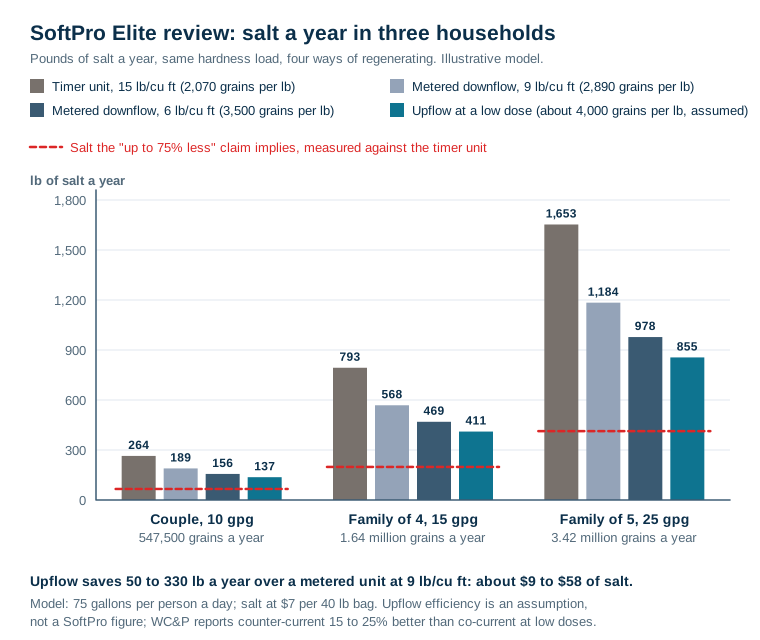
| Household | Timer, 15 lb/cu ft | Metered, 9 lb/cu ft | Metered, 6 lb/cu ft | Upflow, low dose | Upflow saving vs 9 lb | Upflow saving vs 6 lb |
|---|---|---|---|---|---|---|
| Couple, 10 gpg | 264 lb | 189 lb | 156 lb | 137 lb | 52 lb, about $9 | 19 lb, about $3 |
| Family of 4, 15 gpg | 793 lb | 568 lb | 469 lb | 411 lb | 158 lb, about $28 | 59 lb, about $10 |
| Family of 5, 25 gpg | 1,653 lb | 1,184 lb | 978 lb | 855 lb | 329 lb, about $58 | 122 lb, about $21 |
Model only. Real use runs a little higher at every setting, because regenerations happen with some capacity unused. The ratios between columns hold.
Three things stand out.
- The saving scales with the hardness load. It is the same percentage in every household, but a percentage of 1,184 lb is worth more than a percentage of 189 lb. The Elite earns its keep on hard water and in big households.
- The comparison you pick decides the headline. Against an old timer unit, upflow saves about half the salt. Against a modern metered unit set to a standard dose it saves about 28%, and against one tuned to 6 lb per cubic foot about 12%. A conventional softener can get much of the way there just by being programmed well. That process is covered step by step in optimizing a softener for salt and water efficiency.
- Water savings are small in dollars. SoftPro's product page puts regeneration water at around 30 gallons. The EPA WaterSense fact sheet on water softeners asks for no more than 4 gallons per 1,000 grains removed and more than 3,350 grains per pound of salt. Even a unit at that water ceiling, for the family of four, sends about 6,600 gallons a year to the drain. That costs roughly $79 at $12 per 1,000 gallons for water and sewer combined. An efficient unit trims some of that, worth tens of dollars a year, not hundreds.
Where the Savings Matter, and Where They Do Not
The numbers point to three situations where the Elite's efficiency is worth more than the bag price.
Septic systems. Every gallon of regeneration water and every pound of salt goes to the drain field. A family of five that cuts about 330 lb of salt and some regeneration water a year is reducing load on the system, not just saving money. The evidence on softeners and septic tanks, and the setup that limits the risk, is in planning a water softener for a home with septic.
Chloride limits. Some communities restrict softener discharge because chloride passes through treatment plants into rivers. Lower salt per grain removed is the practical answer, and a counter-current bed lets you run a low dose without hardness breaking through.
Very hard water. At 25 gpg and above, the absolute saving is large enough to notice, and the low leakage of an upflow bed helps keep the water soft at an efficient setting.
Where the efficiency barely matters is the small household on moderate water. A couple at 10 gpg saves about $9 a year against a standard metered softener. They are better served by a smaller, cheaper metered unit programmed for efficiency, or by deciding whether they need a softener at all. The trade-offs between treatment types are laid out in salt-based vs salt-free water treatment.
Does the Saving Pay Back the Premium?
The fair comparison is a metered downflow softener of the same size with the same 10% crosslink resin. AFW's store sells Fleck 5600SXT systems with 10% resin in 32k, 48k and 64k sizes. At the brand-store prices we saw on 1 October 2026, the Elite cost considerably more than each of them, size for size. The payback figures below divide that premium by the yearly salt saving; check both stores' current prices and rerun the sum for your size.
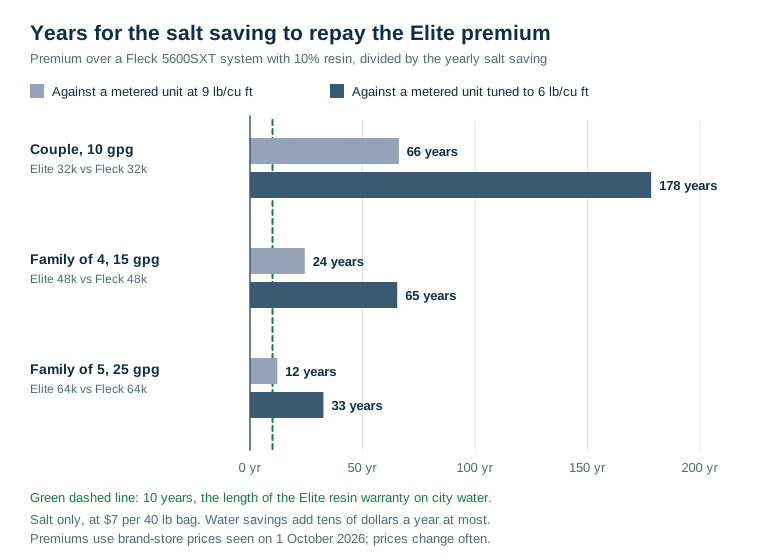
| Household | Size compared | Payback vs metered at 9 lb | Payback vs metered at 6 lb |
|---|---|---|---|
| Couple, 10 gpg | 32k | about 66 years | about 178 years |
| Family of 4, 15 gpg | 48k | about 24 years | about 65 years |
| Family of 5, 25 gpg | 64k | about 12 years | about 33 years |
On salt alone the Elite never pays back for the smaller households. For the large hard-water household it comes close to the 10-year resin warranty against a softener at a standard setting.
That does not make the Elite a bad buy. It means the efficiency is not the reason to buy it. The reasons that hold up are:
- The warranty. Lifetime coverage on the valve body and tanks, 7 years on electronics and a 10-year prorated resin warranty on city water. Typical 5600SXT system warranties are 5 years on the valve and 10 on the tank.
- Support. SoftPro offers phone and video help from its own technicians. For a first-time DIY installer, that has real value.
- The low-salt use case on septic or under a chloride limit, where every pound counts.
Where the Upflow Design Is a Weak Fit
Counter-current brining needs a bed that stays layered. The WC&P review is blunt that this is "far less attractive for well waters than for municipal waters", because a bed that cannot backwash freely holds on to iron, manganese and sediment.
SoftPro's own terms point the same way:
- The warranty's operating conditions allow up to 2.0 ppm of dissolved iron.
- The 10-year resin warranty covers city-water systems only.
- On well-water systems, the piston, seals and spacers are maintenance parts. SoftPro's own words are that iron and sediment "wear them over time, which is why the right pre-treatment matters."
The Elite's option to skip backwash for up to 10 cycles is aimed at clean city water. On a well carrying iron or silt, leave the backwash on and treat the water ahead of the softener. If your well test shows iron near or above 2 ppm, a softener designed around fine-mesh resin and full backwash, with iron treatment where needed, is the more robust choice.
Warranty and Return Terms, Read Closely
SoftPro's warranty page, read on 1 October 2026, lists:
| Part | Coverage |
|---|---|
| Tanks | Lifetime |
| Control valve | Lifetime |
| Piston, seals and spacers | 5 years on city-water systems; maintenance parts on well systems |
| Circuit board and electronics | 7 years |
| Resin, 10% crosslink | 10 years, prorated, city-water systems only |
| Operating conditions | Iron up to 2.0 ppm, 20 to 125 psi, 33 to 100°F, chlorine or chloramine at typical municipal levels |
Two cautions. First, return terms have changed over time. An earlier independent review reported a 25% restocking fee. The current page says 6 months from ship date with no restocking fee, but the buyer pays return shipping and original shipping is not refunded. A 64k system is heavy, so the return freight is real money. Second, the terms are SoftPro's own store policy. If you buy through Amazon, confirm with SoftPro that the same warranty and return terms apply to that order, and register the unit.
Certification: What We Could and Could Not Confirm
SoftPro's product page carries an "NSF / WQA / ANSI Certified" badge. We searched NSF's public listings for the SoftPro trade name under NSF/ANSI 44, the softener standard, on 1 October 2026 and found no matching products. Independent reviewers report that the NSF/ANSI 44 certification is held by Canature, the company that makes the valve and system, rather than under the SoftPro name.
That may be a paperwork matter rather than a quality problem. Many softeners are certified under the manufacturer's name and sold under another. But a certification you cannot look up is worth less than one you can. Ask SoftPro for the listed company, model number and the salt setting the efficiency figure was certified at. A certified efficiency at a stated dose is the number that would settle the savings question for good.
Installation Notes
The Elite installs like any two-tank softener: a bypass valve, inlet and outlet connections to the main line ahead of the water heater, a drain line with an air gap, a brine overflow line and a power outlet. SoftPro rates it as a DIY job of a few hours, with installation videos and phone support. A plumber will charge extra on top of the purchase price.
Two setup choices decide whether you get the savings modeled here:
- Enter your real hardness, measured with a test kit, not a city average. Add about 4 gpg for every 1 ppm of dissolved iron on well water.
- Leave the salt dose low. The efficiency only appears at low doses. Turning the dose up to chase capacity throws the upflow advantage away.
Who Should Not Buy the SoftPro Elite
- Small households on moderate water who want to save money. A metered Fleck or similar unit at an efficient setting costs considerably less, and the Elite's extra salt saving is worth single-digit dollars a year.
- Well owners with iron above about 2 ppm, manganese or sediment who do not plan to add pre-treatment. The warranty conditions and the upflow design both work against you.
- Buyers who need a certification they can verify themselves before purchase, until SoftPro supplies the listing details.
- Anyone shopping on the "75% less salt" figure. Against a modern metered softener, expect roughly 12 to 28% less salt, depending on how that softener is programmed.
The Verdict
The bottom line of this SoftPro Elite review: the Elite does what upflow brining promises. It makes a low salt dose usable, and that saves salt and some water. The saving is worth about $9 to $58 a year against a standard metered softener across our three households, so it does not repay the Elite's price premium for most homes on salt alone. Buy the Elite for the warranty, the support, and for homes where low salt use matters for its own sake, such as septic systems, chloride limits and very hard water. If you are buying it to cut a salt bill on moderate water, a well-programmed conventional softener gets most of the way there for less.
Frequently Asked Questions
Is the SoftPro Elite worth the money?
It depends on your water and your drain. The Elite costs considerably more than a comparable Fleck 5600SXT system with 10% crosslink resin. On salt alone, at the prices we saw on 1 October 2026, that premium takes about 12 years to repay for a family of five on 25 gpg water, about 24 years for a family of four on 15 gpg, and longer than the unit will last for a couple on 10 gpg. It is worth it where low salt use has value beyond the bag price, such as a septic system or a local chloride limit, or where you value the long valve warranty and phone support.
Does the SoftPro Elite really use 75% less salt?
Not against a modern metered softener. SoftPro's Amazon listing says the Elite saves up to 75% on salt compared with other leading brands. Against a timer softener running a heavy 15 lb per cubic foot dose, an efficient upflow unit uses roughly half the salt. Against a metered downflow unit at a standard setting, the saving in our model is about 28%, and against one tuned to a low dose it is about 12%. A 75% cut against a heavy-dose softener would need more softening per pound of salt than the chemistry allows, so the claim only holds against units that waste capacity.
Can I use the SoftPro Elite on well water?
SoftPro sells a well-water version, but read the terms first. The warranty's operating conditions allow up to 2.0 ppm of dissolved iron, the 10-year resin warranty applies to city-water systems only, and on well systems the piston, seals and spacers are treated as maintenance parts. Upflow brining also works best on a bed that stays still, which suits clean water better than water carrying iron or sediment. Test the well first and add pre-treatment where it is needed.
What warranty does the SoftPro Elite have?
On 1 October 2026 SoftPro's warranty page listed lifetime coverage on the tanks and control valve, 5 years on the piston, seals and spacers for city-water systems, 7 years on the circuit board and electronics, and a 10-year prorated warranty on the resin for city-water systems. Returns were accepted for 6 months from the ship date with no restocking fee, but original shipping is not refunded and the buyer pays return shipping. If you buy on Amazon, confirm with SoftPro that the same terms apply to that purchase.
Is the SoftPro Elite NSF certified?
SoftPro's product page shows an NSF, WQA and ANSI certification badge. When we searched NSF's public listings for the SoftPro trade name under NSF/ANSI 44 on 1 October 2026, nothing was listed. Independent reviewers report that the certification is held by the valve and system maker, Canature, rather than under the SoftPro name. Ask SoftPro for the exact listing and model number before relying on it.
How often does the SoftPro Elite regenerate?
It regenerates on demand, so the interval depends on your hardness, water use and the capacity it is programmed for. SoftPro's own figure is about every 14 days on average and around 30 gallons of water per regeneration. A large family on very hard water will regenerate far more often than that, and a couple on moderate water less often. The meter, not the calendar, decides.
