
Tier1 Water Softener Review: The Ceramic-Disc Valve, Real Capacity and the Warranty Fine Print
This Tier1 water softener review starts with the part Tier1 sells hardest: a patented ceramic-disc control valve with no seals, spacers or piston to rebuild. That is a real design advantage over a piston valve. What the listings say less clearly is what surrounds it. The valve, bypass and electronics carry one year of warranty, extendable to five only if you register and buy four bottles of Tier1 cleaner every year. The manual expects chlorine below 0.1 ppm and iron below 0.3 ppm. And a "48,000-grain" Tier1 delivers about 31,500 to 40,000 grains at the salt doses most owners will run. The 32,000 and 48,000-grain two-tank models are fairly priced for a metered softener, but only for water inside those limits.
Disclosure: Hard Water Solved may earn a commission if you buy through links on this page, at no extra cost to you. It does not change which products we include or how we rank them. Read our disclaimer.
How this review was built. Nothing here was physically tested. The evidence is the Tier1 WS-165-150 owner's manual, Tier1's Everyday Series warranty document, the product pages on DiscountFilterStore.com (Tier1's own store), the Amazon listings, and NSF's public softener listings. Capacity is restated at a stated salt dose using standard resin performance. Prices are not listed here because they change often. Use the buttons to see the current price on Amazon.
4 Catches in This Tier1 Water Softener Review
- Inlet limits. The manual expects chlorine below 0.1 ppm and ferrous iron below 0.3 ppm, and the warranty excludes resin damaged beyond them.
- Valve cover. One year on the valve and electronics. Five years only with registration and four bottles of Tier1 cleaner a year.
- Capacity. The grain number in each name is a heavy-salt figure. Tier1's own manual says to plan on 75 percent of it.
- Listing details. Two Amazon titles disagree with their own specifications or with Tier1's store on resin volume and house size.
Who Makes Tier1, and Where It Is Sold
The Tier1 manual is plain about it: "Tier1 is a registered trademark of US Water Filters, Inc.", of Zumbrota, Minnesota. US Water Filters is also named as the warrantor in the Everyday Series warranty. Tier1 sells through DiscountFilterStore.com, a Tier1 brand store on Amazon and some home-improvement retailers, and it makes refrigerator, furnace and pool filters as well as softeners.
We found no Tier1 softener on NSF's register of certified softeners when we searched it by brand name on 2 October 2026. The Amazon listings say the resin is "NSF/ANSI 44 certified cation resin", which is a claim about one component, not a certification of the whole softener's capacity or efficiency.
The Tier1 Lineup
| Model | Resin | Mineral tank | Brine tank | Amazon |
|---|---|---|---|---|
| Everyday 24,000 compact | 0.75 cu ft (Amazon listing) | 8 x 39 in | 13.5 x 32 in | Check price on Amazon |
| Everyday 32,000, WS-165-132 | 1.0 cu ft, 8% crosslink | 9 x 53 in with valve | 13.5 x 32 in | Check price on Amazon |
| Everyday 48,000, WS-165-150 | 1.5 cu ft, 8% crosslink | 10 x 59 in with valve | 13.5 x 32 in | Check price on Amazon |
| Everyday 64,000, WS-165-164 | 2.0 cu ft, 8% crosslink | 12 x 57 in with valve | 13.5 x 32 in | Not checked |
| All-in-One cabinet 24,000 | 0.75 cu ft | Cabinet 44.6 x 11.4 x 18.9 in | Inside cabinet | Check price on Amazon |
The two-tank Everyday models share the ceramic-disc valve, 1-inch NPT connections, a metered control and a bypass that opens automatically during regeneration. The store lists 18 gpm of flow for each but gives no pressure drop, so that figure cannot be compared with a spec sheet that states one. The All-in-One cabinet is a different design: Tier1 describes its valve as a "digital manual control valve with LCD" and does not claim a ceramic valve for it. It uses 3/4-inch connections, and the store recommends an iron filter above 3 ppm.
Read the Amazon titles with care. The 24,000-grain compact's title says "1 Cu Ft" of resin, while its own bullet points and specification field say 3/4 cubic foot. Tier1's store sells a separate "Compact 32,000" with 1 cubic foot in a 10 x 40 in tank, so check which tank you are ordering. The 32,000-grain model's Amazon title says it suits "3-4 bathroom homes", while Tier1's store recommends the same model for 1 to 2 bathrooms.
How the Ceramic-Disc Valve Works, Compared With Fleck's Piston
Every softener control valve does the same five jobs: service, backwash, brine draw, brine refill and rinse. How it switches between them is the difference. The general mechanics are in how a water softener control valve works.
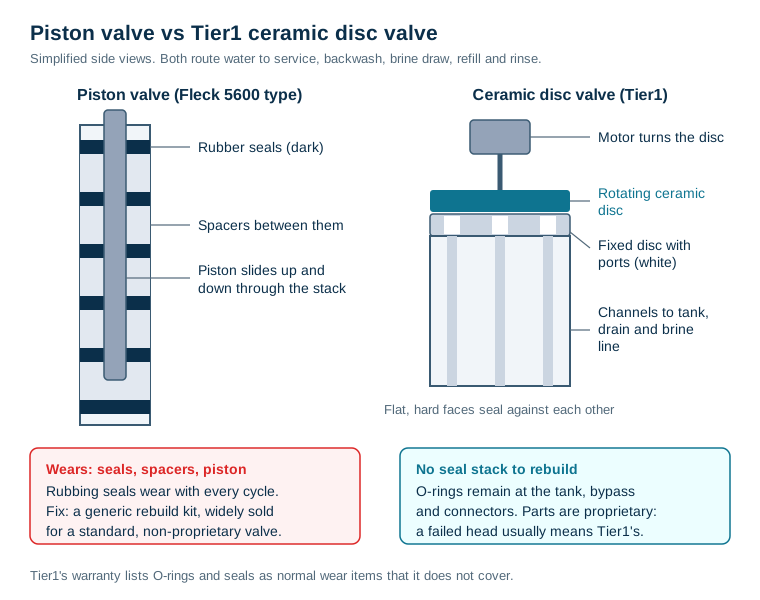
A piston valve, such as the Fleck 5600, slides a piston up and down a bore lined with alternating rubber seals and spacers. Each stop opens a different set of ports. The seals rub on every move, and in time they wear, especially on gritty or iron-bearing water. The fix is a seal and spacer kit, which is cheap and sold everywhere because the Fleck valve is used by many brands.
Tier1's ceramic-disc valve turns a ceramic disc against a fixed ceramic disc with ports cut through it. The motor rotates the moving disc to each position, and the openings line up to send water to the resin tank, the drain or the brine line. The two faces are hard and flat, and they seal against each other rather than relying on compressed rubber. The manual describes the display reading "-00-" while the motor "positions the ceramic discs" between stages.
What that means for an owner:
- No seal stack to rebuild. Tier1 says the valve is designed to last "with no need for seals, spacers or piston rebuild kits". There is nothing equivalent to a Fleck seal kit to buy.
- O-rings still exist. The master O-ring at the tank, the bypass O-rings and the connector O-rings are ordinary rubber parts. The warranty lists "O-rings, seals" as normal wear items it does not cover.
- The valve is proprietary. A Fleck 5600 can be repaired by almost any water-treatment dealer from generic parts. A Tier1 head is repaired with Tier1 parts and Tier1's phone support. If you value repairability by anyone, that matters more than the absence of a seal kit.
- Sediment still needs stopping. The manual says a filter "should be installed before the softening system" when turbidity is moderate to high, and recommends a pre-filter above 5 FTU. The Amazon listings say a sediment pre-filter is included with the two-tank models.
Capacity at Real Salt Settings
Tier1 names each model after the conventional 32,000 grains per cubic foot of resin. That figure applies only at a heavy salt dose. Tier1's own manual tells installers to plan on less: "To figure capacity, multiply the total resin volume multiplied by .75", with the worked example "(48,000 x .75) ÷ 15 = 2400 gallons" for 1.5 cubic feet at 15 gpg.
Here is each model restated three ways:
| Model | Resin | Label | At 6 lb salt per cu ft | Tier1's 75% planning figure | At 15 lb per cu ft |
|---|---|---|---|---|---|
| 24,000 compact or cabinet | 0.75 cu ft | 24,000 | ~15,750 | 18,000 | ~23,250 |
| 32,000 | 1.0 cu ft | 32,000 | ~21,000 | 24,000 | ~31,000 |
| 48,000 | 1.5 cu ft | 48,000 | ~31,500 | 36,000 | ~46,500 |
| 64,000 | 2.0 cu ft | 64,000 | ~42,000 | 48,000 | ~62,000 |
The 6 lb and 15 lb columns use standard resin performance of about 21,000 and 31,000 grains per cubic foot, as set out in advertised vs usable softener capacity.
The 48,000-grain manual's defaults sit between those columns. It recommends a brine refill of 5 gallons for the 10 x 54 system and notes that "1 gal water dissolves 3lbs of salt", so each regeneration uses about 15 lb of salt, or 10 lb per cubic foot. That restores roughly 27,000 grains per cubic foot, or about 40,000 grains in total. The default regeneration takes about two hours, starting at 2 a.m., with a 10-minute backwash, a 60-minute brine and slow rinse, a 5-minute refill and a 10-minute fast rinse.
Size a Tier1 the way its manual does: on the 75 percent figure, or on the 6 lb figure if you want to use less salt. A family of four on 15 gpg water uses about 4,500 grains a day. A 48,000-grain Tier1 at 36,000 grains regenerates about every eight days. A 32,000-grain model at 24,000 grains regenerates about every five days.
The Operating Limits in the Manual
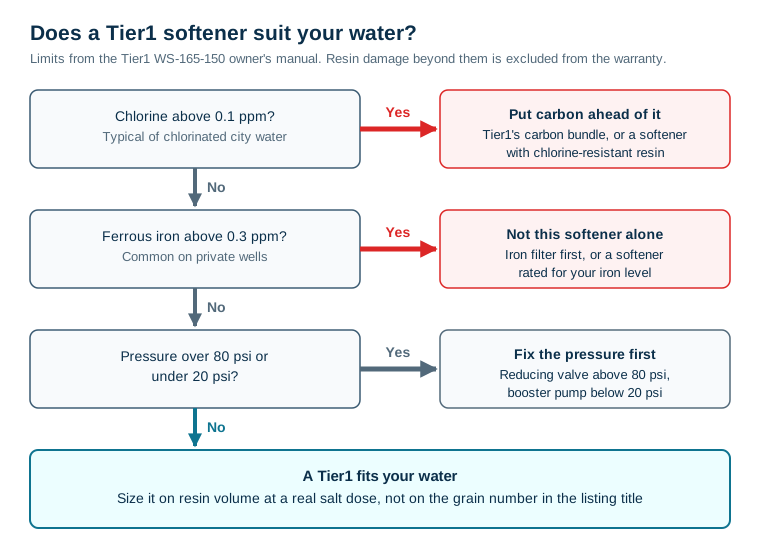
The WS-165-150 manual lists the conditions the softener is designed for. Three of them rule out a lot of homes.
| Condition | Tier1 manual | What it means |
|---|---|---|
| Chlorine | Below 0.1 ppm | Most chlorinated city water carries more |
| Ferrous iron | Below 0.3 ppm | Many private wells carry more |
| Turbidity | Below 5 FTU | Above that, fit a pre-filter |
| Pressure | 21 to 120 psi; pressure valve above 80 psi, booster pump below 20 psi | The store lists 20 to 87 psi |
| Water temperature | 40 to 120°F | The care section says never above 110°F |
These are not just efficiency notes. The Everyday Series warranty excludes "water softener resin degradation from iron, manganese, chlorine, or chloramines" above the operating parameters. Chlorine attacks standard 8 percent crosslink resin over time, as explained in how chlorine damages softener resin. The usual answers are a carbon filter ahead of the softener or a 10 percent crosslink resin, a choice Tier1 does not offer in its Everyday Series. Tier1 sells its 32,000 and 48,000-grain softeners in bundles with chlorine or chloramine carbon filters.
The Warranty, Quoted
Tier1's listings lead with "10-year tank warranty". The Everyday Series warranty document sets out what that covers:
- Fiberglass resin tank and brine tank: 10 years.
- Control valve, bypass, fittings and electronic components: 1 year.
- Extension: register the softener, and each year's "purchase and use of four (4) bottles of TIER1-WS-CLNSR-16 Water Softener Cleaner within one (1) year" extends the valve and electronics cover by one more year, up to five years in total. Proof of purchase is needed each year.
- Not covered: "Labor necessary to maintain the product", normal wear parts such as "O-rings, seals, or filter media", and damage from "neglect, misuse, alterations, accident, physical damage".
There is an inconsistency to note. The warranty and the Amazon listings call for one bottle every three months. The WS-165-150-BLK installation manual tells owners to pour a bottle into the brine well "every four months". If you want the extension, follow the warranty document: four bottles a year, with receipts.
The cost is easy to work out: multiply the bottles below by the current price of the cleaner on DiscountFilterStore.com.
| To keep the valve covered for | Bottles to buy |
|---|---|
| 1 year | 0 |
| 2 years | 4 |
| 3 years | 8 |
| 5 years | 16 |
So five years of valve cover costs 16 bottles of cleaner, plus the discipline to keep every receipt. Whether that beats self-insuring depends on what a replacement Tier1 valve head costs, which we could not find listed. On iron-bearing water a resin cleaner does real work. On clean city water behind a carbon filter, its main value is the warranty. Our guide to reading a water softener warranty covers conditional extensions like this one.
Installation and Day-to-Day Use
The two-tank models install at the main water line and need a 120 V outlet and a drain. The manual calls for an air gap between the end of the drain hose and the drain, so sewer water cannot flow back, and for "all plumbing and electrical work" to be done by an accredited professional to meet local codes. Plastic connections are hand-tightened first.
Day to day, the brine tank takes 40 lb of salt minimum and 120 lb maximum. Tier1 asks for softener salt at least 99.5 percent pure and says not to use small-grain salt. The metered valve counts gallons through an impeller in the bypass outlet and regenerates at the set time once the programmed capacity is used. It also forces a regeneration every 30 days if no water is used. Watch for salt bridging in humid basements; the manual's fix is to break it up, let the unit use up the salt, clean the tank and manually regenerate.
On Amazon, owner ratings were 4.2 out of 5 for the 48,000-grain listing (309 ratings) and 3.7 for the 32,000-grain listing (58 ratings) on 2 October 2026. Those are small samples and say nothing about long-term valve life.
Who the Tier1 Softener Is Wrong For
- Chlorinated city water without a carbon filter. The manual's 0.1 ppm limit and the warranty's resin exclusion make this the most common wrong buy. Buy the bundle or add carbon.
- Wells with iron above 0.3 ppm. That is a low limit. Iron at 1 to 3 ppm needs a softener built for it or an iron filter ahead.
- Owners who will not keep the cleaner schedule. Without it, the valve and electronics are covered for one year.
- Buyers who want repairs from any local dealer. The ceramic valve has no seal kit to wear out, but it is also not a generic part.
- Anyone who needs an NSF-certified system. We found no Tier1 softener listed under the brand on NSF's register.
- Homes that do not need softening at all. If scale is the only complaint and you would rather avoid salt, start with salt-based vs salt-free water treatment.
For a home on low-chlorine or carbon-filtered water with little iron, a Tier1 Everyday softener is a good-value metered unit with a valve that should not need rebuilding. Size it on Tier1's own 75 percent figure, not the title, and decide on day one whether you will buy the cleaner that keeps the valve covered.
Frequently Asked Questions
Who makes Tier1 water softeners?
Tier1 is a registered trademark of US Water Filters, Inc. of Zumbrota, Minnesota, according to the Tier1 owner's manual. The Everyday Series warranty names US Water Filters as warrantor. The softeners are sold through DiscountFilterStore.com, Tier1's Amazon brand store and some home-improvement retailers.
What is the warranty on a Tier1 water softener?
Ten years on the fiberglass resin tank and the brine tank, and one year on the control valve, bypass, fittings and electronics. The one-year cover extends by a year at a time, up to five years in total, if you register the softener and buy and use four bottles of Tier1 TIER1-WS-CLNSR-16 cleaner each year. Labor, O-rings, seals and resin damaged by iron or chlorine above the operating limits are not covered.
Does the Tier1 ceramic valve ever need rebuilding?
Tier1 says the patented ceramic-disc valve needs no seals, spacers or piston rebuild kits, because two hard ceramic discs seal against each other instead of rubber seals sliding on a piston. It still has O-rings at the tank, bypass and connectors, and the warranty treats O-rings and seals as normal wear items. If the valve head itself fails after the first year, the repair is a Tier1 part rather than a generic kit.
Can a Tier1 water softener be used on city water with chlorine?
Only with care. The Tier1 WS-165-150 manual lists chlorine below 0.1 ppm as an inlet water condition, and the warranty excludes resin damage from chlorine or chloramine above the operating parameters. Most chlorinated city water carries more than that, so plan for a carbon filter ahead of the softener. Tier1 also sells its softeners bundled with carbon filters.
Is a Tier1 48,000 grain softener really 48,000 grains?
Only at a heavy salt dose. It holds 1.5 cubic feet of 8 percent crosslink resin. At an efficient 6 lb of salt per cubic foot that resin gives about 31,500 grains, and Tier1's own manual tells you to program capacity at 75 percent of the rating, or 36,000 grains. Its default brine refill of 5 gallons dissolves about 15 lb of salt, which restores roughly 40,000 grains.
