
Does a Water Softener Need Backflow Protection?
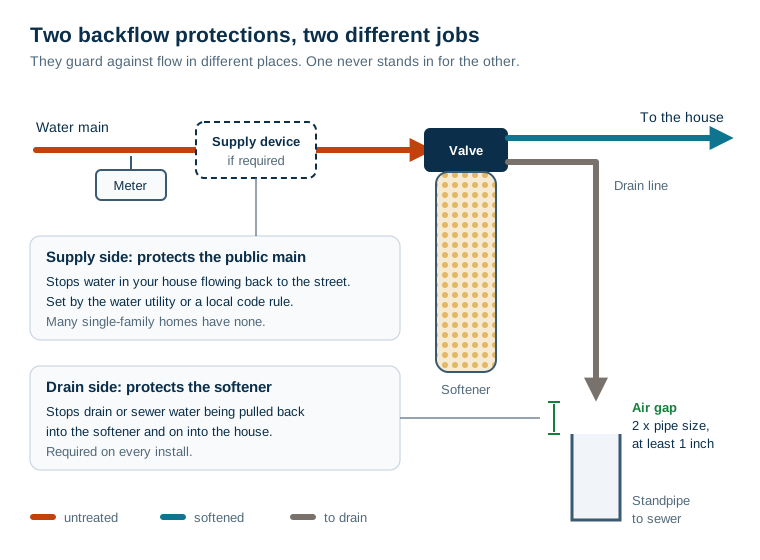
Water softener backflow prevention is two separate jobs that get treated as one. Every softener needs protection on its drain, and that job is done by an air gap, where the drain line ends in open air above the receptor. A mechanical device on the supply side is a different requirement that applies only where your water utility or a local code amendment demands it.
Most confusion, most failed inspections and most unnecessary parts come from mixing those two up. This guide separates them, shows when each applies, and explains how to find out what your own jurisdiction will actually ask for.
Water Softener Backflow Prevention Is Two Separate Jobs
A softener sits at a junction between three kinds of water: the supply coming in, the treated water going to the house, and the waste leaving through its drain line during every regeneration. Backflow can threaten that junction from two directions.
| Drain-side air gap | Supply-side device | |
|---|---|---|
| What it protects | The softener, and through it your household water | The public water main and your neighbours |
| What it stops | Drain or sewer water being drawn back up the drain line | Water from your house flowing back into the street supply |
| Is it a valve? | No. It is a physical gap of open air | Yes. A dual check, double check assembly or reduced pressure assembly |
| Who requires it | Manufacturers and plumbing codes, on every installation | The water utility or a local code rule, only in some places |
| Can it fail? | Only if someone closes the gap | Yes: springs, seats and seals wear, and testable assemblies need inspection |
The drain side is the one that matters on every installation, because that is where the softener is physically connected to something dirty. The supply side is about the utility protecting its system from you, and it depends entirely on local rules.
What Backflow Could Actually Reach a Softener
The EPA's Cross-Connection Control Manual describes two ways water ends up flowing backwards:
- Backsiphonage is backflow caused by negative pressure in the supply pipes. A water main break, a fire department drawing heavily from a hydrant, or a well pump losing prime can drop pressure below atmospheric and turn every open connection into a siphon.
- Backpressure is backflow caused by the downstream side being at higher pressure than the supply, which pushes water the wrong way.
Apply that to a softener. During regeneration the control valve opens a path from the resin tank to the drain line. If supply pressure collapses at that moment, and the end of the drain line is sitting in water, the softener can siphon that water back through the drain port into the mineral tank. A blocked standpipe or a floor drain backing up is exactly the kind of water you do not want there.
On the supply side, the concern runs the other way. Brine from the salt tank, drain water pulled in as above, or anything else in your house plumbing could in theory be pushed or siphoned back to the main. Whether the utility treats a softener as a hazard worth guarding against is its call, not the homeowner's.
Protection 1: The Drain Air Gap
An air gap is the simplest backflow preventer that exists: the drain line stops, there is open air, and then the receptor begins. Nothing can be siphoned across air.
How big it must be. The EPA manual states that the air gap must be twice the supply pipe diameter but never less than one inch. Pentair's Fleck 5600SXT service manual gives the same rule for the softener drain specifically: an air gap of twice the drain line diameter, with a one-inch minimum, "to prevent back flow of drain water into the system."
| Drain line size | Minimum air gap |
|---|---|
| 1/2 inch | 1 inch (the minimum applies) |
| 5/8 inch | 1-1/4 inches |
| 3/4 inch | 1-1/2 inches |
Where you measure it. From the open end of the drain tube down to the flood rim of whatever receives it: the top of a standpipe, the rim of a laundry tub, or the top of a floor drain's hub. It is not measured to the water surface inside the standpipe.
Air gap versus air break. An air break is a lesser arrangement where the drain tube ends inside the receptor, below its rim, but above the trap seal. It stops the receptor's contents being siphoned under normal conditions but can be flooded if the receptor backs up. Softener manufacturers ask for a true air gap, and that is what you should plan for unless your local code explicitly allows otherwise.
The details of fittings, heights and termination choices are covered in why a water softener drain needs an air gap. The point here is simpler: the air gap is the backflow protection for the softener's own cross-connection, and no supply-side device replaces it.
How Air Gaps Get Defeated
An air gap cannot wear out, but it can be removed by anyone with a roll of tape. The EPA manual is blunt about the usual cause: excessive splash leads someone to "thrust the supply pipe into the receiving funnel," and the air gap is gone.
The common versions on softener installs:
- Hose pushed down into the standpipe to stop it spraying during backwash.
- Hose taped or cable-tied to the standpipe so the end sits below the rim.
- Drain line joined to the brine tank overflow with a tee, which ties the gravity overflow to a pressurised discharge and can send drain water back into the salt tank.
- Hose run into a laundry tub and left lying in the bowl, so the end sits in water whenever the tub fills.
- A standpipe that is slow or partly blocked, so the water level rises above the end of the drain tube during a regeneration.
If splashing is the problem, the fix is a purpose-made air gap fitting, a larger or taller receptor, or checking whether the drain flow control is sized correctly. It is never lowering the tube.
Protection 2: A Supply-Side Device, and When One Applies
Utilities control backflow into their mains through cross-connection control programs. The EPA manual describes the containment approach, where a device at the service connection isolates a customer from the water main. It states plainly that containment "does not protect the customer within his building"; its purpose is to protect the public supply.
That distinction answers the most common question. A supply-side device at the meter or ahead of the softener is not there to protect your softener or your drinking water. It is there because the utility, or your local code, has decided your premises need to be isolated from the main.
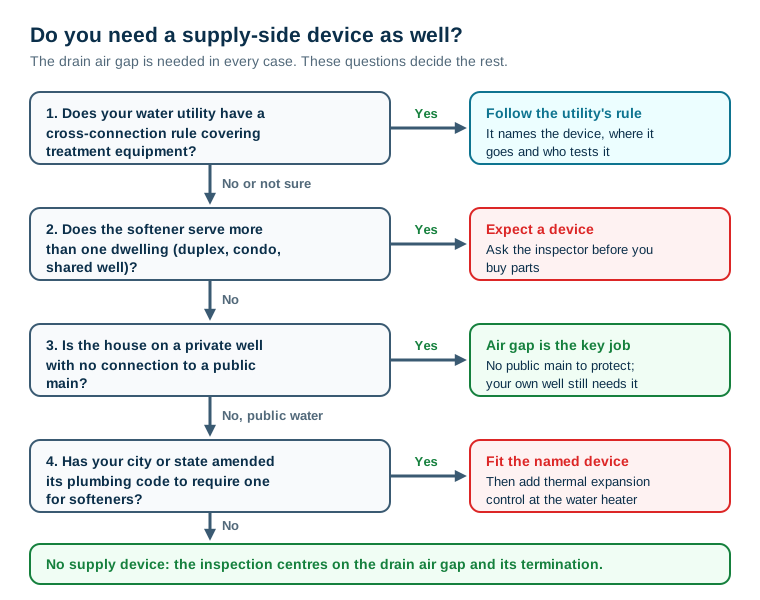
When a supply-side device is more likely:
- Your utility's cross-connection rules list water treatment equipment. Some utilities do, and some ask for a device at the meter for any home with a softener, irrigation system or boiler. The rule names the device type.
- The softener serves more than one dwelling. A duplex, a small condo building or several houses on one well is a shared system, and shared systems draw more scrutiny because one household's backflow reaches the others.
- Your city or state has amended its plumbing code. Model codes are adopted with local changes, and a softener-specific requirement can arrive that way.
When one is usually not needed: a single-family house on its own well, or on public water where neither the utility nor the local code asks for one. The International Residential Code's general rule in section P2902 is that a potable supply must be protected from contamination and that cross-connections are prohibited unless approved backflow protection is installed. On a softener, the approved protection for the one real cross-connection, the drain, is the air gap.
Device types you may see named: a dual check backflow preventer (ASSE 1024), a double check valve assembly (ASSE 1015) or a reduced pressure principle assembly for higher hazards. These are listed with their standards in the IRC's backflow table. A plain check valve from a hardware store is not one of them.
A Supply Device Turns Your Plumbing Into a Closed System
This is the consequence most often missed. Any check-type device on the supply, including a dual check at the meter or a pressure-reducing valve with a built-in check, stops water flowing back toward the main. When the water heater heats a full tank, that water expands, and on a closed system it has nowhere to go.
The IRC deals with it directly. Section P2903.4.2 requires a device for controlling pressure wherever a backflow prevention device or check valve means thermal expansion raises the pressure on a system with storage water heating. In practice that is an expansion tank on the cold supply to the water heater.
Without it, pressure spikes every time the heater fires. The softener, which sits on that same closed system, sees every one of them, and the water heater's relief valve starts to drip. The full pressure picture, including why a pressure-reducing valve creates the same problem, is in water softener pressure requirements.
If you are told to fit a supply-side device, budget for the expansion tank at the same time.
How to Verify What Your Jurisdiction Requires
No national rule settles this, because backflow requirements come from three places that differ by location: the plumbing code your state adopted, local amendments to it, and your water utility's own cross-connection rules. Checking all three takes a few phone calls.
- Find the adopted code. Your state or city building department can tell you whether it uses the International Plumbing Code, the International Residential Code, the Uniform Plumbing Code, or its own, and which edition.
- Ask whether it has a softener-specific amendment. Ask directly: "Is there any requirement for backflow protection on a water softener, beyond the drain air gap?"
- Call the utility's cross-connection or backflow program. Most larger utilities have one, often under water quality. Ask whether a residential softener triggers a containment device at the meter, which device, and who tests it.
- Ask about the permit. Whether the job needs a permit at all, and what the inspection covers, is covered in do you need a permit for a water softener.
- Write down names and dates. If the answers conflict, the stricter one normally governs, and a note of who told you what is useful at inspection.
On a private well, the utility step drops out. Ask the county health department or building department instead, especially if the well serves more than one home.
What an Inspector Will Actually Look At
Inspectors do not test backflow on a softener with instruments. They look at the drain termination and at any device the local rules require.
| What they check | What passes | What commonly fails |
|---|---|---|
| Drain line termination | Tube ends in open air above an approved receptor | Tube pushed into the standpipe, taped to it, or lying in a tub |
| Air gap size | At least twice the tube diameter, one inch minimum | A gap of a few millimetres, or none |
| Receptor | Standpipe, floor drain or laundry tub able to take the backwash flow | A receptor that overflows during backwash |
| Brine tank overflow | Its own gravity line to its own air gap | Overflow teed into the softener drain line |
| Drain line itself | Correct size and secured so the end cannot move | Undersized line, or an end free to fall into the drain |
| Supply-side device, if required | The named device, accessible, installed the right way round | Wrong device, or a device with no expansion control downstream |
The drain line's own sizing and routing rules, including the Fleck requirement for 3/4-inch line on long runs or high backwash flows, are covered in water softener drain line requirements.
What Backflow Protection Does Not Do
- It does not make your water safe to drink. Backflow protection stops contamination travelling backwards. It does nothing about what is already in the supply. A softener removes hardness; it is not a treatment for bacteria, nitrate or lead.
- An air gap does not stop the brine tank overflowing. It protects the drain connection only. A stuck float or a valve stuck in refill still needs a working overflow line.
- A supply-side device does not protect your household water. As the EPA manual notes, containment protects the public supply, not the people inside the building.
- Neither protection stops a leak. A cracked valve body or a failed bypass still floods the floor.
Put simply: every softener needs the drain air gap, installed and left alone. Whether it also needs a device on the supply depends on your utility and your local code, so ask before you buy parts, and if the answer is yes, plan for thermal expansion control in the same job.
Frequently Asked Questions
Does a water softener need a backflow preventer?
It needs backflow protection on its drain in every case, and that protection is an air gap: the drain line ends in open air above the standpipe or floor drain. A mechanical backflow preventer on the supply side is a separate requirement that applies only where your water utility's cross-connection rules or a local code amendment call for one. Many single-family homes on public water have no supply-side device at the softener.
How big does a water softener drain air gap need to be?
At least twice the diameter of the drain line and never less than one inch. That is the rule in the EPA's Cross-Connection Control Manual and it matches the Fleck 5600SXT installation instructions. A half-inch drain line therefore needs a one-inch gap, and a three-quarter-inch line needs a one-and-a-half-inch gap, measured from the end of the tube to the flood rim of the receptor.
Can I push my softener drain hose down into the standpipe?
No. Pushing the hose below the rim of the standpipe removes the air gap, which is the only thing stopping drain water being pulled back into the softener when supply pressure drops. The EPA manual singles this out as the usual way an air gap gets defeated, often to stop splashing. Fix splashing with a proper air gap fitting or a larger receptor, not by lowering the hose.
Is a check valve enough backflow protection for a water softener?
A plain check valve is not an approved backflow preventer, and it does nothing for the drain side, which is where the softener's real cross-connection is. If your utility requires supply-side protection, it will name an approved device, often a dual check or a testable assembly. Any check-type device also closes the plumbing system, so thermal expansion control at the water heater becomes necessary.
Does a softener on a private well need backflow protection?
Yes, on the drain. The air gap protects your own well water, your pressure tank and your household plumbing from whatever is in the drain or septic line, and that risk does not depend on a public main. A supply-side containment device is rarely required on a well that serves one house, but a well shared by several homes is often treated like a small public system, so ask the local health or building department.
Will an inspector check backflow on a water softener installation?
Where a permit is required, the inspector will look at the drain termination first: an open air gap of the right size, a drain line that is not taped, clamped or pushed into the receptor, and a separate brine tank overflow. If your utility or local code requires a supply-side device, they will check that the specified device is installed, accessible, and followed by thermal expansion control.
