
Softener Brine Restrictions and Drought Rules
Most water softener restrictions in the US are local, and most of the country has none. Where they exist, they target salt-based softeners that regenerate at home and discharge brine. They range from voluntary salt-reduction programs, through efficiency conditions and septic backwash bans, to local bans on new units and, in one California district, removal of existing ones. The reason is always chloride.
This page sorts the rules into five types, quotes the laws behind the best-known ones, and ends with how to check your own address and what you can install if you are restricted.
Why Water Softener Restrictions Exist
Every pound of salt that goes into a softener's brine tank ends up in the wastewater. The chloride leaves in the regeneration discharge, and conventional sewage treatment does not remove it. The Minnesota Pollution Control Agency says softener brine goes to treatment plants "that are not designed to remove salt." The full path, including the septic side, is traced in where water softener regeneration waste goes.
That creates a problem for a sewer district whose discharge permit limits chloride. Its effluent may go to a stream with a chloride limit, recharge an aquifer used for drinking water, or be reused for irrigation. When the limit is reached, the district can either build salt-removal treatment or cut the salt coming in. Madison Metropolitan Sewerage District in Wisconsin put the first option at more than $400 million on its chloride page and chose source reduction.
Residential softeners are one of the few salt sources a district can act on directly. That is where the restrictions come from.
Five Kinds of Water Softener Restriction
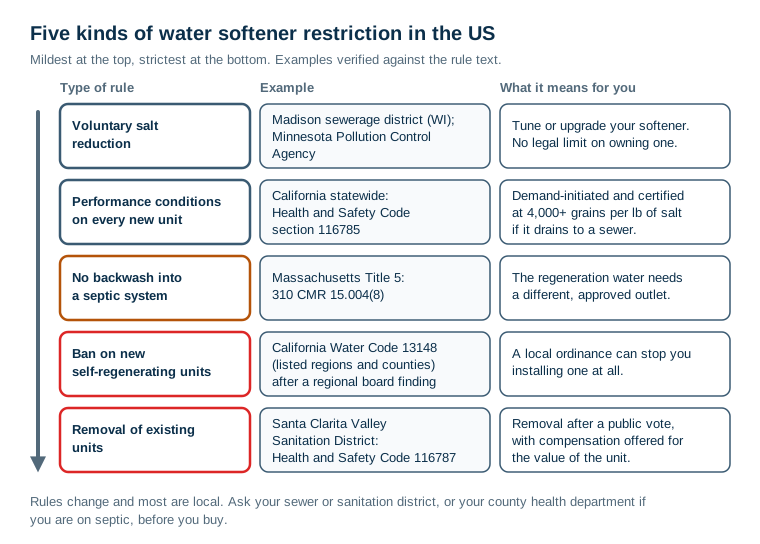
The rules fall into five broad types, and they differ a lot in what they mean for a homeowner.
| Type | What it does | Example |
|---|---|---|
| 1. Voluntary salt reduction | Encourages owners to tune settings or replace old, inefficient units, sometimes with rebates | Madison MMSD (Wisconsin); Minnesota Pollution Control Agency |
| 2. Performance conditions | Allows softeners but sets minimum efficiency and control standards | California statewide, Health and Safety Code 116785 |
| 3. No discharge to on-site systems | Bars softener backwash from septic, so it needs another approved outlet | Massachusetts Title 5, 310 CMR 15.004(8) |
| 4. Ban on new self-regenerating units | Prohibits installing new salt-discharging softeners | Local ordinances under California Water Code 13148 |
| 5. Removal of existing units | Requires existing units to be taken out, with compensation | Santa Clarita Valley Sanitation District, Health and Safety Code 116787 |
Types 1 and 2 cover most of the places where anything applies. Types 4 and 5 are rare and concentrated in California.
California: The Most Developed Rules
California has written more softener law than any other state, in three layers.
Layer 1: statewide conditions. Health and Safety Code section 116785 says a residential softener may be installed only if one of two things applies:
- it regenerates "at a nonresidential facility separate from the location of the residence", which is how portable exchange service works, or
- it discharges to a community sewer and meets three conditions. Regeneration must be demand-initiated, not on a fixed timer. Its salt efficiency must be certified by a third party at no less than 3,350 grains of hardness per pound of salt for units installed from 2000, and 4,000 grains per pound for units installed after January 1, 2002. And water conservation devices, such as faucet and shower head flow restrictors, must be installed on fixtures using softened water, with some exceptions.
That last condition is the state's drought link. The softener is allowed, but only alongside fixtures that cut the water it treats.
Layer 2: local limits. Section 116786 lets a local agency limit or prohibit softeners discharging to its sewer if it finds this is necessary to meet its waste discharge or water reclamation requirements. It must back that with an independent salinity study and show it has already limited salt from commercial and industrial sources. Any ordinance is prospective, and it cannot require removal of units already installed.
In 2009 the legislature added Water Code section 13148. It applies to agencies running community sewers or water recycling facilities in the Central Coast, South Coast, San Joaquin River and Tulare Lake hydrologic regions and in Butte, Glenn, Placer, Sacramento, Solano, Sutter and Yolo counties. After a regional water board finds that controlling salinity will help meet water quality objectives, such an agency may:
- require the highest-efficiency certified softeners commercially available
- require a plumbing permit before installation
- restrict softeners to the hot water supply only
- run voluntary buy-back or exchange programs
- require retrofits or replacement with more efficient units
- prohibit new installations
- require removal of existing units, with compensation for their reasonable value
Layer 3: removal. One district got its own law. That is the next section.
Santa Clarita Valley: What a Removal Program Looks Like
The Santa Clarita Valley Sanitation District, in northern Los Angeles County, is the best-known example of a US district removing existing softeners. The enabling law was SB 475, now Health and Safety Code section 116787. Its conditions show how high the bar is:
- Findings first. The district had to show removal was "necessary and cost-effective" compared with the alternatives, including advanced salt-removal treatment, and assess its earlier voluntary program.
- A public vote. The ordinance needed "approval by a majority vote of the qualified votes cast" in the district's service area. Voter materials had to include projected cost comparisons.
- Compensation. Before the ordinance took effect, the district had to offer owners "100 percent of the reasonable value" of a removed unit plus removal costs. After it took effect, compensation dropped to 75 percent.
- Scope. The law defines the targeted appliances as residential self-regenerating softeners that discharge brine into the community sewer. Exchange tanks and salt-free conditioners were outside it.
If you live somewhere a removal program is being discussed, those are the questions to ask: what the alternative treatment would cost, whether there will be a vote, and what compensation is offered.
Septic-Side Rules: Massachusetts and County Health Departments
Homes on septic answer to a different authority: the state onsite wastewater code and the county or local health department that permits septic systems.
The clearest statewide example is Massachusetts. Its Title 5 septic code, at 310 CMR 15.004(8), says: "Backwash of water purification or filtration devices shall not be discharged to an on-site system." A softener's regeneration water is backwash under that wording, so it needs a different approved outlet.
Elsewhere the rules vary by county. Some allow softener discharge into a septic tank, some want it kept out of certain advanced treatment units, and some regulate the alternatives, such as dry wells. Whether softener brine actually harms a septic system is a separate question from whether it is allowed. The research mostly clears efficient softeners, but the county's rule decides.
Voluntary Programs in Wisconsin and Minnesota
Most places concerned about chloride do not ban anything. They ask.
- Madison, Wisconsin. The sewerage district asks residents and businesses to reduce salt through water softener optimization and blending valves. Its reasoning is that the plant is not designed to remove chloride, so every pound kept out of the sewer is a pound kept out of the streams.
- Minnesota. The Pollution Control Agency names water softeners as the second major source of chloride after road salt and reports that 50 of the state's water bodies exceed the chloride standard for aquatic life.
Voluntary programs sometimes come with rebates for replacing old timer softeners with efficient demand-initiated units. See water softener rebates and incentives for how those work and where to look.
Legal Options in a Restricted Area
If you are restricted, the options depend on which type of rule applies.
| Option | How it complies | Where it fits | What you give up |
|---|---|---|---|
| Portable exchange service | Tanks are regenerated at a central facility. California law explicitly allows this | Bans on self-regenerating units, removal areas, septic backwash bans | Ongoing service fees and delivery schedule |
| Certified high-efficiency softener | Meets efficiency and control conditions | Performance-condition rules; some local ordinances | Still discharges brine, so not an option under an outright ban |
| Salt-free conditioner | Discharges no brine | Almost any restriction on salt discharge | Does not remove hardness. It reduces scale formation, and water still tests hard |
| Hot-water-only softening | Treats less water, so uses less salt | Where an agency adopts this measure under Water Code 13148 | Cold water stays hard |
| No treatment at the point of entry | Nothing to regulate | Everywhere | Scale and soap problems return |
The two most common choices are compared in portable exchange tank vs installed softener and salt-based vs salt-free water treatment.
How to Check the Rules Where You Live
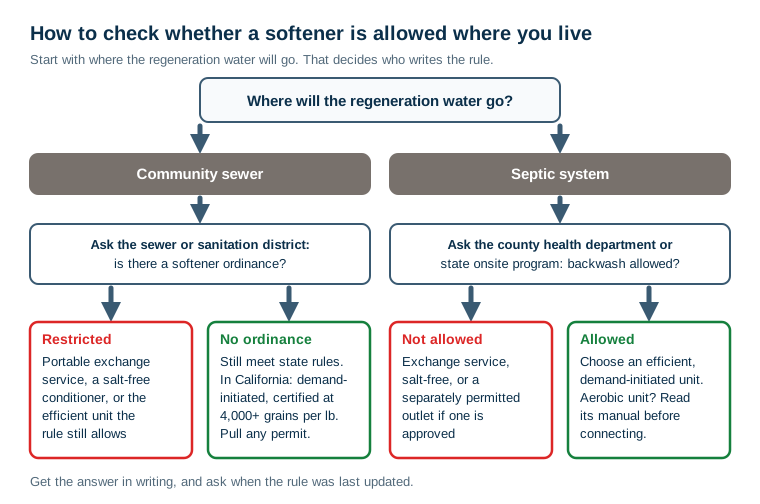
There is no national database of softener rules, and local ordinances change. Check before you buy, and especially before you sign a rental or financing contract.
- Find out where your drain goes. Sewer or septic. Your water and sewer bill will say if you pay for sewer service.
- On sewer, contact the sewer or sanitation district, not only the water utility. They are often different agencies, and the rule belongs to whoever runs the treatment plant. Ask whether there is an ordinance on self-regenerating water softeners, or a salt-reduction program.
- On septic, contact the county health department or the state onsite wastewater program. Ask whether softener backwash may go into your system and whether your permit says anything about it.
- Check your state's rules. In California, the statewide conditions in HSC 116785 apply wherever you are.
- Ask the building department about permits for the plumbing connection.
- Get the answer in writing and ask when the rule was last changed.
Dealers usually know the local rules, but they have an interest in the answer. Confirm with the agency.
What This Page Cannot Tell You
- It is not a complete list. Local ordinances exist in places not covered here, and new ones are adopted. The absence of your town from this page does not mean there is no rule.
- It is not legal advice. The laws are quoted as published. How they apply to your home is for the local agency to say.
- A softener cannot be made chloride-free. Potassium chloride reduces sodium in the discharge but still contains chloride. No household add-on removes chloride from the brine.
Water softener restrictions are narrower than they are often made to sound, and they are not arbitrary. They appear where a treatment plant has run out of room for chloride, and they tighten as that room shrinks.
Frequently Asked Questions
Are water softeners banned in California?
Not statewide. California allows residential softeners that regenerate off-site, or that drain to a sewer and meet conditions in Health and Safety Code section 116785, including demand-initiated regeneration and a certified salt efficiency of at least 4,000 grains per pound for units installed after 2002. Separately, Water Code section 13148 lets local sewer and recycling agencies in listed regions restrict or prohibit self-regenerating softeners after a regional water board finding. Santa Clarita Valley went further and required removal of existing units.
Why do some cities ban water softeners?
Because of chloride. A salt-based softener sends the chloride from its salt to the sewer during regeneration, and conventional treatment plants are not designed to remove it. When a plant's discharge exceeds chloride limits set to protect rivers, groundwater or recycled water, reducing salt at the source is far cheaper than adding treatment. Madison's sewerage district estimated chloride treatment would cost over $400 million.
Can I still use a portable exchange water softener where softeners are banned?
Usually yes. California's law explicitly allows softeners that regenerate at a separate nonresidential facility, and the definitions used in its restriction laws target appliances that discharge brine into the community sewer. An exchange tank is swapped and regenerated off-site. Check the wording of your local ordinance to be sure.
Are salt-free water conditioners allowed where softeners are restricted?
In general, yes, because they discharge no brine. The rules discussed here target salt-discharging, self-regenerating units. Be aware that salt-free conditioners do not remove hardness the way a softener does. They are designed to reduce scale, and hard water will still test hard.
Can a septic system take water softener discharge?
It depends on your state and county. Many allow it. Massachusetts does not: its Title 5 code, 310 CMR 15.004(8), states that backwash of water purification or filtration devices shall not be discharged to an on-site system. Ask your county health department or state onsite wastewater program before installing.
Do I need a permit to install a water softener?
Sometimes. Many areas require a plumbing permit for the connection to the water supply and drain. In California, Water Code section 13148 also lists requiring a plumbing permit among the measures a qualifying local agency can adopt. Check with your local building department and your sewer or sanitation district.
