
The Lifecycle Environmental Impact of a Water Softener
The water softener environmental impact that matters most is chloride. Every pound of salt a softener uses ends up in the wastewater, and conventional treatment cannot remove it, so it accumulates in rivers, lakes and aquifers. Regeneration water, salt production and end-of-life waste add smaller costs. On the other side, softening cuts scale-related energy loss in gas water heaters and extends appliance life. The balance depends on how hard your water is and where your drain goes.
Most pages on this topic pick a side. This one runs both sides of the ledger for one typical house, says where the numbers come from, and marks where the balance turns against the softener.
The House This Accounting Uses
One worked example keeps the numbers honest and comparable. It matches the house used in the total cost of owning a water softener, so the money and environmental figures line up.
- Household: four people, 240 gallons a day of indoor water
- Hardness: 15 grains per gallon
- Softener: metered, demand-initiated, reasonably efficient at 3,000 grains of hardness removed per pound of salt
- Regeneration water: 4 gallons per 1,000 grains removed
- Water heater: gas storage
From those inputs, one year of softening removes 15 × 240 × 365 = 1,314,000 grains of hardness. The rest follows by arithmetic. All figures are calculated, not measured, and yours will differ.
Water Softener Environmental Impact, Stage by Stage
Stage 1: Making and delivering the salt
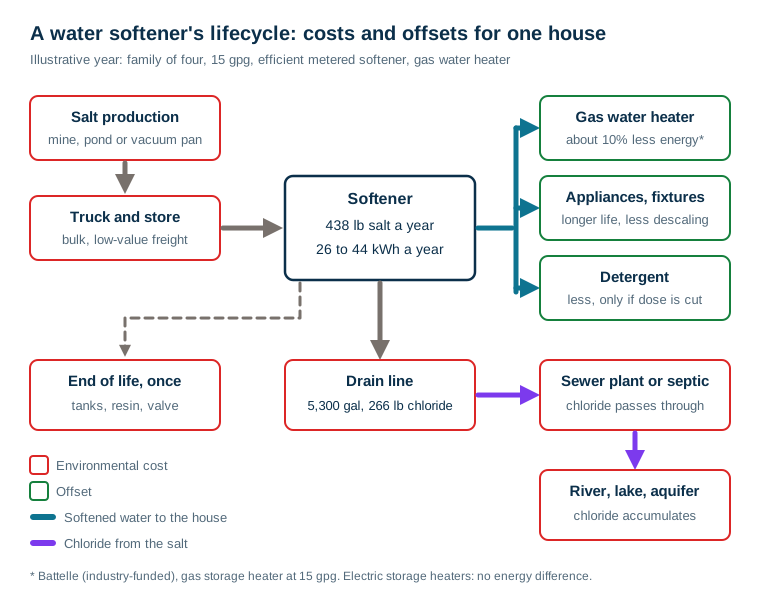
The house above uses about 438 pounds of salt a year, around eleven 40 lb bags. That salt is mined as rock salt, evaporated by the sun in coastal or desert ponds, or evaporated with fuel from pumped brine in vacuum pans. The last route uses the most energy. All three are trucked to a store and then home.
We have found no published lifecycle assessment that puts a reliable carbon figure on softener salt specifically, so this page does not invent one. What can be said is that it is a bulk, low-value product moved by truck, and that evaporated pellets carry more production energy than solar salt or rock salt.
Stage 2: Running it: water and electricity
- Regeneration water: 1,314 × 4 = about 5,300 gallons a year to the drain. That is roughly 6 percent of the household's 87,600 gallons of indoor use. EPA WaterSense says inefficient softeners can use 25 gallons a day or more and up to 10,000 gallons a year, so a timer unit or a wrong hardness setting can double the figure.
- Electricity: a control valve draws a few watts, about 26 to 44 kWh a year. It is the smallest line on the ledger.
Stage 3: What goes down the drain
This is the stage that decides the outcome. Salt is 60.7 percent chloride by weight, so 438 pounds of salt carries about 266 pounds of chloride a year into the sewer or septic system.
None of it is removed on the way. The Minnesota Pollution Control Agency's chloride page says softener brine drains to "municipal wastewater treatment plants that are not designed to remove salt from wastewater, so the salt passes through to a lake or stream." On septic, it moves down through the drainfield toward groundwater. The full path is traced in where water softener regeneration waste goes.
To put 266 pounds in context: EPA's chronic aquatic-life criterion for chloride in fresh water is 230 mg/L. Dissolved to exactly that level, 266 pounds of chloride would bring about 138,000 gallons of fresh water up to the limit, every year, from one house. MPCA's shorter version is that one teaspoon of salt permanently pollutes five gallons of water.
It matters because chloride does not break down. MPCA reports that 50 Minnesota lakes and streams already exceed the standard that protects fish and aquatic life, with 75 more close to it. Nationally, a 2018 study in PNAS, Freshwater salinization syndrome on a continental scale, found increasing specific conductance, a measure of dissolved salts, at 39 percent of the 232 US river sites it examined. It names road salt as a major driver and lists wastewater and water reuse among the sources. Softeners are one contributor among several, not the main one nationally, but they are a large one in some sewersheds.
Stage 4: End of life
A softener eventually leaves as a fiberglass-wrapped resin tank, a plastic brine tank, spent resin beads, a control valve with electronics and some brass fittings. Most of it goes to landfill or bulky waste. The brass and copper can be scrapped, the electronics recycled, and a sound tank and valve can be kept in service by replacing only the resin. Spread over the unit's working life, this is a small line compared with a decade of chloride.
The Other Side of the Ledger
A fair accounting also counts what softened water saves. These benefits are real, but each one depends on something about the house.
Water heating energy. The best measurement comes from Battelle, in a 2009 study funded by the Water Quality Research Foundation, the research arm of the water treatment industry. Its executive summary estimates life-cycle energy cost savings for gas storage heaters on softened water of 3.1 percent at 5 gpg, 10.3 percent at 15 gpg and 19.0 percent at 25 gpg. For electric storage heaters it recorded no difference in electricity use. So the energy offset is real for gas heating, grows with hardness, and is zero for electric tanks. The industry funding does not make the result wrong, but it is worth knowing.
Appliance and fixture life. Scale shortens the life of heater elements, tankless heat exchangers, showerheads, kettles and dishwashers. Each replacement avoided is manufacturing and shipping avoided. This offset is hard to put a number on. It is largest for a house with a tankless heater that would otherwise need regular descaling.
Detergent and soap. Soft water needs less soap and detergent to do the same job. The environmental saving only happens if the household actually cuts the dose. Most do not, so this line is often zero in practice.
What is not an offset. Softening does not reduce total water use, does not improve drinking water safety, and does not replace any other treatment.
The Ledger at a Glance
For the example house, per year:
| Side | Item | Size | Confidence |
|---|---|---|---|
| Cost | Salt produced and trucked | About 438 lb | Calculated from inputs |
| Cost | Chloride to sewer or septic | About 266 lb, permanently | Calculated; chemistry is certain |
| Cost | Regeneration water | About 5,300 gallons | Calculated; doubles on a timer unit |
| Cost | Electricity | 26 to 44 kWh | Estimated |
| Cost | End-of-life waste | Tanks, resin, valve, once per unit life | Small per year |
| Offset | Gas water heater energy | About 10 percent of heating energy at 15 gpg | Industry-funded lab study |
| Offset | Appliance and fixture life | Fewer replacements and descaling jobs | Real but unquantified |
| Offset | Detergent | Zero unless dose is cut | Depends on behaviour |
The two sides are not in the same units, which is why honest pages avoid a single "net" number. Energy saved in a water heater does not cancel chloride in a trout stream. The useful question is where each side is large.
Where the Balance Tips Against the Softener
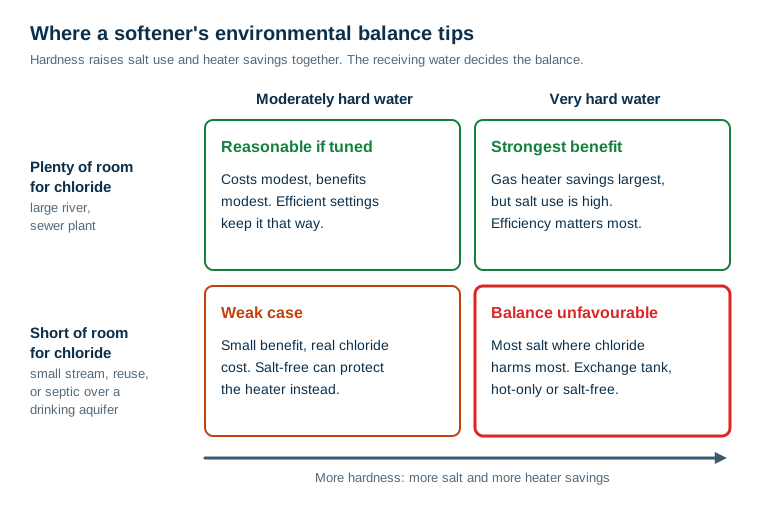
Two things decide it: how hard the water is, and how much room the local receiving water has for chloride.
Hardness raises both sides together. At 25 gpg a softener uses roughly two-thirds more salt than at 15 gpg, and it also saves more gas-heater energy. So hardness alone does not settle it.
The receiving water settles it. A treatment plant discharging to a large river has room for chloride. One discharging to a small stream, recharging an aquifer, or supplying recycled irrigation water may not. Madison Metropolitan Sewerage District in Wisconsin receives about 220,000 pounds of salt a day, mostly from softeners, operates under a chloride variance, and found that removing chloride at the plant would cost more than $400 million, according to its chloride reduction page. Arid regions that reuse wastewater are under the same pressure. That is where softener brine restrictions and drought rules come from.
So the balance is genuinely unfavourable in one combination: very hard water, served by a wastewater system that is already short of room for chloride, or by septic over an aquifer used for drinking water. In that case the softener uses the most salt precisely where chloride does the most harm, and the heater benefit can usually be had another way. With an electric water heater the offset is smaller still.
Elsewhere the case is closer and depends on use. With moderately hard water, a gas heater and a well-tuned softener feeding a large river system, the costs are modest and the benefits real.
How to Shrink the Cost Side
Almost the entire cost side scales with salt, so the actions that matter all reduce salt.
- Set the hardness correctly. A setting above your actual hardness makes the softener regenerate more often. Test the raw water once a year.
- Use demand-initiated regeneration. A timer regenerates whether or not the resin is used up.
- Use an efficient salt dose. Lower salt settings remove more hardness per pound. Water softener salt efficiency shows how to find the setting.
- Keep outdoor taps off the softener. Softening lawn water spends salt for nothing.
- Soften only what needs it. Some households only need hot water softened, which cuts salt substantially.
- Consider the alternatives where the balance is unfavourable. A portable exchange tank moves regeneration to a central facility. A salt-free conditioner protects the water heater with no brine at all, though it will not change soap, spots or laundry.
Switching to potassium chloride removes sodium from the discharge but not chloride, so it does not fix the main problem.
What This Accounting Cannot Tell You
- There is no published cradle-to-grave study of household softeners that we could verify. This page assembles the parts from separate sources and arithmetic, and says so.
- Your numbers will differ. Hardness, household size, softener efficiency and heater type each move the result substantially.
- The heater benefit rests largely on one industry-funded study. It is the best available, but independent replication would strengthen it.
- A softener cannot treat its own brine. No household device removes chloride from the discharge.
The honest bottom line: a well-tuned softener on moderately hard water in a place with room for chloride has a modest footprint and real benefits. A badly tuned one on very hard water, draining to a stressed river or aquifer, is a clear environmental cost.
Frequently Asked Questions
Are water softeners bad for the environment?
Salt-based softeners have one significant environmental cost: the chloride from their salt, which passes through sewage treatment and septic systems into rivers, lakes and groundwater, where it accumulates. They also send regeneration water to the drain. Against that, they reduce scale-related energy loss in gas water heaters and extend appliance life. Where water is very hard and the local wastewater system discharges to a chloride-sensitive river or reuse system, the balance is unfavourable.
How much salt does a water softener put into the environment?
All of it. Whatever salt goes into the brine tank ends up in the wastewater, partly in regeneration brine and partly through the taps. A family of four on 15 gpg water with an efficient metered softener uses roughly 438 pounds of salt a year, about 266 pounds of which is chloride.
Is potassium chloride better for the environment than salt?
It reduces the sodium in the discharge, which helps soil and septic drainfields, but it still contains chloride, which is the main concern for rivers and aquifers. It also costs several times more. Using less of either salt, through efficient settings and a correct hardness setting, does more for the environment than switching salts.
Do water softeners waste a lot of water?
Some. EPA WaterSense says regeneration can use 25 gallons a day or more, up to 10,000 gallons a year, for inefficient units. An efficient metered softener in a typical house uses far less, around 5,000 gallons a year in the worked example on this page, which is roughly 6 percent of the household's indoor water use.
Are salt-free water conditioners more environmentally friendly?
They discharge no brine and use no water or salt, so their operating footprint is close to zero. The trade-off is that they do not remove hardness, so they give none of the soap, detergent or spotting benefits. Where the goal is only protecting a water heater, they are the lower-impact choice.
Can a water softener reduce my carbon footprint?
Possibly, if you heat water with gas. An industry-funded Battelle study found gas storage heaters on hard water lost efficiency as scale built up, with estimated energy savings from softening of 10.3 percent at 15 gpg. Electric storage heaters showed no difference in energy use. That benefit has to be set against the energy used to produce and deliver the salt.
