
Why Softener Salt Looks Brown or Dirty
When water softener salt looks dirty, the colour tells you which of two unrelated things you are looking at. Grey-brown grit is insoluble residue from the salt grade you bought and is expected. Orange or rust-coloured staining is iron arriving from the resin side, and that is a fault.
Confusing the two is easy and costly in both directions — cleaning the tank when the salt was simply cheap, or shrugging off staining when a fouled bed is quietly losing capacity.
The Two Explanations Are Not Related
Almost every article on this subject answers the question one way and stops. The useful version is a fork, because the two cases share nothing but the moment you notice them.
| Insoluble residue | Iron staining | |
|---|---|---|
| Colour | Grey, grey-brown, dull tan | Orange, rust, reddish-brown |
| Where | Mixed through the salt, heaviest at the floor | Stains the salt surface and the tank walls at the water line |
| Texture | Gritty, silty, sandy | Slimy or powdery; often a film rather than grains |
| Source | The bag you bought | The resin bed, travelling back up the brine line |
| Rate | Builds slowly over years | Appears within weeks of the underlying fault |
| Softening affected? | Not until it blocks the brine well | Yes — capacity is already falling |
| Correct response | Change salt grade, clean on a schedule | Investigate the bed and the raw water iron level |
What makes the iron case counter-intuitive. Water in the brine tank is supposed to travel in one direction during refill: from the valve, down the brine line, into the tank. Iron appearing in that tank means iron-bearing water is arriving through that same path — carried out of a bed so loaded with iron that the refill water itself is discoloured, or dragged back during the draw and refill transition.
The tell that separates them instantly. Insolubles are dispersed and the water in the tank stays roughly clear above them. Iron stains everything it touches, including the white plastic of the tank wall, and leaves a tidemark you can rub with a finger.
If the discolouration came with other symptoms — coloured water at the taps after a cycle, particles in the aerators — the investigation starts elsewhere, in why water turns brown after softener regeneration.
The Jar Test That Settles It
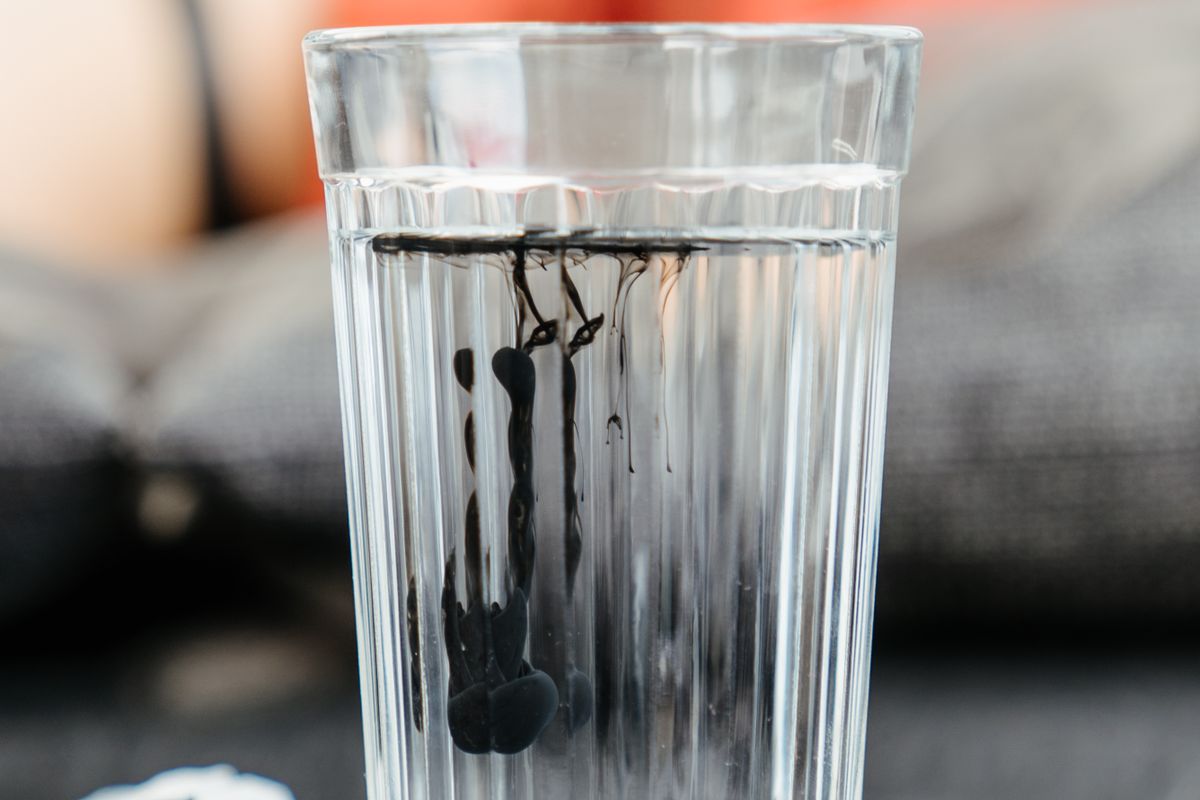
This takes twenty minutes and needs a jar. It is the closest thing to a definitive answer without a lab.
The procedure:
- Take a cup of salt straight from the bag, not from the tank. You are testing the supply, not the accumulation.
- Drop it into a clear jar of warm water — roughly four times as much water as salt, so it can fully dissolve.
- Shake for thirty seconds, then set it down somewhere it will not be knocked.
- Wait twenty minutes and look at the bottom and at the water above it.
- Repeat with a second grade if you have one. Side by side is far more informative than a single jar.
Reading the result:
| What you see | What it means |
|---|---|
| Water clear, trace of fine sediment | Evaporated pellets or cubes. Very low insolubles |
| Water mostly clear, thin pale layer | Solar crystals. Normal |
| Cloudy water, distinct grey-brown band | Rock salt or a low-grade pellet. This is your tank residue |
| Orange tint or reddish sediment | Unusual in salt — check the jar and the water source before blaming the bag |
The conclusion the test gives you. If the jar residue matches what you see in the tank, the salt explains it and no fault exists. If the jar comes out clean and the tank is stained orange, the salt is exonerated and the problem is on the softener side.
One caveat worth stating. Tap water used for the test can itself carry iron. If you are on a well with visible iron, make the jar up with bottled or filtered water so you are testing the salt rather than the water.
Grey and Gritty: The Normal Case
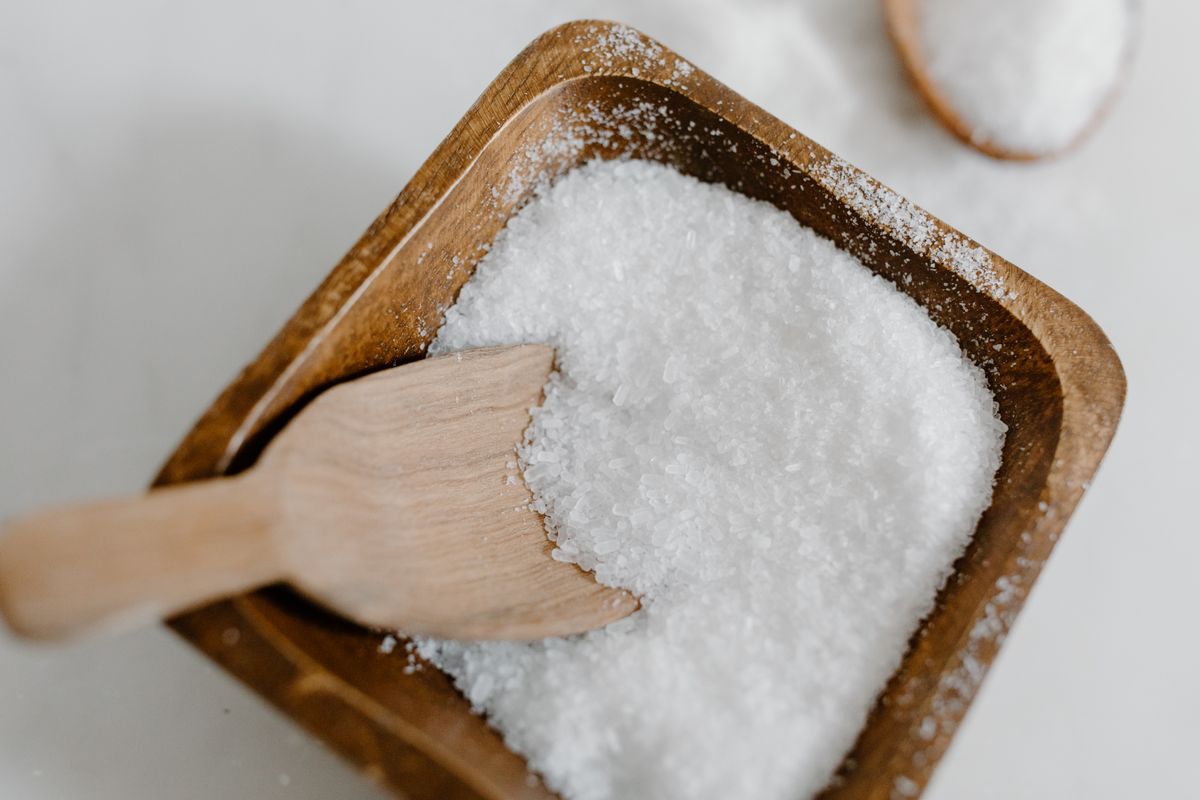
Softener salt is not chemically pure, and no grade claims to be. What varies is how much of each bag is material that will never dissolve.
Where the grit comes from. Rock salt is mined and mechanically crushed. Whatever the deposit contained — clay, gypsum, shale, silt — comes along with it. Solar salt is evaporated from brine ponds and picks up less. Evaporated salt is produced by dissolving, purifying and recrystallising, which is why it is the cleanest and why it costs more.
Why you notice it in the tank and not in the bag. The insolubles are a small fraction by weight, but they are the only part that stays. Every pound of salt consumed leaves its insoluble share behind, permanently. A tank that has consumed a ton of rock salt has concentrated all of that ton's residue into a few inches at the bottom.
When grey residue stops being cosmetic:
- Under an inch on the floor — normal accumulation, no action beyond the annual clean
- One to three inches — clean it now, before it reaches the brine well openings
- Over three inches — it has likely already compacted into a sludge layer, which is a distinct fault covered in what causes salt mushing in a brine tank
- Any depth, if brine draw has failed — the residue is the prime suspect regardless of how thick it looks
The practical decision. Switching from rock salt to evaporated pellets costs a few dollars more per bag and removes the source. Across a year the price gap is smaller than one service call, and it also lowers the risk of bridging in a humid tank — the mechanism for which is set out in how to identify and break a salt bridge.
Orange and Rust-Coloured: The Case That Matters
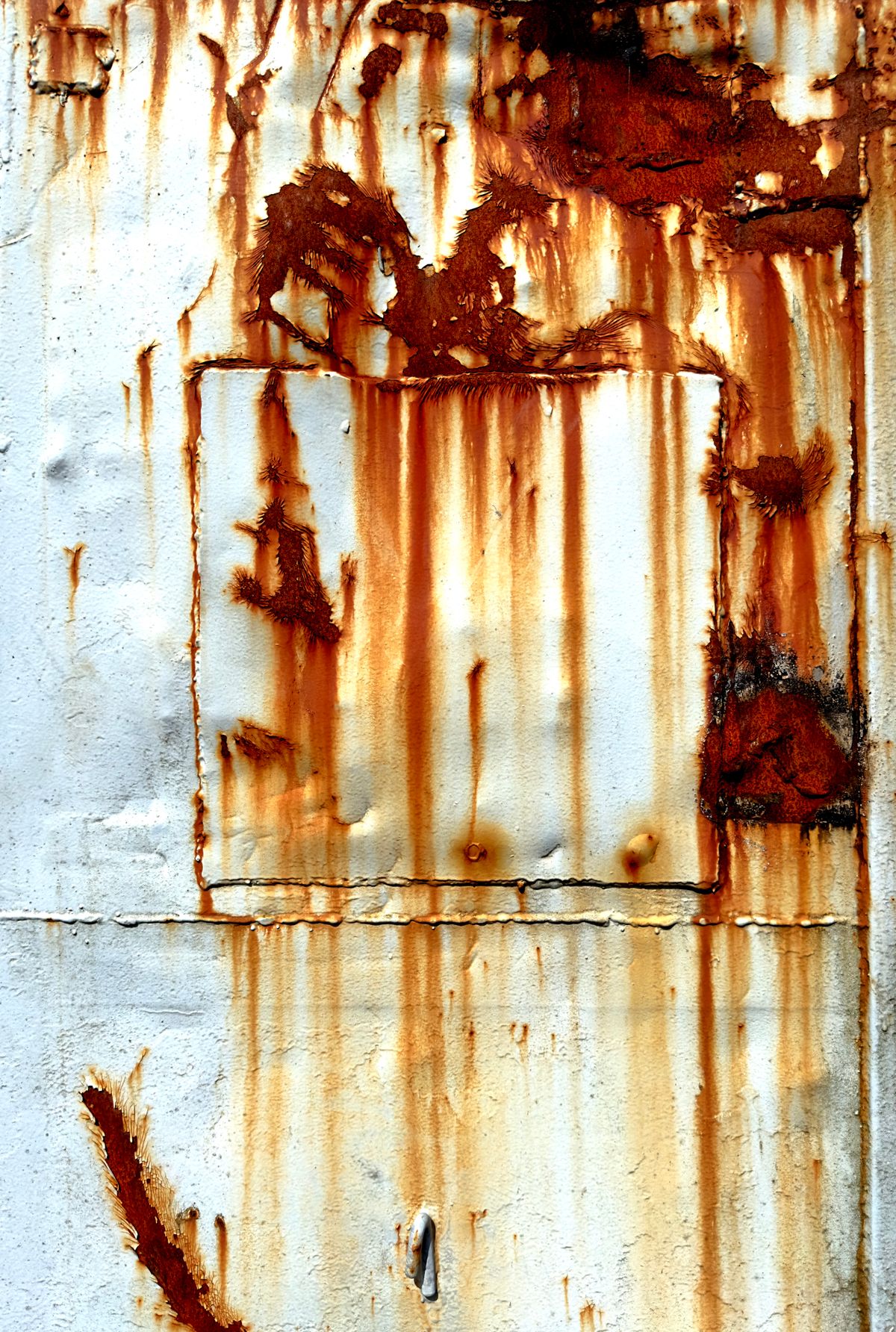
Orange in a brine tank is not a salt story. It means iron has reached a part of the system it has no business being in, and the reason it got there is what needs fixing.
Three mechanisms put it there:
1. The resin bed is loaded beyond what regeneration removes. A softener exchanges iron the same way it exchanges calcium, but iron does not release as readily. When the bed carries more than a regeneration can strip, iron accumulates and starts showing up in water that travels back through the brine line during refill. Capacity is already falling at this point, and the mechanism is the one described in what is water softener resin fouling.
2. Backwash is not flushing iron to drain. The backwash stage is supposed to lift the bed and carry loosened iron out. Low house pressure, a restricted drain line, or a fouled flow control leaves the iron in the tank cycle after cycle. This is the same root cause behind resin channeling, and if you have one it is worth measuring for the other.
3. Raw water iron exceeds what the softener is rated for. Softeners handle a limited amount of dissolved ferrous iron and essentially none of the oxidised ferric form. Above the unit's rating, iron accumulates faster than it can be removed no matter how well everything else is working.
The number that frames the decision. The EPA sets a secondary standard of 0.3 mg/L for iron and 0.05 mg/L for manganese in its guidance on nuisance chemicals — thresholds set for staining and taste rather than health. Most softeners are rated for a few mg/L of clear-water ferrous iron at most, and many for considerably less. Penn State Extension's guide to iron and manganese in private water systems sets out where a softener's tolerance ends and dedicated iron removal has to come first.
What to test before doing anything else:
| Test | Why it matters |
|---|---|
| Total iron, on raw water before the softener | Establishes whether the unit is within its rating |
| Ferrous versus ferric | Ferric iron must be filtered out, not exchanged |
| Manganese | Often present alongside iron, and fouls resin similarly |
| pH | Governs whether iron stays dissolved or precipitates in the bed |
| Hardness | Needed to size any replacement correctly |
Sampling has to be done on the raw supply, not on the softened tap, and the reasons that distinction matters are covered in test iron and manganese before sizing a softener.
What to Actually Do
The two cases diverge completely here.
If the residue is grey:
- Run the jar test to confirm the grade is the source.
- Measure the depth on the tank floor.
- Clean the tank if it is over an inch — the full procedure is in how to clean a water softener brine tank.
- Switch to evaporated pellets or solar crystals for future refills.
- Let the tank run down before refilling rather than perpetually topping up.
- Put a tank clean in the calendar annually and stop thinking about it.
If the residue is orange:
- Do not simply clean the tank and move on. The tank is downstream of the problem.
- Test raw water iron and manganese, before the softener.
- Measure backwash flow rate against the manual's specification for your tank diameter — a bucket and a watch.
- Inspect the resin bed. Iron-fouled beads are visibly rust-coloured rather than the amber of healthy resin.
- Attempt recovery with an iron-specific resin cleaner if the bed is fouled but intact.
- Add dedicated iron removal ahead of the softener if raw iron exceeds the unit's rating. No amount of salt fixes an iron load the softener was never specified for.
- Consider whether the bed has passed the point of recovery, which is worked through in water softener resin life and when to replace it.
A note on cleaners and salt additives. Salt sold with rust-removal additives can help maintain a bed that is within its iron rating. It will not rescue a system running on water that is well over that rating, and the EPA's overview of cation exchange water softeners is clear that a softener's job is hardness, with iron handled only within narrow limits.
In Order
- Look at the colour first. Grey means salt grade; orange means iron. Everything else follows from that.
- Check the tank walls at the water line for a rub-off tidemark, which points to iron.
- Run the jar test on a cup of salt from the bag, using iron-free water.
- Compare the jar residue to the tank residue. Matching means the salt explains it.
- Measure residue depth on the floor — the number that decides whether you clean now.
- If grey: change grade, clean the tank, set an annual reminder. Done.
- If orange: test raw water iron and manganese before touching anything else.
- Measure backwash flow against the manual's figure.
- Inspect the bed for rust-coloured beads.
- Decide between cleaning, pretreatment, or replacement on the basis of those numbers rather than on the colour in the tank.
The colour in a brine tank is a genuinely useful signal, but only if you read it as two signals rather than one. Grey costs you an hour with a bucket sometime this year. Orange is the system telling you it has been losing capacity for months.
Frequently Asked Questions
Why does my water softener salt look brown or dirty?
Most often because the salt grade you are using carries insoluble impurities. Rock salt and lower-cost pellets contain clay, gypsum and silt that never dissolve, so they accumulate as a grey-brown residue as the salt around them goes into solution. This is cosmetic and expected for that grade. The exception is orange or rust-coloured staining, which is iron rather than salt residue and indicates a genuine fault on the resin side of the system.
Is dirty-looking salt in a brine tank a problem?
Grey insoluble residue is not a performance problem in small quantities, but it accumulates. Over several years it builds into a sludge layer on the tank floor that blocks the brine well openings and stops brine draw altogether. So it is cosmetic in the short term and a scheduled maintenance item in the long term. Orange iron staining is a problem immediately, because it means iron is fouling the resin bed.
What does orange or rust-coloured salt mean?
Iron is being carried back into the brine tank, which only happens by way of the brine line during refill or by iron-laden water reaching the tank. It points at a resin bed that is holding more iron than it can release, an inadequate backwash that is not flushing iron out to drain, or raw water iron levels above what the softener is rated to handle. The discolouration is a symptom of a bed problem, not a salt problem.
How do I test whether my salt is the cause?
Put a cup of salt straight from the bag into a jar of warm water, shake it, and leave it twenty minutes. Evaporated pellets leave the water almost clear with barely any sediment. Solar crystals leave a little. Rock salt leaves a distinct grey-brown band of silt and water that stays cloudy. If the bag produces the same colour you are seeing in the tank, the salt is the explanation. If the tank is orange and the jar is grey, the tank discolouration is coming from somewhere else.
Should I clean the brine tank if the salt looks dirty?
Yes, once the residue is more than about an inch deep on the floor, regardless of cause. A full cleanout takes around an hour: bypass the softener, remove salt and water, lift out the brine well and grid plate, scrape and wash the tank, and check that the brine well openings are clear. If the residue is orange, cleaning the tank treats the symptom only — the iron source and the resin bed still need addressing.
Does dirty salt damage a water softener?
Indirectly, yes. Insoluble residue does not harm the resin, but sludge drawn into the brine line reaches the injector and air check valve, both of which have very fine passages that block easily. Iron is more damaging: it coats resin beads, progressively reduces exchange capacity, and beyond a point cannot be recovered with cleaners. Neither problem is caused by the salt being visibly discoloured — the colour is just the first thing you notice.