
How to Build a Water Test Panel Before Treatment
A water test panel before a softener should cover more than hardness. On every supply, test hardness, iron, manganese, pH and TDS. On city water, add free and total chlorine. On a private well, add turbidity, coliform bacteria and nitrate. Hardness sets the softener's size. Each of the others changes something else: the resin grade, a prefilter, the order of the equipment, or whether a softener is the right answer at all.
Below are two ready-made panels, one for municipal water and one for wells, with what each test costs and the specific buying decision it changes.
Why a Water Test Panel Before a Softener Needs More Than Hardness
A softener exchanges calcium and magnesium for sodium. It does that well on clean water. Nearly every early softener failure traces back to something in the water that was never measured before purchase: iron that fouled the resin, chlorine that broke it down, sediment that buried it, or acidic water that should have been neutralized first.
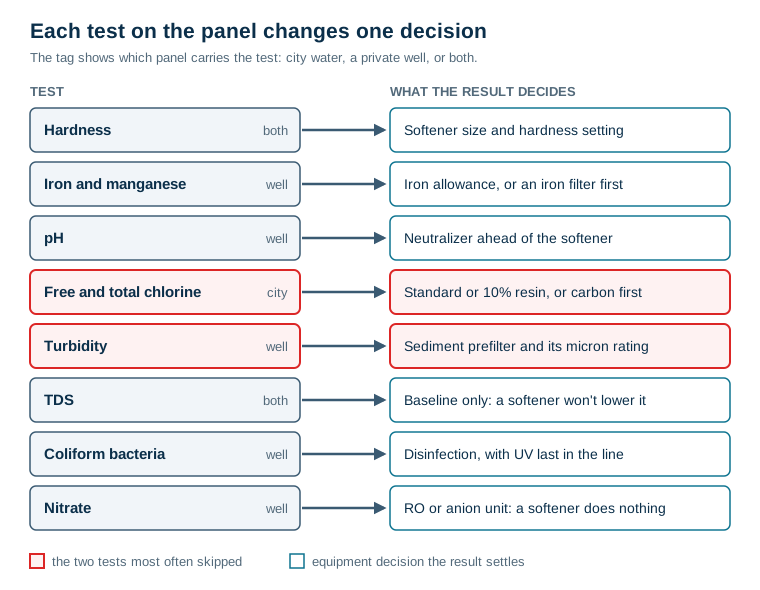
Each test earns its place by changing one decision. If a result cannot change anything you would buy, it does not belong on this panel. That is why lead and arsenic are missing here. They matter a great deal for health, but a softener does not treat them, so they belong on a separate drinking-water test.
Panel 1: City Water
Most of the city panel is free. Every community water system publishes an annual Consumer Confidence Report (CCR), usually on the utility's website or mailed with a bill. It lists the disinfectant, its residual range, and often hardness, pH and TDS. What it gives is a system average, so confirm the two numbers that matter most at your own tap.
| Test | How to get it | Typical cost | The decision it changes |
|---|---|---|---|
| Hardness | Titration drop kit at your tap; CCR as a cross-check | About $15 | Softener size and the hardness setting |
| Free and total chlorine | DPD chlorine kit at your tap; CCR for the yearly range | About $15 to $25 | Standard or 10 percent resin, or a carbon prefilter |
| pH | CCR, or a calibrated meter | Free to $15 | Rarely changes anything on city water. Confirms the baseline |
| TDS | CCR, or a $15 meter | Free to $15 | Baseline only. Useful later if you add reverse osmosis |
| Iron | CCR, or a strip at a tap after old galvanized pipe | Free to $15 | Only matters if you have iron staining or old steel pipe |
Panel cost: about $15 to $40.
The step most city buyers miss is the second row. Chlorine is on almost every city supply, and chloramine is increasingly common. Your utility's report tells you which one is used, and a tap test that reads free and total chlorine separately confirms it. A large gap between total and free chlorine indicates chloramine.
Panel 2: Private Well
On a well there is no utility report, and the parameters that decide the equipment are the ones home kits handle worst. A certified lab package is the cheaper route.
Prices below come from the Penn State Agricultural Analytical Services Lab fee schedule, a typical state university lab. Commercial labs often charge more.
| Test | Penn State price | The decision it changes |
|---|---|---|
| Hardness, iron, manganese, pH, TDS, alkalinity, copper, coliform bacteria | $85 as one package (WD02) | Softener size; iron allowance or iron filter; neutralizer; corrosion risk |
| Nitrate | $15 added, or $70 with the basic package | Whether an RO or anion unit is needed. A softener does not remove it |
| Suspended solids (a turbidity proxy) | $15 added | Whether a sediment prefilter goes first, and how fine |
| Everything above and more | $220 extensive package (WD08) | Worth it for a new well, a home purchase or any unexplained symptom |
Panel cost: about $115 at this lab ($85 + $15 + $15), or $220 for the extensive package.
Two free field checks to add:
- Smell the cold water as the tap first opens. A rotten-egg smell means hydrogen sulfide. A softener does not remove it, and it points to aeration, oxidation or carbon.
- Let a glass of fresh water stand for an hour. Clear water that turns orange or brown means dissolved iron, which a softener can handle in small amounts. Water that comes out already orange means oxidized iron, which a softener handles badly. A tea-colored tint that does not settle suggests tannins.
The EPA's advice for private well owners is to test at least once a year for total coliform bacteria, nitrates, total dissolved solids and pH, and immediately after flooding or a change in taste, smell or color. So the well panel doubles as your first annual test.
The Two Tests Everyone Skips
Hardness, iron and pH are on most checklists. Chlorine and turbidity rarely are. Each prevents a specific, expensive mistake.
Chlorine: the test that picks the resin
What it measures: the disinfectant residual reaching your softener, in mg/L, as free chlorine and total chlorine.
What it decides: the resin grade. Chlorine attacks the cross-links that hold each resin bead together. Resin makers work on a rule of thumb that each 1 mg/L of residual roughly halves the bed's life. At a low residual, standard 8 percent resin is fine. At a typical city residual, 10 percent chlorine-resistant resin usually pays for itself. At a high residual, or on chloramine, a carbon filter in front protects any grade. The crossover points are worked through in standard vs chlorine-resistant softener resin.
The equipment error when it is skipped: a standard-resin softener on 2 mg/L chlorine loses capacity for years without a single hard tap. The owner sees salt use creep up, then hardness returns, then pays for a re-bed years before one should have been needed.
What the result will not tell you: how much chlorine a carbon filter will need to remove at peak flow. That needs the flow rate as well.
Turbidity: the test that picks the prefilter
What it measures: cloudiness from suspended particles such as silt, sand, clay and rust. Labs report it as turbidity in NTU, or as total suspended solids in mg/L, which is what Penn State's $15 test measures.
What it decides: whether a sediment filter goes ahead of everything else, and how fine it should be. Wells that pump sand after heavy rain, or that have a failing screen, can send grit that settles into a resin bed, scores valve seals and blinds distributor screens.
The equipment error when it is skipped: sediment builds up in the bed, backwash cannot lift it all out, and pressure drop across the softener rises. The resin gets blamed. Often it was simply buried.
What the result will not tell you: how the load changes after a storm. One sample on a dry week can read clean. If your water ever looks cloudy after rain, test again then, or fit a prefilter anyway. They are cheap.
Collecting Samples So the Numbers Mean Something
A panel is only as good as the water in the bottle.
- Sample raw water. Use a cold tap that is plumbed before any softener, filter or neutralizer. Outdoor hose bibs often are. On a well, the pressure tank drain or a tap next to it is the rawest water you can reach.
- Remove the aerator and run the tap for several minutes, until the water runs cold, so you are sampling the well or the main rather than the pipe.
- Use the lab's bottles and follow their rules. Bacteria bottles are sterile. Metals bottles may contain acid. Do not rinse them out or swap in a kitchen jar.
- Fill iron bottles to the brim with no air left under the cap. Air turns dissolved iron into particles, and the lab result can come back low. Why that matters for sizing is covered in test iron and manganese before sizing a softener.
- Watch the clock on bacteria. Many labs must receive bacteria samples within 24 to 30 hours. Collect early in the week and keep them cold.
- Take chlorine and turbidity readings on the spot. Chlorine fades within minutes in an open container, so test it at the tap. Take turbidity during a typical week, and again after heavy rain if the well is shallow.
Whether each parameter needs a certified lab or a home kit will do is set out test by test in home water test kit vs certified laboratory test.
Reading the Results in the Right Order
The results are read in the order the water meets the equipment, and hardness comes last. Every earlier result can change the hardness figure you size with, or rule a softener out.
- Bacteria and nitrate. A positive coliform or high nitrate result is a health problem first. The EPA's drinking water limit for nitrate is 10 mg/L as nitrogen. Solve these before spending on a softener, because neither is touched by one.
- pH. The EPA's secondary standards give 6.5 to 8.5 as the aesthetic range. Below about 6.5, a neutralizer usually goes ahead of the softener. Some neutralizers add hardness, so the hardness you size for is the figure after the neutralizer, not the raw number. How to read the two together is in how to interpret pH and hardness together.
- Iron, manganese and hydrogen sulfide. The secondary standards for iron and manganese are 0.3 and 0.05 mg/L, the levels where staining starts. Small amounts of dissolved iron can be handled by the softener with a raised hardness setting. Larger amounts, oxidized iron or any real manganese usually call for dedicated removal in front.
- Turbidity. Decide the sediment prefilter.
- Chlorine. Decide the resin grade or a carbon filter.
- Hardness. Now size the softener, using compensated hardness: raw hardness, plus any hardness a neutralizer adds, plus the iron allowance from the manual.
- TDS. Record it as a baseline. A softener does not lower it, so it is only a sizing input if reverse osmosis is added later.
On a well, those results usually add up to several stages rather than one unit. Complete systems for the four most common well water profiles shows what each sequence looks like and costs.
What a Test Panel Cannot Tell You
- Whether your water is safe to drink. This panel is built to choose softening equipment. A health panel adds lead, arsenic, uranium and other contaminants, depending on your area. A softener treats none of them.
- How the water changes over the year. Well chemistry moves with rainfall and pumping. One test is a snapshot, so retest yearly and whenever the water changes.
- Your household's water use. Sizing needs gallons a day as well as grains per gallon. Read the water meter or bill.
- What is wrong with an existing softener. Testing softened water measures the softener's output. To diagnose a softener, test the raw and softened water side by side.
- Which brand to buy. The panel sets the specification. Check any softener you shortlist against the iron, pH, chlorine and sediment limits in its own spec sheet. Going from test results to type, size, quotes and certification covers the steps after this one.
Frequently Asked Questions
What should I test my water for before buying a water softener?
Hardness, iron, manganese, pH and TDS on every supply. On city water, add free and total chlorine, which decides the resin grade or a carbon prefilter. On a private well, add turbidity or suspended solids, coliform bacteria and nitrate. Each one changes the equipment specification or the order it is installed in, not just the size of the softener.
How much does a water test panel cost before buying a softener?
On city water, often $15 to $40, because the utility's annual report covers most of it and a hardness kit and chlorine kit cover the rest. On a private well, expect roughly $100 to $220 at a certified lab. Penn State's lab, for example, charges $85 for a package with hardness, iron, manganese, pH and TDS, and $15 each for nitrate and suspended solids.
Is a hardness test enough to size a water softener?
It is enough to size one on clean city water with no iron. On a well it is not. Dissolved iron and manganese use resin capacity just as hardness does, and many manuals add 3 to 4 gpg to the hardness setting for each 1 ppm of iron. Above a few ppm, an iron filter usually has to go in first. A softener sized on hardness alone can be both undersized and quickly fouled.
Why test chlorine before installing a water softener?
Because chlorine slowly destroys standard softener resin. Resin makers work on a rule of thumb that each 1 mg/L of chlorine roughly halves resin life. Knowing your residual, and whether your utility uses chloramine, tells you whether standard 8 percent resin is fine, whether 10 percent chlorine-resistant resin is worth the extra cost, or whether a carbon filter should go in front.
Do I need a certified lab or is a home test kit enough?
For hardness, pH, TDS and chlorine, a good home kit or meter is usually enough to choose equipment. For iron, manganese, bacteria and nitrate on a well, use a state-certified lab. Strips cannot resolve low manganese or separate dissolved from rusted iron, and a bacteria result is only valid from a lab that received the sample on time.
Where should I take the water sample from?
From a cold tap that carries raw, untreated water. That means before any existing softener, filter or neutralizer. Outdoor hose bibs are often plumbed before the softener, and a well's pressure tank drain is another option. A sample taken after existing treatment tests the treatment, not the water you are buying equipment for.
