
Water Softener Buying Guide: Seven Steps From Water Test to Soft Water at the Tap

This water softener buying guide is seven decisions in a fixed order. Test the water, choose the type, size it, pick a buying channel and a 10-year budget, get quotes, check certification, then install and start it up. Each step produces one decision that the next step depends on. Most bad softener purchases come from skipping ahead, such as choosing a model before the water is tested, or taking the size from the grain number on the box.
Each step below is short on purpose. It says what to decide, how to decide it, and which page on this site covers it in depth.
Disclosure: Hard Water Solved may earn a commission if you buy through links on this page, at no extra cost to you. It does not change which products we include or how we rank them. Read our disclaimer.
The Whole Purchase on One Page
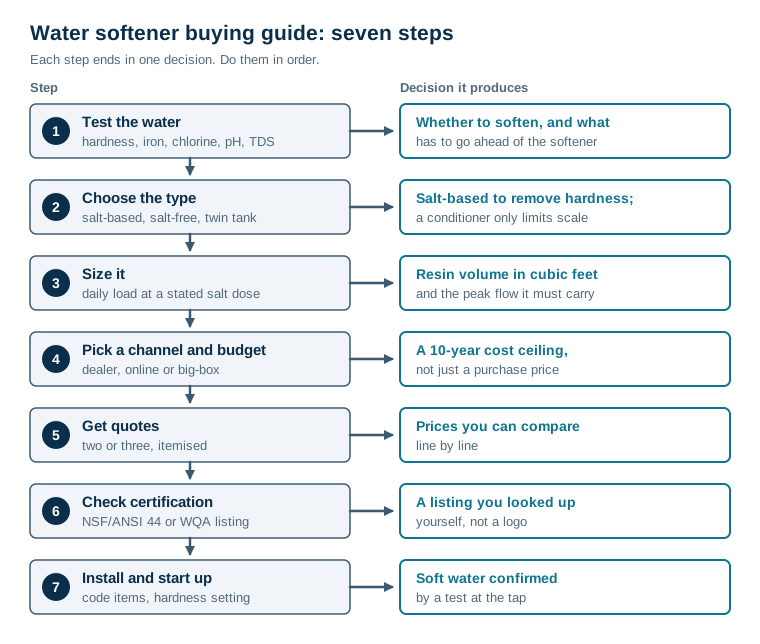
| Step | You decide | You need | Typical time |
|---|---|---|---|
| 1. Test | Whether to soften, and what goes first | A hardness test, plus a fuller panel on a well | A day to two weeks for a lab |
| 2. Type | Salt-based, salt-free or twin tank | Your test results and your goal | An evening |
| 3. Size | Resin volume and peak flow | Hardness, measured water use | An evening |
| 4. Channel and budget | Dealer, online or big-box, and a 10-year ceiling | Local prices for salt and water | An evening |
| 5. Quotes | Which offer to take | Two or three itemised quotes | One to two weeks |
| 6. Certification | Whether the model's claims are verified | The exact model number | Ten minutes |
| 7. Install | Who installs, and that the water is soft | A permit answer and a test kit | A day |
There are no product picks on this page. Once you have finished steps 1 to 4 you will know what to look for, and the site's best water softeners roundup ranks models by situation.
Step 1: Test the Water Before Anything Else
The decision: whether a softener is the right tool, and what has to be treated ahead of it.
Hardness is the number everyone knows to test. It sets the size. But the other results decide the design. Iron and manganese foul resin and can need their own filter. Low pH points to an acid neutralizer. Chlorine or chloramine on city water attacks resin over the years and changes which resin you should buy. Sediment calls for a prefilter.
- City water: start with your utility's annual water quality report, then confirm hardness with a home test kit at the tap. Look for the disinfectant the utility uses, chlorine or chloramine.
- Private well: pay for a lab panel. Hardness, iron, manganese, pH, total dissolved solids and a bacteria test are the minimum. Add hydrogen sulfide if the water smells of eggs.
Which tests to run, and how to read them in the right order, are in how to build a water test panel before treatment. If the results leave you unsure whether softening is worth it at all, do you need a whole-house water softener runs a payback worksheet on three households.
Step 2: Choose the Type
The decision: a salt-based ion exchange softener, or something else.
Only ion exchange removes calcium and magnesium. Salt-free conditioners, usually template-assisted crystallization, change how hardness behaves so that less scale forms. They do not remove it. If your goal is soft water for soap, skin, laundry or spot-free glass, buy a salt-based softener. If your goal is only to limit scale in pipes and a water heater, and you cannot run a drain or use salt, a conditioner may do. The side-by-side is in salt-based vs salt-free water treatment.
Within salt-based softeners, three choices matter more than brand:
- Single tank or twin tank. A twin-tank unit always has a regenerated tank in service. It suits large households, very hard water and homes with no quiet hour for regeneration. Most homes do not need one.
- Resin type. Standard 8% crosslink resin suits most well water. 10% crosslink resin holds up better against chlorine on city water.
- Downflow or upflow brining. Upflow (counter-current) brining gets more capacity from less salt. It costs more and suits clean water best.
Step 3: Size It From Your Own Numbers
The decision: the resin volume in cubic feet, and the peak flow it must carry.
The grain number on the box is normally the capacity at a heavy salt setting. Size against it and you end up programming the least efficient setting to match. Size from your own figures instead:
- Daily load = hardness in grains per gallon, plus an iron allowance, × measured daily indoor water use.
- Required capacity = daily load × (days between regenerations + one day of reserve).
- Resin volume = required capacity ÷ capacity per cubic foot at the salt dose you will use.
- Peak flow check against the unit's service flow at a stated pressure drop.
One published resin table gives about 22,930 grains per cubic foot at 6 lb of salt, against about 32,310 at 15 lb. That gap is why two softeners sold as "48,000 grain" can differ by a third in practice. The full method, with a worked example and a worksheet, is in how to size a water softener. The reasons the box rating misleads are in advertised vs usable softener capacity.
Write down the resin volume and the peak flow. They are the two numbers you will hold every quote against.
Step 4: Pick a Buying Channel and a 10-Year Budget
The decision: where you buy, and the most you will spend over ten years, not just at checkout.

There are three channels, and each changes who installs, who services and what parts cost later.
| Channel | You buy | Installation | Service and parts | Watch for |
|---|---|---|---|---|
| Dealer | A complete system from a local dealer, often a dealer brand | Included in the contract | From the dealer; some brands use proprietary valves | One figure for everything; ask for it itemised |
| Online | A unit shipped to you, often a Fleck or Clack valve on a standard tank | You hire it, or do it yourself | Standard valves have parts from many sellers | Return freight on a heavy tank, and setup you must do |
| Big-box store | A cabinet or two-tank unit off the shelf | The store can usually arrange it | Varies by maker | Who holds the licence and the labour warranty |
Then set the budget over ten years. Salt, regeneration water, electricity, upkeep and one resin change usually add up to more than the purchase. In the site's illustrative model for a family of four, the ten-year total runs from about $3,250 at 7 gpg to about $5,640 at 25 gpg, and the equipment and installation is only a third to a half of that. The full model, with every assumption, is in the total cost of owning a water softener.
Water use counts too. The EPA's WaterSense program notes that softener regeneration can use 25 gallons of water or more a day, up to 10,000 gallons a year. A metered, demand-initiated valve regenerates only when the capacity is used, which keeps that line down.
Step 5: Get Two or Three Quotes You Can Compare
The decision: which offer to take.
Quotes are only comparable if they describe the same thing. Ask every seller for the same six specs, in writing:
- Resin volume in cubic feet, not the grain rating.
- Resin type: 8% or 10% crosslink, standard or fine mesh.
- Control valve maker and model. Rebranded valves are common, and the maker decides where parts come from.
- Capacity at a stated salt dose, and the salt efficiency at that dose.
- Service flow at a stated pressure drop.
- How regeneration is triggered: metered demand, timer, or both.
A worksheet for laying quotes side by side, and how to find the real valve maker behind a brand name, is in how to compare water softener spec sheets.
For the installation part of each quote, ask for separate lines for the permit, the parts beyond the softener (shutoffs, bypass, drain line, air gap, bonding jumper), any new plumbing, removal of the old unit, startup and the workmanship guarantee. A quote that is one number cannot be compared with anything.
A quote is not worth taking if it names a model before anyone has a hardness figure, carries a "today only" price, or makes health claims. A softener removes hardness and some dissolved iron. It is not a purifier.
Step 6: Check Certification Yourself
The decision: whether the claims on the box have been independently verified.
The standard for household softeners is NSF/ANSI 44. A full listing confirms that the published hardness capacity was verified, the materials are safe in drinking water and the tank and valve passed structural testing. Salt efficiency is an optional extra claim, so check that it sits next to the model too. Look up the exact model on NSF's public listings for drinking water treatment units, where you can search by standard, or on WQA's Gold Seal listings.
Three cautions:
- Search the model, not the brand. A listing for one model in a range does not cover the others.
- A logo is not a listing. Some boxes show a certification mark for one component, such as the tank, or for a different standard.
- No listing is not an automatic no. Many well-built online softeners use certified valves and resin but are not listed as complete systems. If so, the capacity and efficiency claims are the seller's own, and you should size from a published resin table rather than the box.
What the standard does and does not cover is set out in what NSF/ANSI 44 means.
Step 7: Install It and Prove It Works
The decision: who installs, and evidence that the water is soft.
First, ask your local permit office whether the job needs a permit and who may pull it. Rules vary by city and state, as do you need a permit for a water softener explains. Then choose the installer, or do it yourself where you are allowed to. Either way, the same code items decide whether the job is right: an air gap at the drain, a bonding jumper on metal pipe, a separate brine overflow line, and supply-side backflow protection only where your utility requires it. The full sequence is in how to install a whole-house water softener.
Startup is part of the purchase, not an afterthought:
- Program the hardness from your own test, plus an allowance for iron, not the factory default.
- Set the salt dose you sized for in step 3, and a regeneration time when little water is used.
- Run the first regeneration, then test at a tap. A reading near zero is the proof. A reading that stays high points to the setup, not the softener, in most cases. The usual causes are in common water softener installation mistakes.
Where Buyers Most Often Go Wrong
The same shortcuts come up again and again:
- Buying from the grain number. Step 3 exists because the box rating assumes a heavy salt setting.
- Testing hardness only. A well with iron or low pH needs treatment the softener cannot provide, and the softener can fail early without it.
- Comparing purchase prices only. A cheaper unit with a less efficient valve can cost more over ten years.
- Taking certification on trust. Ten minutes on a public listing settles it.
- Skipping the test after startup. The only proof a softener is working is a soft-water reading at the tap.
Replacing an Old Softener: Which Steps You Can Shorten
A replacement is not a first purchase, but it is not a free pass either.
- Step 1 still applies. Water changes. A utility can switch from chlorine to chloramine, and a well's iron can rise over the years. Test again rather than reusing a number from the old install.
- Step 3 is easier. Your water bill or meter readings give a real daily use figure, which is better than any rule of thumb. Do not simply buy the same grain rating. If the household has changed size, the old unit may have been wrong for years.
- Step 7 may be shorter. If the loop, bypass, drain and jumper are already right, a like-for-like swap is a small job. Check each one anyway. Old jumpers are often cut when the old unit comes out.
When to Stop Before Step 7
Some homes reach the end of step 2 and should not buy a softener at all. If hardness is under about 3.5 gpg, there is little to gain. If the main problem is iron, sulfur smell or acidity, the first purchase is the filter or neutralizer for that problem. If you rent, a portable or point-of-use option may be the only one available. If the house will be sold within a couple of years, a softener rarely pays back.
Follow the seven steps in order and the shortlist of models narrows itself. Steps 1 and 3 do most of that work: test before you shop, and size from your own numbers before you compare prices.
Frequently Asked Questions
What should I look for when buying a water softener?
Look past the grain number. Compare resin volume in cubic feet, resin type, the control valve maker and model, capacity at a stated salt dose, service flow at a stated pressure drop, and how regeneration is triggered. Then check that the exact model appears on the NSF or WQA listing for NSF/ANSI 44, and work out the 10-year cost, not just the purchase price.
What size water softener do I need?
Multiply your hardness in grains per gallon, plus an allowance for iron, by your measured daily indoor water use. That is the daily load. Multiply it by the days you want between regenerations plus one day of reserve, then divide by the capacity per cubic foot at the salt dose you will actually use. Finally, check the unit's service flow against your peak demand.
Is it better to buy a water softener from a dealer or online?
Online and big-box softeners usually cost less to buy, and you choose the installer. Dealer systems come with installation, setup and service from one company, often at a higher price and sometimes with proprietary parts. Compare them on the same 10-year cost and the same spec sheet, and ask a dealer for an itemised quote rather than one figure.
Do I need to test my water before buying a softener?
Yes. Hardness sets the size, but iron, manganese, pH, chlorine and sediment decide what has to go ahead of the softener, or whether a softener is the right tool at all. City water customers can start with the utility's annual water quality report and a home hardness test. Private well owners need a fuller lab panel.
How much does a water softener cost over 10 years?
In this site's illustrative model for a family of four, about $3,250 to $5,640 over ten years, depending mostly on hardness. That covers equipment and installation, salt, regeneration water, electricity, upkeep and one resin change. The purchase and installation is only a third to a half of the total.
What certification should a water softener have?
NSF/ANSI 44, the standard for cation exchange water softeners. Look the exact model up on NSF's public listings or WQA's Gold Seal listings rather than trusting a logo on the box. A listing for the brand or for one model in a range does not cover every model sold under that name.
